Synthomycin
Ukraine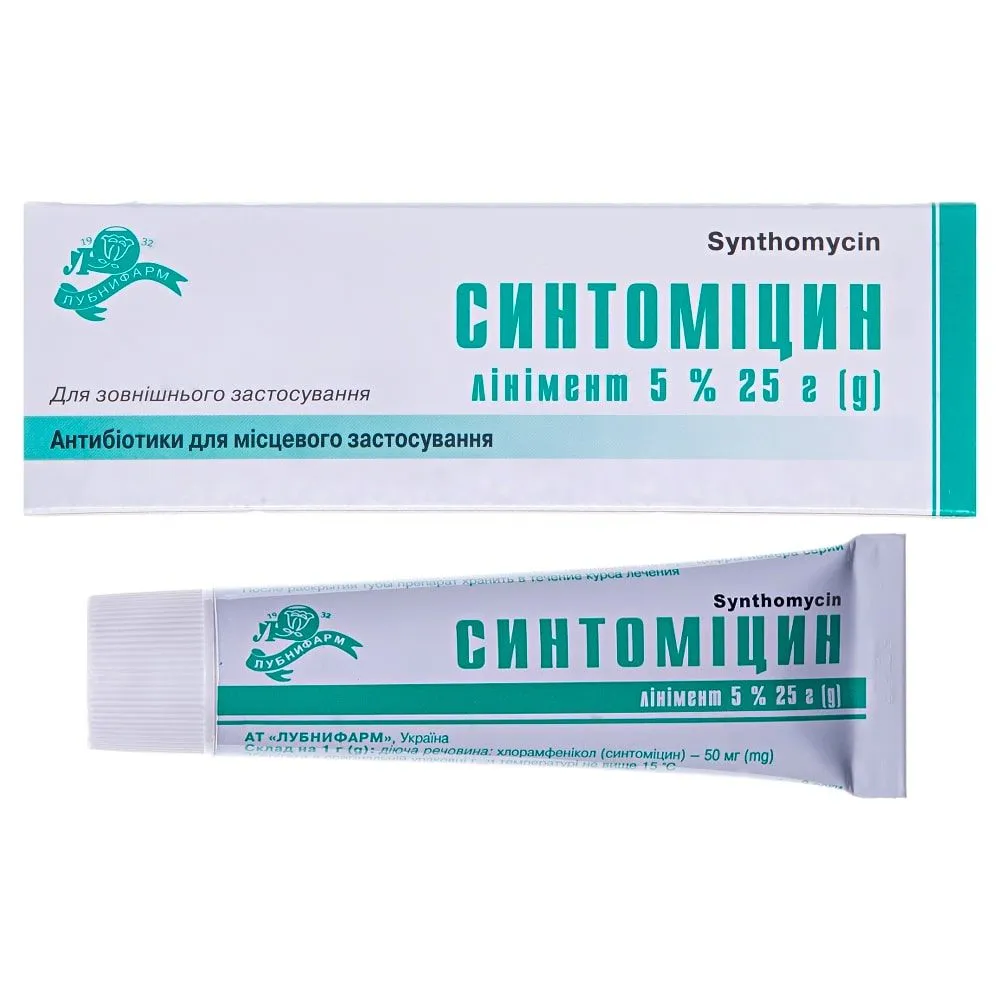
Table of Contents
INSTRUCTION FOR MEDICAL USE OF THE MEDICINAL PRODUCT SINTOMYCIN (SYNTHOMYCIN)
Composition:
Active substance: 1 g of liniment contains sintomycin 50 mg or 100 mg;
Excipients: castor oil, emulsifier No. 1, sorbic acid, sodium carboxymethylcellulose, purified water.
Pharmaceutical form. Liniment for external use.
Main physicochemical characteristics:
Liniment is white or white with a yellowish tint, with a weak specific odor.
Pharmacotherapeutic group. Antibiotics for topical use.
ATC code D06AX02.
Pharmacological Properties.
Pharmacodynamics.
A broad-spectrum antibiotic. The drug is active against strains of bacteria resistant to penicillin, streptomycin, and sulfonamides; against Gram-positive (Staphylococcus spp., Streptococcus spp.) and Gram-negative cocci (Neisseria gonorrhoeae, Neisseria meningitidis), many bacteria (Escherichia coli, Haemophilus influenzae, Salmonella spp., Shigella spp., Klebsiella spp., Serratia spp., Proteus stuartii), Yersinia, rickettsiae, spirochetes, causative agents of trachoma, psittacosis, and inguinal lymphogranuloma, among others. It exerts antimicrobial and antibacterial (bacteriostatic) effects. The mechanism of action is associated with inhibition of microbial protein synthesis. Microbial resistance to chloramphenicol develops relatively slowly.
Pharmacokinetics.
When applied topically, it penetrates well into tissues and body fluids. It is excreted mainly in the urine as inactive metabolites, and partially in the bile and feces.
Clinical characteristics.
Indications.
Skin abscesses, carbuncles, purulent wounds, furunculosis, slow-healing ulcers, second- and third-degree burns, nipple fissures, trachoma, purulent-inflammatory diseases of mucous membranes.
Contraindications.
Individual hypersensitivity to components of the drug, history of allergy or toxic reactions (dyspeptic symptoms, dysbacteriosis, mental disorders) to chloramphenicol, psoriasis, eczema, fungal skin diseases. Not prescribed to children during the first 4 weeks of life.
Interaction with other medicinal products and other forms of interactions.
Concomitant use of the drug with erythromycin, oleandomycin, nystatin, and levorin enhances the antibacterial activity of the liniment, whereas concomitant use with benzylpenicillin salts reduces it. The drug is incompatible with cytostatics, sulfonamides, diphenyl, barbiturates, pyrazolone derivatives, and alcohol.
Special precautions for use.
Before applying the medicinal product, the affected area should be washed with soap and water and thoroughly dried. The drug should not be used more frequently or for longer than prescribed. If there is no improvement within 1 week, medical advice should be sought.
The use of topical antibacterial agents may lead to skin sensitization, resulting in hypersensitivity reactions upon subsequent use of these drugs either topically or in systemic dosage forms.
Avoid contact of the liniment with the eyes. Unsupervised use of the drug in pediatric practice should be avoided; its use in children is permitted only under medical supervision.
The product contains castor oil, which may cause skin reactions, and sorbic acid, which may cause local skin reactions (e.g., contact dermatitis).
Use during pregnancy or breastfeeding.
Chloramphenicol crosses the placenta. However, studies have not revealed any adverse effects of chloramphenicol on the human fetus following topical application. During pregnancy, the drug should be used only after careful consideration of the benefit/risk ratio for mother and fetus.
It is not known whether the drug passes into breast milk. However, no complications have been reported in humans; therefore, the use of Chloramphenicol for treating cracked nipples in nursing mothers does not require discontinuation of breastfeeding. Before nursing, any residual product should be removed from the nipple and surrounding skin with a clean cloth, and the breast should be carefully and thoroughly washed.
Ability to influence reaction speed when driving or operating machinery.
Has no effect.
Administration and Dosage.
Chloramphenicol is administered externally. Apply the liniment to affected areas and cover with a dressing, with or without parchment or compress paper. Dressings should be changed daily or every other day. For nipple fissures, after feeding, carefully wash the breast and apply the 5% liniment on a sterile pad. Duration of use is 2–5 days.
Children.
Not recommended for children during the first 4 weeks of life.
Overdose.
Information is unavailable.
Side effects.
Prolonged external use often leads to contact sensitization.
Allergic reactions: burning sensation, itching, hyperemia (redness), rashes (papular, urticarial, etc.), swelling, Quincke's edema, other signs of irritation not observed prior to treatment.
Shelf life. 2 years.
Do not use after the expiry date stated on the packaging.
Storage conditions.
Store in the original packaging at a temperature not exceeding 25 °C.
Keep out of reach of children.
Packaging.
25 g in tubes, in a cardboard pack.
Supply category.
Over-the-counter.
Manufacturer/Applicant.
JSC "CHEMFARMPLANT "CHERVONA ZIRKA".
Manufacturer's address and location of business activity / Applicant's address.
1 Gordienkovskaya Street, Kharkiv, Kharkiv Oblast, 61010, Ukraine.