Suprelorin®
Ukraine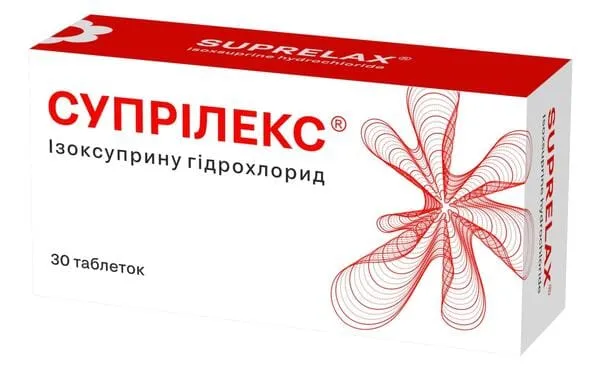
Table of Contents
INSTRUCTIONS FOR MEDICAL USE OF THE MEDICINAL PRODUCT SUPRELEK® (SUPRELAX®)
Composition:
Active substance: isoxsuprine hydrochloride;
1 tablet contains 10 mg of isoxsuprine hydrochloride;
Excipients: microcrystalline cellulose, sodium croscarmellose, magnesium stearate, colloidal anhydrous silicon dioxide.
Pharmaceutical form. Tablets.
Main physicochemical properties: white, round, flat tablets with a score line on one side.
Pharmacotherapeutic group.
Peripheral vasodilators. Derivatives of 2-amino-1-phenylethanol. ATC code C04AA01.
Pharmacological properties.
Pharmacodynamics.
Isoxsuprine is a peripheral vasodilator and a beta-adrenoceptor agonist. By stimulating beta-adrenoceptors, isoxsuprine reduces the tone of smooth muscles in blood vessels, relieves their spasm, and improves peripheral and cerebral circulation, thereby enhancing tissue blood supply. It exerts a positive inotropic and chronotropic cardiac effect, as well as a tocolytic effect. In in vitro and in vivo studies, isoxsuprine suppressed both spontaneous and oxytocin-induced uterine activity during labor.
Isoxsuprine also produces a mild broncholytic effect. At high doses, it inhibits platelet aggregation and reduces blood viscosity.
Pharmacokinetics.
Isoxsuprine is rapidly absorbed from the gastrointestinal tract. It undergoes partial hepatic conjugation metabolism. After oral administration, maximum plasma concentration is reached within approximately 1 hour. The elimination half-life is approximately 1.25 hours. The drug is excreted predominantly in the urine, and to a minor extent in the feces.
Clinical characteristics.
Indications.
Disorders of peripheral circulation, including obliterating endarteritis, obliterating atherosclerosis of limb arteries, diabetic angiopathy, Raynaud's disease and Raynaud's syndrome.
Chronic cerebral vascular insufficiency due to cerebral atherosclerosis.
Atherosclerosis of retinal arteries.
Contraindications.
| |
Increased sensitivity to the active substance or to any other component of the drug. |
| |
Bleeding and hemorrhagic disorders, including history thereof. |
| |
Angina pectoris. |
| |
Arterial hypotension. |
| |
Contraindicated immediately after childbirth. |
Interaction with other medicinal products and other forms of interaction.
There are no data regarding negative interactions of isoxsuprine with other medicinal products. The vasodilating effect may be enhanced when used concomitantly with vasodilators used in cardiology.
Special precautions for use.
Do not exceed the dose and duration of treatment established by the physician. If any unusual reactions occur during the use of the drug, it is necessary to consult a doctor immediately.
The drug should be prescribed with caution in patients with tachycardia, hot flushes, coagulation disorders, glaucoma, and in the acute phase of myocardial infarction and stroke.
Elderly patients should get up from bed carefully and avoid sudden changes in body position during treatment with the drug to prevent orthostatic hypotension.
The effect of the drug may be reduced in patients who smoke.
Do not consume alcoholic beverages during treatment with Suprilex®.
Cases of pulmonary edema in the mother and fetal tachycardia have been reported following intravenous administration of isoxsuprine during premature labor.
Use during pregnancy or breastfeeding.
Pregnancy.
The use of isoxsuprine in pregnant women is contraindicated.
Breastfeeding period.
There are no data on the safety of isoxsuprine use during breastfeeding; therefore, the use of the drug should be avoided during this period.
Ability to influence reaction rate when driving or operating machinery.
The drug may cause drowsiness or dizziness. In such cases, driving vehicles and operating complex machinery should be avoided.
Dosage and Administration
The drug should be administered orally at a dose of 10–20 mg 3–4 times daily after meals. The treatment course lasts 2–3 months.
Children
There are no data on the safety of isoxsuprine use in children; therefore, the drug should not be administered to individuals under 18 years of age.
Overdose
Symptoms: tachycardia, palpitations, chest pain, decreased blood pressure (collapse), dizziness, weakness, loss of consciousness, nausea, vomiting.
Treatment: symptomatic.
Adverse reactions.
Cardiovascular system: tachycardia, palpitations, arterial hypotension, orthostatic hypotension, chest pain.
Nervous system: dizziness, loss of consciousness.
Gastrointestinal system: dyspeptic disorders, nausea, vomiting.
Skin and subcutaneous tissue: skin rashes.
General condition and administration-related reactions: weakness, sensation of flushing.
Immune system: hypersensitivity reactions.
Respiratory system: dyspnea.
Shelf life.
3 years.
Storage conditions.
Store at a temperature not exceeding 25 °C.
Keep out of reach of children.
Packaging.
10 tablets in blisters; 1 or 3 blisters per cardboard pack.
Prescription status.
Prescription only.
Manufacturer.
KUSUM HEALTHCARE PVT LTD.
Manufacturer's address and location of operations.
SP-289 (A), RIICO Industrial area, Chopanki, Bhiwadi, Dist. Alwar (Rajasthan), India.