Somatuline autogel 120 mg
Ukraine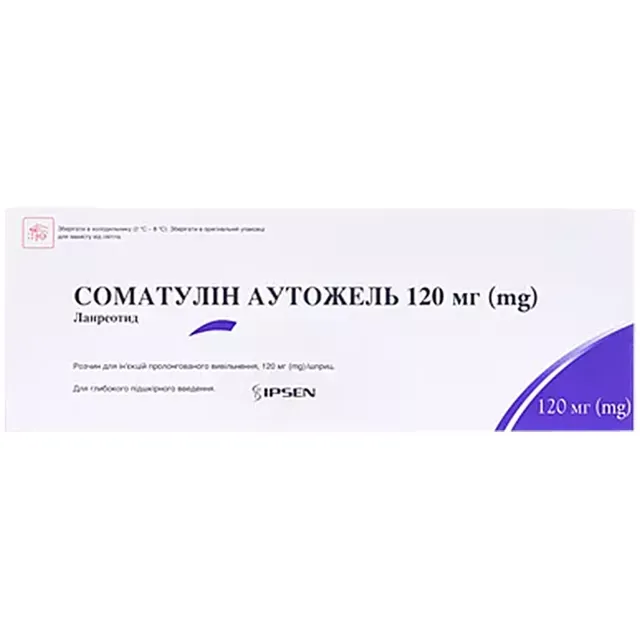
Table of Contents
INSTRUCTIONS FOR MEDICAL USE OF THE MEDICINAL PRODUCT SOMATULINE AUTOJEL 120 mg SOMATULINE AUTOJEL 60 mg SOMATULINE AUTOJEL 90 mg
Composition:
Active substance: lanreotide;
1 pre-filled syringe contains lanreotide (as lanreotide acetate)
120 mg or 60 mg or 90 mg;
Excipients: glacial acetic acid, water for injections.
Pharmaceutical form. Prolonged-release solution for injection. For deep subcutaneous administration.
Main physicochemical characteristics: gel-like solution, white to pale yellow in color.
Pharmacotherapeutic group.
Pituitary and hypothalamic hormones and their analogues; somatostatin and its analogues.
ATC code H01C B03.
Pharmacological Properties.
Pharmacodynamics.
Lanreotide is an octapeptide, an analogue of natural somatostatin. Like natural somatostatin, lanreotide inhibits a number of endocrine, neuroendocrine, exocrine, and paracrine mechanisms. Lanreotide has been shown to have high affinity for human somatostatin receptors SSTR 2 and 5, and low affinity for SSTR 1, 3, and 4. Activation of human somatostatin receptors SSTR 2 and 5 is considered the primary mechanism underlying the suppression of growth hormone (GH) secretion. Lanreotide is more potent and has a longer duration of action than natural somatostatin. Its pronounced selectivity for growth hormone relative to insulin allows its use in the treatment of acromegaly.
Like somatostatin, lanreotide exerts a general exocrine antisecretory effect. It suppresses basal secretion of motilin, gastric inhibitory peptides, and pancreatic polypeptides, but has no significant effect on digestive enzyme secretion or gastric acid secretion. In addition, it reduces plasma chromogranin A and urinary 5-HIAA (5-hydroxyindoleacetic acid) levels in patients with GEP-NETs who have elevated levels of these tumor markers. Lanreotide significantly inhibits food-induced increases in blood flow in the superior mesenteric artery and portal vein.
Lanreotide significantly reduces intestinal secretion (of water, sodium, potassium, and chlorides) stimulated by prostaglandin E1. Lanreotide reduces prolactin levels in patients with acromegaly who are receiving long-term treatment.
In patients with acromegaly, lanreotide therapy leads to a reduction in tumor size.
In an uncontrolled, open-label study, lanreotide at a dose of 120 mg was administered every 28 days for 48 weeks to 90 previously untreated patients with acromegaly diagnosed with pituitary macroadenoma.
Exclusion criteria included anticipated need for pituitary surgery (adenomectomy) or radiotherapy during the study period.
At week 48, 63% of patients showed a clinically significant reduction in tumor size of ≥20% (the primary efficacy endpoint), although statistical significance was not achieved (95% CI 52–73%).
The mean percentage reduction in tumor size was 26.8%. GH levels were below 2.5 µg/L in 77.8% of patients, and IGF-1 levels normalized in 50%. Normalized IGF-1 levels combined with GH levels below 2.5 µg/L were observed in 43.5% of patients.
Most patients reported improvement in symptoms of acromegaly, including headache (38.7%), fatigue (56.5%), excessive sweating (66.1%), arthralgia (59.7%), and soft tissue swelling (66.1%).
Early and sustained reductions in tumor size and concentrations of GH and IGF-1 were observed from week 12 of lanreotide therapy, with treatment effects maintained over 48 weeks.
Lanreotide exerts inhibitory effects on exocrine intestinal secretion, gastrointestinal hormones, and cellular protofibril formation when used in the treatment of symptoms of gastrointestinal and pancreatic endocrine tumors, particularly carcinoid tumors.
A 96-week, randomized, double-blind, multicenter, fixed-duration Phase III study was conducted using the medicinal product Somatuline Autogel in patients with gastrointestinal or pancreatic neuroendocrine tumors to evaluate the antiproliferative effect of lanreotide.
Patients were randomized 1:1 to receive either Somatuline Autogel 120 mg every 28 days (n=101) or placebo (n=103). Randomization was stratified by prior therapy and presence/absence of progression at baseline as assessed by RECIST 1.0 (Response Evaluation Criteria in Solid Tumors) during a screening phase of 3–6 months. Patients had inoperable metastatic and/or locally advanced disease with histologically confirmed well or moderately differentiated tumors with primary localization in the pancreas (44.6% of patients), midgut (35.8% of patients), hindgut (6.9%), or other/unknown primary site (12.7%). 69% of patients with GEP-NETs had Grade 1 tumors defined by Ki67 proliferation index ≤2% (50.5% of the total patient population) or mitotic index <2 mitoses/10 high-power fields (18.5% of the total patient population), and 30% of patients with GEP-NETs had tumors in the lower range of Grade 2 (G2), defined by Ki67 >2%–≤10%. Tumor grade information was unavailable for 1% of patients. Patients with GEP-NET Grade G2 tumors with higher cell proliferation index (Ki67 >10%–≤20%) and patients with Grade G3 neuroendocrine carcinomas of the gastrointestinal tract or pancreas (Ki67 >20%) were excluded from the study.
Overall, 52.5% of patients had hepatic tumor burden ≤10%, 14.5% had hepatic tumor mass >10% and ≤25%, and 33% had hepatic tumor mass >25%.
The primary endpoint was progression-free survival (PFS), measured from the start of treatment until disease progression per RECIST 1.0 or death within 96 weeks. Independent centralized radiological assessment was used for PFS analysis.
The favorable effect of lanreotide on reducing the risk of progression or death was consistent regardless of primary tumor location, hepatic tumor burden, prior chemotherapy, baseline Ki67 value, tumor differentiation grade, or other predefined patient characteristics. A clinically meaningful positive treatment effect with Somatuline Autogel was observed in patients with pancreatic, midgut, or other/unknown primary tumors, both in the overall study population. The limited number of patients with hindgut tumors (14 out of 204) complicates interpretation of results in this subgroup. Based on available data, a lack of effect of lanreotide in these patients cannot be ruled out. In the extension study, 45.6% (47 out of 103) of patients crossed over from placebo to unblinded Somatuline Autogel.
Pharmacokinetics.
Pharmacokinetic parameters of lanreotide after intravenous administration to healthy volunteers indicate limited extravascular distribution, with a volume of distribution at steady state of 16.1 L. Total clearance was 23.7 L/h, elimination half-life was 1.14 hours, and mean residence time was 0.68 hours. Excretion studies showed less than 5% of lanreotide excreted in urine and less than 0.5% unchanged in feces, indicating some biliary excretion.
After deep subcutaneous administration of Somatuline Autogel at doses of 60 mg, 90 mg, and 120 mg to healthy volunteers, lanreotide concentration increased. The mean maximum serum concentration was 4.25, 8.39, and 6.79 ng/mL, respectively. Cmax was reached within the first day after administration, at 8, 12, and 7 hours, respectively (mean values). The mean elimination half-life was 23.3, 27.4, and 30.1 days, respectively. After 4 weeks, the mean serum concentration of lanreotide was 0.9, 1.11, and 1.69 ng/mL, respectively. Absolute bioavailability was 73.4%, 69.0%, and 78.4%, respectively.
After deep subcutaneous administration of Somatuline Autogel at doses of 60 mg, 90 mg, and 120 mg to patients with acromegaly, mean maximum serum concentrations of 1.6, 3.5, and 3.1 ng/mL, respectively, were achieved within the first day after administration, at 6, 6, and 24 hours, respectively (mean values), followed by a decline in these values. After 4 weeks, the mean serum concentration of lanreotide was 0.7, 1.0, and 1.4 ng/mL, respectively.
A steady state level of lanreotide is achieved on average after 4 injections given every 4 weeks. After 4 such injections, mean Cmax values were 3.8, 5.7, and 7.7 ng/mL for the 60 mg, 90 mg, and 120 mg doses, respectively, and mean Cmin values were 1.8, 2.5, and 3.8 ng/mL, respectively.
Linear pharmacokinetic release profiles were observed after deep subcutaneous administration of Somatuline Autogel at doses of 60 mg, 90 mg, and 120 mg in patients with acromegaly. Serum lanreotide levels after three deep subcutaneous injections of Somatuline Autogel at 60 mg, 90 mg, or 120 mg every 28 days were similar to those observed in patients with acromegaly previously receiving intramuscular injections of Somatuline 30 mg every 14, 10, and 7 days, respectively.
In the pharmacokinetic population analysis of 290 patients with GEP-NET receiving Somatuline Autogel 120 mg, a rapid initial release was observed, with a mean Cmax of 7.49 ± 7.58 ng/mL achieved within the first day after a single dose. Steady-state concentration was achieved after 5 injections of Somatuline Autogel 120 mg every 28 days and was maintained until the last assessment (up to 96 weeks after the first injection). At steady state, the mean Cmax was 13.9 ± 7.44 ng/mL, and the mean serum concentration was 6.56 ± 1.99 ng/mL. The mean elimination half-life was 49.8 ± 28.0 days.
Renal/Hepatic Impairment.
In patients with acute renal impairment, a mean 2-fold reduction in total serum clearance was observed, with a gradual increase in elimination half-life and AUC. In patients with moderate and severe hepatic impairment, a 30% reduction in clearance was observed. Volume of distribution and mean residence time increased in all adult study participants with hepatic impairment of any stage. No impact on lanreotide clearance was observed in the pharmacokinetic analysis population of patients with GEP-NET, including 165 patients with mild and moderate renal impairment (106 and 59 patients, respectively) receiving Somatuline Autogel. Data in patients with GEP-NET and severe renal impairment have not been studied. Similarly, data in patients with GEP-NET and hepatic dysfunction (Child-Pugh criteria) have not been studied. No dose adjustment is necessary for patients with renal or hepatic impairment, as lanreotide serum concentrations in these patient groups are expected to remain within the range safely tolerated by healthy volunteers.
Elderly Patients.
In elderly patients, elimination half-life and mean residence time are increased compared to healthy young volunteers. No initial dose adjustment is required for elderly patients, as lanreotide serum concentrations in this patient group are expected to remain within the range safely tolerated by healthy volunteers.
In the pharmacokinetic analysis population of patients with GEP-NET, including 122 patients aged 65 to 85 years, no effect of age on clearance or volume of distribution of lanreotide was observed.
Clinical characteristics.
Indications.
Treatment of acromegaly with elevated levels of circulating growth hormone (GH) and insulin-like growth factor (IGF-1) following surgery and/or radiotherapy, or when surgery and/or radiotherapy are contraindicated.
Treatment of clinical symptoms caused by acromegaly.
Treatment of clinical symptoms caused by carcinoid tumors.
Treatment of neuroendocrine tumors of the gastrointestinal tract or pancreas (GEP-NETs) with grade 1 differentiation and a subset of grade 2 tumors (Ki67 index up to 10%) originating from the midgut, pancreas, or of unknown origin, excluding tumors originating from hindgut regions, in adults with unresectable locally advanced or metastatic tumors.
Contraindications.
Somatuline Autogel must not be administered to patients with hypersensitivity to the active substance, somatostatin, or related peptides, or to any of the excipients listed in the section "Composition".
Interactions with other medicinal products and other forms of interactions.
Interactions requiring precaution during use.
Concomitant administration of lanreotide may reduce gastrointestinal absorption of other medicinal products, particularly cyclosporine. Lanreotide may reduce the relative bioavailability of cyclosporine. Dose adjustment of cyclosporine may be required when administered concomitantly with lanreotide to maintain therapeutic concentrations.
Interaction with highly plasma protein-bound medicinal products is unlikely due to the moderate ability of lanreotide to bind to serum proteins.
Risk of hypoglycemia and hyperglycemia: changes in the requirement for diabetes treatment due to decreased or increased secretion of endogenous glucagon. Close monitoring of blood glucose levels is necessary, and doses of antidiabetic medicinal products should be adjusted as needed during treatment with lanreotide.
Concomitant use of medicinal products that induce bradycardia (e.g., beta-blockers) may have an additive effect on the slightly reduced heart rate caused by lanreotide. Adjustment of such concomitant therapy may be necessary (see section "Special precautions for use").
Limited published data suggest that concomitant use of somatostatin analogs and bromocriptine may increase bromocriptine availability.
Limited published data indicate that somatostatin analogs may reduce the metabolic clearance of compounds known to be metabolized by cytochrome P450 enzymes. This may occur via inhibition of growth hormone. Since it cannot be excluded that lanreotide may have a similar effect, other medicinal products that are primarily metabolized by the CYP3A4 enzyme and have a narrow therapeutic index (e.g., quinidine) should be used with caution.
Special precautions for use.
Cholelithiasis and complications of cholelithiasis
Lanreotide may reduce gallbladder motility and lead to cholelithiasis. Therefore, periodic monitoring may be required. During long-term treatment, ultrasound examination of the gallbladder is recommended prior to treatment initiation and every 6 months thereafter (see section "Adverse reactions").
Post-marketing reports have documented cases of cholelithiasis leading to complications, including cholecystitis, cholangitis, and pancreatitis, requiring cholecystectomy in patients receiving lanreotide. If complications of cholelithiasis are suspected, lanreotide should be discontinued and appropriate treatment initiated.
Hypoglycemia and hyperglycemia
Lanreotide, like somatostatin and its other analogs, suppresses insulin and glucagon secretion. Therefore, hypoglycemia and hyperglycemia may occur in patients undergoing treatment with lanreotide. Blood glucose levels should be monitored at the beginning of lanreotide therapy or when dose adjustments are made. Antidiabetic therapy should be adjusted accordingly. In diabetic patients receiving insulin, the insulin dose should initially be reduced by 25%, and then further adjusted based on blood glucose monitoring initiated at the start of treatment.
Hypothyroidism
A slight reduction in thyroid function has been observed during lanreotide therapy in patients with acromegaly, although clinical hypothyroidism is rare. Thyroid function testing is recommended if symptoms develop.
Bradycardia
Lanreotide may cause a decrease in heart rate in patients without concomitant cardiac disorders, although this does not necessarily result in bradycardia. Sinus bradycardia may occur in patients with pre-existing cardiac conditions. Caution is advised when initiating lanreotide therapy in patients with bradycardia.
Pancreas and related events
Exocrine pancreatic insufficiency (EPI) has been observed in some patients receiving lanreotide for gastroenteropancreatic neuroendocrine tumors. Symptoms of EPI may include steatorrhea, loose stools, abdominal bloating, and weight loss. The possibility of such symptoms should be considered, and treatment should be administered according to clinical guidelines.
Significant and persistent increase in steatorrhea suggests additional prescription of pancreatic enzyme extracts.
Monitoring of pituitary tumor size
In patients with acromegaly, lanreotide treatment should be accompanied by monitoring of pituitary tumor size.
Use during pregnancy or breastfeeding.
Pregnancy. Data on the use of lanreotide in pregnant women are limited (fewer than 300 pregnancy cases reported).
Animal studies have demonstrated reproductive toxicity but have not shown teratogenic effects. The potential risk in humans is unknown. As a precautionary measure, it is advisable to avoid using lanreotide during pregnancy.
Breastfeeding. It is unknown whether this medicinal product is excreted in human milk.
A risk to newborns/infants cannot be excluded. Somatuline Autogel should not be used during breastfeeding.
Fertility.
Reduced fertility has been observed in female rats due to inhibition of growth hormone secretion when administered at doses exceeding the therapeutic doses for humans.
Ability to affect reaction speed when driving or operating machinery.
Somatuline Autogel has a minor or moderate influence on the ability to drive or operate machinery. Studies specifically investigating the effect on driving ability or operating machinery have not been conducted. However, dizziness has been reported with the use of this medicinal product (see section "Adverse reactions"). If such a reaction occurs, patients should refrain from driving or operating machinery.
Method of Administration and Dosage
Somatuline Autogel, prolonged-release injectable solution, is available in three dosage strengths: 60 mg, 90 mg, and 120 mg.
Acromegaly
The recommended initial dose is 60–120 mg every 28 days.
The dose should subsequently be adjusted individually based on the patient's response (assessed by reduction in clinical symptoms and/or decrease in growth hormone (GH) levels and/or insulin-like growth factor-1 (IGF-1)).
The dose may be increased in case of inadequate response.
Dose escalation may be considered if growth hormone (GH) levels exceed 2.5 ng/mL.
The dose should be maintained unchanged if GH levels range between 2.5 ng/mL and 1 ng/mL.
Dose reduction may be considered upon normalization of hormone levels (GH < 1 ng/mL and normalization of IGF-1 levels and/or resolution of clinical symptoms).
Patients who have achieved effective disease control with somatostatin analogues may be switched to Somatuline Autogel 120 mg administered every 42 or 56 days.
For example:
- Patients effectively controlled with Somatuline Autogel 60 mg every 28 days may receive Somatuline Autogel 120 mg every 56 days;
- Patients effectively controlled with Somatuline Autogel 90 mg every 28 days may receive Somatuline Autogel 120 mg every 42 days.
Long-term monitoring of growth hormone (GH) and insulin-like growth factor-1 (IGF-1) concentrations, as well as clinical symptoms, is recommended based on clinical judgment.
Treatment of clinical symptoms caused by carcinoid tumors
The recommended initial dose is 60–120 mg every 28 days.
Subsequently, the dose should be individually adjusted based on the patient’s response (evaluated according to improvement in clinical symptoms). The maximum recommended dose of Somatuline Autogel is 120 mg every 28 days.
Patients who have achieved effective disease control with somatostatin analogues may be switched to Somatuline Autogel 120 mg administered every 42 or 56 days.
For example, patients effectively controlled with Somatuline Autogel 60 mg every 28 days may receive Somatuline Autogel up to 120 mg every 56 days, and patients effectively controlled with Somatuline Autogel 90 mg every 28 days may receive Somatuline Autogel 120 mg every 42 days. When extending the dosing interval, careful monitoring for recurrence of clinical symptoms is required.
Treatment of well-differentiated (Grade 1) neuroendocrine tumors (NETs) of the gastrointestinal tract or pancreas, and a subset of Grade 2 tumors (Ki67 index ≤10%) originating from the midgut, pancreas, or of unknown origin, excluding tumors of hindgut origin, in adult patients with unresectable locally advanced or metastatic disease
The recommended dose is one injection of Somatuline Autogel 120 mg every 28 days. Treatment with Somatuline Autogel should be continued for as long as necessary to maintain tumor control.
Patients with renal or hepatic impairment
Dose adjustment is not required (see section "Pharmacokinetics").
Elderly patients
Dose adjustment is not required (see section "Pharmacokinetics").
Method of Administration
The injectable solution must be administered deeply subcutaneously into the upper outer quadrant of the buttock or the upper outer thigh. Injections should be performed by a healthcare professional. However, if patients are receiving a stable dose of Somatuline Autogel, they or their caregivers may administer the injection themselves after appropriate training by a healthcare professional. When self-administering, the medication should be injected into the upper outer thigh. The decision to allow self-administration by the patient or a trained caregiver must be made by the physician. Regardless of the injection site, the skin should not be pinched, and the needle should be inserted rapidly and perpendicularly into the skin to its full length. The injection site should be alternated between the right and left buttocks or thighs.
Instructions for Use
This medicinal product is intended for single use immediately after opening the protective pouch. It is essential to strictly follow the instructions for use. Do not use the medicinal product if the multilayer pouch is damaged or opened. Unused medicinal product and waste material must be disposed of according to instructions provided by healthcare professionals.
Administration Instructions
Warning: Please read all instructions carefully before administering the injection. This medicinal product is administered via deep subcutaneous injection, which requires a specific technique different from standard subcutaneous injections. The instructions below describe how to administer Somatuline Autogel.
Somatuline Autogel is supplied in a ready-to-use, pre-filled syringe equipped with an automatic needle protection system. After administration, the needle retracts and is automatically locked to prevent needlestick injuries.
Fig. 1.
Before Use
| Syringe barrel |
| Tray |
| Cap |
After use
(needle in the safety system)
- Remove Somatuline Autogel from the refrigerator 30 minutes before administering the injection. Injecting a cold medication may cause discomfort or pain. Do not open the pouch until it is time to administer the injection.
Fig. 2
| 30 minutes |
- Warning! Before opening the sachet, make sure it is undamaged and the medicinal product has not expired.
Do not use the pre-filled syringe:
- if you have dropped or damaged the pre-filled syringe, or if the pre-filled syringe or sachet appears damaged;
- if the expiry date of the medicinal product has passed; the expiry date is indicated on the carton and on the sachet.
In any of these situations, contact your doctor or pharmacist.
- Wash your hands with soap.
- Open the sachet along the dotted line and remove the pre-filled syringe. The contents of the pre-filled syringe is a gel-like solution ranging from white to pale yellow in color, with viscous characteristics. The supersaturated solution may also contain microbubbles, which may disappear during injection. These differences are normal and do not affect the quality of the medicinal product.
After opening the protective multilayer sachet, the medicinal product must be used immediately.
Fig. 3
- Select the injection site:
5a. If the injection is administered by a healthcare professional or a trained person close to you, choose the upper outer quadrant of the buttock for the injection.
5b. If the patient is self-injecting, select the upper outer part of the thigh (if you are administering the medicinal product yourself).
| Injection is administered by a healthcare professional or a trained family member |
| Self-injection |
- Alternate the injection site (right and left side) each time you administer Somatuline Autogel. Avoid areas of skin with moles, scars, redness, or areas where lumps have formed.
- Disinfect the intended injection site.
- Before injection, take the pre-filled syringe out of the tray. Discard the tray into the waste container.
- Remove the needle cap by pulling it off and discard it into the waste container.
- Stretch the skin around the injection site using the thumb and index finger of the hand not holding the pre-filled syringe, to flatten and tighten the skin. Do not pinch the skin into a fold. With a firm, deliberate motion, similar to throwing a dart, quickly insert the needle fully into the skin perpendicularly (at a 90-degree angle).
It is very important to insert the needle completely. After full insertion, the needle should not be visible.
Do not aspirate (do not pull back on the syringe plunger).
| Self-injection |
| The injection is administered by a healthcare professional or a trained family member |
| or |
- Release the injection site that you have been massaging with your hand. Press on the plunger with a steady motion. The medication is viscous and may be harder to inject than expected. Usually, it takes about 20 seconds. Inject the full dose until the plunger is fully depressed, continuing until you feel that the plunger can no longer move.
| 20 seconds |
Note: Continue to hold the plunger depressed with your thumb to prevent activation of the automatic safety system.
- Without releasing the plunger, withdraw the needle from the injection site.
- Release the plunger. The needle will automatically retract into the safety system, where it will be permanently locked.
- Apply a dry cotton swab or sterile gauze to the injection site to prevent bleeding. Do not rub or massage the injection site after administration.
- Dispose of the used syringe according to the instructions provided by your doctor or healthcare professional. Do not dispose of the device in household waste.
If you have received an overdose of this medicinal product, you should:
Consult your doctor.
If you have received an overdose of Somatuline Autogel, you may experience additional or more severe adverse reactions (see section "Adverse reactions").
Children.
The safety and efficacy of Somatuline Autogel in children and adolescents have not been established.
Overdose.
In case of overdose, symptomatic therapy is recommended.
Adverse Reactions
Adverse reactions were observed in patients with acromegaly and GEP-NETs during clinical studies. Adverse reactions are presented according to the following classification: very common (≥1/10); common (≥1/100 to <1/10); uncommon (≥1/1000 to <1/100); unknown (frequency cannot be estimated from the available data). The most common adverse reactions following treatment with lanreotide are gastrointestinal disorders (most frequently diarrhea and abdominal pain, usually mild or moderate and transient), cholelithiasis (most frequently asymptomatic), and injection site reactions (pain, nodules, induration). The adverse reaction profile is similar across all indications.
| System organ class |
Very common (≥1/10) |
Common (≥1/100 to <1/10) |
Uncommon (≥1/1,000 to <1/100) |
Post-marketing safety studies (frequency not known) |
| Immune system disorders |
Allergic reactions (including angioedema, anaphylaxis, hypersensitivity) |
|||
| Metabolism and nutrition disorders |
Hypoglycemia, decreased appetite**, hyperglycemia, diabetes mellitus |
|||
| Psychiatric disorders |
Insomnia* |
|||
| Nervous system disorders |
Dizziness, headache, lethargy** |
|||
| Cardiac disorders |
Sinus bradycardia* |
|||
| Vascular disorders |
Facial flushing* |
|||
| Gastrointestinal disorders |
Diarrhea, loose stools*, abdominal pain |
Nausea, vomiting, constipation, flatulence, abdominal distension, abdominal discomfort*, dyspepsia, steatorrhea** |
Change in stool color* |
Exocrine pancreatic insufficiency, pancreatitis |
| Hepatobiliary disorders |
Cholelithiasis |
Dilation of bile ducts* |
Cholecystitis, cholangitis |
|
| Musculoskeletal and connective tissue disorders |
Skeletal muscle pain**, myalgia** |
|||
| Skin and subcutaneous tissue disorders |
Alopecia, hypotrichosis* |
|||
| General disorders and administration site conditions |
Asthenia, fatigue, injection site reactions (pain, swelling, induration, nodules, pruritus) |
Injection site abscess |
||
| Investigations |
Increased ALT*, abnormal AST*, abnormal ALT*, increased blood bilirubin*, increased blood glucose*, increased glycated hemoglobin*, decreased body weight*; decreased pancreatic enzyme levels** |
Increased AST*, increased blood alkaline phosphatase*, abnormal blood bilirubin*, decreased blood sodium* |
* Based on studies conducted in patients with acromegaly.
** Based on studies conducted in patients with GEP-NETs.
Reporting of suspected adverse reactions
It is important to report suspected adverse reactions after marketing authorization of the medicinal product. This enables continuous monitoring of the benefit-risk balance of the medicinal product. Healthcare professionals should report any suspected adverse reactions through the national reporting system.
Shelf life.
3 years.
Storage conditions.
Store in a refrigerator (2 °C – 8 °C). Keep in the original packaging to protect from light.
After removal from the refrigerator, the medicinal product, if kept in the original sealed pouch, may be returned to the refrigerator (provided that temperature fluctuations do not exceed three instances) for continued storage and subsequent use, provided it has been stored for no more than 72 hours in total at a temperature not exceeding 40 °C.
Keep out of the reach of children.
Packaging.
The medicinal product is supplied in a pre-filled syringe (polypropylene) equipped with an automatic safety system, including a piston stroke protector (bromobutyl rubber) and a needle (stainless steel), covered with a plastic cap. Each ready-to-use pre-filled syringe is placed on a plastic tray and packaged in a multilayer pouch and a cardboard box. The box contains one 0.5 mL pre-filled syringe and one needle (1.2 mm×20 mm).
Prescription status.
Prescription only.
Manufacturer.
IPSEN PHARMA BIOTECH / IPSEN PHARMA BIOTECH.
Manufacturer's address.
Parc d’activites du Plateau de Signes, chemin departemental № 402, 83870 SIGNES, France / Parc d’activites du Plateau de Signes, chemin departemental № 402, 83870 SIGNES, France.
Marketing Authorization Holder.
IPSEN PHARMA / IPSEN PHARMA.
Address of the Marketing Authorization Holder.
65, quai Georges Gorse - 92100 Boulogne Billancourt, France / 65, quai Georges Gorse - 92100 Boulogne Billancourt, France.