Serdolekt
Ukraine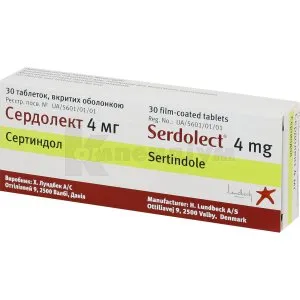
Table of Contents
INSTRUCTIONS FOR MEDICAL USE OF THE MEDICINAL PRODUCT SERDOLECT (Serdolect®)
Composition:
Active substance: sertindole;
1 tablet contains 4 mg or 12 mg of sertindole;
Excipients: maize starch; lactose monohydrate; hydroxypropylcellulose, microcrystalline cellulose, sodium croscarmellose, magnesium stearate, hypromellose, macrogol 400, titanium dioxide (E 171); for 4 mg tablets – yellow iron oxide (E 172); for 12 mg tablets – yellow iron oxide (E 172), red iron oxide (E 172).
Pharmaceutical form. Film-coated tablets.
Main physicochemical properties:
4 mg: oval, yellow, biconvex tablets with the imprint «S4»;
12 mg: oval, beige, biconvex tablets with the imprint «S12».
Pharmacotherapeutic group. Selective antipsychotic agents.
ATC code N05AE03.
Pharmacological Properties
Pharmacodynamics
The neuropharmacological profile of sertindole's antipsychotic activity is due to selective blockade of mesolimbic dopaminergic neurons and balanced inhibitory effects on central dopamine D2 and serotonin 5HT2 receptors, as well as on α1-adrenergic receptors. In pharmacological animal studies, sertindole suppressed spontaneously active dopamine neurons in the mesolimbic ventral area of the brain with a selectivity coefficient of over 100 compared to dopamine neurons in the substantia nigra pars compacta (SNc). Inhibition of SNc activity is considered to be involved in the development of extrapyramidal side effects (EPS) associated with many antipsychotic agents. It is known that antipsychotic drugs increase plasma prolactin levels due to dopamine blockade. Prolactin levels in patients taking sertindole remain within normal limits both during short-term and long-term (1 year) treatment. However, during the post-marketing period of sertindole use, rare cases of hyperprolactinemia and prolactin-related reactions have been reported. Sertindole does not affect muscarinic (m-cholinergic) receptors or histamine H1 receptors. This is confirmed by the absence of anticholinergic and sedative effects associated with these receptors.
In a prospective study of sertindole (SCoP), which compared all-cause mortality, cardiovascular safety, and suicidality of sertindole (n=4930) and risperidone (n=4928) during a treatment period of up to 4 years, all-cause mortality was similar between sertindole and risperidone. Causes of mortality differed between the two treatment groups. The leading causes of death in the sertindole group were cardiovascular in origin, with a significantly higher risk of cardiac mortality compared to the risperidone group. The sertindole group had a lower risk of suicide attempts, although the risk of completed suicide did not differ significantly between the two groups.
Preclinical studies did not provide evidence of teratogenic effects, but increased offspring mortality and developmental delay were observed when doses similar to or lower than the maximum recommended clinical doses (on a mg/m² basis) were administered; mating frequency and fertility were reduced.
The effect on fertility, which was reversible, was explained by the pharmacological profile of sertindole.
Pharmacokinetics
Sertindole is eliminated via hepatic metabolism with a mean elimination half-life of approximately 3 days. Moderate inter-individual differences in sertindole pharmacokinetics are due to polymorphism of the cytochrome P450 2D6 (CYP2D6) enzyme. Patients with deficiency of this enzyme have sertindole elimination rates of about 1/2 to 1/3 of those in patients with normal enzyme activity. Patients with poor enzyme function (approximately 10% of the population) thus have 2–3 times higher plasma concentrations of sertindole. Therapeutic effect and tolerability, better guided by sertindole concentration, allow individual dose adjustment.
Absorption. Sertindole is well absorbed; maximum concentration after oral administration (tmax) is reached at approximately 10 hours. Different doses of the drug are bioequivalent. Food intake or concomitant use of aluminium-magnesium antacids has almost no effect on absorption.
Distribution. The volume of distribution of sertindole after dose escalation is approximately 20 L/kg. Sertindole is 99.5% bound to plasma proteins, primarily to albumins and α1-glycoproteins. In patients receiving recommended doses, 90% of measured concentrations are below 140 ng/mL (≈320 nmol/L). Sertindole penetrates into erythrocytes with a blood-to-plasma ratio of 1. Sertindole readily crosses the blood-brain and placental barriers.
Metabolism. Two metabolites of sertindole are detectable in human plasma: deshydro-sertindole (oxidation of the imidazolidinone ring) and nor-sertindole (N-alkylation). Concentrations of deshydro-sertindole and nor-sertindole are approximately 80% and 40% of the parent compound at steady state, respectively. The pharmacological activity of sertindole is primarily due to the parent compound; metabolites do not exhibit significant pharmacological activity in humans.
Excretion. Sertindole and its metabolites are eliminated very slowly, with 50–60% of a radiolabeled oral dose recovered within 14 days after administration. Approximately 4% of the dose is excreted unchanged and less than 1% as metabolites in urine. The remainder of unchanged drug and metabolites is excreted in feces, which is the primary route of elimination.
Clinical Characteristics.
Indications.
Schizophrenia.
Due to the cardiovascular safety warning, sertindole should be prescribed only to patients who have demonstrated intolerance to at least one other antipsychotic agent.
Sertindole should not be used in emergency situations for rapid symptom relief during exacerbations in patients.
Contraindications.
Hypersensitivity to sertindole or to any component of the medicinal product.
Sertindole is contraindicated in patients with documented uncorrected hypokalemia or hypomagnesemia.
Sertindole is contraindicated in patients with clinically significant cardiovascular disease, congestive heart failure, cardiomyopathy, arrhythmia, or bradycardia (< 50 beats/min) in medical history, as well as in patients with congenital long QT syndrome or family history of this disorder, or in patients with acquired prolonged QT interval (QTc > 450 msec in males and > 470 msec in females).
Sertindole is contraindicated in patients with severe hepatic impairment.
Sertindole is contraindicated in patients receiving medicinal products that markedly prolong the QT interval. These classes include:
- Class Ia and III antiarrhythmic agents (e.g., quinidine, amiodarone, sotalol, dofetilide);
- certain antipsychotics (e.g., thioridazine);
- certain macrolides (e.g., erythromycin);
- certain antihistamines (e.g., terfenadine, astemizole);
- certain quinolone antibiotics (e.g., gatifloxacin, moxifloxacin).
The above list is not exhaustive; therefore, other medicinal products that markedly prolong the QT interval (e.g., cisapride, lithium) are also contraindicated.
Concomitant administration of sertindole with medicinal products that are potent inhibitors of hepatic cytochrome P450 3A enzymes is contraindicated. These classes include:
- systemic "azole" antifungal agents (e.g., ketoconazole, itraconazole);
- certain macrolide antibiotics (e.g., erythromycin, clarithromycin);
- HIV protease inhibitors (e.g., indinavir);
- certain calcium channel blockers (e.g., diltiazem, verapamil).
The above list is not exhaustive; therefore, other medicinal products capable of strongly inhibiting CYP3A enzymes (e.g., cimetidine) are also contraindicated.
Interaction with other medicinal products and other forms of interaction.
The risk of QT interval prolongation associated with sertindole treatment may be exacerbated when administered concomitantly with other medicinal products capable of prolonging the QT interval. Therefore, concomitant use of such medicinal products is contraindicated. Such an interaction may occur, for example, between quinidine and sertindole. In addition to QT interval prolongation, quinidine is a strong inhibitor of CYP2D6.
Sertindole is metabolized predominantly by CYP2D6 and CYP3A isoenzymes of the cytochrome P450 system. CYP2D6 is polymorphic in the population, and both isoenzymes are inhibited by various psychotropic and other medicinal products.
CYP2D6 Inhibitors
In patients concurrently receiving fluoxetine or paroxetine (potent CYP2D6 inhibitors), plasma concentrations of sertindole increase 2- to 3-fold. Therefore, sertindole should be administered with these or other CYP2D6 inhibitors only with extreme caution. A lower maintenance dose of sertindole and careful ECG monitoring may be required before and after any dose adjustment of these agents.
CYP3A Inhibitors
A minor increase (< 25%) in plasma concentration of sertindole has been observed when macrolide antibiotics (e.g., erythromycin, a CYP3A inhibitor) and calcium channel blockers (diltiazem, verapamil) are used. However, consequences may be severe in patients with reduced CYP2D6 function (since elimination of sertindole via both CYP2D6 and CYP3A may be impaired). Therefore, because it is not possible to routinely identify patients with reduced CYP2D6 function, concomitant administration of CYP3A inhibitors and sertindole is contraindicated, as this may lead to a significant increase in sertindole concentration.
The metabolism of sertindole may be significantly enhanced by medicinal products capable of inducing CYP isoenzymes, particularly rifampicin, carbamazepine, phenytoin, and phenobarbital, which may reduce sertindole plasma concentrations by 2- to 3-fold. Reduced antipsychotic effect in patients receiving these or other CYP-inducing agents may require the use of sertindole at higher end of the dosage range.
Special precautions for use.
Cardiovascular system
Clinical studies have shown that sertindole has a greater potential to prolong the QT interval compared to some other antipsychotics. The average QT prolongation is higher at the upper end of the recommended dose range (20 and 24 mg). QTc interval prolongation by certain drugs is associated with the potential to induce arrhythmias such as Torsade de Pointes (TdP, a potentially fatal polymorphic ventricular tachycardia) and sudden cardiac death.
However, clinical and non-clinical data are insufficient to confirm that sertindole is more arrhythmogenic than other antipsychotics. Therefore, sertindole should be prescribed to patients in whom treatment with at least one other antipsychotic agent has been associated with intolerance reactions.
Prescribing the drug must fully comply with safety warnings.
ECG monitoring
ECG monitoring is mandatory before initiating and during sertindole treatment.
Sertindole is contraindicated if QTc interval exceeds 450 msec in males or 470 msec in females on pre-treatment evaluation.
An ECG should be performed prior to starting treatment, during attainment of steady-state levels after approximately 3 weeks or at a dose of 16 mg, and again after three months of treatment.
During maintenance therapy, ECGs should be evaluated every 3 months.
During maintenance therapy, ECG measurements should be performed before and after each dose increase.
An ECG is recommended after adding or increasing the dose of a drug that may increase sertindole concentration (see «Interaction with other medicinal products and other forms of interaction»).
Sertindole treatment must be discontinued if QTc interval exceeds 500 msec.
The prescribing physician must immediately evaluate the patient, including ECG, if symptoms such as tachycardia, seizures, or syncope occur, as these may indicate the development of arrhythmia.
ECG monitoring should preferably be performed in the morning, using either Bazett’s or Fridericia’s formula to calculate the QTc interval.
The risk of QT prolongation is increased in patients receiving concomitant drugs that prolong the QTc interval or drugs that inhibit sertindole metabolism.
Cases of venous thromboembolism (VTE) have been reported with the use of antipsychotic agents. Since patients receiving antipsychotics often have acquired VTE risk factors, all potential VTE risk factors should be identified before and during sertindole treatment, and appropriate preventive measures should be implemented.
Baseline serum potassium and magnesium levels should be determined before initiating sertindole treatment in patients at risk of significant electrolyte disturbances. Low serum potassium and magnesium levels must be corrected before continuing treatment. Serum potassium monitoring is recommended in patients with vomiting, diarrhea, use of potassium-sparing (loop) diuretics, or other electrolyte imbalances.
Due to sertindole’s α1-blocking activity, symptoms of postural hypotension may occur during the initial dose titration period.
Antipsychotics may diminish the effects of dopamine agonists. Sertindole should be used with caution in patients with Parkinson’s disease.
Some selective serotonin reuptake inhibitors, such as fluoxetine and paroxetine (potent CYP2D6 inhibitors), may increase plasma levels of sertindole by 2–3 times. Therefore, concomitant use of sertindole with such agents should be undertaken with extreme caution and only if the potential benefit outweighs the risk. A lower maintenance dose of sertindole and careful ECG monitoring may be required before and after any dose adjustment of these agents.
Sertindole should be used with caution in patients with impaired CYP2D6 function.
Hyperglycemia or exacerbation of pre-existing diabetes has been reported very rarely during sertindole treatment. Appropriate clinical monitoring is advisable for diabetic patients and for patients with risk factors for developing diabetes.
Elderly patients
Sertindole is not indicated for the treatment of psychosis and behavioral disorders associated with dementia and is not recommended for use in elderly patients with dementia.
In randomized, placebo-controlled clinical trials of certain antipsychotics in patients with dementia, approximately a threefold increased risk of cerebrovascular adverse events was observed. The mechanism of this increased risk is unknown. An increased risk cannot be excluded for other antipsychotics or other patient populations. Sertindole should be used with caution in patients with risk factors for stroke.
Due to the increased risk of serious cardiovascular disorders in the elderly, sertindole should be used with caution in patients aged 65 years and older. Clinical trial data in patients aged 65 years and above are limited.
Pharmacokinetic studies have not shown age-related differences. Slower titration and lower maintenance doses are recommended for elderly patients. Treatment should only be initiated after a thorough cardiovascular evaluation.
Renal impairment
Sertindole may be administered in the usual dose to patients with renal impairment. Hemodialysis does not affect the pharmacokinetics of sertindole.
Hepatic impairment
Patients with mild to moderate hepatic impairment require careful monitoring, slower titration, and lower maintenance doses.
Tardive dyskinesia
Tardive dyskinesia is thought to result from hypersensitivity of dopamine receptors in the basal ganglia due to prolonged receptor blockade by antipsychotics. Clinical studies have shown a low incidence of extrapyramidal symptoms during sertindole treatment compared to placebo. However, long-term treatment with antipsychotics (especially at high doses) is associated with a risk of tardive dyskinesia. If signs of tardive dyskinesia appear, the dose should be reduced or the drug discontinued.
Seizures
Sertindole should be used with caution in patients with a history of seizures.
Neuroleptic malignant syndrome
A potentially fatal condition, neuroleptic malignant syndrome (NMS), has been associated with antipsychotic agents. Management of NMS should include immediate discontinuation of antipsychotic drugs.
Discontinuation of treatment
Acute withdrawal symptoms such as nausea, vomiting, hyperhidrosis, and insomnia may occur after discontinuation of antipsychotics. Psychotic symptoms may recur, and involuntary movement disorders (akathisia, dystonia, and dyskinesia) may appear. Therefore, gradual discontinuation of the drug is recommended.
Excipients
The tablets contain lactose monohydrate. Patients with rare hereditary problems of galactose intolerance, Lapp lactase deficiency, or glucose-galactose malabsorption should not take this medicine.
Use during pregnancy or breastfeeding.
Pregnancy. The safety of sertindole during pregnancy has not been established. Animal studies have shown no teratogenic effects. Peri- and postnatal studies in rats showed reduced fertility at doses within the human therapeutic range. Therefore, sertindole should not be used during pregnancy.
Newborns whose mothers have taken antipsychotics (including Serdolect) during the third trimester of pregnancy are at risk of developing adverse reactions, including extrapyramidal and/or withdrawal symptoms, the severity and duration of which may vary after delivery. Reported symptoms include agitation, arterial hypertension/hypotension, tremor, somnolence, respiratory disorders, or feeding difficulties. Therefore, newborns should be closely monitored.
Breastfeeding. Studies in breastfeeding women have not been conducted, but excretion of sertindole into breast milk is likely. If treatment with sertindole is necessary, breastfeeding should be discontinued.
Fertility. Preclinical studies have shown that oral administration of sertindole impaired fertility in males at systemic exposures similar to or lower than those expected in humans at the maximum recommended clinical dose. The reversible effect on male fertility is likely related to α1-adrenoceptor antagonism. Decreased mating frequency and fertility in females have also been demonstrated.
In clinical practice, adverse effects such as hyperprolactinemia, galactorrhea, erectile dysfunction, ejaculation disorders, and anejaculation have been reported. These may negatively affect male and/or female sexual function and fertility.
If clinically significant hyperprolactinemia, galactorrhea, or sexual dysfunction occurs, dose reduction (if possible) or discontinuation of the drug should be considered.
Effects after discontinuation of the drug are reversible.
Ability to influence reaction speed while driving or operating machinery.
Sertindole is not a sedative, but patients should not drive or operate machinery until their individual response to the drug has been established.
Method of Administration and Dosage
Sertindole is administered orally once daily, regardless of food intake.
For patients requiring sedation, a benzodiazepine may be co-administered.
Electrocardiogram (ECG) monitoring is required at the beginning and throughout treatment with sertindole (see «Special Warnings and Precautions for Use»). Clinical trials have demonstrated that sertindole has a greater potential to prolong the QT interval compared to some other antipsychotic agents. Prescribing must fully comply with necessary safety precautions (see «Special Warnings and Precautions for Use»).
Dosage Titration
Treatment of all patients should be initiated at a dose of 4 mg of sertindole daily. The dose should be increased by 4 mg every 4–5 days until the optimal daily maintenance dose within the range of 12–20 mg is reached. Due to sertindole’s activity as an α1-blocker, symptoms of postural hypotension may occur during the initial phase of dose titration. An initial dose of 8 mg or rapid dose escalation significantly increases the risk of postural hypotension.
Maintenance Dose
Depending on clinical response, the dose may be individually increased up to 20 mg daily. In exceptional cases, the maximum dose of 24 mg may be prescribed, although clinical studies have not demonstrated greater efficacy with doses above 20 mg, and QT interval prolongation may increase at higher dose ranges.
Blood pressure should be monitored during the dose titration period and at the beginning of maintenance therapy.
Re-titration of dose in patients previously discontinued from sertindole
Patients who have had an interruption in sertindole treatment of less than 1 week do not require re-titration and may resume their previous maintenance dose. In all other cases, the recommended dose titration method must be followed. Prior to re-initiation of sertindole, an ECG assessment is required.
Switching from other antipsychotic medications
Treatment with sertindole may be initiated according to the recommended dose titration method after discontinuation of other oral antipsychotic agents. For patients previously receiving depot antipsychotic injections, sertindole should be started instead of the next scheduled depot injection.
Duration of treatment is determined individually for each patient depending on the course of the disease and the patient’s condition.
Children
Sertindole is not recommended for use in children, as safety and efficacy data are limited.
Overdose
Experience is limited. However, patients have recovered without adverse consequences after ingesting doses up to 840 mg. Symptoms of overdose included somnolence, slurred speech, tachycardia, hypotension, and transient QTc interval prolongation. Cases of arrhythmias such as Torsade de Pointes have occurred, often in combination with other drugs capable of producing this effect. Fatal cases have been reported.
Management
In cases of acute overdose, airway access should be ensured and adequate oxygenation maintained. Continuous ECG and vital function monitoring should be initiated immediately. In case of QTc interval prolongation, ECG monitoring is recommended until normalization. The 2–4 day half-life of sertindole should be taken into account. Intravenous access should be established, and activated charcoal and a laxative should be administered. Multiple medications may be used. There is no specific antidote, and dialysis is not indicated; therefore, appropriate supportive measures should be implemented. Hypotension and circulatory collapse should be treated with intravenous fluids. If sympathomimetic agents are required for cardiovascular support, adrenaline (epinephrine) and dopamine should be used with caution, as β-stimulants combined with sertindole’s α1-antagonist activity may worsen hypotension.
In the context of antiarrhythmic therapy, drugs such as quinidine, disopyramide, and procainamide pose a theoretical risk due to their QT-prolonging effects in addition to those of sertindole.
In cases of severe extrapyramidal symptoms, anticholinergic agents should be administered. Close observation and monitoring are required until full recovery of the patient.
Adverse Reactions
In clinical studies, adverse events associated with sertindole that occurred at an incidence greater than 1% and significantly differed from placebo were (listed in descending order of frequency): rhinitis/nasal congestion, ejaculation disorder (reduced ejaculatory volume), dizziness, dry mouth, postural hypotension, weight gain, peripheral edema, dyspnea, paresthesia, and QT interval prolongation (see «Special Warnings and Precautions for Use»).
The incidence of extrapyramidal symptoms (EPS), as well as the frequency of use of medications for treatment of EPS, was similar in patients receiving sertindole and those receiving placebo.
Some of the adverse reactions may occur at the beginning of treatment and subside during continued therapy, e.g., postural hypotension.
The adverse reactions listed in the table below are categorized by system organ class and frequency as follows: very common (≥ 1/10); common (≥ 1/100, < 1/10); uncommon (≥ 1/1000, < 1/100); rare (≥ 1/10000, < 1/1000); very rare (< 1/10000); frequency not known (cannot be estimated from available data).
| System, organ, class |
Frequency |
Adverse reactions |
| Endocrine system |
Uncommon |
Hyperprolactinaemia |
| Metabolism and nutrition disorders |
Common |
Weight gain |
| Uncommon |
Hypoglycaemia |
|
| Nervous system disorders |
Common |
Dizziness, paraesthesia |
| Uncommon |
Syncope, convulsions, movement disorders (especially tardive dyskinesia) |
|
| Rare |
Neuroleptic malignant syndrome |
|
| Cardiac disorders |
Common |
Peripheral oedema QT interval prolongation |
| Uncommon |
Torsade de Pointes |
|
| Vascular disorders |
Common |
Postural hypotension |
| Not known |
Venous thromboembolism, including pulmonary embolism and deep vein thrombosis associated with the use of antipsychotics |
|
| Respiratory, thoracic and mediastinal disorders |
Very common |
Rhinitis/stuffy nose |
| Common |
Dyspnoea |
|
| Gastrointestinal disorders |
Common |
Dry mouth |
| Pregnancy, puerperium and perinatal conditions |
Not known |
Withdrawal syndrome in newborns |
| Reproductive system and breast disorders |
Very common |
Anejaculation |
| Common |
Ejaculation disorder Erectile dysfunction |
|
| Uncommon |
Galactorrhoea |
|
| Other investigations |
Common |
Presence of erythrocytes or leucocytes in urine |
Shelf life. 5 years.
Storage conditions.
Store in the original packaging, protected from light.
Keep out of reach of children.
Packaging.
4 mg: 3 blisters of 10 tablets each, in a cardboard package.
12 mg: 2 blisters of 14 tablets each, in a cardboard package.
Prescription category. Prescription only.
Manufacturer.
H. Lundbeck A/S.
Manufacturer's location and address of place of business. Ottiliavej 9, 2500 Valby, Denmark.