Salicylic ointment
Ukraine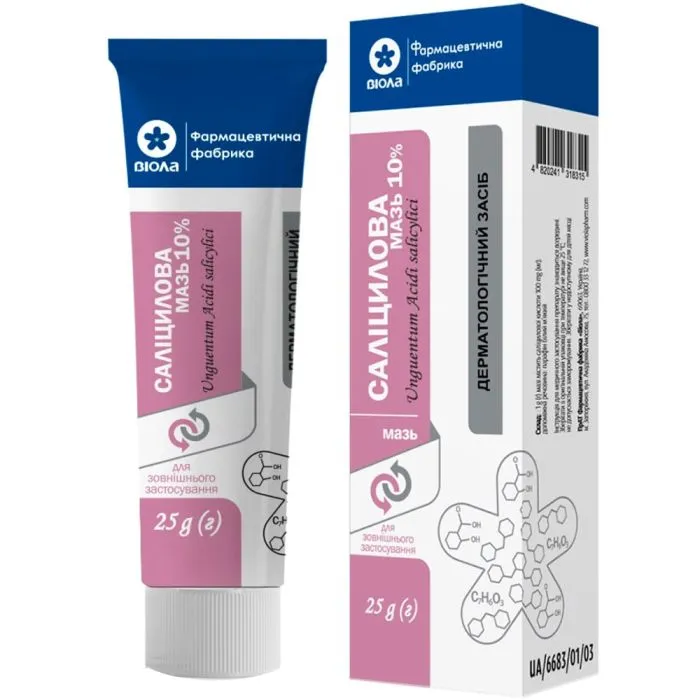
Table of Contents
INSTRUCTIONS for medical use of the medicinal product SALICYLIC OINTMENT
Composition:
Active substance: salicylic acid;
1 g of ointment contains salicylic acid 20 mg or 50 mg or 100 mg;
Excipient: white soft paraffin.
Pharmaceutical form. Ointment.
Main physicochemical properties: homogeneous ointment of white or light yellow color.
Pharmacotherapeutic group. Dermatological agents. Salicylic acid preparations.
ATC code D02AF.
Pharmacological properties.
Pharmacodynamics.
When applied topically, salicylic acid exhibits weak antiseptic, irritant, and counterirritant effects. It suppresses the secretion of sebaceous and sweat glands. At low concentrations, it demonstrates keratoplastic action, while at high concentrations – keratolytic action.
Pharmacokinetics.
Salicylic ointment is intended for external use and is practically not absorbed into the systemic circulation, thus not producing any resorptive effects.
Clinical characteristics.
Indications. 2 % and 5 % ointment: topical treatment of extensive hyperkeratotic conditions (e.g., psoriasis).
10 % ointment: topical treatment of warts and calluses.
Contraindications. Hypersensitivity to salicylic acid.
Special precautions. Avoid contact with eyes; do not apply to mucous membranes.
Interaction with other medicinal products and other forms of interaction. When used concomitantly with topical medicinal products, new compounds with unpredictable effects may be formed, requiring consultation with a physician.
Topical application of salicylic acid should not be combined with oral administration of drugs containing acetylsalicylic acid and other nonsteroidal anti-inflammatory agents. Do not use concomitantly with benzoyl peroxide and topical retinoids.
Salicylic acid may increase skin permeability to other topical medicinal products, thereby enhancing their systemic absorption. In addition, salicylic acid may potentiate the adverse effects of methotrexate and the hypoglycemic effect of oral antidiabetic drugs of the sulfonylurea derivatives.
If the patient is taking any other medicinal products, this must be reported to the physician.
Special precautions for use.
The product should not be applied to large areas of skin.
Use during pregnancy or breastfeeding.
Pregnancy
Data on the use of salicylic acid during pregnancy are lacking or limited.
Salicylic acid should not be used during pregnancy, except for short-term treatment of a small, localized area of skin/wart/callus/verruca.
It is unknown whether systemic exposure to salicylic acid achieved after topical application could be harmful to the embryo/fetus.
During the third trimester of pregnancy, systemic use of prostaglandin synthetase inhibitors may cause cardiovascular and renal toxicity in the fetus. Towards the end of pregnancy, use of salicylic acid may lead to prolonged labor and increased risk of bleeding in both mother and child.
Ability to influence the reaction rate when driving vehicles or operating machinery.
The effect of the medicinal product on the ability to drive vehicles or operate machinery has not been reported.
Method of Administration and Dosage
Before applying a dressing with salicylic ointment, remove necrotic tissue from the wound and irrigate with an antiseptic solution.
Apply the ointment to affected areas 2–3 times daily using a sterile swab, or apply a sterile dressing saturated with the ointment to the wound.
In cases of pronounced inflammation, dilute the 2% ointment with petroleum jelly in a ratio of 1:2 to 1:4 and apply once or twice daily. After desquamation has resolved, switch to other appropriate agents.
For the treatment of warts and calluses, use the 10% ointment.
Duration of treatment course: from 6 to 20 days.
Children. Experience with use in children has not been described.
Overdose. The ointment is intended for external use only. If ingested, symptoms include burning sensation and pain along the esophagus and in the stomach, recurrent vomiting (sometimes with blood), and occasionally bloody diarrhea. Patients may become agitated and euphoric. Dizziness, tinnitus, hearing loss, and visual disturbances may occur. Respiration becomes loud and rapid.
Treatment: gastric lavage via a tube, forced diuresis, and administration of large amounts of alkaline fluids.
When large amounts of the ointment are applied topically, keratolytic effects and allergic reactions may intensify. In such cases, wash off the ointment with water and consult a physician. Symptomatic therapy should be administered.
Side effects.
Rarely – local reactions such as itching, burning, skin rash, dryness, peeling, irritation, contact dermatitis, urticaria.
With prolonged use, systemic absorption of the drug is possible, leading to salicylate-related adverse effects: tinnitus, dizziness, epigastric pain, nausea, vomiting, acidosis, rapid breathing.
If any adverse events occur, medical advice should be sought immediately!
Reporting of adverse reactions following marketing authorization is of great importance. It enables ongoing monitoring of the benefit-risk balance of the medicinal product. Healthcare and pharmaceutical professionals, as well as patients or their legal representatives, should report all suspected adverse reactions and lack of efficacy via the Automated Pharmacovigilance Information System at: https://aisf.dec.gov.ua.
Shelf life. 3 years.
Storage conditions. Store in the original packaging at a temperature not exceeding 25 °C; do not freeze. Keep out of reach of children.
Packaging. Containers of 25 g. Tubes of 20 g or 25 g. One tube per carton or without carton.
Supply category. Over-the-counter (without prescription).
Manufacturer. JSC Pharmaceutical Factory "Viola".
Manufacturer's address and place of business.
75 Amosova Akademika Street, Zaporizhzhia, Ukraine, 69063.
Marketing Authorization Holder. JSC Pharmaceutical Factory "Viola".
Address of the Marketing Authorization Holder.
75 Amosova Akademika Street, Zaporizhzhia, Ukraine, 69063.