Salfenix
Ukraine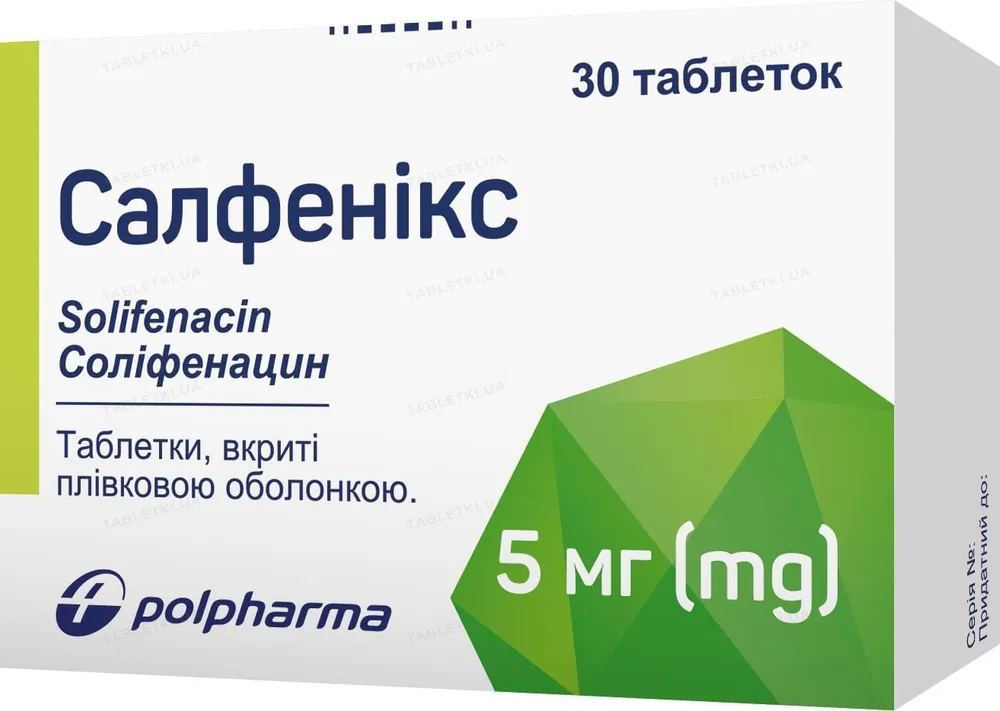
Table of Contents
INSTRUCTIONS FOR MEDICAL USE OF THE MEDICINAL PRODUCT SALFENIX
Composition:
Active substance: solifenacin succinate;
1 tablet contains 5 mg or 10 mg of solifenacin succinate, corresponding to 3.77 mg and 7.54 mg of solifenacin, respectively;
Excipients: pregelatinized maize starch, lactose monohydrate, sodium stearyl fumarate;
Coating composition for 5 mg tablets: hypromellose (6 mPa·s), titanium dioxide (E 171), lactose monohydrate, macrogol (MW 3350), triacetin, iron oxide yellow (E 172).
For 10 mg tablets: hypromellose (6 mPa·s), titanium dioxide (E 171), lactose monohydrate, macrogol (MW 3350), triacetin, iron oxide yellow (E 172), iron oxide red (E 172), iron oxide black (E 172).
Pharmaceutical form. Film-coated tablets.
Main physicochemical properties: 5 mg tablets – light yellow, round, biconvex tablets, film-coated;
10 mg tablets – pink, round, biconvex tablets, film-coated.
Pharmacotherapeutic group. Agents used in urology. Agents for the treatment of frequent urination and urinary incontinence. ATC code G04BD08.
Pharmacological properties.
Pharmacodynamics.
Solifenacin is a competitive, specific antagonist of cholinergic receptors. The urinary bladder is innervated by parasympathetic cholinergic nerves. Acetylcholine induces contraction of the detrusor smooth muscles by acting on muscarinic receptors, predominantly of the M3 subtype.
In vitro and in vivo studies have demonstrated that solifenacin is a competitive, specific antagonist of cholinergic receptors, primarily of the M3 subtype. It has also been established that solifenacin has weak or no affinity for other receptors and tested ion channels.
The efficacy of the drug, studied in several double-blind, randomized, controlled clinical trials in men and women with overactive bladder syndrome, was observed as early as week 1 of treatment and stabilized over the following 12 weeks of therapy. Open-label studies with long-term use have shown that efficacy is maintained for at least 12 months.
Pharmacokinetics.
Absorption. After tablet intake, maximum plasma concentration (Cmax) of solifenacin is reached within 3–8 hours. The time to reach maximum concentration (tmax) does not depend on the drug dose. Cmax and area under the curve (AUC) values increase proportionally with dose in the range of 5 mg to 40 mg. Absolute bioavailability is approximately 90%. Food intake does not affect Cmax and AUC values of solifenacin.
Distribution. Solifenacin is highly bound (approximately 98%) to plasma proteins, primarily to α1-acid glycoprotein.
Metabolism. Solifenacin is extensively metabolized in the liver, primarily by cytochrome P450 3A4 (CYP3A4). Systemic clearance of solifenacin is approximately 9.5 L/hour, and its terminal elimination half-life ranges from 45–68 hours. After oral administration, in addition to solifenacin, one pharmacologically active metabolite (4R-hydroxysolifenacin) and three inactive metabolites (N-glucuronide, N-oxide, and 4R-hydroxy-N-oxide of solifenacin) have been identified in plasma.
Excretion. After a single 10 mg dose of [14C-labeled] solifenacin, approximately 70% of the radioactive label is recovered in urine and 23% in feces. In urine, approximately 11% of the radioactive label is excreted as unchanged active substance; approximately 18% as the N-oxide metabolite, 9% as the 4R-hydroxy-N-oxide metabolite, and 8% as the 4R-hydroxy metabolite (active metabolite).
Dose proportionality. Within the therapeutic dose range, the pharmacokinetics of the drug are linear.
Pharmacokinetic characteristics in specific patient populations.
Age. Dose adjustment based on patient age is not necessary. Studies have shown that solifenacin exposure (5 and 10 mg), expressed as AUC, is similar in elderly healthy volunteers (aged 65 to 80 years) and younger healthy volunteers (< 55 years). The mean absorption rate, expressed as tmax, was slightly lower, and the terminal elimination half-life was approximately 20% longer in elderly patients. These minor differences are not clinically significant.
Pharmacokinetics of solifenacin have not been studied in children and adolescents.
Gender. The pharmacokinetics of solifenacin are not influenced by patient gender.
Race. Race does not affect the pharmacokinetics of solifenacin.
Renal impairment. Cmax and AUC of solifenacin in patients with mild to moderate renal impairment are slightly different from those in healthy volunteers. In patients with severe renal impairment (creatinine clearance < 30 mL/min), solifenacin exposure is significantly higher—Cmax increases by approximately 30%, AUC by over 100%, and elimination half-life by over 60%. A statistically significant relationship between creatinine clearance and solifenacin clearance has been observed. Pharmacokinetics in patients undergoing hemodialysis have not been studied.
Hepatic impairment. In patients with moderate hepatic impairment (Child–Pugh score of 7 to 9), Cmax remains unchanged, AUC increases by 60%, and elimination half-life doubles. Pharmacokinetics in patients with severe hepatic impairment have not been studied.
Clinical characteristics.
Indications
Symptomatic treatment of urgency (imperative) urinary incontinence and/or frequent urination, as well as urgency (imperative) micturition urges characteristic of patients with overactive bladder syndrome.
Contraindications
- In patients with hypersensitivity to the active substance or to any of the excipients;
- In patients with urinary retention, severe gastrointestinal disorders (including toxic megacolon), myasthenia gravis, or closed-angle glaucoma, and in patients at risk of developing these conditions;
- During hemodialysis (see section "Pharmacokinetics");
- In patients with severe hepatic impairment (see section "Pharmacokinetics");
- In patients with severe renal impairment or moderate hepatic impairment who are being treated with strong inhibitors of cytochrome CYP3A4, such as ketoconazole (see section "Interaction with other medicinal products and other types of interactions").
Interaction with other medicinal products and other types of interactions
Pharmacological interactions
Concomitant use of other medicinal products with anticholinergic properties may result in enhanced therapeutic and adverse effects. After discontinuation of Trospium, an interval of approximately one week should be observed before initiating another anticholinergic therapy. The therapeutic effect of solifenacin may be reduced when used concomitantly with cholinergic receptor agonists. Solifenacin may reduce the effect of drugs that stimulate gastrointestinal motility, such as metoclopramide and cisapride.
Pharmacokinetic interactions
In vitro studies have shown that solifenacin, at therapeutic concentrations, does not inhibit hepatic microsomal enzymes CYP1A1/2, 2C9, 2C19, 2D6, or 3A4. Therefore, it is unlikely that solifenacin affects the clearance of drugs metabolized by CYP enzymes.
Effect of other medicinal products on the pharmacokinetics of solifenacin
Solifenacin is metabolized by the CYP3A4 enzyme. Concomitant administration of ketoconazole (200 mg/day), a potent CYP3A4 inhibitor, resulted in a doubling of solifenacin AUC, while administration of ketoconazole at a dose of 400 mg/day caused a threefold increase in solifenacin AUC. Therefore, the maximum dose of Trospium should be limited to 5 mg when administered concomitantly with ketoconazole or therapeutic doses of other potent inhibitors of CYP3A4 enzyme (e.g., ritonavir, nelfinavir, itraconazole) (see section "Dosage and administration").
Concomitant use of solifenacin and a potent CYP3A4 inhibitor is contraindicated in patients with severe renal impairment or moderate hepatic impairment.
The effect of enzyme inducers on the pharmacokinetics of solifenacin and its metabolites has not been studied, nor has the effect of substrates of CYP3A4 with high affinity and their metabolites on solifenacin exposure. Since solifenacin is metabolized by CYP3A4, pharmacokinetic interactions are possible with other substrates of this enzyme that have high affinity (e.g., verapamil, diltiazem) and with CYP3A4 enzyme inducers (e.g., rifampicin, phenytoin, carbamazepine).
Effect of solifenacin on the pharmacokinetics of other medicinal products
Oral contraceptives
Administration of Trospium does not affect the pharmacokinetic interaction of solifenacin with combined oral contraceptives (ethinylestradiol/levonorgestrel).
Warfarin
Administration of Trospium does not affect the pharmacokinetic interaction of R-warfarin or S-warfarin or its effect on prothrombin time.
Digoxin
Administration of Trospium does not affect the pharmacokinetics of digoxin.
Special precautions for use.
Before initiating treatment with this medicinal product, the likelihood of other causes of frequent urination (such as heart failure or kidney disease) should be assessed. If a urinary tract infection is diagnosed, appropriate antibacterial therapy should be initiated.
The medicinal product should be used with caution in patients:
- with clinically significant obstruction of the bladder outlet, which may lead to risk of urinary retention;
- with gastrointestinal obstructive disorders;
- at risk of reduced gastrointestinal motility;
- with severe renal impairment (creatinine clearance ≤ 30 mL/min) (see sections “Dosage and administration” and “Pharmacokinetics”), and the dose should not exceed 5 mg in such patients;
- with severe renal impairment (creatinine clearance < 30 mL/min) and moderate hepatic impairment (Child–Pugh score of 7 to 9) (see sections “Dosage and administration” and “Pharmacokinetics”); doses in these patients should not exceed 5 mg;
- receiving concomitant strong CYP3A4 inhibitors, such as ketoconazole (see sections “Dosage and administration” and “Interaction with other medicinal products and other forms of interaction”);
- with hiatal hernia and/or gastroesophageal reflux and/or those concurrently taking medicinal products (such as bisphosphonates) that may cause or exacerbate esophagitis;
- with autonomic neuropathy.
In patients with risk factors such as a previously documented QT interval prolongation syndrome and hypokalemia, prolongation of the QT interval and ventricular fibrillation (torsade de pointes) have been observed.
The safety and efficacy of this medicinal product have not been studied in patients with increased activity of the neurogenic sphincter.
In some patients treated with solifenacin succinate, angioedema with airway obstruction has been reported. If angioedema occurs, treatment with solifenacin succinate should be discontinued and appropriate measures taken or appropriate therapy initiated.
In some patients treated with solifenacin succinate, anaphylactic reactions have been observed. If anaphylactic reactions occur, treatment with solifenacin succinate should be discontinued and appropriate measures taken or appropriate therapy initiated.
The maximum effect of the medicinal product is achieved no earlier than 4 weeks after initiation of treatment.
Lactose
The medicinal product Salfenix contains lactose:
- The 5 mg tablet contains 56.08 mg of lactose monohydrate.
- The 10 mg tablet contains 1132.6 mg of lactose monohydrate.
Patients with rare hereditary problems of galactose intolerance, total lactase deficiency, or glucose-galactose malabsorption should not take this medicinal product.
This medicinal product contains less than 1 mmol (23 mg)/dose of sodium, i.e., essentially "sodium-free".
Use during pregnancy or breastfeeding.
Pregnancy.
There are no clinical data on women who became pregnant during treatment with solifenacin. Animal studies have not revealed any direct adverse effects on fertility, embryonic/foetal development, or parturition. The potential risk is unknown. Caution should be exercised when administering this medicinal product to pregnant women.
Breastfeeding.
There are no data on the excretion of solifenacin into breast milk. In mice, solifenacin and/or its metabolites cross into milk and cause dose-dependent growth deficiency in newborn mice. The use of Salfenix is not recommended during breastfeeding.
Ability to affect reaction speed when driving or operating machinery.
Since solifenacin, like other anticholinergic medicinal products, may cause blurred vision and, less frequently, somnolence and increased fatigue (see section “Adverse effects”), the use of this medicinal product may negatively affect the ability to drive a vehicle or operate machinery.
Dosage and Administration
Adults, including elderly patients: The recommended dose is 5 mg of the drug once daily. If necessary, the dose may be increased to 10 mg once daily.
Patients with renal impairment: No dose adjustment is required in patients with mild to moderate renal impairment (creatinine clearance > 30 mL/min). In patients with severe renal impairment (creatinine clearance ≤ 30 mL/min), the drug should be used with caution at a dose not exceeding 5 mg once daily (see section "Pharmacokinetics").
Patients with hepatic impairment: No dose adjustment is required in patients with mild hepatic impairment. In patients with moderate hepatic impairment (Child-Pugh score 7–9), the drug should be administered with caution and the dose should not exceed 5 mg once daily (see section "Pharmacokinetics").
When using strong cytochrome P450 3A4 inhibitors: The maximum dose of Salfenix should be limited to 5 mg when co-administered with ketoconazole or therapeutic doses of other potent inhibitors of cytochrome CYP3A4 isoenzyme, such as ritonavir, nelfinavir, or itraconazole (see section "Interaction with other medicinal products and other forms of interaction").
Salfenix should be administered orally. Tablets should be swallowed whole with liquid, regardless of food intake.
Children
The safety and efficacy of Salfenix in children have not been established; therefore, Salfenix should not be prescribed to this patient group.
Overdose
Symptoms
Overdose of solifenacin succinate may lead to severe anticholinergic effects. The highest accidental dose of solifenacin succinate reported in a single patient was 280 mg within 5 hours, resulting in altered mental status that did not require hospitalization.
Treatment
In case of solifenacin succinate overdose, activated charcoal should be administered. Gastric lavage may be beneficial if performed within 1 hour after drug intake; however, emesis should not be induced.
For other anticholinergic effects, symptomatic treatment should include:
- Severe central nervous system anticholinergic effects such as hallucinations or increased excitability: treat with physostigmine or carbachol;
- Seizures or increased excitability: treat with benzodiazepines;
- Respiratory insufficiency: treat with artificial ventilation;
- Tachycardia: treat with beta-blockers;
- Urinary retention: treat with catheterization;
- Mydriasis: treat with ophthalmic drops, e.g., pilocarpine, and/or place the patient in a dark room.
As with overdose of other anticholinergic agents, special attention should be paid to patients at increased risk of QT interval prolongation (e.g., hypokalemia, bradycardia, concomitant use of drugs that prolong the QT interval) and patients with cardiac conditions (myocardial ischemia, arrhythmias, congestive heart failure).
Adverse reactions.
Solfenix may cause adverse effects related to the anticholinergic action of solifenacin, which are generally mild or moderate in intensity. The frequency of these effects depends on the dose of the drug.
The most commonly observed adverse effect is dry mouth, reported in 11% of patients receiving a 5 mg daily dose, in 22% of patients receiving 10 mg daily, and in 4% of patients receiving placebo. The severity of dry mouth was generally mild, and only in isolated cases led to discontinuation of treatment. Overall, the medicinal product was well tolerated (approximately 99%), and about 90% of patients completed the full 12-week study period.
The table below lists other adverse effects observed during clinical trials of Solfenix and in the post-marketing period.
Infections and infestations:
Uncommon – urinary tract infections, cystitis.
Immune system disorders:
Not known – anaphylactic reaction*.
Metabolism and nutrition disorders:
Not known – decreased appetite*, hyperkalemia.
Psychiatric disorders:
Very rare – hallucinations*, confusion*.
Not known – delirium*.
Nervous system disorders:
Uncommon – somnolence, taste disturbance.
Rare – dizziness*, headache*.
Eye disorders:
Common – blurred vision.
Uncommon – dry eyes.
Not known – glaucoma*.
Cardiac disorders:
Not known – torsades de pointes*, QT interval prolongation on electrocardiogram*, atrial fibrillation*, palpitations*, tachycardia*.
Respiratory, thoracic and mediastinal disorders:
Uncommon – dryness of nasal mucosa.
Not known – dysphonia*.
Gastrointestinal disorders:
Very common – dry mouth.
Common – constipation, nausea, dyspepsia, abdominal pain.
Uncommon – gastroesophageal reflux, dryness of throat.
Rare – colonic obstruction, fecal impaction, vomiting*.
Not known – intestinal obstruction*, abdominal discomfort*.
Hepatobiliary disorders:
Not known – liver function abnormalities*, abnormal liver function test results*.
Skin and subcutaneous tissue disorders:
Uncommon – dry skin.
Rare – pruritus*, rash*.
Very rare – erythema multiforme*, urticaria*, angioedema*.
Not known – exfoliative dermatitis*.
Musculoskeletal and connective tissue disorders:
Not known – muscle weakness*.
Renal and urinary disorders:
Uncommon – difficulty in micturition.
Rare – urinary retention.
Not known – renal failure*.
General disorders:
Uncommon – fatigue, peripheral edema.
*Post-marketing period.
Reporting of suspected adverse reactions
Reporting of suspected adverse reactions after marketing authorization is important. It allows continuous monitoring of the benefit-risk balance of the medicinal product. Healthcare professionals and patients or their legal representatives should report all suspected adverse reactions and lack of efficacy via the Automated Pharmacovigilance Information System at: https://aisf.dec.gov.ua.
Shelf life.
2 years.
Storage conditions.
Store at a temperature not exceeding 30 °C.
Keep out of reach and sight of children.
Packaging.
10 tablets in a blister, 3 blisters in a cardboard box.
30 tablets in a blister, 1 blister in a cardboard box.
Prescription status. Prescription only.
Manufacturer.
Pharmaceutical Works «POLPHARMA» S.A., Poland
Manufacturer's address and place of business.
19, Pelplinska Str., 83-200 Starogard Gdanski, Poland
Production Department in Nowa Deba, 2 Metalowca Str., 39-460 Nowa Deba, Poland