Castor oil
Ukraine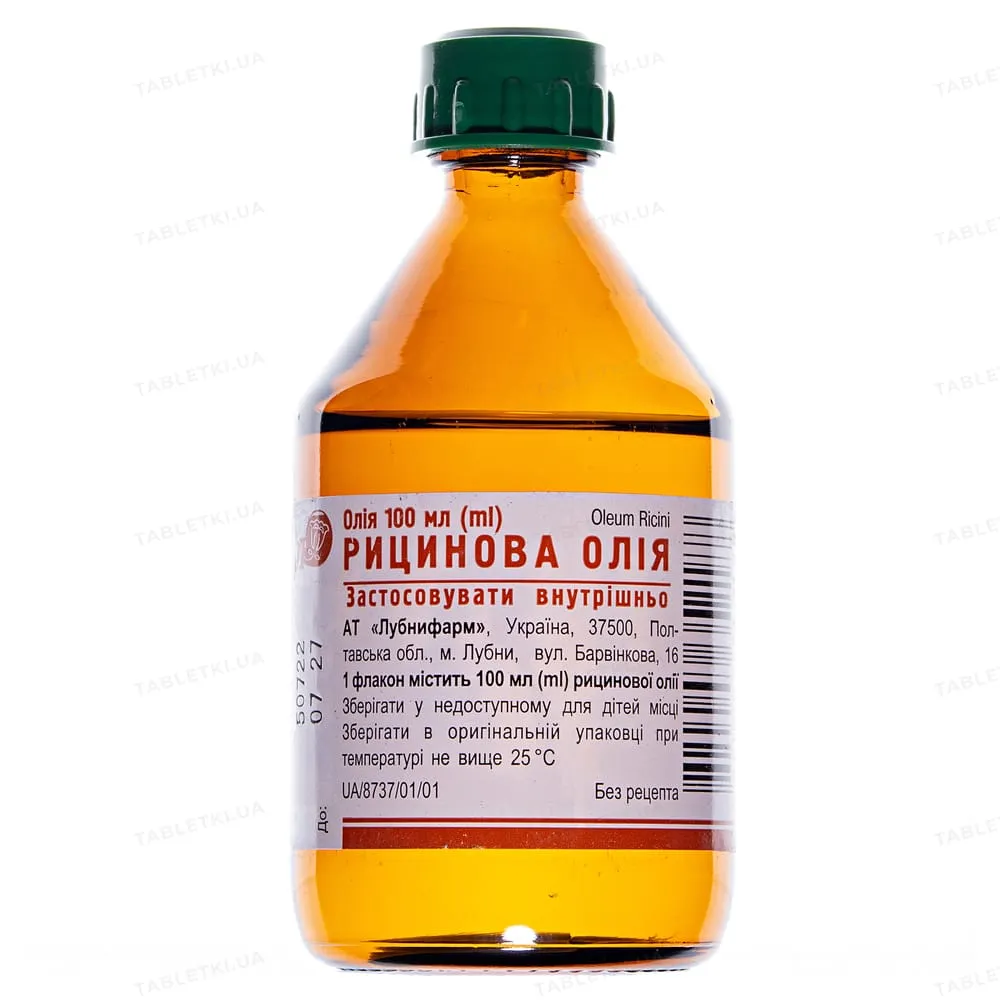
Table of Contents
INSTRUCTIONS FOR MEDICAL USE OF THE MEDICINAL PRODUCT CASTOR OIL (OLEUM RICINI)
Composition:
Active substance: castor oil (Oleum Ricini);
1 vial contains 30 g, or 50 g, or 100 g of castor oil (Oleum Ricini).
Pharmaceutical form. Oil.
Main physicochemical properties.
A transparent, thick and viscous liquid, colorless or slightly yellowish; odor weak, taste peculiar, unpleasant. On exposure to air in a thin layer, it slowly thickens but does not form a dense or solid film.
Pharmacotherapeutic group.
Laxative agent. ATC code A06AB05.
Pharmacological properties.
Pharmacodynamics.
When administered orally, the drug is hydrolyzed by lipase in the small intestine, forming ricinoleic acid, which irritates intestinal receptors and reflexively enhances intestinal peristalsis. The laxative effect usually occurs within 5–6 hours. The drug also causes reflex contraction of the myometrium.
Pharmacokinetics.
Pharmacokinetics has not been established.
Clinical characteristics.
Indications. Constipation.
Contraindications.
Hypersensitivity to the drug. Poisoning with fat-soluble substances (phosphorus, benzene, phenol).
Peptic ulcer of the stomach and duodenum, ulcerative colitis. Poisoning with fat-soluble anthelmintics, male fern extract. Acute inflammatory conditions within the abdominal cavity (appendicitis, peritonitis). Uterine bleeding. Cachexia. Pregnancy. Advanced age. Pediatric age under 12 years.
Hypersensitivity to plants of the Euphorbiaceae family, undiagnosed abdominal pain, biliary tract obstruction, severe dehydration.
Special precautions.
None.
Do not violate the rules for using the medicinal product, as this may harm your health.
Interaction with other medicinal products and other types of interactions.
Concurrent use of Castor Oil with male fern extract is not recommended.
Special precautions for use.
Use during pregnancy or breastfeeding.
The use of the drug is contraindicated in pregnant women. During breastfeeding, the drug should be used only if the expected benefit to the mother outweighs the potential risk to the infant.
Ability to affect reaction speed when driving or operating machinery.
Data are lacking.
Dosage and Administration.
For oral use.
The recommended dose for adults and children aged 12 years and older is 15–30 g per administration.
If the drug is used for bowel cleansing prior to diagnostic procedures, it should be taken 6 hours before the procedure.
Children.
The drug can be used in children aged 12 years and older.
Overdose.
Nausea, vomiting, abdominal pain, diarrhea. Treatment is symptomatic.
Side effects.
Nausea, vomiting, diarrhea, abdominal pain, disturbances of water and electrolyte balance. After bowel evacuation, constipation is possible. With prolonged use – digestive disturbances, enterocolitis, development of dependence, intestinal atony.
Allergic reactions are possible.
Shelf life.
5 years.
Storage conditions.
Store in the original packaging at a temperature not exceeding 25 °C. Keep out of reach of children.
Packaging.
30 g in a glass bottle; 1 bottle per carton or without a carton. 50 g or 100 g in glass bottles. 30 g, 50 g, or 100 g in polymer bottles, in a carton or without a carton.
Dispensing category. Over-the-counter.
Manufacturer. JSC Pharmaceutical Factory "Viola".
Manufacturer's address and place of business.
69063, Ukraine, Zaporizhzhia, Akademika Amosova St., 75.
Marketing authorization holder. JSC Pharmaceutical Factory "Viola".
Address of the marketing authorization holder.
69063, Ukraine, Zaporizhzhia, Akademika Amosova St., 75.