Rhythmkor
Ukraine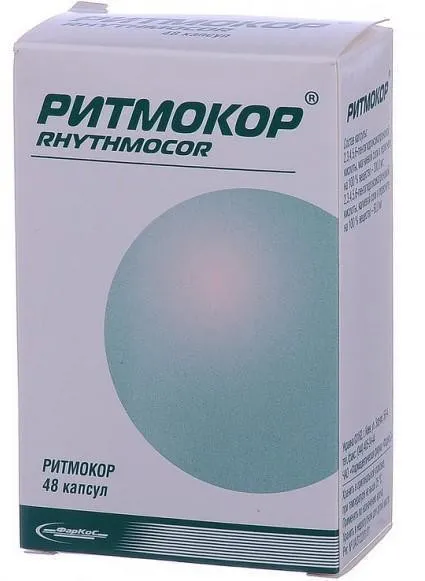
Table of Contents
INSTRUCTIONS FOR MEDICAL USE OF THE MEDICINAL PRODUCT RHYTHMOCOR® (RHYTHMOCOR)
Composition:
Active substances: 1 capsule contains magnesium salt of 2,3,4,5,6-pentahydroxycaproic acid, calculated as 100 % substance – 300 mg,
potassium salt of 2,3,4,5,6-pentahydroxycaproic acid, calculated as 100 % substance – 60 mg;
Excipients: colloidal anhydrous silicon dioxide, calcium stearate.
Pharmaceutical form. Capsules.
Main physicochemical properties: hard gelatin capsules of cylindrical shape with hemispherical ends, white-green in color (with or without the imprint "FarCoS"). The capsule contents – odorless white or almost white powder.
Pharmacotherapeutic group. Mineral supplements. Magnesium preparations. ATC code A12CC.
Pharmacological Properties.
Pharmacodynamics. RITMOKOR**®** is a combination medicinal product that exhibits metabolic, antioxidant, membrane-stabilizing, and antiarrhythmic effects. The metabolic activity of RITMOKOR**®** is due to activation of cellular redox enzymes and an increase in adenosine triphosphate (ATP) and creatine phosphate levels. These effects of the drug promote optimization of cellular ion pump function. Due to these effects and the content of magnesium and potassium ions, the drug exerts antiarrhythmic action and enhances the clinical efficacy of antiarrhythmic agents.
Pharmacokinetics. After oral administration, maximum blood concentration is reached within 1–1.5 hours. Within 48 hours, 95 % of the drug is metabolized; metabolites are excreted by the kidneys.
Clinical characteristics.
Indications.
Diseases and conditions associated with hypomagnesemia and hypokalemia (as part of complex therapy):
- ischemic heart disease;
- cardiac arrhythmias (atrial and ventricular extrasystolic arrhythmia);
- vegetative-vascular dystonia;
- cardiomyopathies;
- electrolyte imbalance (for correction of magnesium and potassium ion levels);
- chronic fatigue syndrome.
Contraindications.
Hypersensitivity to the components of the drug. Third-degree atrioventricular block. Cardiogenic shock (with systolic blood pressure below 90 mm Hg in adults). Comatose states of unknown etiology. Decompensated forms of diabetes mellitus. Acute and chronic kidney dysfunction of grade II–IV. Addison's disease. Hyperkalemia and hypermagnesemia.
Interaction with other medicinal products and other forms of interaction.
When RITMOKOR**®** is used concomitantly with antiarrhythmic and antihypertensive agents, mutual enhancement of drug activity is observed. When used concomitantly with potassium-sparing diuretics and angiotensin-converting enzyme inhibitors, serum levels of potassium and magnesium should be monitored. When used concomitantly with cardiac glycosides, the risk of their toxic effects on the heart is reduced.
Special precautions.
During treatment with RYTHMOCOR**®**, monitoring of serum potassium and magnesium levels is necessary. Particular attention should be paid to patients at high risk of developing hypermagnesemia and hyperkalemia. Hypermagnesemia and hyperkalemia may manifest as paresthesia, decreased tendon reflexes, tremor, and respiratory depression. To reduce hypermagnesemia, calcium preparations should be used.
With prolonged use, continuous ECG monitoring is required. Use with caution in patients with myasthenia gravis and in conditions that may lead to hyperkalemia, such as acute dehydration, extensive tissue damage, particularly in severe burns.
In patients with diabetes mellitus, the possibility of falsely elevated glucose readings should be considered when using the orthotolidine method, due to the presence of gluconic (pentahydroxycaproic) acid in the drug.
1 capsule contains 0.03 bread units.
Use during pregnancy or breastfeeding.
There is no experience of use.
Ability to affect reaction speed when driving or operating machinery.
Generally does not affect, but the possibility of dizziness related to the first-dose effect should be taken into account.
Method of Administration and Dosage
The duration and dosage of RITMOKOR**®** are determined by a physician in each individual case. Capsules should be taken orally, 10–15 minutes before meals. The single dose should be washed down with a small amount of water.
Adults: Take 1–2 capsules 3–4 times daily. In more severe cases, administration of 3 capsules 3 times daily may be used. Once therapeutic effect is achieved (usually within 5–7 days), the dose should be reduced to 1 capsule taken 3 times daily. The duration of treatment course is determined individually by the physician.
If rapid onset of therapeutic effect is required, treatment should begin with the injectable form of the medicinal product RITMOKOR**®**.
In cardiac rhythm disorders (atrial and ventricular extrasystolic arrhythmias) caused by hypokalemia and hypomagnesemia, as well as for prophylaxis of paroxysmal atrial fibrillation regardless of heart rate, concomitant use of RITMOKOR**®** with cardiac glycosides reduces the risk of their arrhythmogenic effects.
For chronic fatigue syndrome, the drug is administered at a dose of 1 capsule 3 times daily for 3–6 months.
Children: For children aged 6 to 12 years, administer 1 capsule 3 times daily; for children aged 12 years and older – same as adults.
Children
The drug in this pharmaceutical form may be used in children aged 6 years and older.
Overdose
Cases of overdose have not been reported. Since the drug contains magnesium and potassium ions, in case of overdose, ECG changes characteristic of hypermagnesemia and hyperkalemia may occur. Hyperkalemia and hypermagnesemia may manifest as paresthesia, decreased tendon reflexes, tremor, and respiratory depression.
Symptoms of hyperkalemia: nausea, vomiting, diarrhea, abdominal pain, metallic taste in the mouth, bradycardia, weakness, disorientation, muscle paralysis.
Symptoms of hypermagnesemia: facial skin flushing, thirst, arterial hypotension, neuromuscular transmission disturbances, arrhythmia, seizures, and ECG changes.
To reduce manifestations of hyperkalemia, calcium preparations should be administered.
Adverse reactions.
The drug is well tolerated; adverse reactions develop very rarely.
From the skin and subcutaneous tissue: skin rash, urticaria, itching, skin hyperemia.
From the respiratory system: respiratory depression.
From the musculoskeletal system: paresthesia, hyporeflexia, convulsions.
From the cardiovascular system: myocardial conduction disturbances, decreased arterial pressure, AV block.
From the gastrointestinal tract: nausea, vomiting, diarrhea, abdominal pain, discomfort or burning sensation in the epigastric region, gastrointestinal bleeding, mucosal ulcers of the digestive tract, dry mouth, dyspeptic symptoms (very rare).
From the vestibular apparatus: dizziness (very rare), associated with the first-dose effect.
From the vascular system: feeling of warmth.
From the immune system: allergic reactions, including rash, itching, urticaria, feeling of warmth, skin hyperemia. In case of allergic manifestations, desensitizing therapy is prescribed.
Shelf life. 3 years.
The drug must not be used after the expiry date stated on the packaging.
Storage conditions. Store in the original packaging, out of reach of children, at a temperature not exceeding 25°C.
Packaging. 12 capsules per blister. 4 or 5 blisters per carton; 1 blister without carton in secondary packaging.
Availability category. Over-the-counter.
Manufacturer.
LLC "Pharmaceutical Company "PharCoS".
Manufacturer's location and address of business activity.
50-A Zodchykh St., Kyiv, Ukraine, 03162.
360 Sviato-Pokrovska St., town of Hostomel, Irpin, Kyiv region, Ukraine, 08290.
Applicant. LLC "Pharmaceutical Company "PharCoS".
Applicant's address.
50-A Zodchykh St., Kyiv, Ukraine, 03162.