Rutacid
Ukraine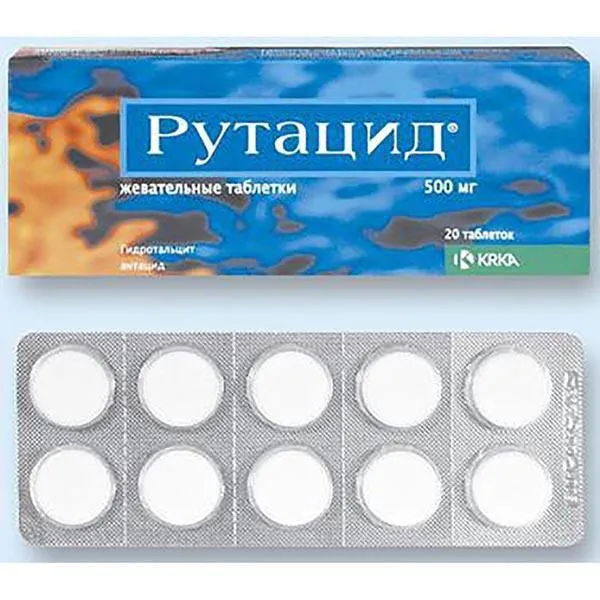
Table of Contents
INSTRUCTIONS FOR MEDICAL USE OF THE MEDICINAL PRODUCT RUTACID (Rutacid®)
Composition:
Active substance: hydrotalcite;
One chewable tablet contains 500 mg of hydrotalcite;
Excipients: mannitol (E 421), sodium saccharin, sodium starch glycolate (type A), talc, magnesium stearate, peppermint flavoring.
Pharmaceutical form. Chewable tablets.
Main physico-chemical properties: white, round tablets with bevelled edges.
Pharmacotherapeutic group. Antacids. Combinations and complexes of aluminium, calcium and magnesium compounds. ATC code A02A D04.
Pharmacological Properties
Pharmacodynamics
Hydrotalcite is an aluminum magnesium hydroxycarbonate hydrate belonging to the group of non-systemic antacids. In addition to neutralizing gastric acid, hydrotalcite enhances protective mechanisms and protects the mucous membrane from aggressive factors. At the same time, it improves healing of damaged mucosa of the stomach and duodenum. The pronounced acid-neutralizing effect of hydrotalcite is based on its specific spatial lattice structure. Hydrotalcite rapidly neutralizes excess gastric acid and provides a prolonged effect. Magnesium and aluminum ions are gradually released from the crystal structure depending on the amount of acid in the stomach, maintaining gastric acidity at a level between pH 3 and 5 without excessive alkalization of gastric contents.
Pharmacokinetics
Absorption
Studies on absorption in animals and humans have demonstrated that hydrotalcite is almost not absorbed in the gastrointestinal tract when administered at recommended doses.
Metabolism
Hydrotalcite is not metabolized.
Excretion
Hydrotalcite is excreted in feces. After reacting with gastric acid, aluminum ions are converted into aluminum chloride, which is absorbed in negligible amounts and excreted in urine. The non-absorbed portion in the intestine is transformed into insoluble phosphates, carbonates, and soaps and is excreted in feces. Studies in volunteers have shown no changes in serum concentrations of calcium, phosphorus, magnesium, and aluminum after administration of hydrotalcite. With normal kidney function, hydrotalcite administration does not lead to disturbances in serum mineral concentrations or aluminum accumulation.
Caution should be exercised when administering large doses of this antacid, particularly in patients with impaired renal function, due to reduced elimination of aluminum.
Clinical characteristics.
Indications.
Symptomatic treatment of conditions associated with excessive gastric acidity:
- heartburn and acid regurgitation,
- inflammation of the gastric mucosa (gastritis) due to stress, improper diet, excessive alcohol consumption, or use of nonsteroidal anti-inflammatory drugs;
- peptic ulcer of the stomach and duodenum;
- reflux esophagitis.
Contraindications.
- Hypersensitivity to the active substance or to any of the excipients of the medicinal product.
- Severe renal impairment.
- Hypophosphatemia.
- Myasthenia gravis.
Interaction with other medicinal products and other forms of interaction.
Hydrotalcite should not be taken simultaneously with the following drugs: glycosides, tetracyclines, or quinolone derivatives such as ofloxacin and ciprofloxacin, H2-receptor antagonists, coumarin derivatives, sodium chloride, chenodeoxycholate, due to possible interference with their absorption.
Generally, other medicinal products should be administered at least 1–2 hours before or after taking hydrotalcite.
Special precautions for use.
High doses and prolonged exposure should be avoided in patients with impaired renal function (particularly those undergoing hemodialysis), in patients with Alzheimer's disease or other forms of dementia, and in patients with hypophosphatemia or those on a low-phosphate diet.
Hydrotalcite should not be taken simultaneously with food containing acid (e.g., wine, fruit juices) due to increased intestinal absorption of aluminium hydroxide.
This medicine does not contain sugar and therefore can be used by diabetic patients.
It is not recommended for use in children under 6 years of age, as the safety and efficacy of the medicine in this patient group have not been established.
Use during pregnancy or breastfeeding.
Use of the medicine Rutacid during pregnancy or breastfeeding is possible only for a short period if, in the physician’s opinion, the expected beneficial effect for the mother outweighs the potential risk to the fetus or infant. Since pharmacokinetic studies have shown that serum aluminium levels remain within the normal range, hydrotalcite should be used only for a short duration during pregnancy in order to minimize the potential impact of aluminium on the fetus.
Generally, aluminium-containing substances pass into breast milk. There are no available data on the passage of hydrotalcite into breast milk; however, due to its low intestinal absorption in both mother and infant, no health risks are expected for the newborn.
Effect on ability to drive and use machines.
No influence on the ability to drive or operate machinery has been observed.
Dosage and Administration
Chewable tablets should not be swallowed whole; they must be thoroughly chewed.
Adults
The recommended dose is 1–2 tablets 3–4 times daily, usually taken 1 hour after meals and at bedtime, or as needed.
Elderly patients
No dose adjustment is required.
Patients with renal impairment
Patients with impaired renal function may take Rucacid only for a short period and in reduced doses.
Patients with hepatic impairment
No dose adjustment is required.
Children
The recommended dose for children aged 6 to 12 years is half the adult dose, administered 3–4 times daily, usually 1 hour after meals and at bedtime, or as needed.
Children
Rucacid is indicated for use in children aged 6 years and older.
Overdose
There have been no reports of overdose with Rucacid.
Side effects.
When taking hydrotalcite at recommended doses, adverse effects are rarely observed and are mild in nature.
Gastrointestinal tract: at high doses – soft stools, increased frequency of bowel movements, vomiting, diarrhea.
Immune system: allergic reaction.
Laboratory findings: decreased serum phosphate levels, hypermagnesemia.
Long-term treatment of patients with impaired renal function may lead to aluminum intoxication with osteomalacia and encephalopathy.
If severe adverse effects occur, treatment should be discontinued.
Shelf life.
5 years.
Storage conditions.
Store at a temperature not exceeding 30 °C.
Keep out of reach of children.
Packaging.
10 chewable tablets in a blister pack; 2 or 6 blisters per cardboard box.
Prescription status.
Over-the-counter (without prescription).
Manufacturer.
KRKA, d.d., Novo mesto / KRKA, d.d., Novo mesto.
Manufacturer's address and location of business operations.
Šmarješka cesta 6, 8501 Novo mesto, Slovenia / Šmarješka cesta 6, 8501 Novo mesto, Slovenia.