Resoglogin
Ukraine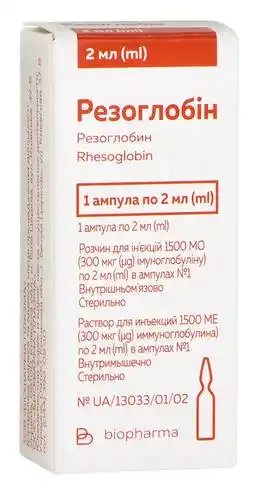
Table of Contents
INSTRUCTION FOR MEDICAL USE OF THE MEDICINAL PRODUCT Rhesoglobin
Composition:
Active substance: Anti-D (Rh) immunoglobulin;
1 ampoule or 1 pre-filled syringe (1 ml or 2 ml) contains specific antibodies to anti-Rh0(D) – 1500 IU (300 μg of immunoglobulin);
Excipients: glycine (glycocol, aminoacetic acid), sodium chloride.
Pharmaceutical form. Solution for injection.
Main physicochemical characteristics: clear or slightly opalescent, colorless or slightly yellow liquid. A slight precipitate may appear during storage, which disappears upon shaking. The product is an immunologically active protein fraction of plasma from immunized (or re-immunized) donors, tested negative for antibodies to HIV-1, HIV-2, hepatitis C virus, and hepatitis B surface antigen, purified and concentrated by ethanol fractionation, and subjected to viral inactivation by solvent-detergent method and nanofiltration, with a high content of anti-Rh0(D) antibodies. Protein content in 1.0 ml of the product ranges from 0.09 g to 0.11 g. The product contains no preservatives or antibiotics.
Pharmacotherapeutic group. Specific immunoglobulins. Human anti-Rhesus Rh0(D) immunoglobulin. ATC code: J06BB01.
Immunological and biological properties.
Pharmacodynamics.
The active component of the product is immunoglobulin specific to the Rh0(D) antigen. The product prevents Rh-sensitization in Rh-negative women that may occur due to the entry of Rh0(D)-positive fetal blood into the maternal circulation during delivery of Rh0(D)-positive infants, during termination of pregnancy (spontaneous or induced), during amniocentesis, or following abdominal trauma during pregnancy.
Pharmacokinetics.
Specific antibodies to anti-Rh0(D) – 1500 IU (300 μg of immunoglobulin).
Clinical characteristics.
Indications.
The drug is indicated:
- for prophylaxis during the antepartum period in Rh-negative women who are not sensitized to the Rho(D) antigen;
- for prophylaxis during the postpartum period in Rh-negative women who are not sensitized to the Rh0(D) antigen, i.e., those who have not produced Rh antibodies (in case of first pregnancy and delivery of an Rh-positive infant whose blood is compatible with the mother's blood according to the ABO blood group system);
- in cases of induced abortion in Rh-negative women who are not sensitized to the Rh0(D) antigen, when the father is Rh-positive;
- in cases of miscarriage or threatened miscarriage at any stage of pregnancy;
- during amniocentesis;
- following abdominal trauma during pregnancy.
Contraindications.
The drug is contraindicated in selective IgA deficiency when anti-IgA antibodies are present; in patients with a history of severe allergic reactions to administration of human blood protein products, as well as in cases of hypersensitivity to human donor immunoglobulins.
Administration of the drug is contraindicated in Rh-positive parturient women, as well as in Rh-negative parturient women sensitized to the Rh0(D) antigen, in whom Rh antibodies have been detected in serum.
The drug should not be administered in cases of severe thrombocytopenia and other coagulation disorders.
Interaction with other medicinal products and other forms of interaction.
Possible combination with other specific medicinal products.
Immunization of women with live vaccines should be performed no earlier than 3 months after administration of the drug.
Special precautions.
Intravenous administration of the drug is strictly prohibited!
Patients who have received the drug must remain under medical supervision for 30 minutes.
Patients suffering from allergic diseases or having such conditions in their medical history should be administered antihistamine drugs on the day of immunoglobulin administration and for the following 3 days. In case of anaphylactic shock, standard anti-shock therapy should be administered.
Use under medical supervision. Prior to administration, the ampoule or prefilled syringe with the drug should be kept for 2 hours at room temperature (20 ± 2) °C. The drug in an opened ampoule must not be stored. After expiration of the shelf life, the drug must not be used.
Use during pregnancy or breastfeeding.
The medicinal product should be used during pregnancy and breastfeeding if indicated.
Ability to influence reaction rate when driving or operating machinery.
Not studied.
Method of Administration and Dosage
The medicinal product should be administered intramuscularly.
The following criteria should be considered when using the product:
- The mother must be Rh-negative and must not have been previously sensitized to the Rh0(D) antigen;
- The newborn must be Rh-positive and must have a negative result on the direct antiglobulin test. If the product is administered antenatally, it is very important that the mother receives another dose of the product within 72 hours after delivery of an Rh-positive infant. If it is established that the father is Rh-negative, administration of the product is unnecessary.
The product is administered as a single intramuscular dose of 1500 IU (300 μg) (1 vial or 1 pre-filled syringe):
-
For antenatal prophylaxis at approximately 28 weeks of gestation. After this, another dose of 1500 IU (300 μg) must be administered, preferably within 72 hours after delivery, if the newborn is found to be Rh-positive;
-
For postnatal prophylaxis within 72 hours after delivery;
-
Following induced abortion or termination of ectopic pregnancy, immediately after completion of the procedure. During pregnancy after 13 weeks, administration of a single dose is recommended;
- If pregnancy is terminated before 13 weeks, a single administration of a mini-dose of immunoglobulin of approximately 250 IU (50 μg) may be considered;
-
In cases of miscarriage or threatened miscarriage at any stage of pregnancy;
-
Following amniocentesis or abdominal trauma during the second and/or third trimester of pregnancy, one dose of the product is recommended immediately after completion of the procedure. If amniocentesis or abdominal trauma necessitates administration of the product between 13–18 weeks of gestation, an additional dose of 1500 IU (300 μg) (1 vial or 1 pre-filled syringe) should be administered between 26–28 weeks of gestation.
Children. Safety and efficacy of the product in children have not been studied.
The product must not be administered to newborns!
In infants whose mothers received the product before delivery, weakly positive results in direct antiglobulin tests may occur at birth. Passive anti-Rh0(D) antibodies may be detected in maternal serum if antibody screening is performed after antenatal or postnatal administration of the product.
Overdose.
Not studied.
Side effects
Reactions to the administration of immunoglobulin are generally absent.
Possible side effects:
Local injection site reactions – swelling, pain, erythema, induration, redness, rash, itching;
General disorders and administration site conditions – fever, weakness, chills;
Immune system disorders – hypersensitivity reactions, and in exceptionally rare cases, anaphylactic shock;
Nervous system disorders – headache;
Cardiovascular system disorders – tachycardia, hypotension;
Gastrointestinal disorders – nausea, vomiting;
Skin and subcutaneous tissue disorders – erythema, itching;
Musculoskeletal and connective tissue disorders – arthralgia.
Shelf life
3 years.
Storage conditions
Store in a dry, dark place at a temperature of 2 to 8 °C.
Keep out of reach of children.
Incompatibilities
Mixing the drug with other medicinal products in the same syringe is not permitted.
Packaging
1 ml or 2 ml (specific antibodies to anti-Rh0(D) – 1500 IU (300 μg immunoglobulin)) in an ampoule or in a pre-filled syringe. 1, 3, or 5 ampoules or 1 pre-filled syringe per pack.
Prescription status
By prescription only.
Manufacturer
LLC "BIOFARMA PLAZMA", Ukraine.
Manufacturer's address and address of the place of business activity
Legal address: 37-V Kyivska Street, Bila Tserkva, Kyiv region, 09100, Ukraine.
Address of the place of business activity:
37-V Kyivska Street, Bila Tserkva, Kyiv region, 09100, Ukraine.