Remisar
Ukraine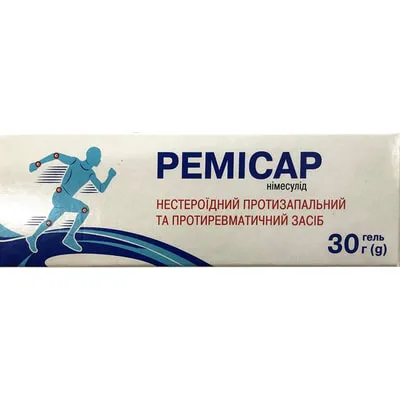
Table of Contents
INSTRUCTIONS FOR MEDICAL USE OF THE MEDICINAL PRODUCT REMISAR (REMISAR)
Composition:
Active substance: nimesulide;
1 g of gel contains 10 mg of nimesulide;
Excipients: dimethyl sulfoxide, propylene glycol, levomenthol, macrogol 400, carbomer 980, tromethamine, purified water.
Pharmaceutical form. Gel.
Main physicochemical characteristics: yellow or yellowish-green colored, almost transparent gel with a weak specific odor. It should be homogeneous in appearance.
Pharmacotherapeutic group.
Non-steroidal anti-inflammatory drugs for topical use. ATC code M02A A26.
Pharmacological Properties
Pharmacodynamics
Remisar is a non-steroidal anti-inflammatory drug (NSAID), a selective inhibitor of cyclooxygenase-2. In equimolar concentrations, nimesulide demonstrates anti-inflammatory activity comparable to indomethacin and piroxicam in the early stages of inflammation. By inhibiting prostaglandin synthesis at the site of inflammation, nimesupride has virtually no effect on the synthesis of regulatory prostaglandins in the gastric mucosa and kidneys. It suppresses the activity of platelet-activating factor, tumor necrosis factor-α, proteases, histamine, and the formation of free oxygen radicals. When applied topically, it reduces or eliminates pain at the site of application, including joint pain at rest and during movement, decreases morning stiffness and joint swelling, and promotes an increase in range of motion.
Pharmacokinetics
After topical application of Remisar, a gradual transdermal infusion of nimesulide into subcutaneous tissues and joint synovial fluid occurs. The drug practically does not penetrate into systemic circulation, which explains the absence of significant systemic effects.
Clinical characteristics.
Indications.
Local treatment of musculoskeletal disorders characterized by pain, inflammation, and restricted mobility, such as osteoarthritis, periarthritis, post-traumatic tendinitis, tenosynovitis, muscle strains, and severe physical stress on joints.
Contraindications.
Hypersensitivity to nimesulide and to other components of the medicinal product.
Skin dermatitis and infectious skin diseases. Epidermal damage. Do not use in patients in whom acetylsalicylic acid or other drugs that inhibit prostaglandin synthesis cause allergic reactions (rhinitis, urticaria, or bronchospasm). Third trimester of pregnancy.
Interaction with other medicinal products and other types of interactions.
When applied topically, no interactions of this medicinal product with other drugs have been established. However, it should be taken into account that if nimesulide enters systemic circulation, it may enhance the efficacy and toxicity of many drugs due to displacement from plasma protein binding sites, thereby increasing their free fraction in the blood. Therefore, the medicinal product should be used with caution when administered concomitantly with anticoagulants, digoxin, phenytoin, lithium preparations, diuretics, antihypertensive agents, other nonsteroidal anti-inflammatory drugs (NSAIDs), cyclosporine, methotrexate, and oral hypoglycemic agents.
When applying several NSAIDs locally at the same time, local irritation may develop, manifesting as urticaria, skin redness, and desquamation.
Glucocorticoids and antirheumatic agents (gold preparations, aminoquinolones) enhance the anti-inflammatory effect of Remisar.
Special precautions for use.
Medical supervision is required when prescribing the medicinal product to elderly patients with impaired renal or hepatic function, or with congestive heart failure. The medicinal product should be used under medical supervision in patients with gastroduodenal bleeding, peptic ulcers in the acute phase, or severe coagulation disorders.
Do not use concomitantly with other locally applied medicinal products.
The gel should be applied only to intact skin areas, avoiding contact with open wounds. Care should be taken to prevent the gel from entering the eyes or mucous membranes. Do not apply the gel under occlusive dressings.
To minimize the risk of adverse reactions, the lowest effective dose for the shortest duration necessary should be used. If the patient's condition does not improve, medical advice must be sought.
Do not use in patients with known hypersensitivity to NSAIDs. If hypersensitivity reactions occur, treatment should be discontinued.
During treatment, photosensitivity reactions may occur. To reduce the risk of photosensitivity, patients should avoid exposure to UV radiation and refrain from using sunbeds.
Important information about excipients.
The medicinal product contains dimethyl sulfoxide and propylene glycol, which may cause skin irritation.
Use during pregnancy or breastfeeding.
There are no clinical data on the use of Remisar during pregnancy. Even though systemic exposure is lower compared to oral administration, it is unknown whether systemic exposure to Remisar achieved after topical application could be harmful to the embryo/fetus. Remisar should not be used during the first and second trimesters of pregnancy unless clearly necessary. If used, the dose should be as low as possible and the duration of treatment as short as possible.
During the third trimester of pregnancy, systemic use of prostaglandin synthetase inhibitors, including Remisar, may cause cardiovascular and renal toxicity in the fetus. Prolonged bleeding may occur in both mother and child near term, and labor may be prolonged. Therefore, Remisar is contraindicated during the last trimester of pregnancy (see section "Contraindications").
Ability to affect reaction speed when driving or operating machinery.
No effect.
Method of Administration and Dosage.
Apply externally to adults. Before applying the gel, wash and dry the skin surface. Apply a thin strip of gel approximately 3 cm long onto the affected painful areas and gently rub in. Apply 3–4 times daily.
The duration of treatment is determined individually depending on treatment efficacy and should not exceed 4 weeks.
Children.
Do not use in children.
Overdose.
When the gel is applied over large skin areas or when recommended doses are exceeded, systemic adverse effects typical of nimesulide and other nonsteroidal anti-inflammatory agents may occur: dyspepsia, headache, dizziness, epigastric pain.
Treatment. Reduce dose or discontinue the medication, symptomatic therapy.
Side effects.
Immune system disorders: rarely, anaphylactic reactions such as angioedema, vasomotor rhinitis, urticaria, bronchospasm may occur in sensitive patients.
Skin and subcutaneous tissue disorders: local mild to moderate skin irritation: erythema, rash, desquamation, pruritus, allergic reactions.
Reporting of suspected adverse reactions.
Reporting suspected adverse reactions after marketing authorization of the medicinal product is an important procedure. It enables ongoing monitoring of the benefit-risk balance of the medicinal product. Healthcare professionals are required to report any suspected adverse reactions through the national reporting system.
Shelf life. 3 years.
Storage conditions.
Store in the original packaging at a temperature not exceeding 25 °C. Do not freeze.
Keep out of reach and sight of children.
Packaging.
30 g in a tube; 1 tube per carton.
Availability. Over-the-counter (without prescription).
Manufacturer. JSC "Pharmaceutical company "Darnytsia".
Manufacturer's address and location of operations.
13, Borispilska Street, Kyiv, 02093, Ukraine.