Relief® advance
Ukraine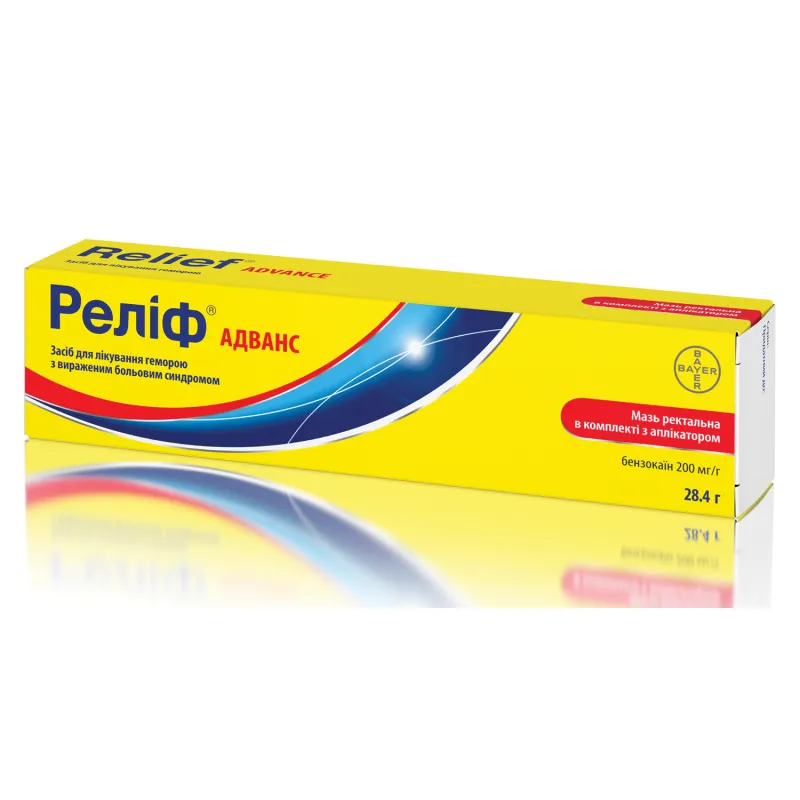
Table of Contents
INSTRUCTION FOR MEDICAL USE OF THE MEDICINAL PRODUCT Relif® Advance
Composition:
Active ingredient: benzocaine;
1 g of ointment contains benzocaine 200 mg;
Excipients: light mineral oil, white soft paraffin, propylene glycol, methylparaben (E 218), propylparaben (E 216), sorbitan stearate.
Pharmaceutical form. Rectal ointment.
Main physicochemical properties: ointment from white to yellowish in color, free from extraneous particles.
Pharmacotherapeutic group. Agents for treatment of hemorrhoids and anal fissures for topical use. Local anesthetics. ATC code C05AD03.
Pharmacological properties.
Pharmacodynamics.
Benzocaine reversibly stabilizes the neuronal membrane, thereby reducing its permeability to sodium ions. Depolarization of the neuronal membrane is inhibited, thus blocking the generation and conduction of nerve impulses. As a result, benzocaine exerts a pronounced local anesthetic effect.
Pharmacokinetics.
The drug is intended for topical use. Benzocaine contained in the formulation is released in the mucus or in extremely small amounts excreted by the kidneys.
Clinical characteristics.
Indications.
External and internal hemorrhoids, erosions, fissures, anorectal diseases accompanied by pronounced pain syndrome, itching, and burning in the anorectal area; postoperative period in patients after proctological surgery; for pain relief during diagnostic procedures.
Contraindications.
Hypersensitivity to any component of the drug, including excipients, and to other amide-type local anesthetics; thromboembolic disease; granulocytopenia.
Interaction with other medicinal products and other forms of interaction.
The use of the drug should not be recommended without strict medical indications and physician supervision in combination with regular administration of monoamine oxidase inhibitors (MAOIs), antidepressants, and antihypertensive agents, due to the theoretical possibility of reduced MAOI efficacy or enhanced antihypertensive effects resulting from interaction with benzocaine if recommended doses and treatment duration are significantly exceeded.
With local application of Relief® Advans, rectal ointment in the anal area, the excipient white soft paraffin may reduce the strength and safety of latex condoms used simultaneously with the drug (to prevent pregnancy and/or reduce the risk of sexually transmitted infections or human immunodeficiency virus infection).
Special precautions for use.
In case of profuse bloody discharge from the anus or presence of symptoms of the disease during 7 days of treatment, or worsening of condition, additional consultation with a proctologist is necessary.
Use with caution and only as prescribed by a physician in the following conditions: severe arterial hypertension, serious cardiac arrhythmias, clinically evident thyrotoxicosis, urinary retention.
Unless otherwise directed by a physician, the recommended daily dose should not be exceeded in order to minimize the risk of systemic adverse reactions. Do not apply to damaged skin, as this may promote systemic absorption.
In case of bleeding from the anus, immediate consultation with a physician is required.
There have been reports that medications containing benzocaine may cause methemoglobinemia. Symptoms such as cyanosis of the skin, lips, and nail beds, headache, dizziness, dyspnea (difficulty breathing), weakness, and tachycardia observed during treatment may indicate potentially life-threatening methemoglobinemia, which requires immediate medical intervention.
Propylene glycol may cause skin irritation. Methylparaben and propylparaben may cause allergic reactions (possibly delayed).
Use during pregnancy or breastfeeding.
During pregnancy, the medication should be used only if absolutely necessary, after a careful assessment by the physician of the benefit to the mother versus the risk to the fetus or child.
During breastfeeding, a decision should be made whether to discontinue breastfeeding or to discontinue use of the medicinal product, taking into account the importance of the drug therapy for the mother.
Ability to affect reaction rate when driving vehicles or operating machinery. No influence on the ability to drive vehicles or operate machinery has been observed.
Method of Administration and Dosage
For adults and children aged 12 years and older, the drug should be applied after performing hygienic procedures. Remove the protective cap from the applicator. Attach the applicator to the tube and squeeze out a small amount of ointment to lubricate the applicator. The ointment is carefully administered through the applicator onto affected areas externally or internally in the anal region up to 4 times daily, particularly in the evening, in the morning, or after each bowel movement, for 7–10 days.
After each use, thoroughly rinse the applicator and return it to the protective cap.
Do not use if the protective covering is missing or damaged.
Children. The efficacy and safety of Relief® Advance in children under 12 years of age have not been studied. Data are lacking.
Overdose.
Symptoms of overdose may be related to the pharmacological effects of benzocaine. Systemic absorption of benzocaine in overdose may manifest as drowsiness, anxiety, cardiac arrhythmia, and excitation. In severe cases—seizures, coma, reduced respiratory rate, or respiratory failure. There have been reports that administration of benzocaine-containing drugs may cause methemoglobinemia. Symptoms such as cyanosis of the skin, lips, and nail beds, headache, dizziness, dyspnea (difficulty breathing), weakness, and tachycardia observed during treatment may indicate potentially life-threatening methemoglobinemia requiring immediate medical intervention.
Emergency treatment for overdose and development of methemoglobinemia consists of intravenous administration of methylene blue. Other symptoms of overdose require discontinuation of the drug and symptomatic therapy.
Adverse Reactions.
Blood and lymphatic system disorders. Methemoglobinemia may occur during the use of the drug (skin cyanosis, lips and nail beds, headache, dizziness, dyspnea, weakness, tachycardia).
General disorders and administration site conditions: allergic reactions, including hyperemia, skin rashes, itching, pain at the application site, changes at the injection site (irritation, swelling).
Skin and subcutaneous tissue disorders: allergic dermatitis, contact dermatitis.
Shelf life. 2 years.
Opening the tube and starting to use the product does not affect the shelf life, provided the cap is tightly replaced after each use. Do not use after the expiry date stated on the packaging.
Storage conditions.
Store out of the reach of children at a temperature not exceeding 25 ºC.
Packaging. 28.4 g of ointment in a tube. The tube is placed in a cardboard box. Each package contains an applicator in the form of a perforated tube for ointment administration and instructions for medical use of the drug.
Prescription status. Over-the-counter (without prescription).
Manufacturer.
Famar A.V.E. Avlon Plant.
Manufacturer's address and place of business.
49th km National Road Athens-Lamia, Avlona Attiki, 19011, Greece.