Recovel
Ukraine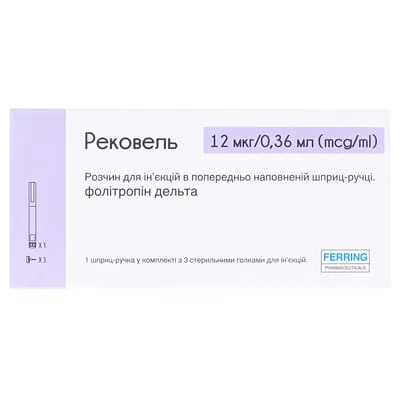
Table of Contents
INSTRUCTIONS FOR MEDICAL USE OF THE MEDICINAL PRODUCT REKOVELLE (REKOVELLE)
Composition:
Active substance: follitropin delta;
1 ml of solution for injection contains 33.3 µg of follitropin delta;
1 pre-filled pen injector contains:
12 µg of follitropin delta in 0.36 ml of solution for injection, or
36 µg of follitropin delta in 1.08 ml of solution for injection, or
72 µg of follitropin delta in 2.16 ml of solution for injection;
Excipients: phenol; polysorbate 20; L-methionine; sodium sulfate, decahydrate; sodium hydrogen phosphate, dodecahydrate; phosphoric acid, concentrated; sodium hydroxide; water for injections.
Pharmaceutical form. Solution for injection.
Main physicochemical characteristics: clear and practically free from visible particles solution.
Pharmacotherapeutic group. Agents affecting the genitourinary system and sex hormones. Gonadal hormones and drugs used in disorders of the reproductive system. Gonadotropic and other ovulation stimulants. Gonadotropic hormones. Follitropin delta. ATC code G03G A10.
Pharmacological properties.
Pharmacodynamics.
Follitropin delta is a recombinant human follicle-stimulating hormone (FSH) produced in the human cell line PER.C6 using recombinant DNA technology. The amino acid sequences of the two FSH subunits in follitropin delta are identical to those of endogenous human FSH. Because follitropin delta is produced in the human cell line PER.C6, its glycosylation profile differs from that of follitropin alfa and follitropin beta.
Mechanism of action
The most important effect achieved with parenteral administration of FSH is the development of multiple mature follicles.
Pharmacodynamic effects
After daily administration of equimolar doses of the medicinal product Rekovelle and follitropin alfa, as determined in an in vivo biological assay in rats (Steelman-Pohley assay), a more pronounced ovarian response (based on estradiol levels, inhibin B levels, and follicular volume) was observed following administration of Rekovelle compared to follitropin alfa. Since the biological assay in rats may not fully reflect the potency of FSH in Rekovelle in humans, Rekovelle is dosed in micrograms (μg), not in IU. Clinical study data indicate that a daily dose of Rekovelle 10.0 μg (95% CI: 9.2; 10.8) provides an ovarian response in most patients comparable to that achieved with 150 IU/day of follitropin alfa.
The number of oocytes suitable for retrieval increases with the dose of Rekovelle and with serum anti-Müllerian hormone (AMH) concentration. Conversely, increased body weight leads to a reduction in the number of oocytes suitable for retrieval (clinically relevant only at Rekovelle doses below 12 μg). An effective dosing regimen for Rekovelle is provided in the section "Posology and method of administration."
Clinical efficacy and safety
The ESTHER-1 study was a randomized, investigator-blinded, controlled trial involving 1,326 patients undergoing in vitro fertilization (IVF)/intracytoplasmic sperm injection (ICSI). In this study, an individualized dosing regimen of Rekovelle with a predetermined daily dose for each patient, fixed throughout the stimulation period without adjustment (see section "Posology and method of administration"), was compared to follitropin alfa dosed by body weight, with an initial dose of 11 μg (150 IU) for the first five days, followed by adjustment from day 6 of stimulation based on follicular development according to the gonadotropin-releasing hormone (GnRH) antagonist protocol. Patients were up to 40 years of age inclusive and had regular menstrual cycles considered to be ovulatory. Single blastocyst transfer on day 5 was mandatory, except for patients aged 38–40 years, who received two blastocyst transfers if no suitable quality blastocyst was available. The two co-primary endpoints were ongoing pregnancy rate and ongoing implantation rate in the fresh cycle, defined as at least one viable intrauterine fetus at 10–11 weeks after transfer, and the number of viable intrauterine fetuses at 10–11 weeks after transfer divided by the number of transferred blastocysts, respectively.
The study demonstrated that Rekovelle was at least as effective as follitropin alfa in terms of ongoing pregnancy rate and ongoing implantation rate (see Table 1).
Table 1. Ongoing pregnancy rate and ongoing implantation rate in the ESTHER-1 study
| Parameter |
Rekovelle, individualized dosing regimen (N = 665) |
Follitropin alfa (N = 661) |
Difference [95% CI] |
| Ongoing pregnancy rate |
30.7% |
31.6% |
-0.9% [-5.9%; 4.1%] |
| Ongoing implantation rate |
35.2% |
35.8% |
-0.6% [-6.1%; 4.8%] |
Population: all randomized patients who received treatment.
The impact of the Recormon dosing regimen on AMH levels was also evaluated in secondary endpoints such as ovarian response and risk management of ovarian hyperstimulation syndrome (OHSS).
In the overall study population, the mean number of oocytes suitable for retrieval was 10.0 ± 5.6 with Recormon (N = 636) using individualized dosing, and 10.4 ± 6.5 with follitropin alfa (N = 643) at a starting dose of 150 IU with subsequent dose adjustments.
In patients with AMH levels ≥ 15 pmol/L, ovarian response with Recormon (N = 355) and follitropin alfa (N = 353) was as follows: mean number of oocytes suitable for retrieval was 11.6 ± 5.9 and 13.3 ± 6.9, respectively, and the proportion of patients with ≥ 20 oocytes was 10.1% (36/355) and 15.6% (55/353), respectively.
In ovulatory patients with polycystic ovaries undergoing GnRH antagonist cycles, the incidence of moderate to severe early OHSS and/or preventive interventions due to early OHSS development was 7.7% with Recormon and 26.7% with follitropin alfa.
In a controlled study evaluating ovarian response with individualized dosing of Recormon in patients with AMH ≤ 35 pmol/L, the mean number of oocytes was 11.1 ± 5.9 in GnRH agonist cycles (N = 202) compared to 9.6 ± 5.5 in GnRH antagonist cycles (N = 204), and the mean duration of stimulation with Recormon was 10.4 ± 1.9 days in GnRH agonist cycles compared to 8.8 ± 1.8 days in GnRH antagonist cycles.
Safety/Immunogenicity
Antibodies to FSH were assessed before and after treatment in patients who received up to three repeated cycles of therapy with Recormon (665 patients in cycle 1 and 252 patients in cycle 2 in the ESTHER-1 study, and 95 patients in cycle 3 in the ESTHER-2 study). The incidence of anti-FSH antibodies after Recormon therapy was 1.1% in cycle 1, 0.8% in cycle 2, and 1.1% in cycle 3. These incidence rates were similar to the pre-treatment anti-FSH antibody incidence rate of 1.4% observed in cycle 1 and comparable to the incidence rates observed after treatment with follitropin alfa. In all patients with anti-FSH antibodies, titers were below the sensitivity threshold or very low and lacked neutralizing capacity. Repeated treatment with Recormon in patients with pre-existing or treatment-induced anti-FSH antibodies did not increase antibody titers, was not associated with reduced ovarian response, and did not cause immune-mediated adverse events.
There is no clinical trial experience with Recormon using a long GnRH agonist protocol.
Pharmacokinetics
The pharmacokinetic profile of follitropin delta was studied in healthy women and in patients undergoing controlled ovarian stimulation in IVF/ICSI cycles. After repeated daily subcutaneous injections of Recormon, steady state is reached within 6–7 days, with concentrations three times higher than after the first dose. Circulating levels of follitropin delta are inversely proportional to body weight, which justifies individualized dosing based on body weight. Follitropin delta demonstrates a more pronounced therapeutic effect compared to follitropin alfa.
Absorption
After daily subcutaneous administration of Recormon, maximum serum concentration is reached within 10 hours. Absolute bioavailability is approximately 64%.
Distribution
The apparent volume of distribution after subcutaneous administration is approximately 25 L, and the volume of distribution at steady state after intravenous administration is 9 L. Within the therapeutic dose range, exposure to follitropin delta increases proportionally with dose.
Elimination
After subcutaneous and intravenous administration, the apparent clearance of follitropin delta is 0.6 L/h and 0.3 L/h, respectively. Terminal half-life after single and multiple subcutaneous administrations is 40 hours and 28 hours, respectively. The apparent clearance of follitropin delta is low, at 0.6 L/h after multiple subcutaneous administrations, contributing to its pronounced therapeutic effect. Follitropin delta is predictably eliminated similarly to other follitropins, primarily via the kidneys. Approximately 9% of follitropin delta is excreted unchanged in urine.
Clinical characteristics.
Indications.
Controlled ovarian stimulation for the development of multiple follicles in women undergoing assisted reproductive technologies (ART), such as in vitro fertilization (IVF) or intracytoplasmic sperm injection (ICSI) cycles.
Contraindications.
- Hypersensitivity to the active substance or to any of the excipients listed in the section "Composition";
- tumors of the hypothalamus or pituitary gland;
- enlarged ovaries or ovarian cysts not related to polycystic ovary syndrome;
- gynecological bleeding of unknown etiology (see section "Special precautions");
- carcinoma of the ovaries, uterus, or breasts (see section "Special precautions").
Conditions that preclude achieving the treatment objective with the medicinal product Recogev:
- primary ovarian insufficiency;
- congenital abnormalities of the genital organs incompatible with pregnancy;
- uterine fibroids incompatible with pregnancy.
Interaction with other medicinal products and other forms of interaction.
Interaction studies with the medicinal product Recogev have not been conducted. During pituitary desensitization induced by a GnRH agonist (GnRH), prolonged stimulation, and therefore a higher total dose of Recogev, may be required to achieve an adequate follicular response. No clinically significant interactions with other medicinal products during therapy with Recogev have been reported, and such interactions are not expected.
Special precautions for use.
Traceability
To improve traceability of biological medicinal products, the name and batch number of the administered product should be clearly recorded in the patient's medical records.
The medicinal product Recovelle contains an active substance with potent gonadotropic activity, which may cause adverse reactions ranging from mild to severe. Therefore, this medicinal product should be prescribed only by physicians experienced in the management of infertility and its treatment.
Therapy with gonadotropins requires a significant time commitment from physicians and other healthcare professionals, as well as appropriate monitoring resources. The safety and efficacy of Recovelle require regular monitoring of ovarian response using either ultrasound alone or in combination with serum estradiol level assessments. The dose of Recovelle should be individually adjusted for each patient to achieve an ovarian response with a favorable safety/efficacy profile. Individual responses to FSH administration may vary significantly, ranging from poor response in some patients to excessive response in others.
Prior to initiating treatment, infertile couples should be evaluated for existing or potential contraindications to pregnancy. In particular, patients should be assessed for hypothyroidism and hyperprolactinemia, and appropriate specific treatment should be initiated if necessary.
For dose individualization of Recovelle, it is recommended to use results from AMH measurements performed with the ELECSYS AMH Plus assay by Roche, the ACCESS AMH Advanced assay by Beckman Coulter, or the LUMIPULSE G AMH assay by Fujirebio, as standardized methods for AMH determination are currently not available.
In patients undergoing follicular stimulation, ovarian enlargement may occur, and there is a risk of developing ovarian hyperstimulation syndrome (OHSS). Strict adherence to the recommended dose and administration schedule of Recovelle, along with careful monitoring of therapy, will reduce the frequency of such events.
Ovarian hyperstimulation syndrome (OHSS)
A certain degree of ovarian enlargement is an expected consequence of controlled ovarian stimulation. This phenomenon is most common in patients with polycystic ovary syndrome (PCOS) and usually resolves spontaneously without specific treatment. In contrast to uncomplicated ovarian enlargement, OHSS is a condition that may present with increasing severity. It includes significant ovarian enlargement, elevated serum sex steroid hormone levels, and increased vascular permeability, which may lead to fluid accumulation in the peritoneal, pleural, and rarely pericardial cavities.
Careful and frequent monitoring of follicular development is essential to reduce the risk of OHSS. In severe cases, symptoms of OHSS may include abdominal pain, discomfort, and a sensation of bloating, marked ovarian enlargement, weight gain, dyspnea, oliguria, and gastrointestinal symptoms such as nausea, vomiting, and diarrhea. Clinical examination may reveal hypovolemia, hemoconcentration, electrolyte imbalances, ascites, hemoperitoneum, pleural effusion, hydrothorax, or acute respiratory distress syndrome. Very rarely, severe OHSS may be complicated by ovarian torsion or thromboembolic events such as pulmonary embolism, ischemic stroke, or myocardial infarction.
If human chorionic gonadotropin (hCG) is not used to trigger final follicular maturation, excessive ovarian response to gonadotropin therapy rarely progresses to OHSS. Furthermore, the syndrome may have a more severe and prolonged course if pregnancy occurs. Therefore, if signs of ovarian hyperstimulation are present, administration of hCG should be postponed, and patients should be advised to abstain from sexual intercourse or use barrier contraception for at least 4 days. OHSS may rapidly progress (within 24 hours to several days) and become a serious medical condition. Early OHSS may occur within 9 days after triggering final follicular maturation. Late OHSS may develop as a consequence of hormonal changes during pregnancy, occurring 10 or more days after triggering final follicular maturation. Due to the risk of OHSS, patients should be monitored for at least two weeks following hCG administration.
Thromboembolic events
Women with recent or existing thromboembolic disorders, or those with generally accepted risk factors for thromboembolic events—such as personal or family history, severe obesity (body mass index > 30 kg/m²), or thrombophilia—may have an increased risk of venous and arterial thromboembolic events during or after gonadotropin therapy. Gonadotropin treatment may further increase the risk of exacerbation or occurrence of such events. In these women, the benefit of gonadotropin use should be carefully weighed against the risks. However, it should be noted that pregnancy itself, as well as OHSS, also increases the risk of thromboembolic events.
Ovarian torsion
Cases of ovarian torsion have been reported during ART cycles. This may be associated with other risk factors such as OHSS, pregnancy, previous abdominal surgery, history of ovarian torsion, or presence of ovarian cysts or polycystic ovaries. Tissue damage due to impaired blood flow can be minimized through early diagnosis and prompt surgical correction of torsion.
Multifetal pregnancy
Multifetal pregnancy carries an increased risk of adverse maternal and perinatal outcomes. In patients undergoing ART procedures, the risk of multifetal pregnancy is primarily related to the number and quality of embryos transferred and the patient's age. However, twin pregnancy may rarely occur even after single embryo transfer. Patients should be informed about the potential risk of multifetal pregnancy prior to initiating treatment.
Pregnancy loss
In patients undergoing controlled ovarian stimulation as part of ART, the rate of pregnancy loss due to miscarriage or abortion is higher than after natural conception.
Ectopic pregnancy
Women with a history of tubal disease are at increased risk of ectopic pregnancy, regardless of whether conception occurs spontaneously or following infertility treatment. The incidence of ectopic pregnancy has been reported to be higher after ART compared to the general population.
Reproductive system neoplasms
Cases of both benign and malignant neoplasms of the ovaries and other reproductive organs have been reported in women who have undergone multiple infertility treatment regimens. It remains unclear whether gonadotropin therapy increases the risk of developing such tumors in infertile women.
Congenital malformations
The prevalence of congenital malformations after ART may be slightly higher than after spontaneous conception. This is believed to be due to differences in parental characteristics (e.g., maternal age, sperm quality) and multifetal pregnancies.
Other medical conditions
Medical conditions that are contraindications to pregnancy should also be evaluated before initiating treatment with Recovelle.
Renal and hepatic impairment
The use of Recovelle has not been studied in patients with moderate to severe renal or hepatic impairment.
Sodium content
Recovelle contains less than 1 mmol sodium (23 mg) per dose and is therefore essentially "sodium-free."
Use during pregnancy or breastfeeding.
Pregnancy
Recovelle is not indicated during pregnancy. After clinical use of gonadotropins for controlled ovarian stimulation, no teratogenic risk has been reported. Data on accidental use of Recovelle in pregnant women are lacking. Reproductive toxicity of Recovelle has been demonstrated in animal studies at doses exceeding the recommended maximum human dose. The clinical relevance of these findings for the use of Recovelle in humans is limited.
Breastfeeding
Recovelle is not indicated during breastfeeding.
Reproductive function
Recovelle is indicated in infertility (see section "Indications").
Effects on ability to drive and use machines.
Recovelle has no effect or has a negligible effect on the ability to drive vehicles or operate machinery.
Method of administration and dosage.
Treatment with the medicinal product Recovelle should be initiated under the supervision of a physician experienced in the management of reproductive disorders.
Dosage
The dosage of Recovelle is individual for each patient and aims to achieve an ovarian response with a favorable safety/efficacy profile, i.e., to obtain a sufficient number of oocytes suitable for retrieval while minimizing interventions to prevent OHSS. Recovelle is dosed in micrograms (mcg) (see section "Pharmacodynamics"). The dosing regimen is specific to Recovelle, and the dose in micrograms (mcg) cannot be applied interchangeably to other gonadotropins.
For the first treatment cycle, the individual daily dose should be determined based on the patient’s serum AMH level and body weight. The dose should be calculated using a recently measured AMH level (i.e., within the last 12 months) obtained by one of the following diagnostic assays: the ELECSYS AMH Plus immunoassay by Roche (the assay used in clinical development studies), or alternatively, the ACCESS AMH Advanced by Beckman Coulter, or the LUMIPULSE G AMH by Fujirebio (see section "Special precautions for use"). The individual daily dose should be maintained throughout the entire stimulation period. For women with an AMH level < 15 pmol/L, the daily dose is 12 mcg, regardless of body weight. For women with an AMH level ≥ 15 pmol/L, the daily dose decreases from 0.19 to 0.10 mcg/kg as AMH concentration increases (see Table 2). The dose should be rounded to the nearest multiple of 0.33 mcg to correspond to the dosing scale on the pen device. The maximum daily dose for the first treatment cycle is 12 mcg.
To calculate the Recovelle dosage, body weight should be measured immediately before the start of stimulation. When measuring body weight, the patient should remove shoes and outer clothing.
Table 2. Dosing regimen
| AMH level (pmol/L) |
< 15 |
15–16 |
17 |
18 |
19–20 |
21–22 |
23–24 |
25–27 |
28–32 |
33–39 |
≥ 40 |
| Fixed daily dose of Recovelle medicinal product |
12 |
0.19 |
0.18 |
0.17 |
0.16 |
0.15 |
0.14 |
0.13 |
0.12 |
0.11 |
0.10 |
| mcg |
mcg/kg |
||||||||||
Notes: mcg – micrograms.
AMH concentration is expressed in pmol/L and should be rounded to the nearest whole number. If AMH concentration is expressed in ng/mL, this value should be converted to pmol/L by multiplying by 7.14 (ng/mL × 7.14 = pmol/L) before determining the dosage.
The timing of treatment initiation with Recovelle depends on the type of protocol:
- In a gonadotropin-releasing hormone (GnRH) antagonist protocol, treatment should begin on day 2 or 3 of menstrual bleeding;
- In a protocol involving down-regulation using a GnRH agonist, treatment should begin approximately 2 weeks after starting the agonist.
Treatment should continue until adequate follicular development is achieved (≥ 3 follicles ≥ 17 mm), which typically occurs on day 9 or 10 of treatment (range: 5–20 days). A single dose of 250 mcg recombinant hCG or 5,000 IU hCG should be administered to trigger final follicular maturation. Treatment with Recovelle should be discontinued and final follicular maturation with hCG should not be performed in patients with excessive follicular development (≥ 25 follicles ≥ 12 mm).
For subsequent treatment cycles, the daily dose of Recovelle should be maintained or adjusted based on the patient’s ovarian response in the previous cycle. If an appropriate ovarian response was achieved in the previous cycle without ovarian hyperstimulation syndrome (OHSS), the same daily dose should be used. In case of an inadequate ovarian response in the previous cycle, the daily dose in the next cycle should be increased by 25% or 50%, depending on the degree of observed response. In case of excessive ovarian response in the previous cycle, the daily dose in the next cycle should be reduced by 20% or 33%, depending on the degree of observed response. For patients who developed OHSS or were at risk of OHSS in the previous cycle, the daily dose in the next cycle should be reduced by 33% compared to the dose at which OHSS or OHSS risk occurred. The maximum daily dose is 24 mcg.
Patients with renal or hepatic impairment
The safety, efficacy, and pharmacokinetics of Recovelle in patients with renal or hepatic impairment have not been specifically studied in clinical trials. Limited data do not indicate a need for an alternative dosing regimen of Recovelle in this patient population (see section "Special precautions for use").
Patients with polycystic ovary syndrome and anovulatory disorders
The use of Recovelle in women with anovulation and polycystic ovary syndrome has not been studied. Clinical trials were conducted in patients with ovulation and polycystic ovary syndrome (see section "Pharmacodynamics").
Patients with AMH > 35 pmol/L
Patients with potentially high response (AMH level > 35 pmol/L) were not studied in a protocol involving down-regulation using a GnRH agonist.
Elderly patients
There are no relevant indications for the use of Recovelle in elderly patients.
Method of administration
Recovelle is intended for subcutaneous injection, preferably in the abdominal wall area. The first injection should be performed under direct supervision of a healthcare professional. Patients should be trained in the correct use of the Recovelle pen-injector and in performing injections. Self-injection may only be performed by well-motivated, properly trained patients who have access to medical consultation if needed.
INSTRUCTIONS
for using the pre-filled Recovelle pen-injector
Before you perform your first injection, a healthcare professional should show you how to properly prepare and administer Recovelle.
Do not attempt to perform the injection yourself until a healthcare professional has shown you the correct procedure.
Before using the pre-filled Recovelle pen-injector and each time before starting a new pen-injector, read these instructions thoroughly. They may contain new information. Follow these instructions carefully, even if you have previously used a similar pen-injector. Incorrect use of this pen-injector may result in administration of an incorrect dose of the medicinal product.
Contact a healthcare professional if you have any questions about administering Recovelle injections.
The pre-filled Recovelle pen-injector is a single-use, dose-measuring pen-injector that can be used to administer more than one dose of Recovelle. This pen-injector is available in three different strengths:
- 12 mcg/0.36 mL;
- 36 mcg/1.08 mL;
- 72 mcg/2.16 mL.
Components of the pre-filled Recovelle pen-injector
Important information
- The pre-filled Recovelle pen-injector and needles are intended for use by only one person and should not be shared with others.
- This pen-injector should only be used as prescribed and strictly according to instructions provided by a healthcare professional.
- If you have complete or partial vision loss and cannot read the dose scale on the pen-injector, do not use this pen-injector without assistance. Administration is possible with the help of a person with good vision who has been trained to use this pen-injector.
- If you have any questions before administering Recovelle, consult a healthcare professional.
Information about the pre-filled Recovelle pen-injector
This pen-injector allows measuring doses of Recovelle ranging from 0.33 mcg to 20 mcg, with increments of 0.33 mcg. See "Examples of dose measurement."
- The dose scale on this pen-injector is numbered from 0 to 20 mcg.
- Each number is separated by two divisions. Each division corresponds to a 0.33 mcg increase in the measured dose.
- When turning the dose selector, you will hear a click and feel resistance with each dose increment, allowing accurate dose measurement.
Cleaning
- If necessary, the outer surface of the pen-injector may be cleaned with a cloth moistened with water.
- Do not immerse this pen-injector in water or any other liquid.
Storage
- This pen-injector should always be stored with its cap on and the needle detached.
- Do not use this pen-injector after the expiration date ("Exp.") indicated on the pen-injector label.
- Do not store the pen-injector under extreme temperatures, direct sunlight, or very low temperatures, such as in a car or freezer.
- Store the pen-injector out of reach of children and any person not trained to use this pen-injector.
Before use:
- Store the pen-injector in the refrigerator at 2 to 8 °C. Do not freeze.
- Storage of the pen-injector outside the refrigerator (at 2 to 25 °C) may last up to 3 months, including the period of use. Discard (dispose of) the pen-injector after 3 months if it has not been used.
After first use (period of use):
- This pen-injector may be stored for up to 28 days at a temperature not exceeding 25 °C. Do not freeze.
Materials required for Recovelle injection
Before administration (step 1)
Step 1:
- Wash hands.
- Inspect the pen-injector to ensure it is not damaged. Do not use the pen-injector if it is damaged.
- Inspect the pen-injector (cartridge) to ensure the medicinal product is clear and free of particles. Do not use the pen-injector if the medicinal product in the cartridge contains particles or is not clear.
- Ensure you have the correct pen-injector with the correct strength.
- Check the expiration date on the pen-injector label.
Attaching the needle (steps 2 to 6)
Important:
- Always use a new needle for each injection.
- Use only disposable needles supplied with the pen-injector.
Step 2:
- Remove the pen-injector cap.
Step 3:
- Remove the protective foil from the needle.
Step 4:
- Attach the needle.
- A click indicates the needle is securely attached.
- The needle may also be screwed on. A slight resistance indicates the needle is securely attached.
Step 5:
- Remove the outer needle cap.
- Do not discard the outer needle cap. It will be needed for needle disposal after the Recovelle injection.
Step 6:
- Remove the inner needle cap and discard it.
Priming (steps 7 to 9)
- Before first use of the pen-injector, air bubbles must be removed from the cartridge (priming) to ensure accurate dosing.
- Priming is performed only before the first use of the pen-injector.
- Perform steps 7 to 9 even if no air bubbles are visible.
- If the pen-injector has already been used, proceed to step 10.
Step 7:
- Turn the dose selector clockwise until the dose indicator points to the "drop" symbol.
- If an incorrect dose is set for priming, it can be corrected without loss of medicinal product by turning the dose selector in either direction until the dose indicator points to the "drop" symbol.
Step 8:
- Hold the pen-injector with the needle pointing upward.
- Tap the cartridge holder gently with a finger to move air bubbles to the top, upper part of the cartridge.
Step 9:
- While still holding the pen-injector with the needle pointing upward (not toward the face), fully press the dose injection button until the dose indicator points to "0".
- Ensure a drop of liquid appears at the needle tip.
- If no drop appears, repeat steps 7 to 9 (priming) until a drop appears.
- If no drop appears after 5 attempts, remove the needle (see step 13), attach a new needle (see steps 3 to 6), and repeat priming (see steps 7 to 9).
- If no drop appears after using a new needle, use a new pen-injector.
Dose setting (step 10)
See Table 3. Examples of dose measurement.
Step 10:
- Turn the dose selector clockwise until the dose indicator points to the prescribed dose in the dose display window.
- The dose can be adjusted higher or lower without loss of medicinal product by turning the dose selector in either direction until the dose indicator points to the correct dose.
- Do not press the dose injection button while setting the dose to avoid loss of medicinal product.
Administering a split dose:
- More than one pen-injector may be needed to administer the prescribed dose.
- If the full dose cannot be set, this means there is insufficient medicinal product remaining in the pen-injector. A split dose should be administered, or the current pen-injector should be discarded (disposed of) and a new one used to perform the injection.
See the section below "Administering a split dose of Recovelle" for examples of calculating and recording a split dose.
Administering the dose (steps 11 to 12)
Important:
- Do not use the pen-injector if the medicinal product contains particles or is not clear.
- Before performing the injection, review steps 11 and 12.
- This medicinal product should be administered only by subcutaneous injection in the abdominal area.
- Changing the injection site with each injection reduces the risk of skin reactions such as redness and irritation.
- Do not inject into areas that are painful (tender), bruised, red, hardened, scarred, or stretched.
Steps 11 and 12:
- Clean the injection site with an alcohol swab. Do not touch this area until the injection is performed.
- Hold the pen-injector so that the dose display window is visible during injection.
- Pinch the skin and insert the needle into the skin at a right angle, as instructed by the healthcare professional. Do not press the dose injection button.
- After needle insertion, place the index finger on the dose injection button.
- Fully press and hold the dose injection button.
- Continue holding the dose injection button pressed even after the dose indicator points to "0", wait 5 seconds (count slowly to 5) to ensure the full dose is administered.
- After holding the dose injection button pressed for 5 seconds, release it. Then slowly withdraw the needle from the injection site, pulling it out of the skin at a right angle.
- If bleeding occurs at the injection site, gently press a gauze pad or cotton ball against the injection site.
Note:
- Do not tilt the pen-injector during injection or needle removal.
- Tilting the pen-injector may cause bending or breaking of the needle.
- If a broken needle remains in the body, seek immediate medical assistance.
Needle disposal (step 13)
Step 13:
- Carefully place the outer needle cap back onto the needle, pressing firmly (A).
- Unscrew the needle counterclockwise to detach it from the pen-injector (B+C).
- Carefully dispose of the used needle (D).
- See the section "Disposal" below.
Note:
- After each use, the needle should always be disposed of. These needles are intended for single use only.
- Do not store the pen-injector with the needle attached.
Replacing the pen-injector cap (step 14)
Step 14:
- Carefully replace the pen-injector cap to protect it between injections.
Note:
- The pen-injector cap cannot be placed over the needle.
- If administering a split dose, discard (dispose of) the empty pen-injector.
- If a new pen-injector is used to administer the full prescribed dose instead of administering a split dose, discard (dispose of) the pen-injector with insufficient medicinal product for the full dose.
- If the pen-injector is not in use, the pen-injector cap should be placed on it.
Disposal
Needles:
Immediately after use, place the needle in a puncture-resistant container, such as a sharps container. Do not dispose of (discard) the container with used sharps in household waste.
If a sharps container is not available, a household container may be used provided it:
- is made of sturdy plastic;
- can be tightly closed with a puncture-resistant lid, preventing sharps from escaping;
- has a stable upright position during use;
- is leak-proof;
- is properly labeled as hazardous waste.
When the sharps container is nearly full, it should be disposed of according to local requirements.
Pre-filled Recovelle pen-injectors:
- Dispose of used pen-injectors according to local requirements.
Examples of dose measurement
Examples of dose measurement using the pre-filled Recovelle pen-injector
The table below (Table 3) provides examples of prescribed doses, how to set them, and the appearance of the dose display window for the prescribed doses.
Table 3. Examples of dose measurement
| Examples of set doses (in micrograms) |
Dose measurement on the pen |
Dose display window |
| 0.33 |
0 and 1 increment (dial to 0 plus 1 click) |
|
| 0.66 (priming dose) |
0 and 2 increments (dial to 0 plus 2 clicks) |
|
| 2.33 |
2 and 1 increment (dial to 2 plus 1 click) |
|
| 11.00 |
11 (dial to 11) |
|
| 12.33 |
12 and 1 increment (dial to 12 plus 1 click) |
|
| 18.66 |
18 and 2 increments (dial to 18 plus 2 clicks) |
|
| 20.00 |
20 (dial to 20) |
Administration of a split dose of Recovelle
If the entire prescribed dose cannot be measured, this means there is insufficient medication remaining in the pen. You should administer part of the prescribed dose using the current pen, and the remainder of the prescribed dose using a new pen (split-dose administration). Alternatively, you may discard (dispose of) the current pen and use a new pen to administer the entire prescribed dose in a single injection. If you decide to administer a split dose, follow these instructions and record the administered dose in the dose-splitting diary (see Table 4).
- Column A provides examples of prescribed doses. You must enter your prescribed dose in Column A.
- Column B provides examples of the dose remaining in the pen (corresponding to the dose that can be measured).
- You must enter in Column B the dose remaining in the pen. Administer the injection of the dose remaining in the pen.
- Prepare a new pen and perform the initial filling (Steps 1 to 9).
- Calculate and enter in Column C the remaining dose to be administered by subtracting the value in Column B from the value in Column A. Use a calculator to verify the calculation, if necessary.
- If needed, refer to "Examples of dose measurement."
- Doses should be rounded to the nearest measurable value: X.00, X.33, or X.66 mcg. For example, if the number in Column C is 5.34, the remaining dose is rounded down to 5.33. If the number in Column C is 9.67, the remaining dose is rounded down to 9.66.
- If you have any questions about calculating the split dose, consult your healthcare provider.
- Administer the remaining dose (the number in Column C) using the new pen to complete administration of the prescribed dose.
Table 4. Dose-Splitting Diary
| A Prescribed dose |
B Dose remaining in the pen (dose indicated by the dose indicator in the dose display window) |
C = A minus B Dose to be administered with a new pen (dose indicated by the dose indicator in the dose display window) |
| 11.33 |
4.00 (4) |
7.33 (7 and 1 increment (measure 7 plus 1 click)) |
| 12.66 |
12.33 (12 and 1 increment (12 plus 1 click)) |
0.33 (0 and 1 increment (measure 0 plus 1 click)) |
| 11.00 |
3.00 (3) |
8.00 (8 (measure 8)) |
| 12.00 |
6.66 (6 and 2 increments (6 plus 2 clicks)) |
Round 5.34 to 5.33 (5 and 1 increment (measure 5 plus 1 click)) |
| 18.33 |
8.66 (8 and 2 increments (8 plus 2 clicks)) |
Round 9.67 to 9.66 (9 and 2 increments (measure 9 plus 2 clicks)) |
Children.
There are no established indications for the use of Recovelle in children.
Overdose.
The effects of overdose are unknown; however, there is a risk of developing serotonin syndrome (see section "Special warnings and precautions for use").
Adverse reactions.
Summary of safety profile
During treatment with the medicinal product Recovelle, the most frequently reported adverse reactions were gastrointestinal disorders, headache, pelvic pain, nausea, and fatigue. The frequency of these adverse reactions may decrease with repeated treatment cycles, as observed in clinical studies.
List of adverse reactions in tabular form
The table below (Table 5) lists adverse reactions observed during clinical studies in patients who received therapy with the medicinal product Recovelle using the algorithm-based dosing regimen.
Within each frequency category, adverse reactions are listed in order of decreasing severity.
Table 5. Adverse reactions in pivotal clinical studies
| System organ class |
Common (from ≥ 1/100 to < 1/10) |
Uncommon (from ≥ 1/1,000 to <1/100) |
| Psychiatric disorders |
Mood changes |
|
| Nervous system disorders |
Headache |
Somnolence Dizziness |
| Gastrointestinal disorders |
Nausea |
Diarrhea Vomiting Constipation Abdominal discomfortа |
| Reproductive system and breast disorders |
Amenorrhea Pelvic painb |
Vaginal bleeding Breast discomfortv |
| General disorders and administration site conditions |
Fatigue |
a Abdominal discomfort includes abdominal pain/bloating.
b Pelvic pain includes discomfort in the pelvic area and adnexal pain.
c Breast discomfort includes breast pain, breast tenderness, breast swelling, and/or nipple pain.
Description of selected adverse reactions
OHSS is an inherent risk of ovarian stimulation. Known gastrointestinal symptoms associated with OHSS include pain, discomfort, and a sensation of abdominal distension, nausea, vomiting, and diarrhea. Ovarian torsion and thromboembolic events are rare complications of ovarian stimulation (see section "Dosage and Administration").
The formation of antibodies to FSH is a potential risk of gonadotropin therapy (see section "Pharmacodynamics").
Reporting suspected adverse reactions
Reporting of suspected adverse reactions after authorization of the medicinal product is important. It allows continued monitoring of the benefit-risk balance of the medicinal product. Medical and pharmaceutical professionals, as well as patients or their legal representatives, should report any suspected adverse reactions and lack of efficacy of the medicinal product via the Automated Information System for Pharmacovigilance at the following link: https://aisf.dec.gov.ua
Shelf life.
3 years.
Shelf life after first use: 28 days, provided the product is stored at a temperature not exceeding 25 °C.
Storage conditions.
Store in a refrigerator (2–8 °C). Do not freeze.
Keep out of the reach of children.
Prior to first use, store in the original packaging to protect from light.
The medicinal product may be removed from the refrigerator and stored at a temperature not exceeding 25 °C for up to 3 months without re-refrigeration, including the period after first use.
After this period, the medicinal product must be discarded.
Packaging.
12 mcg/0.36 mL solution for injection
A 3 mL multi-dose glass cartridge (Type I glass) with a plunger made of bromobutyl rubber and an aluminum crimp cap with a rubber liner, placed into a pen-injector. One pen-injector with 3 sterile injection needles (stainless steel) in a cardboard box.
36 mcg/1.08 mL solution for injection
A 3 mL multi-dose glass cartridge (Type I glass) with a plunger made of bromobutyl rubber and an aluminum crimp cap with a rubber liner, placed into a pen-injector. One pen-injector with 9 sterile injection needles (stainless steel) in a cardboard box.
72 mcg/2.16 mL solution for injection
A 3 mL multi-dose glass cartridge (Type I glass) with a plunger made of bromobutyl rubber and an aluminum crimp cap with a rubber liner, placed into a pen-injector. One pen-injector with 15 sterile injection needles (stainless steel) in a cardboard box.
Prescription category.
Prescription only.
Manufacturer.
Ferring GmbH
(responsible for batch release and quality control (chemical and dosing accuracy)).
Manufacturer's address and location of operations.
Wittenring 11, 24109 Kiel, Germany.