Propanorm
Ukraine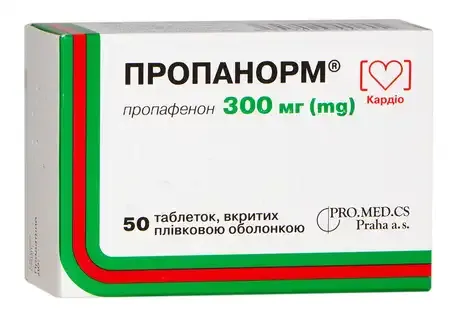
Table of Contents
INSTRUCTIONS FOR MEDICAL USE OF THE MEDICINAL PRODUCT PROPANORM® (PROPANORM®)
Composition:
Active ingredient: propafenone hydrochloride;
1 tablet contains 150 mg or 300 mg of propafenone hydrochloride;
Excipients: microcrystalline cellulose, sodium croscarmellose, sodium lauryl sulfate, maize starch, copovidone, magnesium stearate, OPADRY WHITE 02F 28310 (hypromellose, titanium dioxide (E 171), polyethylene glycol), simethicone emulsion.
Pharmaceutical form. Film-coated tablets.
Main physicochemical properties: almost white, film-coated, biconvex tablets, approximately 8 mm in diameter (150 mg tablets) and approximately 11 mm in diameter (300 mg tablets).
Pharmacotherapeutic group. Drugs for treatment of heart diseases. Antiarrhythmic agents of class IC. Propafenone. ATC code C01BC03.
Pharmacological properties.
Pharmacodynamics.
Propafenone is a class IC antiarrhythmic agent.
It exerts a stabilizing effect on myocardial membranes, reducing the fast inward current carried by sodium ions, thereby decreasing the rate of depolarization and prolonging conduction time through the atria, AV node, and primarily through the His-Purkinje conduction system.
Conduction through accessory pathways, as seen in WPW syndrome (Wolff-Parkinson-White syndrome), is suppressed due to prolongation of the refractory period or blockage of the conduction pathway in both anterograde and predominantly retrograde directions.
Additionally, spontaneous excitability is reduced due to increased threshold of myocardial sensitivity, while electrical excitability of the myocardium is decreased by raising the ventricular fibrillation threshold.
Antiarrhythmic effects include: slowing of the rate of rise of the action potential, reduced excitability, homogenization of conduction coefficient, suppression of ectopic automaticity, and decreased myocardial susceptibility to fibrillation.
Propafenone has mild beta-sympatholytic activity without clinical significance. However, there is a possibility that high daily doses (900–1200 mg) may produce a sympatholytic (antiadrenergic) effect.
On ECG, propafenone causes slight prolongation of P, PR, and QRS intervals, whereas the QTc interval usually remains unchanged.
In digitalized patients with ejection fraction of 35–50%, left ventricular contractility is slightly reduced. In patients with acute transmural myocardial infarction and heart failure, intravenous administration of propafenone may significantly reduce left ventricular ejection fraction, although this effect is considerably less pronounced in patients with acute myocardial infarction not accompanied by heart failure. In both cases, pulmonary artery pressure increases minimally. Peripheral arterial pressure shows no significant changes. This demonstrates that propafenone does not cause clinically significant negative effects on left ventricular function. Clinically significant reduction in left ventricular function should be expected only in patients with pre-existing impaired ventricular function.
Therefore, untreated heart failure may further deteriorate, potentially leading to decompensation.
Pharmacokinetics.
Propafenone is a racemic mixture of S- and R-propafenone.
Absorption
Maximum plasma concentration is reached within 2–3 hours after administration of propafenone hydrochloride. Propafenone undergoes extensive, dose- and formulation-dependent presystemic biotransformation (CYP2D6-dependent first-pass effect in the liver), resulting in dose- and formulation-dependent absolute bioavailability. Although in a single-dose study food intake increased the maximum plasma concentration and bioavailability of the drug, repeated dosing in healthy volunteers showed that food intake did not lead to significant changes in bioavailability.
Distribution
Propafenone is rapidly distributed. The volume of distribution at steady state ranges from 1.9 to 3.0 L/kg. The extent of propafenone binding to plasma proteins depends on its concentration and decreases from 97.3% at a concentration of 0.25 µg/mL to 81.3% at 100 µg/mL.
Biotransformation and elimination
There are two genetically determined pathways of propafenone metabolism. In more than 90% of patients, the drug undergoes rapid and extensive metabolism with an elimination half-life of 2 to 10 hours (extensive metabolizers). In these patients, metabolic transformation of propafenone leads to the formation of two active metabolites: 5-hydroxypropafenone, formed via CYP2D6, and N-depropylpropafenone (norpropafenone), formed via CYP3A4 and CYP1A2. In less than 10% of patients (poor metabolizers), propafenone metabolism is slower, with little or no formation of the 5-hydroxy metabolite. The calculated elimination half-life of propafenone is 2–10 hours in extensive metabolizers and 10–32 hours in poor metabolizers. Propafenone clearance ranges from 0.67 to 0.81 L/h/kg.
Since steady-state concentration of propafenone hydrochloride is achieved within 3–4 days of treatment, the recommended dosing regimen for propafenone is the same for all patients regardless of metabolic type (i.e., both poor and extensive metabolizers).
Linearity/non-linearity
The saturated hydroxylation metabolic pathway (CYP2D6-dependent) in extensive metabolizers leads to non-linear pharmacokinetics of the drug. In poor metabolizers, propafenone pharmacokinetics are linear.
Inter- and intra-individual variability
Propafenone hydrochloride pharmacokinetics are characterized by considerable inter-individual variability, largely due to the first-pass liver effect and non-linear pharmacokinetics in extensive metabolizers. The substantial variability in drug plasma concentrations among patients necessitates careful dose titration, during which clinical and electrocardiographic signs of toxicity must be closely monitored.
Elderly patients
Propafenone exposure levels in elderly patients with normal renal function were highly variable but did not significantly differ from those observed in healthy young volunteers. Exposure to 5-hydroxypropafenone was similar in elderly patients, but exposure to propafenone glucuronides doubled.
Renal impairment
In patients with impaired renal function, propafenone and 5-hydroxypropafenone exposure levels were similar to those in healthy control volunteers, but accumulation of propafenone glucuronide metabolites was observed.
Propafenone hydrochloride should be administered with caution in patients with renal disease.
Hepatic impairment
In patients with impaired liver function, oral bioavailability of propafenone increases and the elimination half-life is prolonged. Therefore, patients with liver disease require dose adjustment.
Clinical characteristics.
Indications.
Prevention and treatment of:
- ventricular arrhythmias;
- paroxysmal supraventricular tachyarrhythmias, including paroxysmal atrial flutter/fibrillation and paroxysmal re-entrant tachycardias involving the AV node or accessory conduction pathways, when standard therapy is ineffective or contraindicated.
Contraindications.
- Hypersensitivity to propafenone hydrochloride or to any other component of the medicinal product listed in the section "Composition".
- Diagnosed Brugada syndrome (see "Special precautions").
- Myocardial infarction within the last 3 months.
- Significant organic heart disease, such as:
- uncontrolled congestive heart failure (left ventricular ejection fraction < 35%);
- cardiogenic shock (if not caused by arrhythmia);
- severe symptomatic bradycardia;
- sinus node dysfunction, atrial conduction disturbances, second-degree or higher AV block, bundle branch block or distal conduction block in the absence of a pacemaker;
- severe arterial hypotension.
- Manifest electrolyte disturbances (e.g. disturbances in potassium metabolism).
- Severe obstructive lung diseases.
- Concomitant use with ritonavir.
- Myasthenia gravis.
- Severe hepatic impairment.
Interaction with other medicinal products and other forms of interaction.
Adverse effects of propafenone hydrochloride may be potentiated when used concomitantly with local anesthetics (e.g. during pacemaker implantation, surgical procedures or dental treatments) or with other agents that suppress heart rate and/or myocardial contractility (e.g. beta-blockers, tricyclic antidepressants).
In a study involving 8 healthy volunteers who received propafenone and warfarin simultaneously, mean steady-state plasma concentrations of warfarin increased by 39%, with a corresponding 25% increase in prothrombin time. Careful monitoring of coagulation is required when propafenone is used concomitantly with oral anticoagulants (e.g. phenprocoumon, warfarin, acenocoumarol), as propafenone may enhance their effect, increasing prothrombin time. Doses of anticoagulants should be reduced accordingly if signs of overdose occur.
Concomitant use of propafenone hydrochloride with medicinal products metabolized by CYP2D6 (such as venlafaxine) may lead to increased concentrations of these drugs. Increased plasma or blood concentrations have been reported for propranolol, metoprolol, desipramine, cyclosporine, theophylline (with development of theophylline toxicity), and digoxin when used concomitantly with propafenone hydrochloride. Doses of these medicinal products should be reduced accordingly if signs of overdose are observed.
Medicinal products that inhibit CYP2D6, CYP1A2, and CYP3A4, such as ketoconazole, cimetidine, quinidine, erythromycin, and grapefruit juice, may lead to increased blood levels of propafenone hydrochloride. Patients receiving propafenone hydrochloride together with inhibitors of these enzymes should be closely monitored, and the dose should be adjusted accordingly.
Combination therapy with amiodarone and propafenone hydrochloride may impair conduction and repolarization and may cause potentially proarrhythmic disturbances. Depending on the therapeutic effect, dose adjustments of both agents may be necessary.
No significant effect on the pharmacokinetics of propafenone or lidocaine was observed after their concomitant administration to patients. However, concomitant use of propafenone hydrochloride and lidocaine has been reported to increase the risk of lidocaine-related central nervous system adverse effects.
Phenobarbital is a known inducer of CYP3A4. During prolonged concomitant use of phenobarbital, clinical response to propafenone therapy should be monitored.
Combined use of propafenone hydrochloride and rifampicin may reduce the antiarrhythmic effect of propafenone due to decreased plasma concentrations (risk of sudden arrhythmias).
Increased plasma levels of propafenone may occur when used concomitantly with selective serotonin reuptake inhibitors such as fluoxetine and paroxetine. Concomitant use of propafenone hydrochloride and fluoxetine in extensive metabolizers increased Cmax (maximum plasma concentration) and AUC (area under the pharmacokinetic curve) of S-propafenone by 39% and 50%, respectively, and Cmax and AUC of R-propafenone by 71% and 50%, respectively. Lower doses of propafenone may be sufficient to achieve the desired therapeutic effect.
Propafenone should be used with caution together with herbal products that modulate cytochrome P450, such as St. John's wort.
Special precautions for use.
Cardiovascular system. Propafenone, like other antiarrhythmic agents, may cause proarrhythmic effects; that is, it may induce new arrhythmias or worsen existing ones (see "Adverse reactions"). It is important that each patient undergoes electrocardiographic and clinical evaluation before and during therapy with propafenone hydrochloride to assess clinical efficacy and the need for continued treatment.
The weak negative inotropic effect of propafenone hydrochloride may be significant in patients at risk of developing heart failure.
Propafenone use may unmask Brugada syndrome or induce Brugada-type ECG changes in individuals with asymptomatic manifestations of this syndrome. An ECG should be performed after initiation of propafenone therapy to rule out changes indicative of Brugada syndrome.
Propafenone hydrochloride may alter the stimulation threshold and sensitivity of implanted cardiac pacemakers. In patients with pacemakers, device function should be checked and, if necessary, reprogrammed.
There is a potential risk of conversion of paroxysmal atrial fibrillation into atrial flutter with 2:1 or 1:1 conduction (see "Adverse reactions").
As with other class IC antiarrhythmic agents, patients with significant organic heart disease may be predisposed to serious adverse reactions. Therefore, propafenone hydrochloride is contraindicated in such patients (see "Contraindications").
Propafenone slows cardiac conduction, which may lead to dose-dependent prolongation of the PR interval and QRS complex, development of first-degree or higher atrioventricular block, bundle branch block, or intraventricular conduction delay (see "Adverse reactions"). Thus, if signs of increased depression of cardiac conduction occur during treatment with propafenone, the dose should be reduced or the drug discontinued.
Blood system. Rarely, during the first 4–6 weeks of treatment with propafenone, agranulocytosis has been reported, presenting with symptoms such as fever, weakness, malaise, and signs of infection. If leukopenia occurs or if signs and symptoms of agranulocytosis or granulocytopenia appear, propafenone treatment must be discontinued immediately. Recovery of blood cell counts usually occurs within the following two weeks after discontinuation of the drug.
Hepatobiliary system. Propafenone hydrochloride should be used with caution in patients with impaired liver function. Dose titration should be performed under ECG monitoring and clinical supervision. Elevations in liver enzymes, hepatitis, and cholestasis have also been observed (see "Adverse reactions"). Drug accumulation is possible in patients with hepatic impairment.
Immune system. During long-term studies, positive titers of antinuclear antibodies (ANA) have been detected in some patients receiving propafenone, and one case of lupus-like syndrome has been reported. Therefore, patients with pathological ANA test results or elevated ANA titers should discontinue therapy.
Renal system. In patients with impaired renal function, drug accumulation may occur when standard therapeutic doses are administered; therefore, propafenone should be used with caution in patients with renal insufficiency.
Reproductive system. In some patients during clinical evaluation, decreased sperm count, follicle-stimulating hormone, and testosterone levels have been observed.
Other. Due to the beta-blocking effect of propafenone, caution should be exercised when treating patients with obstructive respiratory diseases, such as asthma.
This medicinal product contains less than 1 mmol sodium (23 mg) per tablet, i.e., is essentially "sodium-free".
Use during pregnancy or breastfeeding.
Pregnancy. Animal studies have not shown teratogenic effects. Adequate and well-controlled studies on the use of this medicinal product during pregnancy are lacking; therefore, Propanorm**®** should be used during pregnancy only if the potential benefit justifies the potential risk to the fetus. It is known that propafenone hydrochloride crosses the human placental barrier. Propafenone concentrations in umbilical cord blood have been reported to be 30% of maternal plasma concentrations.
Lactation. Studies on the excretion of propafenone hydrochloride into human breast milk have not been conducted. Limited data suggest that propafenone may pass into human breast milk. Propafenone hydrochloride should be used with caution in breastfeeding women.
Ability to influence the ability to drive and use machines.
It should be considered that in sensitive patients, adverse reactions (blurred vision, dizziness, weakness, postural hypotension) may occur during treatment, which could affect the patient's reaction speed and impair the ability to drive vehicles or operate machinery and perform tasks requiring concentration.
Method of Administration and Dosage
Treatment with the drug Propafenone® should be initiated under hospital conditions and managed by a physician experienced in the treatment of arrhythmias. The individual maintenance dose should be determined under continuous cardiac monitoring, including ECG monitoring and blood pressure control. If the QRS complex is prolonged by more than 20%, the dose should be reduced or administration discontinued until ECG parameters return to normal limits.
Due to the bitter taste and local anesthetic effect of propafenone, tablets should be swallowed whole (without chewing) with liquid.
Administer orally to adults. At the beginning of treatment – 150 mg three times daily, increasing the dose with intervals of at least three days to 300 mg twice daily, and if necessary, up to the maximum dose of 300 mg three times daily. Dose escalation may be considered no earlier than 3–4 days after starting therapy. For patients with body weight less than 70 kg, lower than usual daily doses are recommended, individually adjusted.
Elderly patients
Higher plasma concentrations of propafenone have been observed in elderly patients. Therefore, a clinical response to treatment may be achieved with lower doses in these patients.
Overall, no significant differences in safety or efficacy have been observed in elderly patients; however, increased sensitivity in some individuals cannot be ruled out. Thus, such patients should be closely monitored. The same applies to maintenance dosing. Any necessary dose increase should be carried out after 5–8 days of treatment.
Renal and/or hepatic impairment
Drug accumulation may occur in patients with impaired renal and/or hepatic function when standard therapeutic doses are used. Therefore, in such patients, the dose of propafenone should be carefully adjusted under ECG monitoring and clinical supervision.
Children
Propafenone® tablets are not used in children.
Overdose
Cardiac symptoms of overdose
The effects of propafenone hydrochloride overdose on the myocardium manifest as disturbances in impulse generation and conduction, such as PQ prolongation, widening of the QRS complex, suppression of sinus node automaticity, AV block, ventricular tachycardia, ventricular flutter/fibrillation, and cardiac arrest. Reduced myocardial contractility (negative inotropic effect) may lead to arterial hypotension, which in severe cases may result in cardiogenic shock.
Non-cardiac signs and symptoms of overdose
Metabolic acidosis, headache, dizziness, blurred vision, paresthesia, tremor, nausea, constipation, dry mouth, and seizures have been reported in cases of overdose. A fatal case has also been reported.
In cases of severe poisoning, clonic-tonic seizures, paresthesia, somnolence, coma, and respiratory arrest may develop.
Treatment
Due to the high degree of plasma protein binding (>95%) and large volume of distribution, hemodialysis is ineffective; attempts at elimination via hemoperfusion are poorly effective.
In addition to general emergency measures, vital functions should be monitored and, if necessary, corrected in an intensive care unit setting.
Effective interventions for controlling rhythm and blood pressure include defibrillation and infusion of dopamine and isoproterenol. Intravenous diazepam may be administered to relieve seizures.
General supportive measures, such as mechanical ventilation and external cardiac massage, may also be required.
Adverse Reactions
The most common and frequent adverse reactions associated with propafenone therapy are dizziness, disturbances in cardiac conduction, and palpitations.
The following adverse reactions were observed in at least one of 885 patients treated with propafenone hydrochloride extended-release in five Phase II and two Phase III clinical trials. The type and frequency of adverse reactions are expected to be similar for immediate-release formulations. The reactions listed below also include those reported from post-marketing experience with propafenone. Adverse reactions at least possibly related to propafenone are listed by system organ class and frequency: very common (≥ 1/10), common (≥ 1/100 to < 1/10), uncommon (≥ 1/1000 to < 1/100), and unknown frequency (reactions from post-marketing surveillance; frequency cannot be estimated from available data).
Blood and lymphatic system disorders
Uncommon – thrombocytopenia; unknown frequency – agranulocytosis, leukopenia, granulocytopenia, anemia, hematomas, purpura, prolonged bleeding time.
Immune system disorders
Uncommon – allergic reactions, positive ANA titer; unknown frequency – hypersensitivity (which may manifest as cholestasis, blood dyscrasias, and rash).
Metabolism and nutrition disorders
Uncommon – decreased appetite.
Psychiatric disorders
Common – anxiety, sleep disturbances; uncommon – nightmares; unknown frequency – confusion.
Nervous system disorders
Very common – dizziness (excluding vertigo); common – headache, dysgeusia, insomnia, somnolence; uncommon – syncope, ataxia, paresthesia, speech disorder, depression, memory loss, numbness, paresthesias, psychosis, mania, tinnitus, abnormal sense of smell; unknown frequency – seizures, extrapyramidal symptoms, restlessness, apnea, coma.
Eye disorders
Common – blurred vision; uncommon – eye irritation.
Ear and labyrinth disorders
Uncommon – vertigo.
Cardiac disorders
Very common – cardiac conduction disturbances (including sinoatrial, atrioventricular, and intraventricular block), palpitations; common – sinus bradycardia, bradycardia, tachycardia, atrial flutter, angina pectoris, increased QRS duration, premature ventricular contractions, edema, interventricular block; uncommon – ventricular tachycardia, arrhythmia (propafenone may be associated with proarrhythmic effects, manifesting as increased heart rate (tachycardia) or ventricular fibrillation; some of these arrhythmias may be life-threatening and require resuscitation to prevent possible fatal outcome), AV dissociation, cardiac arrest, hot flushes, sensation of heat, sick sinus syndrome, sinus pause or arrest, supraventricular tachycardia, torsades de pointes; unknown frequency – ventricular fibrillation, heart failure (existing heart failure may worsen), decreased heart rate.
Vascular disorders
Uncommon – arterial hypotension; unknown frequency – orthostatic hypotension.
Respiratory, thoracic and mediastinal disorders
Common – dyspnea.
Gastrointestinal disorders
Common – abdominal pain, vomiting, nausea, diarrhea, constipation, dry mouth, taste disturbances, dyspepsia, anorexia; uncommon – abdominal distension, flatulence, gastroenteritis; unknown frequency – vomiting urge, gastrointestinal disturbances.
Hepatobiliary disorders
Common – liver function abnormalities (this term includes elevated levels of AST, ALT, GGT, and alkaline phosphatase in blood); unknown frequency – hepatocellular injury, cholestasis, hepatitis, jaundice.
Skin and subcutaneous tissue disorders
Uncommon – urticaria, pruritus, rash, erythema; unknown frequency – acute generalized exanthematous pustulosis (AGEP).
Musculoskeletal and connective tissue disorders
Common – joint pain; uncommon – muscle cramps, muscle weakness; unknown frequency – lupus-like syndrome.
Reproductive system and breast disorders
Uncommon – erectile dysfunction; unknown frequency – decreased sperm count (this effect is reversible upon discontinuation of propafenone therapy).
Renal and urinary disorders
Uncommon – nephrotic syndrome; unknown frequency – renal failure.
General disorders
Common – chest pain, weakness, fatigue, fever, increased sweating; uncommon – alopecia, increased blood glucose, pain; unknown frequency – hyponatremia, disturbance in ADH secretion.
Reporting suspected adverse reactions
Reporting suspected adverse reactions after medicine authorization is important. It allows continuous monitoring of the benefit-risk balance of the medicinal product. Healthcare and pharmacy professionals, as well as patients or their legal representatives, should report all suspected adverse reactions and lack of efficacy through the Automated Information System for Pharmacovigilance at: https://aisf.dec.gov.ua
Shelf life. 5 years.
Storage conditions.
No special storage conditions required. Keep out of reach of children.
Packaging.
150 mg tablets: 10 tablets in a blister, 5 blisters in a cardboard box.
300 mg tablets: 10 tablets in a blister, 5 blisters in a cardboard box.
Prescription status.
Prescription only.
Manufacturer.
PRO.MED.CS Prague a.s. /
PRO.MED.CS Prahа a.s.
Manufacturer's address and place of business.
Telčska 377/1, Michle, Praha 4, 140 00, Czech Republic /
Telčska 377/1, Michle, Praha 4, 140 00, Czech Republic.