Proctosan® neo
Ukraine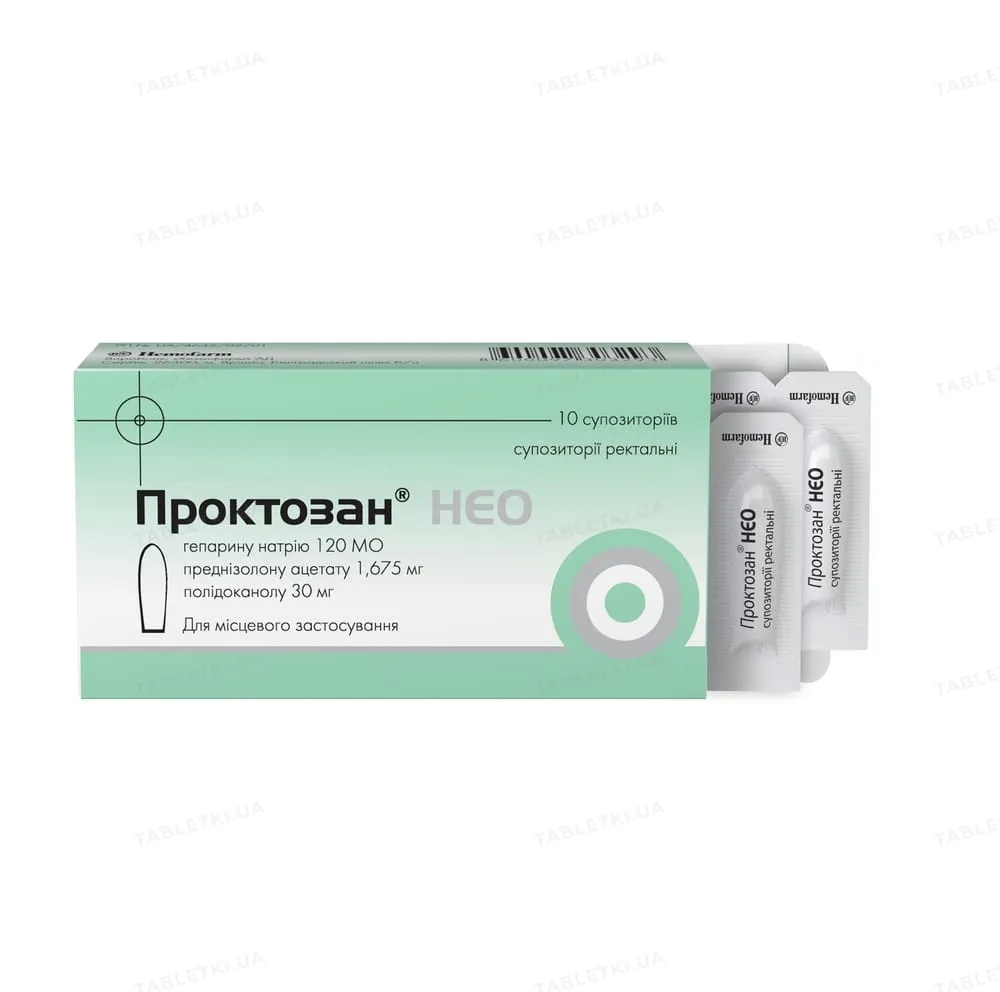
Table of Contents
INSTRUCTION FOR MEDICAL USE OF THE MEDICINAL PRODUCT PROCTOSAN® NEO (PROCTOSAN® NEO)
Composition:
Active substances: sodium heparin, prednisolone acetate, lauromacrogol 400;
1 suppository contains: sodium heparin 120 IU; prednisolone acetate 1.675 mg; lauromacrogol 400 30 mg;
Excipients: medium-chain triglycerides, colloidal anhydrous silicon dioxide, hard fat, glycerol tristearate.
Pharmaceutical form. Rectal suppositories.
Main physicochemical characteristics: white, conical-shaped suppositories.
Pharmacotherapeutic group. Agents for the treatment of hemorrhoids and anal fissures for local use. ATC code C05AX03.
Pharmacological properties.
Pharmacodynamics. Proctosan® NEO provides effective treatment of the characteristic symptoms and consequences of hemorrhoids. The drug rapidly reduces inflammation in the anorectal area, as well as associated sensations such as itching, burning, stinging, pain, and a feeling of moisture.
Proctosan® NEO, due to pure heparin, prevents thrombus formation in hemorrhoidal plexuses.
Prednisolone exerts anti-inflammatory and antiallergic effects.
Laureth-9 (Laureth 400) has local anesthetic action and relieves itching.
Pharmacokinetics. After topical application, heparin is detected in the bloodstream at relatively low concentrations, which does not result in systemic effects. In the blood, it binds to plasma proteins (95%). It is metabolized in the liver (partially by the enzyme hepatic heparinase) and in the reticuloendothelial system. It is excreted by the kidneys. From 20% to 50% of the administered dose is found unchanged in urine. The elimination half-life depends on the dose (increases with increasing dosage).
Prednisolone is present in the formulation and is absorbed in small amounts insufficient to produce systemic effects.
Laureth-9 (Laureth 400) exerts a purely local effect.
Clinical characteristics.
Indications.
For symptomatic treatment of hemorrhoids and pruritus in the perianal area for a short period of time.
Contraindications.
Hypersensitivity to the components of the drug; infections in the perianal area; tendency to bleeding; specific skin lesions (e.g., syphilis); genital herpes; other viral infections; secondary skin infections in the absence of appropriate antibiotic therapy; first trimester of pregnancy. Tuberculous lesions of the anorectal zone.
Interaction with other medicinal products and other forms of interactions.
Interaction studies have not been conducted.
CYP3A4 inhibitors, such as erythromycin, clarithromycin, ketoconazole, diltiazem, aprepitant, itraconazole, oleandomycin, as well as cobicistat, increase the elimination and plasma levels of prednisolone, thereby enhancing the therapeutic and adverse effects of the active ingredient prednisolone.
Proctosan® NEO is not recommended to be used concomitantly with other rectal medicinal products.
Special precautions for use
If skin irritation or allergic reactions occur, administration of the drug should be discontinued immediately and appropriate symptomatic therapy initiated. To avoid local or systemic toxicity, prolonged use of the drug should be avoided.
After administration of systemic corticosteroids, cases of pheochromocytoma crisis have been reported, which may lead to fatal outcomes. The drug should be prescribed to patients with suspected or confirmed pheochromocytoma only after appropriate risk/benefit assessment.
Visual disturbances have been reported with both systemic and topical use of corticosteroids. If symptoms such as blurred vision or other visual disturbances occur, patients should be referred to an ophthalmologist to identify possible causes, including cataract, glaucoma, or rare conditions such as central serous chorioretinopathy, which has been reported after systemic and topical corticosteroid use. Central serous chorioretinopathy may lead to retinal detachment.
The drug should be used with particular caution in patients with glucocorticoid-induced suppression of the hypothalamic-pituitary-adrenal system.
Due to the presence of prednisolone in its composition, prolonged use of Proctosan® NEO should be avoided, as it may cause dryness and microfissures in the anal canal. The drug should also be used with caution in infectious skin diseases of the perianal area and during pregnancy.
Use during pregnancy or breastfeeding. The drug is contraindicated during the first trimester of pregnancy. Caution is recommended when using during later stages of pregnancy (II–III trimesters).
During breastfeeding, it is preferable not to use the drug. Corticosteroids pass into breast milk and may thus affect adrenal cortex function in the newborn and impair growth.
Ability to influence reaction speed while driving or operating machinery. Proctosan® NEO rectal suppositories do not affect reaction speed while driving or operating machinery.
Method of Administration and Dosage.
Apply topically.
Insert one suppository once daily into the rectum after defecation. In case of pronounced symptoms, one suppository may be administered 2–3 times within the first 24 hours of treatment only.
The duration of therapy should not exceed 7 days. If there is no improvement, the underlying causes of the symptoms should be investigated.
Children. There is no clinical experience with the use of this drug in children.
Overdose.
Since the drug is administered locally and reaches only relatively low concentrations in systemic circulation, no toxic effects are expected.
Prolonged use of the drug in high doses may lead to symptoms of hypercorticism.
Symptoms: headache, heart failure, urticaria, rash, severe itching.
Treatment: symptomatic. The drug should be discontinued and medical advice should be sought.
In severe cases, emergency medical assistance is required.
In cases of skin atrophoderma associated with overdose during local administration of the drug, treatment should be discontinued. Symptoms usually regress within 10–14 days.
Adverse reactions.
The product is usually well tolerated; only in isolated cases may hypersensitivity reactions and local skin irritation occur (there is a slight possibility of allergic reactions to lauromacrogol 400).
Local treatment with corticosteroids may cause local adverse events such as dermatitis, folliculitis (at the site of application), acneiform eruptions (steroid acne), contact dermatitis; dryness, thinning, and fragility of the skin; erythema, rash, urticaria, hirsutism, hyperhidrosis, intertrigo, pruritus, skin atrophy, hypopigmentation, skin irritation, striae formation, telangiectasia, burning sensation on the skin, purpura, delayed healing of fissures.
With prolonged local use, suppression of adrenal cortex function, hypercorticism, growth retardation, steroid myopathy, osteonecrosis, osteoporosis (as a manifestation of the resorptive effect of prednisolone), blurred vision, and chorioretinopathy are possible.
Shelf life. 3 years.
Storage conditions. Store at a temperature not exceeding 25 °C in the original packaging (to protect from light and moisture). Keep out of reach of children.
Packaging. 5 suppositories in blisters; 2 blisters per cardboard box.
Prescription status. Over-the-counter.
Manufacturer. «Hemofarm» AD,
LLC «FZ «STADA», Ukraine.
Manufacturer's address and place of business.
Beogradski put bb, 26300, Vrsac, Republic of Serbia.
Ukraine, 09100, Kyiv Oblast, Bila Tserkva, Kyivska St., 37.