Orfadin
Ukraine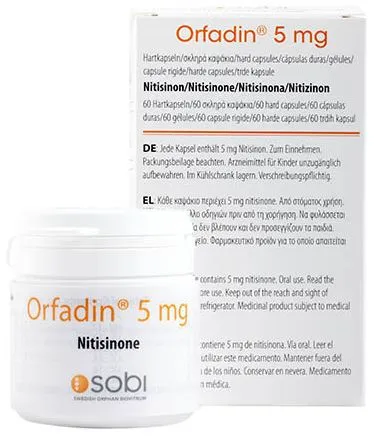
Table of Contents
INSTRUCTIONS FOR MEDICAL USE OF THE MEDICINAL PRODUCT ORFADIN (Orfadin®)
Composition:
Active substance: nitisinone;
1 capsule contains 2 mg, 5 mg or 10 mg of nitisinone;
Excipients: capsule contents – pregelatinized starch;
capsule shell – gelatin, titanium dioxide (E 171);
printing ink on capsule – iron oxide black (E 172), shellac, propylene glycol, ammonium hydroxide.
Pharmaceutical form. Hard capsules.
Main physicochemical characteristics:
2 mg capsules: matt white capsules with the imprint «NTBC 2 mg» containing white or almost white powder.
5 mg capsules: matt white capsules with the imprint «NTBC 5 mg» containing white or almost white powder.
10 mg capsules: matt white capsules with the imprint «NTBC 10 mg» containing white or almost white powder.
Pharmacotherapeutic group. Agents affecting the digestive system and metabolism. Other drugs for the treatment of gastrointestinal tract disorders and metabolic disturbances.
ATC code A16AX04.
Pharmacological properties.
Pharmacodynamics.
Mechanism of action
The metabolic disorder in hereditary tyrosinemia type 1 is characterized by a deficiency of fumarylacetoacetate hydrolase, the terminal enzyme in the catabolism of tyrosine. Nitisinone is a competitive inhibitor of 4-hydroxyphenylpyruvate dioxygenase, the enzyme preceding fumarylacetoacetate hydrolase in the tyrosine catabolic pathway. By inhibiting the normal catabolism of tyrosine in patients with hereditary tyrosinemia type 1, nitisinone prevents the accumulation of toxic metabolic intermediates—maleylacetoacetate and fumarylacetoacetate. In patients with hereditary tyrosinemia type 1, these intermediate metabolites are converted into toxic metabolites—succinylacetone and succinylacetoacetate. Succinylacetone inhibits porphyrin synthesis, leading to the accumulation of 5-aminolevulinic acid.
The biochemical defect in alkaptonuria is a deficiency of homogentisate 1,2-dioxygenase, the third enzyme in the tyrosine catabolic pathway. Nitisinone prevents the accumulation of the harmful metabolite homogentisic acid (HGA), which leads to ochronosis of joints and cartilage, and consequently to the development of clinical features of the disease.
Pharmacodynamic effects
In patients with hereditary tyrosinemia type 1, treatment with nitisinone normalizes porphyrin metabolism and erythrocyte porphobilinogen synthase activity, reduces urinary excretion of 5-aminolevulinic acid, decreases urinary excretion of succinylacetone, increases plasma tyrosine concentration, and increases urinary excretion of phenolic acids. Clinical study data have shown that in more than 90% of patients, urinary succinylacetone levels normalized within the first week of treatment. If the nitisinone dose is appropriately adjusted, succinylacetone is not detectable in urine or plasma.
In patients with alkaptonuria, treatment with nitisinone reduces the accumulation of HGA. Available clinical study data indicate a 99.7% reduction in urinary HGA levels and a 98.8% reduction in serum HGA levels after 12 months of nitisinone treatment compared to untreated control patients.
Clinical efficacy and safety in hereditary tyrosinemia type 1
The clinical study was open-label and uncontrolled. The dosing regimen during the study was twice daily. Data on probability of survival after 2, 4, and 6 years of nitisinone treatment are presented in Table 1.
Table 1
NTBC [2-(2-nitro-4-trifluoromethylbenzoyl)-1,3-cyclohexanedione (nitisinone)] study (n = 250)
| Age at start of treatment |
2 years |
4 years |
6 years |
| ≤ 2 months |
93 % |
93 % |
93 % |
| ≤ 6 months |
93 % |
93 % |
93 % |
| > 6 months |
96 % |
95 % |
95 % |
| Total |
94 % |
94 % |
94 % |
The survival probability data obtained from the retrospective control study are presented in Table 2.
Table 2
| Age at onset of symptoms |
1 year |
2 years |
| < 2 months |
38 % |
29 % |
| > 2 – 6 months |
74 % |
74 % |
| > 6 months |
96 % |
96 % |
It has been observed that treatment with nitisinone reduces the risk of developing hepatocellular carcinoma (HCC) compared to the risk with treatment consisting of a special diet alone (based on retrospective data). Furthermore, it has been found that treatment at early stages of the disease leads to a further reduction in the risk of developing hepatocellular carcinoma.
Table 3 presents data on the probability of remaining free of HCC after 2, 4, and 6 years of nitisinone treatment in patients aged 24 months or younger at the start of treatment, as well as in patients older than 24 months at the start of treatment.
Table 3
NTBC Study (n = 250)
| Patients' age |
Number of patients |
Probability of absence of GVHD (95 % confidence interval) |
|||||
| at baseline |
after 2 years |
after 4 years |
after 6 years |
after 2 years |
after 4 years |
after 6 years |
|
| All patients |
250 |
155 |
86 |
15 |
98 % (95; 100) |
94 % (90; 98) |
91 % (81; 100) |
| Age at start of treatment ≤ 24 months |
193 |
114 |
61 |
8 |
99 % (98; 100) |
99 % (97; 100) |
99 % (94; 100) |
| Age at start of treatment > 24 months |
57 |
41 |
25 |
8 |
92 % (84; 100) |
82 % (70; 95) |
75 % (56; 95) |
During an international study involving patients with hereditary tyrosinemia type 1 who were treated exclusively with dietary restrictions, hepatocellular carcinoma (HCC) was diagnosed in 18% of patients aged 2 years and older.
A pharmacokinetic, efficacy, and safety study comparing a once-daily dosing regimen with a twice-daily regimen was conducted in a cohort of 19 patients with hereditary tyrosinemia type 1. No clinically significant differences in adverse reactions or other safety parameters were observed at the end of treatment between the once-daily and twice-daily groups. At the end of the once-daily treatment period, succinylacetone was not detected in any of the patients. The study results indicate that once-daily administration of the drug is safe and effective for patients of all age groups. However, data in patients with body weight < 20 kg are limited.
Clinical efficacy and safety in alkaptonuria
The efficacy and safety of 10 mg nitisinone once daily in the treatment of adult patients with alkaptonuria were demonstrated in a randomized, blinded, untreated-controlled, parallel-group, 48-month study involving 138 patients (69 of whom received nitisinone). The primary endpoint was the effect on urinary homogentisic acid (HGA) levels; after 12 months, a 99.7% reduction in urinary HGA levels was observed in patients receiving nitisinone compared to untreated control patients. Nitisinone treatment demonstrated a statistically significant positive effect on the clinical assessment of the alkaptonuria severity score (cAKUSSI), eye pigmentation, ear pigmentation, femoral osteopenia, and the number of painful spinal segments compared to untreated controls. cAKUSSI is a composite score that includes assessment of eye and ear pigmentation, kidney and prostate stones, aortic stenosis, osteopenia, bone fractures, tendon/ligament/muscle ruptures, kyphosis, scoliosis, joint replacements, and other manifestations of alkaptonuria. Thus, the reduction in HGA levels in patients receiving nitisinone led to a reduction in the ochronotic process and a decrease in clinical manifestations, supporting a slowing of disease progression.
Ocular adverse reactions such as keratopathy and eye pain, as well as infections, headache, and weight gain, were reported more frequently in patients receiving nitisinone compared to untreated patients. Keratopathy led to temporary or permanent discontinuation of treatment in 14% of patients receiving nitisinone, but was reversible upon discontinuation of nitisinone.
Data in patients over 70 years of age are lacking.
Pharmacokinetics.
Studies on the absorption, distribution, metabolism, and excretion of nitisinone have not been conducted. In 10 healthy male volunteers, after administration of a single oral dose of nitisinone capsules (1 mg/kg body weight), the terminal half-life of nitisinone in plasma was 54 hours (range: 39 to 86 hours). A population pharmacokinetic analysis was performed in a group of 207 patients with hereditary tyrosinemia type 1. Clearance and half-life were measured at 0.0956 L/kg body weight/day and 52.1 hours, respectively.
In vitro studies using human liver microsomes and cDNA-expressed cytochrome P450 enzymes demonstrated limited CYP3A4-mediated metabolism.
Based on clinical drug interaction data, steady-state administration of 80 mg nitisinone increased the AUC∞ of the CYP2C9 substrate tolbutamide by 2.3-fold, indicating moderate inhibition of CYP2C9. Nitisinone caused approximately a 30% decrease in the AUC∞ of chlorzoxazone, indicating weak induction of CYP2E1. Nitisinone does not inhibit CYP2D6, as nitisinone administration did not affect the AUC∞ of metoprolol. The AUC∞ of furosemide increased by 1.7-fold, indicating weak inhibition of OAT1/OAT3 (see sections "Special precautions" and "Interaction with other medicinal products and other forms of interaction").
Based on in vitro studies, nitisinone is not expected to inhibit metabolism mediated by CYP1A2, 2C19, or 3A4, or to induce CYP1A2, 2B6, or 3A4/5. Nitisinone is not expected to inhibit transport mediated by P-gp, BCRP, or OCT2. The plasma concentration of nitisinone achieved under clinical conditions is not expected to inhibit OATP1B1- or OATP1B3-mediated transport.
Non-clinical safety findings
Nitisinone showed embryofetal toxicity in mice and rabbits when administered at clinically relevant doses. In rabbits, nitisinone induced dose-dependent increases in developmental abnormalities (umbilical hernia and gastroschisis) starting at doses 2.5 times the maximum recommended human dose (2 mg/kg/day).
A pre- and postnatal development study in mice showed a statistically significant reduction in offspring survival and development during the weaning period at doses 125 and 25 times the maximum recommended human dose, with a trend toward negative effects on offspring survival starting at a dose of 5 mg/kg/day. In rats, exposure to the drug via breast milk resulted in reduced average body weight of offspring and corneal lesions.
Nitisinone was non-mutagenic but showed weak clastogenic activity in in vitro studies. There was no evidence of genotoxicity in vivo (mouse micronucleus test and DNA repair synthesis analysis in liver cells). In a 26-week carcinogenicity study in transgenic mice (TgrasH2), nitisinone did not show carcinogenic effects.
Clinical characteristics.
Indications.
- Treatment of patients with confirmed diagnosis of hereditary tyrosinemia type 1, under conditions of a diet restricted in products containing tyrosine and phenylalanine.
- Treatment of adult patients with alkaptonuria.
Contraindications.
Hypersensitivity to the active substance or to any of the excipients.
Women undergoing treatment with nitisinone must refrain from breastfeeding.
Interaction with other medicinal products and other forms of interaction.
Nitisinone is metabolized in vitro via the CYP3A4 isoenzyme; therefore, dose adjustment may be required when nitisinone is used concomitantly with inhibitors or inducers of this isoenzyme.
Based on clinical study data evaluating the effect of 80 mg nitisinone in a hospital setting, nitisinone is a moderate inhibitor of CYP2C9 (2.3-fold increase in tolbutamide AUC). Therefore, nitisinone treatment may lead to increased plasma concentrations of medicinal products primarily metabolized by CYP2C9 (see section "Special precautions for use").
Nitisinone is a weak inducer of CYP2E1 (30% decrease in chlorzoxazone AUC) and a weak inhibitor of OAT1 and OAT3 (1.7-fold increase in furosemide AUC), whereas nitisinone does not inhibit CYP2D6 (see section "Pharmacokinetics").
Specific studies on the interaction of the drug with food have not been conducted. However, during efficacy and safety studies, nitisinone was administered with food. Therefore, if nitisinone was initially taken with food at the beginning of treatment, it is recommended to maintain this regimen throughout the entire course of treatment.
Special precautions for use
The patient should visit the physician every 6 months; shorter intervals between visits are recommended if adverse reactions develop.
Monitoring plasma tyrosine levels
An ophthalmological examination is recommended prior to initiating nitisinone treatment and thereafter at least once a year. Patients who develop visual disturbances during nitisinone treatment should be examined immediately by an ophthalmologist.
Hereditary tyrosinemia type 1. It is important to verify patient compliance with a special diet and to measure plasma tyrosine concentration. If plasma tyrosine concentration exceeds 500 µmol/L, dietary intake of tyrosine and phenylalanine should be restricted. It is not recommended to reduce plasma tyrosine concentration by decreasing the dose or discontinuing nitisinone, as metabolic disturbance may lead to worsening of the patient's clinical condition.
Alkaptonuria. In patients who develop keratopathies, plasma tyrosine levels should be monitored. Patients should follow a diet restricted in tyrosine and phenylalanine to maintain plasma tyrosine levels below 500 µmol/L. In addition, nitisinone therapy should be temporarily discontinued and the drug may be reintroduced once symptoms have resolved.
Monitoring liver function
Hereditary tyrosinemia type 1. Liver function should be monitored regularly through liver function tests and liver imaging. Monitoring plasma alpha-fetoprotein concentration is also recommended. Elevated plasma alpha-fetoprotein levels may indicate inadequate treatment. If alpha-fetoprotein levels increase or liver nodules appear, the liver should be evaluated for malignant neoplasms.
Monitoring platelets and leukocytes
Patients with hereditary tyrosinemia type 1 and alkaptonuria should have regular monitoring of platelet and leukocyte counts, as several cases of reversible thrombocytopenia and leukopenia have been observed during clinical studies of hereditary tyrosinemia type 1.
The patient should visit the physician every 6 months; shorter intervals between visits are recommended if adverse reactions develop.
Concomitant use with other medicinal products
Nitisinone is a moderate inhibitor of CYP2C9. Therefore, treatment with nitisinone may increase plasma concentrations of concomitantly administered medicinal products that are primarily metabolized by CYP2C9. Close monitoring is required for patients receiving nitisinone along with medicinal products that have a narrow therapeutic index and are metabolized by CYP2C9, such as warfarin and phenytoin. Dose adjustment of concomitantly administered medicinal products may be necessary (see section "Interaction with other medicinal products and other forms of interaction").
Use during pregnancy or breastfeeding
Pregnancy
There are insufficient data on the use of nitisinone in pregnant women. Toxic effects of nitisinone on reproductive function were observed in animal studies (see section "Pharmacological properties"). The potential risk to humans is unknown. Nitisinone should not be used during pregnancy unless the patient's medical condition necessitates treatment with nitisinone.
Nitisinone crosses the human placenta.
Breastfeeding
It is unknown whether nitisinone is excreted in human milk. Unfavourable effects of nitisinone on offspring development due to excretion of nitisinone in female animal milk were observed in animal studies. Therefore, mothers receiving nitisinone should not breastfeed, as the risk to the infant cannot be excluded (see sections "Contraindications" and "Pharmacological properties").
Fertility
There are no data indicating harmful effects of nitisinone on fertility.
Ability to affect reaction speed when driving or operating machinery
Orfadin has a minor influence on the ability to drive or operate machinery. Ocular adverse reactions (see section "Adverse reactions") may affect vision. If visual impairment occurs, patients should refrain from driving and operating machinery until such adverse effects resolve.
Method of Administration and Dosage.
Dosage
Hereditary Tyrosinemia Type 1
Treatment with nitisinone should be managed by a physician experienced in the treatment of patients with hereditary tyrosinemia type 1.
Treatment of all genotypes of the disease should be initiated as early as possible to improve overall survival and to prevent complications such as liver failure, and hepatocellular and renal carcinoma. Nitisinone therapy must be accompanied by a diet restricted in tyrosine and phenylalanine, which should be supplemented with monitoring of plasma amino acid levels (see sections "Special Warnings and Precautions for Use" and "Adverse Reactions").
Initial Dose in Hereditary Tyrosinemia Type 1
The recommended initial daily dose for children and adults is 1 mg/kg body weight administered orally. The dose of nitisinone should be individualized.
The dose is recommended to be taken once daily. Due to limited data on the use of the drug in patients with body weight < 20 kg, in treating patients in this category, it is recommended to divide the total daily dose into two doses taken daily.
Dose Adjustment in Hereditary Tyrosinemia Type 1
Throughout the course of treatment, monitoring of succinylacetone in urine, liver function, and alpha-fetoprotein concentration is required (see section "Special Warnings and Precautions for Use"). If succinylacetone is still detected in urine one month after initiating nitisinone therapy, the dose of nitisinone should be increased to 1.5 mg/kg body weight per day. A dose of 2 mg/kg body weight per day may be prescribed after evaluation of all biochemical parameters. This dose should be considered the maximum for all patients. If biochemical test results are satisfactory, the dose should be adjusted according to body weight.
Throughout the treatment period, all possible biochemical parameters should also be monitored (succinylacetone levels in plasma, 5-aminolevulinic acid (ALA) in urine, erythrocyte porphobilinogen synthase (PBG-synthase) activity).
Alkaptonuria
Treatment with nitisinone should be managed by a physician experienced in the treatment of patients with alkaptonuria.
The recommended dose for adults with alkaptonuria is 10 mg once daily.
Special Populations
There are no specific dosage recommendations for elderly patients or patients with renal or hepatic impairment.
Children
Hereditary Tyrosinemia Type 1
The recommended dose in milligrams per kilogram of body weight is the same for children and adults.
Due to limited data on the use of the drug in patients with body weight < 20 kg, in treating patients in this category, it is recommended to divide the total daily dose into two daily doses.
Alkaptonuria
The safety and efficacy of ORFADIN in children (aged 0 to 18 years) with alkaptonuria have not been established. Data are lacking.
Method of Administration
Immediately before administration, the capsule may be opened and its contents mixed with a small amount of water or another liquid compatible with the patient's dietary requirements to form a suspension.
Nitisinone therapy should be initiated together with food intake, and thereafter the same administration regimen should be consistently followed (see section "Interaction with Other Medicinal Products and Other Forms of Interaction").
Overdose .
Accidental ingestion of nitisinone by individuals not adhering to a special diet restricted in tyrosine and phenylalanine leads to increased tyrosine concentrations in the body. Elevated tyrosine levels are associated with toxic effects on the eyes, skin, and nervous system. Restriction of dietary intake of tyrosine and phenylalanine should reduce the toxic effects associated with this form of tyrosinemia. Information on specific treatment for overdose is lacking.
Adverse reactions
Summary of safety profile
Due to its mechanism of action, nitisinone increases tyrosine levels in all patients receiving the drug. As a result, tyrosine-related ocular adverse reactions such as conjunctivitis, corneal opacity, keratitis, photophobia, and eye pain are common in patients with hereditary tyrosinemia type 1 and alkaptonuria. In patients with hereditary tyrosinemia type 1, adverse reactions include thrombocytopenia, leukopenia, and granulocytopenia. Exfoliative dermatitis may occur uncommonly.
List of adverse reactions
The list of adverse reactions below is presented by MedDRA system organ classes and frequency categories, based on data from clinical trials in patients with hereditary tyrosinemia type 1 and alkaptonuria, as well as post-marketing experience in hereditary tyrosinemia type 1. Adverse reactions are categorized by frequency as follows: very common (≥ 1/10), common (≥ 1/100, < 1/10), uncommon (> 1/1,000, < 1/100), rare (> 1/10,000, < 1/1,000), very rare (≤ 1/10,000), and not known (frequency cannot be estimated from available data).
Within each frequency group, adverse reactions are listed in order of decreasing severity.
Table 4
| MedDRA system organ classes |
Frequency during treatment of hereditary tyrosinemia type 1 |
Frequency during treatment of alkaptonuria1 |
Adverse reaction |
| Infections and infestations |
Common |
Bronchitis, pneumonia |
|
| Blood and lymphatic system disorders |
Common |
Thrombocytopenia, leukopenia, granulocytopenia |
|
| Uncommon |
Leukocytosis |
||
| Eye disorders |
Common |
Conjunctivitis, corneal opacity, keratitis, photophobia |
|
| Very common2 |
Keratopathy |
||
| Common |
Very common2 |
Eye pain |
|
| Uncommon |
Blepharitis |
||
| Skin and subcutaneous tissue disorders |
Uncommon |
Exfoliative dermatitis, erythematous rash |
|
| Uncommon |
Common |
Pruritus, rash |
|
| Investigations |
Very common |
Very common |
Elevated tyrosine levels |
1 Frequency determined in a clinical study in alkaptonuria.
2 Elevated tyrosine levels are associated with ocular adverse reactions. Patients with alkaptonuria should follow a diet restricted in tyrosine and phenylalanine.
Description of selected adverse reactions
Treatment with nitisinone leads to increased levels of tyrosine.
Elevated tyrosine levels are associated with ocular adverse reactions such as corneal opacities and hyperkeratotic lesions in patients with hereditary tyrosinemia type 1 and alkaptonuria. Restriction of dietary intake of foods containing tyrosine and phenylalanine may reduce the toxic effects of tyrosinemia by lowering tyrosine levels (see section "Special precautions for use").
In clinical studies of hereditary tyrosinemia type 1, severe granulocytopenia (< 0.5 × 10⁹/L) was infrequent and not associated with the development of infections. Hematologic and lymphatic system adverse reactions resolved during long-term treatment with nitisinone.
Children
The safety profile of the drug in hereditary tyrosinemia type 1 is primarily based on data from its use in pediatric patients, as treatment with nitisinone should be initiated as soon as possible after diagnosis of hereditary tyrosinemia type 1. Data from clinical studies and post-marketing experience indicate no differences in the safety profiles among different pediatric subpopulations or compared to the safety profile in adult patients.
Reporting of suspected adverse reactions
Reporting suspected adverse reactions after drug authorization is important. It allows ongoing monitoring of the benefit-risk balance of the medicinal product. Healthcare and pharmacy professionals, as well as patients or their legal representatives, should report all suspected adverse reactions and lack of efficacy through the Automated Pharmacovigilance Information System at the following link: https://aisf.dec.gov.ua
Shelf life.
2 years.
Storage conditions.
Store in a refrigerator at 5+3 °C.
During the shelf life, Orfadin 2 mg hard capsules may be stored for one 2-month period at a temperature not exceeding 25 °C, after which the medicinal product should be destroyed. During the shelf life, Orfadin 5 mg or 10 mg hard capsules may be stored for one 3-month period at a temperature not exceeding 25 °C, after which the medicinal product should be destroyed.
Packaging.
60 capsules in a polyethylene bottle with a tamper-evident cap; 1 bottle in a cardboard box.
Prescription status.
Prescription only.
Manufacturer.
Apotek Produktion & Laboratorier AB /
Apotek Production & Laboratories AB.
Manufacturer's address.
Prismavägen 2, Kungens Kurva, 14175, Sweden /
Prismavägen 2, Kungens Kurva, 14175, Sweden.
Marketing authorization holder.
Swedish Orphan Biovitrum International AB /
Swedish Orphan Biovitrum International AB.
Address of the marketing authorization holder.
SE-112 76 Stockholm, Sweden /
SE-112 76 Stockholm, Sweden.