Pumpkin seed oil
Ukraine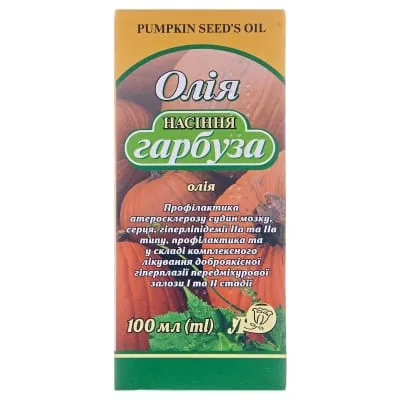
Table of Contents
INSTRUCTION FOR MEDICAL USE OF THE MEDICINAL PRODUCT PUMPKIN SEED'S OIL
Composition:
Active substance: 1 vial contains pumpkin seed oil (oleisemenicucurbitae) – 100 ml;
1 sachet contains pumpkin seed oil (oleisemenicucurbitae) – 2.5 ml or 5 ml.
Pharmaceutical form. Oil.
Main physico-chemical properties: oily greenish-brown liquid with a characteristic odor. Presence of sediment is permissible.
Pharmacotherapeutic group. Hypolipidemic agents. ATC code C10AX.
Pharmacological Properties
Pharmacodynamics. The medicinal product contains a complex of biologically active substances from pumpkin seeds (carotenoids, tocopherols, phospholipids, phosphatides, flavonoids, vitamins B1, B2, C, P, PP, F, unsaturated, polyunsaturated, and monounsaturated fatty acids: palmitic, stearic, oleic, linolenic, linoleic, arachidonic), which provide antioxidant, antiatherosclerotic, anti-inflammatory, hepatoprotective, and choleretic effects. Due to phosphatidylcholine, which activates the enzyme lecithin-cholesterol acyltransferase, the preparation converts free cholesterol into cholesterol esters, which do not participate in the development of atherosclerosis. In addition, phosphatidylcholine becomes incorporated into high-density lipoproteins, promoting accelerated transport of cholesterol into endothelial and platelet membranes and preventing their aggregation. Unsaturated fatty acids inhibit cholesterol absorption and facilitate fatty acid excretion. The preparation improves the functional state of the biliary tract, alters the chemical composition of bile, exerts a mild choleretic effect, and reduces inflammatory processes in the epithelium of the biliary system. The preparation reduces edema, improves microcirculation and epithelialization, exerts a protective effect on granulation tissue, and stimulates trophic and metabolic processes in tissues. The preparation exerts antihypertensive effects, inhibits proliferation of prostate gland cells in benign prostatic hyperplasia, reduces the severity of inflammatory processes, and exhibits mild bacteriostatic properties.
Pharmacokinetics. Not studied.
Clinical characteristics.
Indications. Prevention of atherosclerosis of cerebral and cardiac vessels, type IIa and IIb hyperlipidemia; prevention and as part of complex treatment of benign prostatic hyperplasia stage I and II.
Contraindications. Hypersensitivity to the drug. Concomitant use with antacids. Cholelithiasis. Pancreatitis.
Interaction with other medicinal products and other forms of interaction. Antacids, H2-histamine receptor blockers, proton pump inhibitors, and bismuth-containing preparations reduce absorption of pumpkin oil and decrease the drug's effectiveness.
When using any other medicinal products concomitantly, inform your physician.
Special precautions for use.
The medicinal product is not recommended for patients with exacerbation of gastric and duodenal peptic ulcer, gastritis, esophagitis, duodenitis, colitis, and other diseases of the gastrointestinal mucosa in the stage of exacerbation.
The drug should be used with caution in patients prone to allergic reactions.
Due to the moderate antithrombotic effect of the drug, it should be administered cautiously in patients with hemophilia or other forms of hemorrhagic diathesis, as well as in patients taking anticoagulants. During treatment with this drug, laboratory monitoring of blood parameters should be performed at regular intervals (usually every 2–3 months) in such patients.
It is recommended to discontinue the use of the drug at least 4 days before surgery or any other surgical intervention.
If the drug is used for symptomatic treatment of benign prostatic hyperplasia, the condition should be monitored regularly (every 2–3 months).
The drug may alleviate symptoms caused by prostate enlargement, but does not affect the size of the prostate.
Use during pregnancy or breastfeeding. The safety and efficacy of using "Pumpkin Seed Oil" during pregnancy and breastfeeding are unknown; therefore, the drug should be prescribed only if the expected benefit to the mother outweighs the potential risk to the fetus or infant.
Ability to influence reaction rate when driving or operating machinery. No effect.
Dosage and Administration
The medication should be taken orally.
Adults:
For the prevention of hyperlipidemia, take 1 teaspoon of oil (or 1 sachet of 5 ml, or 2 sachets of 2.5 ml) twice daily, usually for 2 months. Then reduce to ½ teaspoon (or 1 sachet of 2.5 ml) twice daily. The duration of treatment depends on the severity and course of the disease, on average 6 months.
For benign prostatic hyperplasia, take 1 teaspoon (or 1 sachet of 5 ml, or 2 sachets of 2.5 ml) twice daily for an average of 4–5 weeks, then reduce to ½ teaspoon (or 1 sachet of 2.5 ml) once daily. The duration of treatment is determined by the physician, usually 5 months.
Children. Safety and efficacy of the medication in children have not been established; therefore, the medication should not be administered to children.
Overdose.
Symptoms: diarrhea, lethargy.
Treatment: discontinue the medication if these symptoms occur. Provide symptomatic therapy.
Side effects
With prolonged use, rare bowel movements and allergic reactions are possible.
If any adverse events occur, consult a physician immediately!
Shelf life: 2 years.
Storage conditions: Store at a temperature between 2 °C and 8 °C in the original packaging.
Keep out of reach of children.
Packaging: 100 ml in a bottle in a box; 2.5 ml or 5 ml in sachets of 20 in a box.
Availability category: Over-the-counter (without prescription).
Manufacturer:
Limited Liability Company "Experimental Plant "GNCLS".
LIMITED LIABILITY COMPANY "CORPORATION "ZDOROVTIA".
Manufacturer's address and place of business:
8 Vorobiova Street, Kharkiv, Kharkiv Oblast, 61057, Ukraine.
(Limited Liability Company "Experimental Plant "GNCLS")
22 Shevchenko Street, Kharkiv, Kharkiv Oblast, 61013, Ukraine.
(LIMITED LIABILITY COMPANY "CORPORATION "ZDOROVTIA")