Oftan® dexamethasone
Ukraine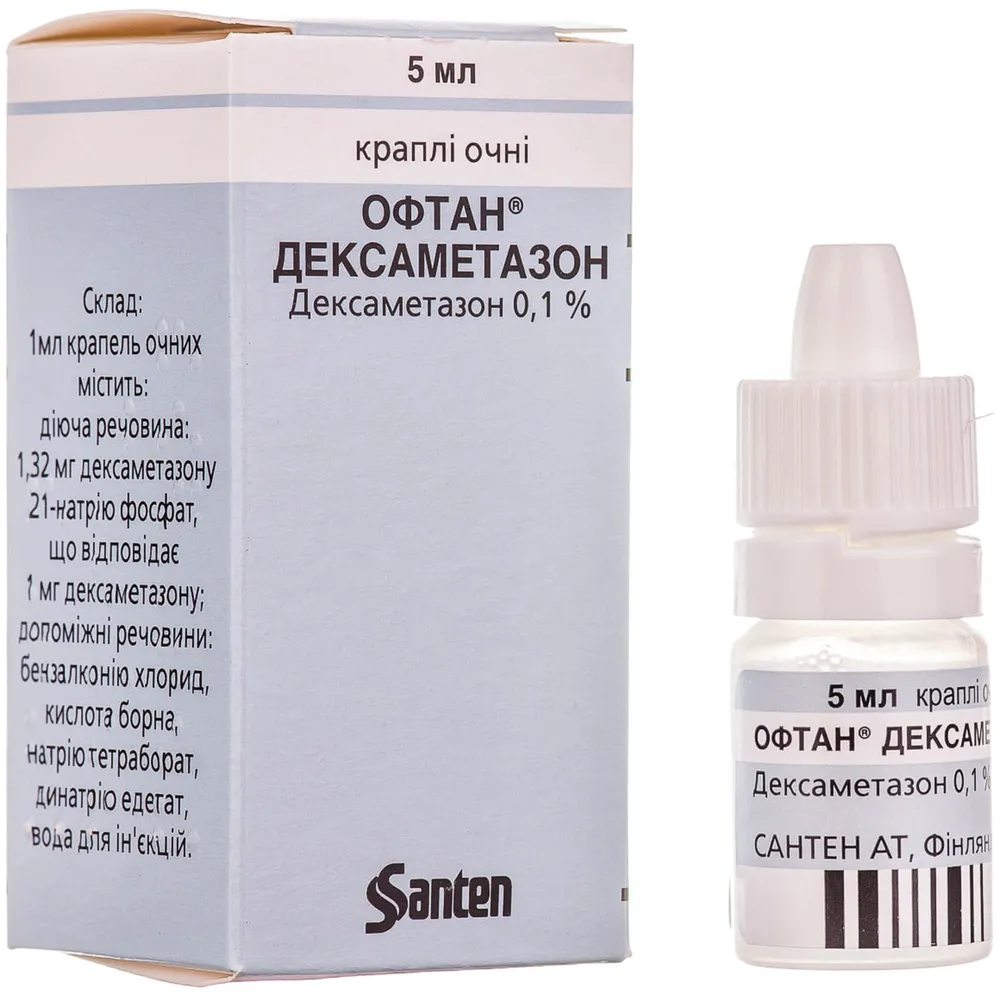
Table of Contents
INSTRUCTIONS FOR MEDICAL USE OF THE MEDICINAL PRODUCT OFTAN® DEXAMETHASONE (OFTAN® DEXAMETHASONE)
Composition:
Active substance: dexamethasone;
1 ml of eye drops contains 1.32 mg of dexamethasone 21-sodium phosphate, equivalent to 1 mg of dexamethasone;
Excipients: benzalkonium chloride, boric acid, sodium tetraborate, disodium edetate, water for injections.
Pharmaceutical form. Eye drops.
Main physicochemical characteristics: clear, colorless solution.
Pharmacotherapeutic group. Anti-inflammatory agents used in ophthalmology. Corticosteroids. ATC code: S01BA01.
Pharmacological properties.
Pharmacodynamics.
Mechanism of action.
Dexamethasone is a synthetic fluorinated glucocorticosteroid. Its anti-inflammatory efficacy is 25–30 times higher than that of hydrocortisone. Dexamethasone has no mineralocorticoid activity. Its target receptor is the nuclear steroid receptor of activated leukocytes.
Glucocorticoids used in ophthalmology exhibit anti-inflammatory, antiallergic, immunosuppressive, and analgesic effects. They suppress leukocyte migration, cytokinesis, as well as collagen and protein synthesis. The effect of cortisone on carbohydrate and lipid metabolism is negligible when administered locally into the eye.
Pharmacokinetics.
Dexamethasone is a lipophilic substance that, when applied locally to the eye, penetrates well into ocular tissues and intraocular fluid.
Therapeutic concentrations of dexamethasone in the anterior chamber of the eye are achieved with local instillation into the eye. However, local administration is insufficient for treating diseases of the posterior chamber. Part of the drug administered locally into the eye may enter the systemic circulation via the nasolacrimal duct, nasal mucosa, nasopharynx, and gastrointestinal tract; however, measurable systemic concentrations have not been detected following local ocular administration.
The bioavailability of orally administered dexamethasone is 70–80%, the average volume of distribution is 0.8 L/kg, and the plasma half-life is 3 hours.
Dexamethasone is metabolized in the liver by CYP2C enzymes; metabolites are excreted in bile.
Clinical characteristics.
Indications.
Treatment of non-infectious inflammatory and allergic eye diseases such as conjunctivitis, keratitis, iritis, iridocyclitis, corneal injuries, and marginal ulcers, including postoperative conditions.
Contraindications.
Ocular tuberculosis, herpes simplex, varicella (chickenpox), smallpox, and other viral and fungal eye infections.
Purulent ocular infections without concomitant antimicrobial therapy. Corneal perforation.
Hypersensitivity to the active substance or to any of the excipients of the drug.
Interaction with other medicinal products and other forms of interaction.
Clinically significant interactions are absent when the drug is applied topically to the eyes.
CYP3A4 inhibitors (including drugs containing ritonavir and cobicistat) may reduce dexamethasone clearance, leading to enhanced effects and adrenal suppression / Cushing's syndrome.
Special precautions for use.
Visual disturbances
Visual disturbances may occur with systemic and topical use of corticosteroids. If a patient experiences blurred vision or other visual disturbances, an ophthalmologist should be consulted to evaluate possible causes such as cataract, glaucoma, or rare conditions like central serous chorioretinopathy, which have been reported following systemic and topical corticosteroid use.
Use of cortisone for more than 2 weeks may increase intraocular pressure. Topical application of glucocorticoids may delay healing of corneal injuries. Corticosteroid treatment may mask bacterial or fungal infections, the progression of which could lead to permanent eye damage. OFTAN® DEXAMETHASONE may be used to treat an affected eye only in combination with specific antibiotic therapy.
Cushing's syndrome and/or suppression of adrenal function associated with systemic absorption of ocular dexamethasone may occur after intensive or prolonged continuous therapy in susceptible patients, including children and patients receiving CYP3A4 inhibitors (including ritonavir and cobicistat). In such cases, treatment should be gradually discontinued.
The medicinal product contains the preservative benzalkonium chloride. Contact lenses must be removed before instilling OFTAN® DEXAMETHASONE eye drops, and patients should wait 15 minutes after instillation before reinserting contact lenses. Benzalkonium chloride may discolor soft contact lenses.
Benzalkonium chloride has been reported to cause eye irritation, symptoms of dry eye, and may affect the tear film and corneal surface. Caution is advised in patients with dry eye and in patients who may have corneal damage. Patients should be monitored during prolonged use.
Use during pregnancy or breastfeeding.
A small amount of dexamethasone may be absorbed into the systemic circulation following topical ocular administration. However, blood concentrations are very low. Although some dexamethasone may pass into breast milk and fetal circulation, the effect on the fetus or breastfed infant is very unlikely and weak.
Ability to influence reaction rate while driving or operating machinery.
OFTAN® DEXAMETHASONE does not affect the ability to drive or operate machinery.
Method of Administration and Dosage.
Dosage
Instill 1–2 drops into the affected eye(s) every hour as initial therapy, then reduce to 4–6 times daily. The duration of treatment ranges from several days to several weeks.
Children.
Safety and efficacy in children (under 18 years of age) have not been established.
Overdose.
Systemic side effects due to overdose are highly unlikely with topical administration. Systemically administered doses of dexamethasone are hundreds of times higher than the amount contained in one dose of OFTAN® DEXAMETHASONE ophthalmic drops.
Adverse Reactions
When administered locally into the eyes, OFTAN® DEXAMETHASONE is well tolerated, and local irritation is rarely observed. A transient stinging sensation in the eye may occur after instillation of the drops.
Common (> 1/100)
If treatment continues for weeks, dexamethasone may increase intraocular pressure, potentially leading to the development of glaucoma.
Prolonged local use of glucocorticosteroids for several months carries a risk of corneal ulceration and clouding, and may lead to subcapsular cataract formation.
Frequency unknown (cannot be estimated from available data)
Blurred vision.
Cushing's syndrome, adrenal suppression.
Reporting of suspected adverse reactions
Reporting suspected adverse reactions after a medicinal product has been authorized is important. It allows continued monitoring of the benefit-risk balance of the medicinal product. Healthcare professionals are encouraged to report any suspected adverse reactions.
Shelf life.
2 years.
Use within 28 days after opening the bottle.
After opening, store the bottle at a temperature below 25 °C.
Storage conditions.
Store at 2 to 8 °C.
Keep out of the reach of children.
Store the bottle in the original cardboard carton to protect from light.
Packaging.
5 ml in a bottle with dropper. 1 bottle with dropper in a cardboard box.
Prescription status.
Prescription only.
Manufacturer.
Santen Oy / Santen Oy.
Manufacturer's address.
Kelloportinkatu 1, Tampere, 33100, Finland /
Kelloportinkatu 1, Tampere, 33100, Finland.