Obajio
Ukraine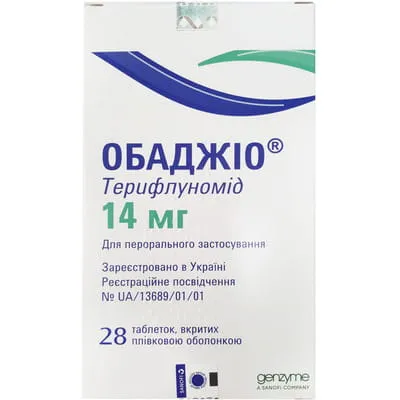
Table of Contents
INSTRUCTIONS FOR MEDICAL USE OF THE MEDICINAL PRODUCT OBAJIO® (AUBAGIO®)
Composition:
Active substance: teriflunomide;
One film-coated tablet contains 7 mg of teriflunomide;
Excipients: tablet core: lactose monohydrate, corn starch, hydroxypropylcellulose, microcrystalline cellulose, sodium starch glycolate (type A), magnesium stearate; tablet coating: hypromellose, titanium dioxide (E 171), talc, macrogol, indigo carmine (E 132), yellow iron oxide (E 172).
One film-coated tablet contains 14 mg of teriflunomide;
Excipients: tablet core: lactose monohydrate, corn starch, hydroxypropylcellulose, microcrystalline cellulose, sodium starch glycolate (type A), magnesium stearate; tablet coating: hypromellose, titanium dioxide (E 171), talc, macrogol, indigo carmine (E 132).
Pharmaceutical form. Film-coated tablets.
Main physicochemical properties:
7 mg film-coated tablets: very light greenish-blue-grey to pale greenish-blue, hexagonal, film-coated tablets, 7.5 mm in diameter, with an imprint of the active substance content as the digit "7" on one side and an engraved corporate logo on the other.
14 mg film-coated tablets: pale blue, pentagonal, film-coated tablets, 7.5 mm in diameter, with an imprint of the active substance content as the digit "14" on one side and an engraved corporate logo on the other.
Pharmacotherapeutic group. Antineoplastic and immunomodulating agents. Immunosuppressants. Dihydroorotate dehydrogenase (DHODH) inhibitors. Teriflunomide.
ATC code L04AK02.
Pharmacological properties.
Pharmacodynamics.
Mechanism of action
Teriflunomide is an immunomodulatory agent with anti-inflammatory properties that selectively and reversibly inhibits the mitochondrial enzyme dihydroorotate dehydrogenase (DHODH), which is functionally linked to the respiratory chain. As a result of this inhibition, teriflunomide generally reduces the proliferation of rapidly dividing cells that require de novo pyrimidine synthesis for their development. The exact mechanism by which teriflunomide exerts its therapeutic effect in multiple sclerosis (MS) is not fully understood, but it is mediated through a reduction in the number of lymphocytes.
Pharmacodynamic effects
Immune system. Effect on the number of immunocompetent cells in blood: in placebo-controlled studies, teriflunomide at a dose of 14 mg once daily caused a mild reduction in lymphocyte count—on average by less than 0.3 × 10⁹/L—during the first 3 months of treatment, after which this level remained stable throughout the treatment period.
QT interval prolongation potential. In a placebo-controlled thorough QT interval study conducted in healthy volunteers, teriflunomide at mean steady-state concentrations showed no potential for prolonging the QTcF interval compared to placebo: the maximum difference between the mean value of this parameter under teriflunomide and placebo at corresponding time points was 3.45 ms, with an upper bound of the 90% CI of 6.45 ms.
Effect on renal tubular function. In placebo-controlled studies, patients treated with teriflunomide showed a reduction in serum uric acid levels by an average of 20% to 30% compared to those receiving placebo. The average decrease in serum phosphorus levels was approximately 10% in the teriflunomide group compared to placebo. These effects are considered to be related to enhanced renal tubular excretion and are not associated with changes in glomerular function.
Clinical efficacy and safety
The efficacy of Obadijo® was demonstrated in two placebo-controlled studies—TEMSO and TOWER—in which the administration of teriflunomide at doses of 7 mg and 14 mg once daily was evaluated in adult patients with relapsing-remitting multiple sclerosis (RRMS).
In the TEMSO study, a total of 1088 RRMS patients were randomized to receive either teriflunomide 7 mg (n = 366) or 14 mg (n = 359) once daily, or placebo (n = 363) for a period of 108 weeks. All patients had a confirmed diagnosis of MS (based on McDonald criteria, 2001) with a relapsing clinical course, with or without progression, and had experienced at least one relapse within the year prior to the study or at least two relapses within the preceding two years. At study entry, patients had an Expanded Disability Status Scale (EDSS) score ≤ 5.5. The mean age of study participants was 37.9 years. The majority of patients had relapsing-remitting multiple sclerosis (91.5%), while a small subgroup had secondary progressive (4.7%) or progressive relapsing multiple sclerosis (3.9%). The mean annualized relapse rate in the year prior to enrollment was 1.4, and gadolinium-enhancing lesions were present at baseline in 36.2% of patients. The median EDSS score at baseline was 2.50, with 249 patients (22.9%) having an EDSS score > 3.5 at baseline. The mean duration of disease from the onset of first symptoms was 8.7 years. The majority of patients (73%) had not received disease-modifying therapies for MS in the 2 years prior to enrollment. Study results are shown in Table 1.
Long-term follow-up results from an extended long-term safety assessment in participants of the TEMSO study (median total treatment duration approximately 5 years, maximum treatment duration approximately 8.5 years) revealed no new or unexpected safety findings.
In the TOWER study, a total of 1169 RRMS patients were randomized to receive either teriflunomide 7 mg (n = 408) or 14 mg (n = 372) once daily, or placebo (n = 389) for variable periods ending 48 weeks after randomization of the last patient. All patients had a confirmed diagnosis of MS (based on McDonald criteria, 2005) with a relapsing clinical course, with or without progression, and had experienced at least one relapse within the year prior to the study or at least two relapses within the preceding two years. At study entry, patients had an Expanded Disability Status Scale (EDSS) score ≤ 5.5.
The mean age of study participants was 37.9 years. The majority of patients had relapsing-remitting multiple sclerosis (97.5%), while a small subgroup had secondary progressive (0.8%) or progressive relapsing multiple sclerosis (1.7%). The mean annualized relapse rate in the year prior to enrollment was 1.4. Data on the presence of gadolinium-enhancing lesions at baseline were not available. The median EDSS score at baseline was 2.50, with 298 patients (25.5%) having an EDSS score > 3.5 at baseline. The mean duration of disease from the onset of first symptoms was 8 years. The majority of patients (67.2%) had not received disease-modifying therapies for MS in the 2 years prior to enrollment. Study results are shown in Table 1.
Table 1
Primary outcomes for the approved dose (data for the population of patients who were randomized and received at least one dose of study drug [ITT])
| Parameter |
TEMSO Study |
TOWER Study |
||
| Teriflunomide 14 mg |
Placebo |
Teriflunomide 14 mg |
Placebo |
|
| N |
358 |
363 |
370 |
388 |
| Clinical Endpoints |
||||
| Annualized relapse rate |
0.37 |
0.54 |
0.32 |
0.50 |
| Rate difference (95% CI) |
-0.17 (-0.26, -0.08)*** |
-0.18 (-0.27, -0.09)**** |
||
| Number of patients relapse-free at week 108 |
56.5% |
45.6% |
57.1% |
46.8% |
| Hazard ratio (95% CI) |
0.72 (0.58, 0.89)** |
0.63 (0.50, 0.79)**** |
||
| Proportion with sustained disability progression over 3 months at week 108 |
20.2% |
27.3% |
15.8% |
19.7% |
| Hazard ratio (95% CI) |
0.70 (0.51, 0.97)* |
0.68 (0.47, 1.00)* |
||
| Proportion with sustained disability progression over 6 months at week 108 |
13.8% |
18.7% |
11.7% |
11.9% |
| Hazard ratio (95% CI) |
0.75 (0.50, 1.11) |
0.84 (0.53, 1.33) |
||
| MRI Endpoints |
Not assessed |
|||
| Change in T2 lesion volume at week 108(1) |
0.72 |
2.21 |
||
| Change from placebo |
67%*** |
|||
| Mean number of gadolinium-enhancing lesions at week 108 |
0.38 |
1.18 |
||
| Change from placebo (95% CI) |
-0.80 (-1.20, -0.39)**** |
|||
| Number of unique active lesions per scan |
0.75 |
2.46 |
||
| Change from placebo (95% CI) |
69% (59%; 77%)**** |
|||
**** p < 0.0001, *** p < 0.001, ** p < 0.01, * p < 0.05 compared with placebo
1LZ — disease severity: total volume of lesions (T2 and T1 hypointense) in milliliters.
Efficacy in patients with high disease activity
In the TEMSO study, a consistent treatment effect was observed regarding relapse rate and sustained disability progression over 3 months in the subgroup of patients with high disease activity (n = 127). According to the study design, high disease activity was defined as ≥2 relapses within 1 year and ≥1 gadolinium-enhancing lesion on brain MRI. A similar subgroup analysis was not performed in the TOWER study, as MRI data were not collected in that study. There are no data available on the number of patients who showed no response to a full and adequate course of beta-interferon treatment (typically not less than 1 year of treatment), who had at least 1 relapse during the preceding year while on treatment and who had at least 9 T2-hypointense lesions or at least 1 gadolinium-enhancing lesion on brain MRI, as well as on the number of patients in whom the annualized relapse rate during the year preceding the study did not decrease or increased compared with the previous 2 years.
The TOPIC study was a double-blind, placebo-controlled trial evaluating teriflunomide 7 mg and 14 mg once daily for up to 108 weeks in patients with a first clinical manifestation of a demyelinating event (mean patient age was 32.1 years). The primary endpoint was time to the second clinical event (relapse). A total of 618 patients were randomized to receive either teriflunomide 7 mg (n = 205) or 14 mg (n = 216), or placebo (n = 197). The risk of a second clinical event over 2 years was 35.9% in the placebo group and 24.0% in the 14 mg teriflunomide group (risk ratio: 0.57, 95% confidence interval: 0.38–0.87, p = 0.0087). The results of the TOPIC study confirmed the efficacy of teriflunomide in relapsing-remitting multiple sclerosis (RRMS), including at the early stage of RRMS with a first clinical manifestation of a demyelinating event and dissemination of lesions in time and space on MRI.
The efficacy of teriflunomide was compared with that of subcutaneous interferon beta-1a (at the recommended dose of 44 mcg three times weekly) in 324 randomized patients in the TENERE study, with a minimum treatment duration of 48 weeks (maximum 114 weeks). The primary endpoint was the risk of treatment failure (confirmed relapse or permanent discontinuation of the study drug, whichever occurred first). The number of patients who permanently discontinued the study drug in the 14 mg teriflunomide group was 22 out of 111 patients (19.8%), with reasons being adverse reactions (10.8%), lack of efficacy (3.6%), other reasons (4.5%), and loss to follow-up (0.9%). The number of patients who permanently discontinued the study drug in the subcutaneous interferon beta-1a group was 30 out of 104 patients (28.8%), with reasons being adverse reactions (21.2%), lack of efficacy (1.9%), other reasons (4.8%), and non-compliance with the study protocol (1%). Regarding the primary endpoint, teriflunomide 14 mg/day did not show superiority over interferon beta-1a: the percentage of patients with treatment failure at 96 weeks, calculated by the Kaplan-Meier method, was 41.1% compared to 44.4% (in the 14 mg teriflunomide group versus the interferon beta-1a group, p = 0.595).
Pediatric population
Children (aged 10 to 17 years)
The EFC11759/TERIKIDS study was an international, double-blind, placebo-controlled trial involving patients aged 10 to 17 years with relapsing-remitting MS, evaluating once-daily teriflunomide (doses adjusted to achieve exposure equivalent to the 14 mg dose in adults) for 96 weeks followed by an open-label extension study. All patients had experienced at least 1 relapse within 1 year or at least 2 relapses within 2 years prior to the study. Neurological examinations were performed at screening and every 24 weeks until study completion, as well as during unscheduled visits in case of suspected relapse. Patients with a clinical relapse or high MRI activity (at least 5 new or enlarging T2-weighted lesions on two consecutive scans) were transferred to the open-label extension study before week 96 to ensure active treatment. The primary endpoint was time to first clinical relapse after randomization. Time to first confirmed clinical relapse or high MRI activity, whichever occurred first, was predefined as a sensitivity analysis, as it includes both clinical and MRI criteria corresponding to the criteria for transition to the open-label extension study.
A total of 166 patients were randomized 2:1 to receive teriflunomide (n = 109) or placebo (n = 57). At study entry, the Expanded Disability Status Scale (EDSS) score was ≤5.5; mean patient age was 14.6 years; mean body weight was 58.1 kg; mean disease duration since diagnosis was 1.4 years; and mean number of gadolinium-enhancing T1-weighted lesions on MRI at baseline was 3.9. All patients had relapsing-remitting MS with a mean EDSS score of 1.5 at study start. Mean duration of treatment was 362 days in the placebo group and 488 days in the teriflunomide group. Transition from the double-blind phase to open-label treatment due to high MRI activity occurred more frequently than expected and more often and earlier in the placebo group than in the teriflunomide group (26% in the placebo group, 13% in the teriflunomide group).
Teriflunomide reduced the risk of clinical relapse by 34% compared to placebo, which was not statistically significant (p = 0.29) (Table 2). In a pre-specified sensitivity analysis, teriflunomide achieved a statistically significant 43% reduction in the composite risk of clinical relapse or high MRI activity compared to placebo (p = 0.04) (Table 2).
Teriflunomide significantly reduced the number of new and enlarging T2-weighted lesions by 55% (p = 0.0006) (a retrospective analysis also adjusted for baseline T2 values showed a 34% reduction, p = 0.0446) and the number of gadolinium-enhancing T1-weighted lesions on MRI scans by 75% (p < 0.0001) (Table 2).
Table 2
Clinical and MRI outcomes from the EFC11759/TERIKIDS study
| Analysis set "patients with assigned treatment" in study EFC11759 |
Teriflunomide (N = 109) |
Placebo (N = 57) |
| Clinical endpoints |
||
| Time to first confirmed clinical relapse Probability (95% CI) of confirmed relapse at Week 96 Probability (95% CI) of confirmed relapse at Week 48 |
0.39 (0.29, 0.48) 0.30 (0.21, 0.39) |
0.53 (0.36, 0.68) 0.39 (0.30, 0.52) |
| Hazard ratio (95% CI) |
0.66 (0.39, 1.11)^ |
|
| Time to first confirmed clinical relapse or high MRI activity Probability (95% CI) of confirmed relapse or high MRI activity at Week 96 Probability (95% CI) of confirmed relapse or high MRI activity at Week 48 |
0.51 (0.41, 0.60) 0.38 (0.29, 0.47) |
0.72 (0.58, 0.82) 0.56 (0.42, 0.68) |
| Hazard ratio (95% CI) |
0.57 (0.37, 0.87)* |
|
| MRI endpoints |
||
| Adjusted number of new or enlarging T2-weighted lesion lesions Estimate (95% CI) Estimate (95% CI), retrospective analysis also adjusted for baseline T2 lesion load |
4.74 (2.12, 10.57) 3.57 (1.97, 6.46) |
10.52 (4.71, 23.50) 5.37 (2.84, 10.16) |
| Relative risk (95% CI) Relative risk (95% CI), retrospective analysis also adjusted for baseline T2 lesion load |
0.45 (0.29, 0.71)∗∗ 0.67 (0.45, 0.99)* |
|
| Adjusted number of gadolinium-enhancing T1-weighted lesions Estimate (95% CI) |
1.90 (0.66, 5.49) |
7.51 (2.48, 22.70) |
| Relative risk (95% CI) |
0.25 (0.13, 0.51)*** |
|
| ^ p ≥ 0.05 compared with placebo, *p < 0.05, ** p < 0.001, ***p < 0.0001 Probabilities were based on Kaplan–Meier estimates, and Week 96 was the end of the study treatment (EOT). |
||
The European Medicines Agency has waived the obligation for the manufacturer to submit the results of studies on the use of Aubagio® in children from birth to less than 10 years of age for the treatment of multiple sclerosis (information on use in children is provided in the section "Dosage and administration").
Pharmacokinetics
Absorption.
The median time to reach maximum plasma concentration after multiple oral doses of teriflunomide is 1 to 4 hours following administration; the bioavailability of the drug is high (approximately 100%).
Food does not have a clinically significant effect on the pharmacokinetics of teriflunomide.
Based on mean predicted pharmacokinetic parameters calculated from population pharmacokinetic (PopPK) analysis using data from healthy volunteers and patients with MS, steady-state concentration is reached slowly (approximately 100 days, 3.5 months, to achieve 95% of steady-state concentration), and the calculated accumulation ratio of AUC is approximately 34.
Distribution.
Teriflunomide is highly bound to plasma proteins (> 99%), likely to albumin, and is distributed predominantly in plasma. The volume of distribution after a single intravenous dose is 11 L. However, this value is likely underestimated, as significant distribution to organs was observed in rats.
Biotransformation.
Teriflunomide is moderately metabolized and is the only compound detected in plasma. The main pathway of biotransformation of teriflunomide is hydrolysis; a less significant pathway is oxidation. Minor metabolic pathways include oxidation, N-acetylation, and sulfate conjugation.
Elimination.
Teriflunomide is excreted into the gastrointestinal tract primarily via bile as unchanged active substance, most likely through direct secretion. Teriflunomide is a substrate of the efflux transporter BCRP, which may be involved in direct secretion. Within 21 days, 60.1% of the administered dose is excreted in feces (37.5%) and urine (22.6%). Following an accelerated elimination procedure using cholestyramine, an additional 23.1% is eliminated (predominantly via feces). According to individual pharmacokinetic parameter predictions using the PopPK model of teriflunomide, the median terminal half-life (t1/2z) in healthy volunteers and patients with MS was approximately 19 days after multiple doses of 14 mg. After a single intravenous dose, the total clearance of teriflunomide is 30.5 mL/h.
Accelerated elimination procedure: cholestyramine and activated charcoal.
Elimination of teriflunomide from the bloodstream can be accelerated by using cholestyramine or activated charcoal, which are believed to block intestinal reabsorption processes. Teriflunomide concentrations measured during an 11-day accelerated elimination procedure using 8 g cholestyramine three times daily, 4 g cholestyramine three times daily, or 50 g activated charcoal twice daily after discontinuation of teriflunomide treatment demonstrated the effectiveness of these regimens in accelerating teriflunomide elimination, resulting in a reduction of plasma teriflunomide concentration by more than 98%; cholestyramine acted faster than activated charcoal. After discontinuation of teriflunomide and initiation of cholestyramine 8 g three times daily, plasma concentrations of teriflunomide decreased by 52% by the end of day 1, by 91% by the end of day 3, by 99.2% by the end of day 7, and by 99.9% by the end of day 11. The choice among these three accelerated elimination regimens depends on patient tolerability. If cholestyramine 8 g three times daily is poorly tolerated, cholestyramine 4 g three times daily may be prescribed. Alternatively, activated charcoal may also be used (these 11 days do not need to be consecutive if rapid reduction of teriflunomide plasma concentration is not required).
Linearity/non-linearity.
Systemic exposure after oral administration of teriflunomide at doses from 7 to 14 mg increases proportionally with dose.
Characteristics in specific patient groups.
Male/female patients, elderly patients. Population pharmacokinetic (PopPK) analysis in healthy volunteers and patients with MS identified several individual factors contributing to variability in pharmacokinetics: age, body weight, sex, race, and levels of albumin and bilirubin. However, the impact of these factors on drug pharmacokinetics remains limited (≤ 31%).
Hepatic impairment. Mild and moderate hepatic impairment does not affect the pharmacokinetics of teriflunomide. Therefore, dose adjustment is not required for patients with mild or moderate hepatic impairment. However, teriflunomide is contraindicated in patients with severe hepatic dysfunction (see sections "Dosage and administration" and "Contraindications").
Renal impairment. Severe renal impairment does not affect the pharmacokinetics of teriflunomide. Therefore, dose adjustment is not required for patients with mild, moderate, or severe renal impairment.
Children.
In children with body weight above 40 kg receiving 14 mg daily, steady-state concentrations were within the range observed in adult patients receiving the same dosing regimen.
In pediatric patients with body weight ≤ 40 kg, treatment with a 7 mg once-daily dose (based on limited clinical data and modeling) resulted in steady-state concentrations within the range observed in adult patients receiving 14 mg once daily.
Observed individual minimum steady-state concentrations were highly variable, as also observed in adult patients with MS.
Preclinical safety data.
Repeated dose toxicity.
Repeated oral administration of teriflunomide to mice, rats, and dogs for periods of up to 3, 6, and 12 months, respectively, revealed that the primary target organs of toxicity were the bone marrow, lymphoid organs, oral cavity/gastrointestinal tract, reproductive organs, and pancreas. Signs of oxidative effects on erythrocytes were also observed. Anemia, thrombocytopenia, and immune system effects, including leukopenia, lymphopenia, and secondary infections, were associated with effects on bone marrow and/or lymphoid organs. Most effects reflect the primary mechanism of action of the compound (inhibition of cell proliferation). Animals are more sensitive to the pharmacological and, consequently, toxic effects of teriflunomide than humans. Therefore, toxic effects of the drug were observed in animals at exposure levels equivalent to or lower than those in humans receiving therapeutic doses.
Genotoxic and carcinogenic potential.
Teriflunomide was not mutagenic in vitro or clastogenic in vivo. The clastogenicity observed in vitro was considered an indirect effect related to nucleotide pool imbalance due to the pharmacological effects of DHODH inhibition. A minor metabolite, TFMA (4-trifluoromethylaniline), caused mutagenicity and clastogenicity in vitro, but not in vivo.
No evidence of carcinogenicity of the drug was observed in rats and mice.
Reproductive toxicity.
Fertility in rats was not altered despite adverse effects of teriflunomide on male reproductive organs, including reduced sperm count. No external developmental abnormalities were observed in offspring of male rats treated with teriflunomide prior to mating with untreated females. Teriflunomide was embryotoxic in rats and rabbits when administered at doses within the therapeutic range for human use. Adverse effects on offspring were also observed when teriflunomide was administered to pregnant female rats throughout gestation and lactation. The risk of embryofetal toxicity due to teriflunomide intake by the father of the child is considered low. The calculated plasma exposure in women due to transmission of the drug through the semen of a patient receiving treatment is expected to be 100 times lower than the plasma exposure after oral intake of 14 mg teriflunomide.
Juvenile toxicity.
In young rats receiving teriflunomide orally for 7 weeks from weaning to maturity, no adverse effects on growth, physical or neurological development, learning and memory, locomotor activity, sexual development, or fertility were observed. Adverse effects included anemia, reduced lymphoid responsiveness, dose-dependent reduction in T-cell-dependent antibody response, and marked reduction in IgM and IgG concentrations, generally consistent with observations in repeated-dose toxicity studies in adult rats. However, an increase in B-cell count observed in young rats was not seen in adult rats. The significance of this difference is unknown, but complete reversibility was demonstrated, as with most other findings. Due to the high sensitivity of animals to teriflunomide, young rats were affected at lower exposure levels than children receiving the maximum recommended human dose (MRHD).
Clinical characteristics.
Indications.
Obadijo® is indicated for the treatment of adult patients and children aged 10 years and older with relapsing-remitting multiple sclerosis (MS) (important information regarding the patient population in which treatment efficacy has been established is provided in the section «Pharmacodynamics»).
Contraindications.
Hypersensitivity to the active substance or to any of the excipients listed in the section «Composition».
Severe hepatic impairment (Child-Pugh class C).
Pregnancy. Women of childbearing potential must use effective contraception during treatment with teriflunomide and after its discontinuation, until plasma levels of the drug remain above 0.02 mg/L (see section «Use during pregnancy or breastfeeding»). Pregnancy must be excluded prior to initiating treatment with the drug (see section «Use during pregnancy or breastfeeding»).
Breastfeeding period (see section «Use during pregnancy or breastfeeding»).
Severe immunodeficiency states, such as acquired immunodeficiency syndrome (AIDS).
Significant impairment of bone marrow function or significant anemia, leukopenia, neutropenia, or thrombocytopenia.
Severe active infection, until recovery (see section «Special precautions»).
Severe renal impairment requiring dialysis, as clinical experience with the drug under these conditions is currently insufficient.
Severe hypoproteinemia, e.g., in nephrotic syndrome.
Interaction with other medicinal products and other forms of interaction.
Pharmacokinetic interaction: effect of other substances on teriflunomide.
The main pathway of teriflunomide biotransformation is hydrolysis; a less significant pathway is oxidation.
Potent inducers of cytochrome P450 (CYP) and transporters. When rifampicin (an inducer of CYP2B6, 2C8, 2C9, 2C19, and 3A), which is also an inducer of efflux transporters P-glycoprotein [P-gp] and breast cancer resistance protein [BCRP], was administered multiple times (600 mg once daily for 22 days) concomitantly with a single 70 mg dose of teriflunomide, a reduction of approximately 40% in teriflunomide exposure was observed. Rifampicin and other known potent inducers of CYP and transporters, such as carbamazepine, phenobarbital, phenytoin, and St. John’s wort, should be used with caution during teriflunomide treatment.
Cholestyramine or activated charcoal. Cholestyramine or activated charcoal should not be prescribed to patients receiving teriflunomide, as this leads to rapid and substantial reduction in plasma concentrations of teriflunomide, except in cases where accelerated elimination of the drug from the body is desired. This effect is believed to be due to interruption of the enterohepatic recirculation of teriflunomide and/or gastrointestinal dialysis of teriflunomide.
Pharmacokinetic interaction: effect of teriflunomide on other substances.
Effect of teriflunomide on CYP2C8 substrates: repaglinide. After multiple-dose administration of teriflunomide, increases in mean Cmax and AUC of repaglinide (by 1.7- and 2.4-fold, respectively) were observed, indicating an inhibitory effect of teriflunomide on CYP2C8 in vivo. Therefore, medicinal products whose metabolism is mediated by the CYP2C8 enzyme, such as repaglinide, paclitaxel, pioglitazone, or rosiglitazone, should be used with caution during teriflunomide treatment.
Effect of teriflunomide on oral contraceptives: 0.03 mg ethinylestradiol and 0.15 mg levonorgestrel. After multiple-dose administration of teriflunomide, increases in mean Cmax and AUC0–24 of ethinylestradiol (by 1.58- and 1.54-fold, respectively) and of Cmax and AUC0–24 of levonorgestrel (by 1.33- and 1.41-fold, respectively) were observed. Although a negative impact of this interaction with teriflunomide on the efficacy of oral contraceptives is not expected, it should be taken into account when selecting an oral contraceptive or adjusting its dose when used in combination with teriflunomide.
Effect of teriflunomide on CYP1A2 substrate: caffeine. After multiple-dose administration of teriflunomide, decreases in mean Cmax and AUC of caffeine (a CYP1A2 substrate) by 18% and 55%, respectively, were observed, suggesting that teriflunomide may be a weak inducer of CYP1A2 in vivo. Therefore, medicinal products whose metabolism is mediated by the CYP1A2 enzyme (such as duloxetine, alosetron, theophylline, and tizanidine) should be used with caution during teriflunomide treatment, as it may lead to reduced efficacy of these drugs.
Effect of teriflunomide on warfarin. After multiple-dose administration of teriflunomide, no effect on the pharmacokinetics of S-warfarin was observed, indicating that teriflunomide is neither an inhibitor nor an inducer of CYP2C9. However, when teriflunomide and warfarin were administered concomitantly, a 25% reduction in the maximum international normalized ratio (INR) was observed compared to warfarin monotherapy. Therefore, careful monitoring and control of INR are recommended when warfarin is used concomitantly with teriflunomide.
Effect of teriflunomide on organic anion transporter 3 (OAT3) substrates. After multiple-dose administration of teriflunomide, increases in mean Cmax and AUC of cefaclor (by 1.43- and 1.54-fold, respectively) were observed, indicating an inhibitory effect of teriflunomide on OAT3 in vivo. Therefore, caution is recommended when co-administering teriflunomide with OAT3 substrates such as cefaclor, benzylpenicillin, ciprofloxacin, indomethacin, ketoprofen, furosemide, cimetidine, methotrexate, and zidovudine.
Effect of teriflunomide on substrates of BCRP and/or organic anion transporting polypeptides B1 and B3 (OATP1B1/B3). After multiple-dose administration of teriflunomide, increases in mean Cmax and AUC of rosuvastatin (by 2.65- and 2.51-fold, respectively) were observed. However, no notable effect of this increased rosuvastatin plasma exposure on HMG-CoA (hydroxymethylglutaryl-coenzyme A) reductase activity was observed. When co-administered with teriflunomide, the dose of rosuvastatin should be reduced by 50%. Concomitant use of teriflunomide with other BCRP substrates (e.g., methotrexate, topotecan, sulfasalazine, daunorubicin, doxorubicin) and OATP transporters, particularly HMG-CoA reductase inhibitors (e.g., simvastatin, atorvastatin, pravastatin, methotrexate, nateglinide, repaglinide, rifampicin), requires caution. Patients should be closely monitored for symptoms of excessive concentrations of these drugs in blood, and dose reduction should be considered.
Special precautions for use.
This medicinal product contains sodium starch glycolate (type A). Caution should be exercised when administering to patients on a sodium-controlled diet.
Monitoring
Prior to treatment.
Before initiating teriflunomide therapy, the following parameters should be assessed:
- arterial blood pressure;
- alanine aminotransferase/serum glutamate-pyruvate transaminase (ALT/SGPT) levels;
- complete blood count including white blood cell differential and platelet count.
During treatment. During teriflunomide therapy, the following parameters should be monitored:
- arterial blood pressure (periodic monitoring);
- alanine aminotransferase/serum glutamate-pyruvate transaminase (ALT/SGPT) levels. Liver enzymes should be evaluated at least every four weeks during the first 6 months of treatment and regularly thereafter. Additional monitoring should be considered when Aubagio® is prescribed to patients with pre-existing liver disease, in combination with other potentially hepatotoxic drugs, or if clinical symptoms such as unexplained nausea, vomiting, abdominal pain, fatigue, anorexia, jaundice, and/or dark urine occur. Liver enzymes should be assessed every two weeks during the first 6 months of treatment and at least every 8 weeks for at least 2 years from the start of treatment. If ALT (SGPT) levels increase to 2–3 times above the upper limit of normal (ULN), weekly monitoring is recommended;
- complete blood count should be performed during treatment due to the potential development of symptoms (e.g., during infections).
Accelerated elimination procedure.
Teriflunomide is slowly eliminated from plasma. Without an accelerated elimination procedure, it takes on average 8 months to achieve plasma concentrations below 0.02 mg/L, although due to individual variability in active substance clearance, this process may last up to 2 years. The accelerated elimination procedure can be applied at any time after discontinuation of teriflunomide (see detailed description in sections "Pharmacokinetics" and "Use in pregnancy or lactation").
Hepatic effects. Elevated liver enzyme levels have been observed in patients receiving teriflunomide (see section "Adverse reactions"). Such elevations occur predominantly within the first 6 months of treatment.
Cases of drug-induced liver injury (DILI) have been reported during teriflunomide therapy, sometimes life-threatening. In most cases, DILI developed within several weeks or months after initiation of treatment, but DILI may also occur during prolonged use of teriflunomide.
The risk of elevated liver enzymes and DILI during teriflunomide treatment may be higher in patients with pre-existing liver disease, concomitant use of other hepatotoxic drugs, and/or alcohol abuse. Therefore, patients should be closely monitored for signs and symptoms of liver injury.
If liver injury is suspected, teriflunomide therapy should be discontinued and the accelerated elimination procedure initiated. Discontinuation of teriflunomide should be considered if liver enzyme levels are confirmed to be more than 3 times the ULN.
After treatment discontinuation, liver function tests should be monitored until transaminase levels normalize.
Hypoproteinemia
Since teriflunomide is highly protein-bound and binding depends on albumin concentration, increased levels of unbound teriflunomide in plasma are expected in patients with hypoproteinemia, e.g., in nephrotic syndrome. Teriflunomide should not be administered to patients with severe hypoproteinemia.
Effect on blood pressure. Increased blood pressure may occur during teriflunomide therapy (see section "Adverse reactions"). Blood pressure should be checked before starting teriflunomide therapy and periodically thereafter. Elevated blood pressure requires appropriate management before and during teriflunomide therapy.
Infections. Initiation of teriflunomide therapy should be delayed in patients with severe active infections until recovery.
In placebo-controlled trials, no increased incidence of serious infections was observed during teriflunomide therapy (see section "Adverse reactions"). However, due to the immunomodulatory effect of teriflunomide, the need to suspend treatment with Aubagio® should be considered in case of serious infection, and benefit-risk should be re-evaluated before resuming therapy. Due to the long elimination half-life of the drug, accelerated elimination using cholestyramine or activated charcoal may be considered.
Patients taking Aubagio® should be informed to report symptoms of infection to their physician. Patients with active or chronic infections should not initiate Aubagio® therapy until the infection(s) have resolved.
The safety of teriflunomide in patients with latent tuberculosis is currently unknown, as systematic tuberculosis screening was not performed in clinical trials. Patients with positive tuberculosis screening results should receive treatment according to standard medical practice before initiating therapy.
Respiratory reactions.
Post-marketing reports have described cases of interstitial lung disease (ILD) and pulmonary hypertension associated with teriflunomide use.
This risk may be higher in patients with a history of ILD.
ILD may develop acutely at any time during therapy and may present with various clinical manifestations.
ILD may be fatal. The onset or worsening of pulmonary symptoms such as persistent cough and dyspnea may warrant discontinuation of therapy and further evaluation if indicated. If therapy discontinuation is necessary, the need for an accelerated elimination procedure should be considered.
Effect on hematopoiesis. A decrease in leukocyte count, averaging less than 15% from baseline, has been observed (see section "Adverse reactions"). As a precaution, a complete blood count including white blood cell differential and platelet count should be obtained shortly before starting therapy and performed during treatment based on clinical signs and symptoms (e.g., in case of infection).
Patients with pre-existing anemia, leukopenia, and/or thrombocytopenia, as well as those with impaired bone marrow function or at risk of bone marrow suppression, have an increased risk of hematological disorders. If such effects occur, the need for an accelerated elimination procedure (see above "Accelerated elimination procedure") to reduce plasma teriflunomide levels should be considered.
In case of severe hematological reactions, including pancytopenia, Aubagio® and all concomitant myelosuppressive agents must be discontinued, and the need for accelerated elimination of teriflunomide should be considered.
Skin reactions. In the post-marketing period, cases of serious, sometimes fatal, skin reactions have been reported during Aubagio® use, including Stevens-Johnson syndrome, toxic epidermal necrolysis, and drug reaction with eosinophilia and systemic symptoms (DRESS syndrome).
If a patient develops skin and/or mucosal reactions (e.g., ulcerative stomatitis) suggestive of severe generalized serious skin reactions (Stevens-Johnson syndrome, toxic epidermal necrolysis – Lyell’s syndrome, or drug reaction with eosinophilia and systemic symptoms), teriflunomide and all other potentially causative agents must be discontinued and the accelerated elimination procedure initiated immediately. Re-administration of teriflunomide is contraindicated in such cases (see section "Contraindications").
New onset of psoriasis (including pustular) and worsening of pre-existing psoriasis have been reported during teriflunomide use. Discontinuation of therapy and initiation of accelerated elimination may be considered based on the patient's disease and medical history.
Peripheral neuropathy. Cases of peripheral neuropathy have been reported in patients receiving Aubagio® (see section "Adverse reactions"). In most patients, improvement was observed after discontinuation of Aubagio®. However, there was considerable variability in the final outcome of this adverse reaction: in some patients neuropathy resolved completely, while in others residual symptoms persisted. If a patient develops confirmed peripheral neuropathy while on Aubagio®, discontinuation of therapy and performance of an accelerated elimination procedure should be considered.
Vaccination. Two clinical studies showed that vaccination with inactivated neoantigens (primary vaccination) or sensitizing antigens (booster vaccination) was safe and effective during Aubagio® therapy. The use of live attenuated vaccines may pose an infection risk and should therefore be avoided.
Immunosuppressive or immunomodulatory therapy. Since leflunomide is a prodrug of teriflunomide, concomitant use of teriflunomide and leflunomide is not recommended.
Concomitant use with antineoplastic or immunosuppressive agents used for MS treatment has not been studied. Safety studies in which teriflunomide was administered concomitantly with interferon beta or glatiramer acetate for up to one year did not reveal any specific safety concerns, but a higher frequency of adverse reactions was observed compared to teriflunomide monotherapy. The long-term safety of such combinations in multiple sclerosis treatment is currently undefined.
Switching from Aubagio® to another agent or from another agent to Aubagio®. Based on clinical data regarding concomitant use of teriflunomide with interferon beta or glatiramer acetate, no waiting period is required when initiating teriflunomide therapy after interferon beta or glatiramer acetate, or when initiating interferon beta or glatiramer acetate after teriflunomide.
Due to the long elimination half-life of natalizumab, simultaneous presence of both drugs in the blood may occur during the 2–3 months after switching from natalizumab to Aubagio®, resulting in combined immune effects. Therefore, caution is advised when switching patients from natalizumab to Aubagio®.
Due to the elimination half-life of fingolimod, a 6-week drug-free period is required after fingolimod discontinuation for its clearance from circulation and a 1–2 month period for lymphocyte levels to return to normal. Initiating Aubagio® therapy during this interval will result in simultaneous presence of teriflunomide and fingolimod in blood. This may lead to additive effects on the immune system; therefore, caution is recommended.
In MS patients after repeated administration of teriflunomide 14 mg, the median terminal elimination half-life (t1/2z) was approximately 19 days. If a decision is made to discontinue Aubagio® therapy, initiating another agent within an interval of 5 elimination half-lives (approximately 3.5 months, though longer in some patients) will result in simultaneous presence of teriflunomide and the new agent in blood. This may lead to additive effects on the immune system; therefore, caution is recommended.
Children
Pancreatitis. In a clinical trial involving pediatric patients, cases of pancreatitis, including acute pancreatitis, were observed (see section "Adverse reactions"). Clinical symptoms included abdominal pain, nausea and/or vomiting. These patients had elevated serum amylase and lipase levels. The onset of these events ranged from several months to three years. Patients should be informed about the characteristic symptoms of pancreatitis. In case of suspected pancreatitis, pancreatic enzyme levels and other appropriate laboratory parameters should be measured. If pancreatitis is confirmed, teriflunomide should be discontinued and accelerated elimination initiated (see section "Pharmacokinetics").
Lactose. Since Aubagio® tablets contain lactose, patients with rare hereditary problems such as galactose intolerance, Lapp lactase deficiency, or glucose-galactose malabsorption should not take this medication.
Sodium. This medicinal product contains less than 1 mmol (23 mg) of sodium per tablet, i.e., essentially "sodium-free".
Effect on ionized calcium measurement results
Falsely low values of ionized calcium may be obtained during leflunomide and/or teriflunomide (active metabolite of leflunomide) therapy, depending on the type of ionized calcium analyzer used (e.g., blood gas analyzer). Therefore, in patients receiving leflunomide or teriflunomide, the reliability of low ionized calcium values should be carefully evaluated. In case of doubtful results, serum calcium concentration should be measured with correction for total albumin level.
Use in pregnancy or lactation.
Use in men. The risk of embryofetal toxicity due to paternal exposure to teriflunomide is considered low (see section "Pharmacological properties").
Pregnancy. Teriflunomide is contraindicated during pregnancy (see section "Contraindications"). Data on teriflunomide use in pregnant women are currently limited. Animal studies have demonstrated toxic effects on reproductive function (see section "Pharmacological properties").
Teriflunomide may cause severe congenital malformations if used during pregnancy.
Women of childbearing potential must use effective contraception during treatment and after its completion until plasma teriflunomide concentrations fall below 0.02 mg/L. During this period, women should discuss any plans regarding discontinuation or change of contraception with their physician. Girls and/or their parents/guardians should be informed to contact a physician as soon as menstruation occurs in a girl undergoing Aubagio® therapy. New female patients capable of becoming pregnant should receive counseling on contraception and potential fetal risk. Referral to a gynecologist should be considered.
Patients must be informed that if menstrual delay occurs or pregnancy is suspected, they must discontinue Aubagio® and immediately consult a physician for a pregnancy test. In case of a positive test, the physician and patient should discuss the risks to pregnancy. Rapid reduction of teriflunomide blood levels by applying the accelerated elimination procedure described below at the first sign of menstrual delay may reduce fetal risk.
Women receiving teriflunomide who wish to become pregnant must discontinue the drug, and the accelerated elimination procedure is recommended to achieve concentrations below 0.02 mg/L more rapidly (see below).
If the accelerated elimination procedure is not used, teriflunomide plasma levels are expected to remain above 0.02 mg/L for an average of 8 months, although some patients may require up to 2 years to achieve plasma concentrations below 0.02 mg/L. Therefore, plasma teriflunomide concentration must be determined before attempting pregnancy. After plasma teriflunomide concentration is confirmed below 0.02 mg/L, plasma concentration should be retested after an interval of at least 14 days.
If both plasma concentration tests are below 0.02 mg/L, no fetal risk is expected.
For additional information on blood sample testing for this parameter, contact the marketing authorization holder or its local representatives (see section "Manufacturer").
Accelerated elimination procedure
After discontinuation of teriflunomide:
- administer cholestyramine 8 g three times daily for 11 days, or cholestyramine 4 g three times daily if 8 g three times daily is poorly tolerated;
- alternatively, administer 50 g of activated charcoal powder every 12 hours for 11 days.
However, after either accelerated elimination procedure, confirmation by two separate tests at least 14 days apart is required, and a waiting period of one and a half months must be observed between the first plasma concentration result below 0.02 mg/L and conception.
Both cholestyramine and activated charcoal powder may affect the absorption of estrogens and progestogens, potentially compromising the reliability of oral contraceptives during the accelerated elimination procedure with cholestyramine or activated charcoal powder. Alternative contraceptive methods are recommended.
Lactation. Teriflunomide has been shown to be excreted in breast milk in animal studies. Therefore, teriflunomide should not be used in women who are breastfeeding (see section "Contraindications").
Fertility. Animal studies did not demonstrate any effect of the drug on fertility (see section "Pharmacological properties"). Although human data are lacking, no effect of the drug on fertility in men or women is expected.
Ability to drive and use machines.
The effect of Aubagio® on the ability to drive or operate machinery is none or negligible. However, if adverse reactions such as dizziness, which has been reported with leflunomide (a prodrug of teriflunomide), occur, the patient's ability to concentrate and react appropriately may be impaired. In such cases, patients should refrain from driving and operating machinery.
Method of Administration and Dosage
All unused medicinal products or waste materials must be disposed of in accordance with local requirements.
Treatment should be initiated and supervised by a physician experienced in the management of multiple sclerosis.
Dosage
Adults
The recommended dose of Aubagio® is 14 mg orally once daily.
Children (aged 10 years and older)
For children (aged 10 years and older), the recommended dose depends on body weight:
- Children with body weight > 40 kg: 14 mg once daily,
- Children with body weight ≤ 40 kg: 7 mg once daily.
Children who have reached a stable body weight above 40 kg should be switched to the 14 mg tablet once daily.
The tablets should be swallowed whole with a small amount of water. The film-coated tablets may be taken independently of food intake.
Special patient populations
Elderly patients. Aubagio® should be used with caution in patients aged 65 years and older due to limited data on safety and efficacy in this patient population.
Renal impairment. Dose adjustment is not required for patients with mild, moderate, or severe renal impairment who are not receiving dialysis.
Patients with severe renal impairment undergoing dialysis have not been evaluated. Teriflunomide is contraindicated in this patient population (see section "Contraindications").
Hepatic impairment. Dose adjustment is not required for patients with mild or moderate hepatic impairment. Teriflunomide is contraindicated in patients with severe hepatic impairment (see section "Contraindications").
Children
The safety and efficacy of Aubagio® in children under 10 years of age have not been established. No data are available.
Overdose
Symptoms. There is no experience with teriflunomide overdose or teriflunomide-induced intoxication in humans. Teriflunomide at a dose of 70 mg daily was administered for 14 days to healthy volunteers. Adverse reactions were consistent with the safety profile of teriflunomide in patients with multiple sclerosis.
Treatment. In case of significant overdose or signs of toxicity, administration of cholestyramine or activated charcoal is recommended to accelerate drug elimination. The recommended elimination procedure consists of administering cholestyramine 8 g three times daily for 11 days. If this regimen is poorly tolerated, cholestyramine may be administered at a dose of 4 g three times daily for 11 days. Alternatively, if cholestyramine is unavailable, activated charcoal 50 g twice daily for 11 days may be used. Additionally, if necessary for tolerability reasons, administration of cholestyramine or activated charcoal does not have to be performed consecutively over 11 days (see section "Pharmacokinetics").
Adverse reactions.
Summary of safety profile. The most common adverse reactions observed during treatment with teriflunomide (at doses of 7 mg and 14 mg) were: headache (17.8%, 15.7%), diarrhea (13.1%, 13.6%), increased ALT levels (13%, 15%), nausea (8%, 10.7%), and alopecia (9.8%, 13.5%). Headache, diarrhea, nausea, and alopecia were generally mild to moderate in severity, transient, and rarely led to drug discontinuation.
Teriflunomide is the main metabolite of leflunomide. The safety profile of leflunomide use in patients with rheumatoid arthritis or psoriatic arthritis may be applicable to patients with multiple sclerosis (MS) receiving teriflunomide.
Tabulated list of adverse reactions. A total of 2267 patients received teriflunomide (1155 at 7 mg and 1112 at 14 mg) once daily, with a median treatment duration of 672 days, across four placebo-controlled studies (involving 1045 and 1002 patients receiving 7 mg and 14 mg, respectively) and one active-controlled study (110 patients in each teriflunomide treatment group), all involving patients with relapsing forms of MS (relapsing-remitting multiple sclerosis, RRMS).
Table 2 lists adverse reactions reported in adult patients treated with teriflunomide at doses of 7 mg or 14 mg in placebo-controlled studies of the medicinal product Aubagio® in adult patients. Frequencies were defined according to the following criteria: very common (≥ 1/10); common (≥ 1/100 to < 1/10); uncommon (≥ 1/1000 to < 1/100); rare (≥ 1/10,000 to < 1/1000); very rare (< 1/10,000); frequency not known (cannot be estimated from available data). Within each frequency category, adverse reactions are listed in order of decreasing severity.
Table 3
| System Organ Class |
Very common |
Common |
Uncommon |
Rare |
Very rare |
Frequency not known |
| Infections and infestations |
Influenza, upper respiratory tract infection, urinary tract infection, bronchitis, sinusitis, pharyngitis, cystitis, viral gastroenteritis, oral herpes, dental infection, laryngitis, tinea pedis |
Severe infections, including sepsis |
||||
| Blood and lymphatic system disorders |
Neutropeniab, anemia |
Mild thrombocytopenia (platelet count < 100 x 109/L) |
||||
| Immune system disorders |
Mild allergic reactions |
Hypersensitivity reactions (immediate or delayed type), including anaphylaxis and angioedema |
||||
| Psychiatric disorders |
Anxiety |
|||||
| Nervous system disorders |
Headache |
Paraesthesia, sciatica, carpal tunnel syndrome |
Hyperesthesia, neuralgia, peripheral neuropathy |
|||
| Cardiac disorders |
Palpitations |
|||||
| Vascular disorders |
Arterial hypertensionb |
|||||
| Respiratory, thoracic and mediastinal disorders |
Interstitial lung disease |
Pulmonary hypertension |
||||
| Gastrointestinal disorders |
Diarrhea, nausea |
Pancreatitisb,c, upper abdominal pain, vomiting, toothache |
Stomatitis, colitis |
|||
| Hepatobiliary disorders |
Increased alanine aminotransferase (ALT)b |
Increased gamma-glutamyl transferase (GGT)b, increased aspartate aminotransferaseb |
Acute hepatitis |
Drug-induced liver injury (DILI) |
||
| Metabolism and nutrition disorders |
Dyslipidemia |
|||||
| Skin and subcutaneous tissue disorders |
Alopecia |
Rash, acne |
Nail disorders, psoriasis (including pustular)a,b, severe skin reactionsa |
|||
| Musculoskeletal and connective tissue disorders |
Musculoskeletal pain, myalgia, arthralgia |
|||||
| Renal and urinary disorders |
Polyuria |
|||||
| Reproductive system and breast disorders |
Menorrhagia |
|||||
| General disorders and administration site conditions |
Pain, asthenia |
|||||
| Investigations |
Weight decreased, neutrophil count decreasedb, white blood cell count decreasedb, blood creatine phosphokinase increased |
|||||
| Injury, poisoning and procedural complications |
Post-traumatic pain |
a Information is provided in the section with detailed description of these reactions.
b See section "Special precautions".
c Frequency defined as "common" in children based on a controlled pediatric clinical study; frequency defined as "uncommon" in adults.
Description of selected adverse reactions
Alopecia. Alopecia, including hair thinning, reduced hair density, and hair loss, with or without changes in hair texture, was observed in 13.9% of patients receiving teriflunomide 14 mg compared to 5.1% of patients receiving placebo. In most cases, changes were described as diffuse or generalized, affecting the entire scalp (complete baldness was not reported), and most commonly occurred within the first 6 months of treatment. The changes resolved spontaneously while continuing treatment in 121 out of 139 (87.1%) patients receiving teriflunomide 14 mg. Discontinuation of the drug due to alopecia occurred in 1.3% of patients in the teriflunomide 14 mg group compared to 0.1% in the placebo group.
Hepatic effects. In placebo-controlled studies involving adults, the following was observed:
Table 4
| Elevation in ALT levels (based on laboratory findings) compared to baseline levels: safety population in placebo-controlled studies |
||
| ALT level parameter |
Placebo (N = 997) |
Teriflunomide 14 mg (N = 1002) |
| > 3 ULN > 5 ULN > 10 ULN > 20 ULN ALT > 3 ULN and total bilirubin > 2 ULN |
66/994 (6.6 %) 37/994 (3.7 %) 16/994 (1.6 %) 4/994 (0.4 %) 5/994 (0.5 %) |
80/999 (8.0 %) 31/999 (3.1 %) 9/999 (0.9 %) 3/999 (0.3 %) 3/999 (0.3 %) |
In patient groups receiving teriflunomide, mild increases in alanine aminotransferase (ALT) levels up to three times the upper limit of normal (ULN) or below were observed more frequently than in placebo groups. The frequency of ALT elevations above three times the ULN was similar across treatment groups. These transaminase elevations occurred only within the first 6 months of treatment and were reversible upon discontinuation of the drug. The time to normalization of this parameter ranged from several months to several years.
Effect on blood pressure. During placebo-controlled studies in adult patients, the following findings were observed:
- Systolic blood pressure was >140 mm Hg in 19.9% of patients receiving teriflunomide 14 mg/day compared to 15.5% of patients receiving placebo;
- Systolic blood pressure was >160 mm Hg in 3.8% of patients receiving teriflunomide 14 mg/day compared to 2.0% of patients receiving placebo;
- Diastolic blood pressure was >90 mm Hg in 21.4% of patients receiving teriflunomide 14 mg/day compared to 13.6% of patients receiving placebo.
Infections. In placebo-controlled studies involving adult patients, no increase in the frequency of serious infections was observed with teriflunomide 14 mg (2.7%) compared to placebo (2.2%). Serious opportunistic infections occurred in 0.2% of patients in each group. During the post-marketing period, cases of severe infections, including sepsis (sometimes fatal), have been reported.
Effect on hematopoiesis. In placebo-controlled studies involving adult patients, treatment with Obadijo® was associated with a reduction in white blood cell count (on average <15% from baseline levels, primarily due to decreases in neutrophils and lymphocytes), although some patients experienced more pronounced reductions. This reduction in mean white blood cell levels occurred during the first 6 weeks of treatment, then stabilized over time with continued drug administration, but remained at lower levels (less than 15% below baseline). Effects on erythrocyte count (<2%) and platelet count (<10%) were less pronounced.
Peripheral neuropathy. In placebo-controlled studies involving adults, peripheral neuropathy—both polyneuropathy and mononeuropathy (e.g., carpal tunnel syndrome)—was observed more frequently in patients receiving teriflunomide than in those receiving placebo. In the core placebo-controlled studies, the incidence of peripheral neuropathy confirmed by nerve conduction studies was 1.9% (17 out of 898 patients) with teriflunomide 14 mg compared to 0.4% (4 out of 898 patients) with placebo. Treatment was discontinued in 5 patients with peripheral neuropathy who were receiving teriflunomide 14 mg. Peripheral neuropathy resolved after treatment discontinuation in 4 of these patients.
Benign, malignant, and unspecified neoplasms (including cysts and polyps). Clinical trial experience with teriflunomide did not reveal an increased risk of malignancies. However, the risk of malignancies, particularly lymphoproliferative disorders, is increased with the use of certain other immunosuppressive agents (a class effect).
Serious skin reactions. Cases of serious skin reactions have been reported during the post-marketing period with teriflunomide use (see section "Special precautions").
Asthenia
In placebo-controlled studies involving adult patients, the incidence of asthenia was 2.0%, 1.6%, and 2.2% in the placebo, teriflunomide 7 mg, and teriflunomide 14 mg groups, respectively.
Psoriasis
In placebo-controlled studies, the incidence of psoriasis was 0.3%, 0.3%, and 0.4% in the placebo, teriflunomide 7 mg, and teriflunomide 14 mg groups, respectively.
Gastrointestinal disorders
During the post-marketing period, pancreatitis in adults has been reported rarely with teriflunomide, including cases of necrotizing pancreatitis and pancreatic pseudocysts. Pancreatic disorders may occur at any time during teriflunomide treatment and may lead to hospitalization and/or require corrective treatment.
Children
The observed safety profile in children (aged 10 to 17 years) receiving daily teriflunomide was generally similar to that observed in adult patients. However, in a pediatric study (166 patients: 109 in the teriflunomide group and 57 in the placebo group), pancreatitis occurred in 1.8% (2/109) of patients receiving teriflunomide compared to none in the placebo group during the double-blind phase. One of these events led to hospitalization and required corrective treatment. During the open-label phase of the study in pediatric patients receiving teriflunomide, two additional cases of pancreatitis were reported (one reported as a serious event, the other as a non-serious event of mild intensity), and one case of serious acute pancreatitis (with pseudopapilloma). Pancreatitis led to hospitalization in two of these three patients. Clinical symptoms included abdominal pain, nausea and/or vomiting, and elevated serum amylase and lipase levels. All patients recovered after treatment discontinuation, accelerated drug elimination procedure (see section "Special precautions"), and corrective therapy.
Adverse events reported more frequently in children than in adults:
- Alopecia was reported in 22.0% of patients receiving teriflunomide compared to 12.3% of patients receiving placebo.
- Infections were reported in 66.1% of patients receiving teriflunomide compared to 45.6% of patients receiving placebo. Among these, nasopharyngitis and upper respiratory tract infections were more frequently reported with teriflunomide.
- Elevated creatine kinase (CK) was reported in 5.5% of patients receiving teriflunomide compared to 0% in patients receiving placebo. Most cases were associated with documented physical activity.
- Paresthesia was observed in 11.0% of patients receiving teriflunomide compared to 1.8% of patients receiving placebo.
- Abdominal pain was observed in 11.0% of patients receiving teriflunomide compared to 1.8% of patients receiving placebo.
Reporting suspected adverse reactions
Reporting of adverse reactions after drug registration is important. It allows continued monitoring of the benefit-risk balance of the medicinal product. Healthcare professionals, pharmacists, patients, and their legal representatives should report all suspected adverse reactions and lack of efficacy through the automated pharmacovigilance information system at: https://aisf.dec.gov.ua.
Shelf life. 3 years.
Storage conditions. Keep out of reach and sight of children. No special storage conditions required.
Packaging.
For 7 mg dosage:
No. 28 (14×2): 14 film-coated tablets in an aluminum blister; 2 blisters placed in a pouch; 1 pouch placed in a cardboard box.
For 14 mg dosage:
No. 28 (14×2): 14 film-coated tablets in an aluminum blister; 2 blisters placed in a pouch; 1 pouch placed in a cardboard box.
No. 84 (14×6): 14 film-coated tablets in an aluminum blister; 2 blisters placed in a pouch; 3 pouches placed in a cardboard box.
Prescription category. Prescription only.
Manufacturer.
Opella Healthcare International SAS
Manufacturer's address and location of operations.
56 route de Choisy, COMPIEGNE, 60200, France