Nucleo c.m.f. forte
Ukraine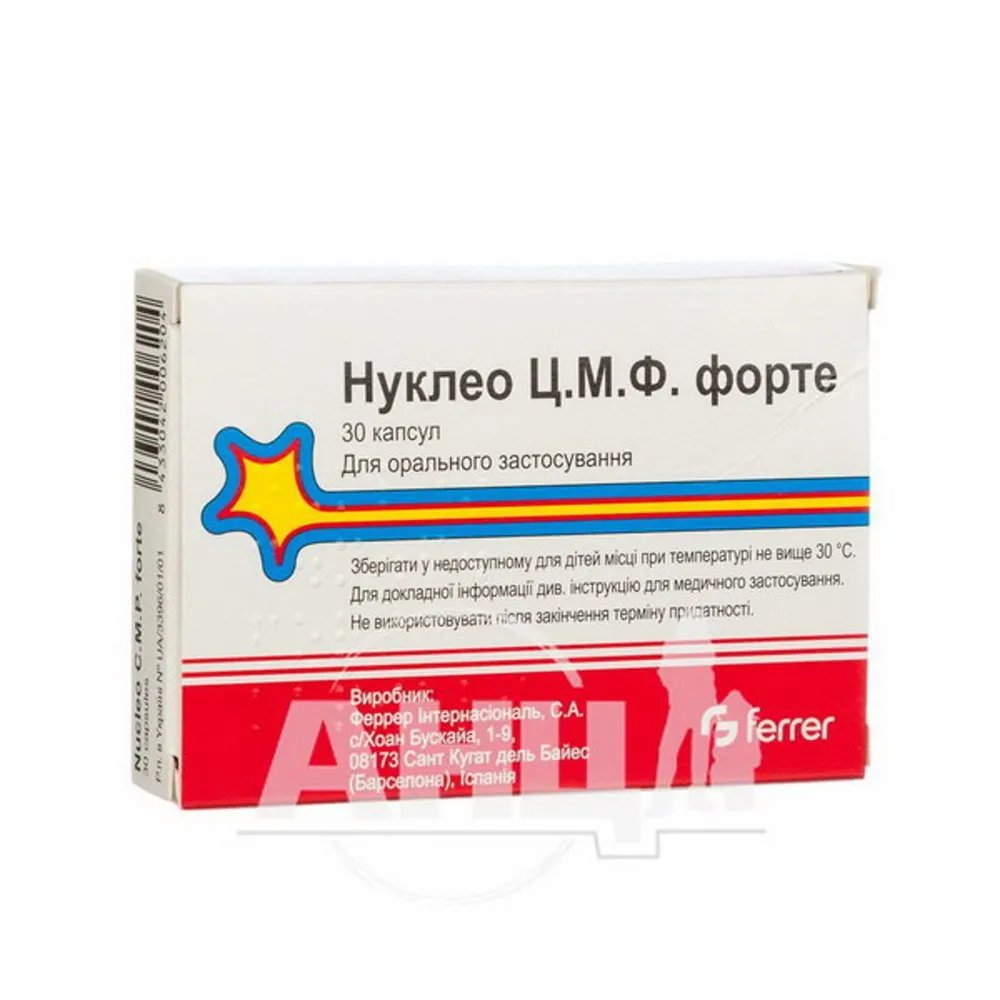
Table of Contents
INSTRUCTIONS FOR MEDICAL USE OF THE MEDICINAL PRODUCT NUCLEO C.M.P. FORTE (NUCLEO C.M.P. FORTE)
Composition:
Active substances: cytidine-5'-disodium monophosphate (CMP disodium salt), uridine-5'-trisodium triphosphate (UTP trisodium salt), uridine-5'-disodium diphosphate (UDP disodium salt), uridine-5'-disodium monophosphate (UMP disodium salt);
1 capsule contains: cytidine-5'-monophosphate disodium salt (CMP disodium salt) 5 mg, uridine-5'-triphosphate trisodium salt (UTP trisodium salt), uridine-5'-diphosphate disodium salt (UDP disodium salt), uridine-5'-monophosphate disodium salt (UMP disodium salt) – total 3 mg (equivalent to 1.330 mg of pure uridine);
Excipients: citric acid anhydrous, sodium citrate, magnesium stearate, colloidal anhydrous silicon dioxide, mannitol (E 421).
Pharmaceutical form. Capsules.
Main physicochemical characteristics: size 2 capsules with blue cap and grey body, containing a white hygroscopic powder.
Pharmacotherapeutic group. Agents affecting the nervous system.
ATC code: N07XX.
Pharmacological Properties
Pharmacodynamics
Nucleo C.M.F. Forte contains nucleotides in its composition: cytidine monophosphate (CMP) and uridine triphosphate (UTP), which are widely used in the treatment of central nervous system (CNS) disorders.
From a biochemical standpoint, the actions of these components are as follows:
CMP participates in the synthesis of a complex of lipids that form the neuronal membrane, primarily sphingomyelin—the main component of the myelin sheath. Additionally, CMP serves as a precursor to nucleic acids (DNA and RNA), which in turn are key elements in cellular metabolism (e.g., in protein synthesis).
UTP acts as a coenzyme in the synthesis of glycolipids, neuronal structures, and the myelin sheath, thereby complementing the action of CMP. Furthermore, UTP serves as an energy source in the process of muscle contraction.
CMP and UTP are involved in the synthesis of phospholipids and glycolipids, which primarily constitute the myelin sheath and other neural structures. This promotes intense metabolic activity, thereby supporting the regeneration of the myelin sheath and regulating demyelination in peripheral nerve injuries. Thus, the combined action of CMP and UTP promotes regeneration of the myelin sheath, proper conduction of nerve impulses, and restoration of muscle trophicity.
Pharmacokinetics
Nucleo C.M.F. Forte contains physiological substances naturally present in biological fluids of the body, making its study more difficult. This is the reason why, due to high radiological burden, investigations have been conducted only in experimental animals using radiolabeled compounds.
The objective of the study was to observe the absorption and pharmacokinetics of UMP, CMP, and UTP.
As a result of the study, the same metabolic pathway was identified for UMP and UTP, showing rapid conversion via uracil into at least one additional polar radioactive fraction.
The CMP compound was rapidly converted into cytosine, uracil, and at least one other polar radioactive fraction. Subsequently, cytosine is primarily converted into uracil. These results indicate that uracil remains metabolized in the blood for the longest period in the presence of cytosine, which was initially formed following CMP administration.
Clinical characteristics.
Indications.
Treatment of osteoarticular (sciatica, radiculitis), metabolic (alcoholic, diabetic polyneuropathy), and infectious origin neuropathies (herpes zoster).
Neuralgia of the facial and trigeminal nerves, intercostal neuralgia, lumbago.
Contraindications.
Hypersensitivity to the components of the drug.
Interaction with other medicinal products and other types of interactions.
Not established.
Special precautions for use
The administration of Nucleo C.M.F. Forte is not related to food intake. Therefore, the drug can be taken before, during, or after meals.
Nucleo C.M.F. Forte contains mannitol, which may exert a mild laxative effect. In patients with gastrointestinal disorders, it is recommended to take Nucleo C.M.F. Forte with food.
Use during pregnancy or breastfeeding
The safety of Nucleo C.M.F. Forte during pregnancy and breastfeeding has not been established.
The use of this medicinal product during pregnancy or breastfeeding is possible only if, in the opinion of the physician, the expected beneficial effect for the woman outweighs the potential risk to the fetus/child.
Ability to influence reaction rate while driving or operating machinery
Nucleo C.M.F. Forte does not affect the ability to drive vehicles or operate complex machinery.
Method of administration and dosage.
The drug should be administered orally, regardless of food intake.
Adults: The recommended dose is 1 capsule three times a day.
The duration of treatment is determined individually by a physician.
Children. There is insufficient data on the use of the drug in children.
Overdose.
Due to the low toxicity of the drug, the risk of poisoning is low even in case of accidental overdose.
In case of overdose, symptomatic treatment is required.
Adverse reactions.
Not described. However, hypersensitivity reactions may occur.
Shelf life. 2 years.
Storage conditions. Keep out of reach of children at a temperature not exceeding 30 °C.
Incompatibility. Not established.
Packaging. 15 capsules per blister, 2 blisters per cardboard box.
Prescription status. Prescription only.
Manufacturer. Ferrer Internacional, S.A.
Location of manufacturer and its registered office address.
Registered office:
Gran Vía Carlos III, 94, 08028 Barcelona, Spain.
Place of manufacture:
c/Joan Busquets, 1-9, 08173 Sant Cugat del Vallès (Barcelona), Spain.