Novonorm
Ukraine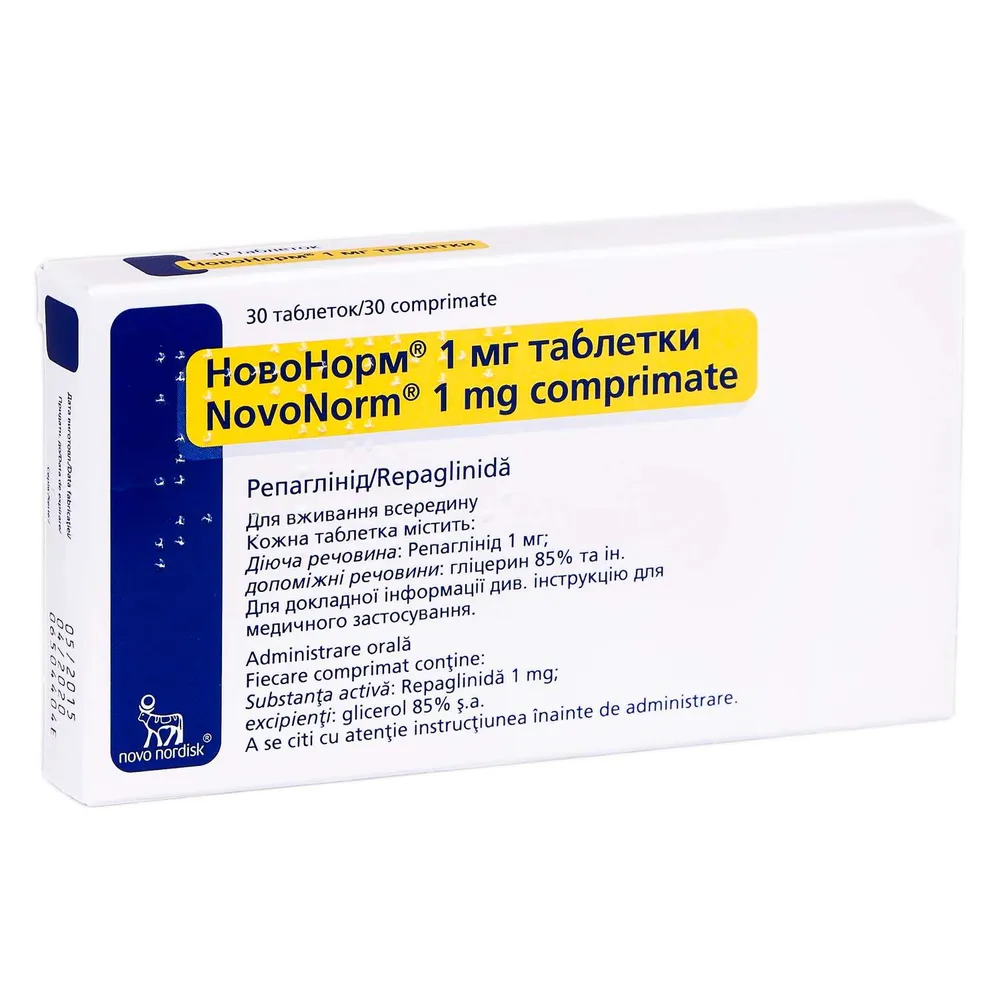
Table of Contents
INSTRUCTIONS FOR MEDICAL USE OF THE MEDICINAL PRODUCT NOVONORM® (NOVONORM®)
Composition:
Active substance: repaglinide;
1 tablet contains:
1 mg tablet – repaglinide 1 mg;
Excipients: microcrystalline cellulose (E 460), calcium hydrogen phosphate, maize starch, potassium polacrilin, povidone K25, glycerol 85%, magnesium stearate, meglumine, poloxamer 188, iron oxide yellow (E 172) – colorant for 1 mg tablets;
2 mg tablet – repaglinide 2 mg;
Excipients: microcrystalline cellulose (E 460), calcium hydrogen phosphate, maize starch, potassium polacrilin, povidone K25, glycerol 85%, magnesium stearate, meglumine, poloxamer 188, iron oxide red (E 172) – colorant for 2 mg tablets.
Pharmaceutical form. Tablets.
Main physicochemical properties:
1 mg tablets: yellow-colored, round, biconvex, one side marked with the Novo Nordisk company symbol;
2 mg tablets: reddish-brown colored, round, biconvex, one side marked with the Novo Nordisk company symbol.
Pharmacotherapeutic group. Antidiabetic agents. Other blood glucose-lowering agents, excluding insulin.
ATC code: A10BX02.
Pharmacological Properties
Pharmacodynamics
Mechanism of action. Repaglinide is a fast-acting oral insulin secretagogue. Repaglinide rapidly reduces blood glucose levels by stimulating insulin secretion from the pancreas, with the drug's effect depending on the number of functioning β-cells in the pancreatic islets.
Repaglinide closes ATP-dependent potassium channels in the β-cell membrane via a specific protein, distinct from other insulin secretagogues. This leads to β-cell depolarization and subsequent opening of calcium channels, increasing intracellular calcium influx, which stimulates insulin secretion.
Effects related to the pharmacodynamic profile of the drug. In patients with type 2 diabetes, an increase in blood insulin concentration occurs within 30 minutes after oral administration of repaglinide. This reduces blood glucose levels throughout the period of food absorption. Elevated insulin levels persist only during the postprandial period. Plasma repaglinide concentrations decline rapidly, with low levels observed in patients with type 2 diabetes within 4 hours after administration.
Clinical efficacy and safety. Following single doses of 0.5 to 4 mg repaglinide in patients with type 2 diabetes, a dose-dependent reduction in glucose levels has been demonstrated. Based on clinical trial results, repaglinide should be taken with main meals (prandial dosing). The drug is usually taken 15 minutes before a meal, although the timing may vary from immediately before the meal up to 30 minutes before eating. In one epidemiological study, an increased risk of acute coronary syndrome was suggested in patients taking repaglinide compared to those taking sulfonylurea agents (see sections "Special Warnings and Precautions for Use" and "Undesirable Effects").
Pharmacokinetics
Absorption. Repaglinide is rapidly absorbed from the gastrointestinal tract, leading to a rapid increase in plasma drug concentration. Peak plasma concentration is reached within 1 hour after administration. After the peak, plasma concentrations decline rapidly. The pharmacokinetics of repaglinide are characterized by a mean absolute bioavailability of 63% (coefficient of variation 11%). Administration of repaglinide immediately before a meal, 15 or 30 minutes before a meal, or in the fasting state does not significantly affect its pharmacokinetic profile. High inter-individual variability (60%) in plasma repaglinide concentrations has been observed in clinical trials; intra-individual variability ranges from low to moderate (35%). Since repaglinide dosing is based on individual clinical response, high inter-patient variability does not affect the drug's efficacy.
Distribution. The pharmacokinetics of repaglinide are characterized by a low volume of distribution of 30 L (consistent with distribution into intracellular fluid). Repaglinide is highly bound (>98%) to human plasma proteins.
Elimination. Repaglinide is rapidly eliminated from blood within 4–6 hours. The elimination half-life is approximately 1 hour. Repaglinide is almost completely metabolized. Its metabolites do not produce any clinically significant glucose-lowering effect.
Repaglinide and its metabolites are primarily excreted via bile. A small fraction (less than 8%) of the administered dose is recovered in urine as metabolites. Less than 1% of the dose is found in feces.
Special patient populations
The effect of repaglinide is increased in patients with hepatic impairment and in elderly patients with type 2 diabetes. AUC (mean error) after a single 2 mg dose (4 mg in patients with hepatic impairment) was 31.4 ng/mL/h (28.3) in healthy volunteers, 304.9 ng/mL/h (228.0) in patients with hepatic impairment, and 117.9 ng/mL/h (83.8) in elderly patients with type 2 diabetes.
After 5 days of treatment with repaglinide (2 mg three times daily) in patients with severe renal impairment (creatinine clearance 20–39 mL/min), results showed a statistically significant twofold increase in exposure (AUC) and elimination half-life (t½) compared to patients with normal renal function.
Children
Data are lacking.
Preclinical safety data
Preclinical data based on studies of pharmacological safety, repeated-dose toxicity, genotoxicity, and carcinogenic potential revealed no hazard to humans.
Animal studies showed that repaglinide has no teratogenic effects. Embryotoxicity and limb malformations were observed in fetuses and newborn rat pups born to rats administered high doses of the drug during late pregnancy and lactation. Repaglinide was detected in the milk of experimental animals.
Clinical characteristics.
Indications.
Type 2 diabetes mellitus (insulin-independent diabetes mellitus), when adequate control of blood glucose levels cannot be achieved with diet, weight reduction, and physical exercise. The use of repaglinide in combination with metformin is also indicated in patients with type 2 diabetes mellitus in whom adequate glycemic control cannot be achieved with metformin monotherapy.
Treatment should be initiated as an adjunct to diet or physical exercise to reduce meal-related blood glucose levels.
Contraindications.
- Hypersensitivity to repaglinide or to any component of the NovoNorm® preparation.
- Type 1 diabetes mellitus (insulin-dependent diabetes mellitus), C-peptide-negative diabetes.
- Diabetic ketoacidosis, with or without coma.
- Pregnancy or lactation period.
- Severe impairment of liver function.
- Concomitant use with gemfibrozil (see section "Interaction with other medicinal products and other forms of interaction").
Interaction with other medicinal products and other forms of interaction.
It is known that a number of drugs may affect the metabolism of repaglinide. The possibility of such interactions should be considered by the physician when prescribing the drug.
In vitro data indicate that repaglinide metabolism is primarily mediated by CYP2C8 and CYP3A4 enzymes. Studies in healthy volunteers have shown that CYP2C8 is the most important enzyme in repaglinide metabolism, while CYP3A4 plays a minor role. However, inhibition of CYP2C8 leads to an increased relative contribution of CYP3A4. Therefore, the metabolism and clearance of repaglinide may be altered when co-administered with drugs that inhibit or induce the activity of cytochrome P450 enzymes. Particular caution should be exercised when repaglinide is used concomitantly with inhibitors of CYP2C8 and CYP3A4. In vitro data also show that repaglinide is actively taken up into hepatocytes via the organic anion transporting protein (OATP1B1). Drugs that inhibit OATP1B1 (e.g., cyclosporine) may potentially increase plasma concentrations of repaglinide.
Drugs that may enhance and/or prolong the hypoglycemic effect of repaglinide.
Gemfibrozil, trimethoprim, rifampicin, ketoconazole, itraconazole, clarithromycin, cyclosporine, deferasirox, clopidogrel, other antidiabetic agents, monoamine oxidase inhibitors, non-selective beta-adrenergic blockers, angiotensin-converting enzyme inhibitors, salicylates, nonsteroidal anti-inflammatory drugs, octreotide, anabolic steroids, alcohol.
Following co-administration of 600 mg gemfibrozil twice daily (an inhibitor of CYP2C8 and OATP1B1) and repaglinide (single dose 0.25 mg), the area under the plasma concentration-time curve (AUC) of repaglinide increased by 8.1-fold and its maximum plasma concentration (Cmax) by 2.4-fold in healthy volunteers. The elimination half-life (t½) increased from 1.3 hours to 3.7 hours, which may enhance and prolong the glucose-lowering effect of repaglinide. When gemfibrozil was administered, plasma concentrations of repaglinide increased 28.6-fold over 7 hours. Concomitant use of gemfibrozil and repaglinide is contraindicated (see section "Contraindications").
No clinically relevant pharmacokinetic interaction was observed between fenofibrate and repaglinide.
Following co-administration of 160 mg trimethoprim twice daily (a weak CYP2C8 inhibitor) and repaglinide (single dose 0.25 mg), the AUC of repaglinide increased by 1.6-fold, Cmax by 1.4-fold, and t½ by 1.2-fold; however, no statistically significant effect on blood glucose levels was observed. Administration of subtherapeutic doses of repaglinide did not produce a pharmacodynamic effect. Since the safety of this combination has not been established for repaglinide doses above 0.25 mg and trimethoprim doses of 320 mg, concomitant use of these drugs should be undertaken with caution. If combination therapy is necessary, careful monitoring of blood glucose levels and the patient's clinical condition is recommended.
Rifampicin, a potent inducer of CYP3A4 and CYP2C8, acts as both an inducer and inhibitor of repaglinide metabolism. Administration of 600 mg rifampicin daily for 7 days, with addition of repaglinide (single dose 4 mg) on day 7, resulted in a 50% reduction in AUC (a result of combined induction and inhibition). When repaglinide was administered 24 hours after the last dose of rifampicin, the AUC decreased by 80% (result of induction only). During concomitant treatment with rifampicin and repaglinide, the repaglinide dose should be adjusted based on careful monitoring of blood glucose levels at the following time points: at the start of rifampicin treatment (acute inhibition), after several days of rifampicin (combined induction and inhibition), after discontinuation of rifampicin (induction only), and 2 weeks after stopping rifampicin, when its inductive effect has subsided. Other inducers such as phenytoin, carbamazepine, phenobarbital, and St. John’s wort may have similar effects.
The effect of ketoconazole (a potent competitive CYP3A4 inhibitor) on the pharmacokinetics of repaglinide was studied in healthy volunteers. Administration of 200 mg ketoconazole twice daily together with repaglinide (single dose 4 mg) increased the AUC and Cmax of repaglinide by 1.2-fold, while the glucose concentration profile changed by less than 8%.
Concomitant use of 100 mg itraconazole (a CYP3A4 inhibitor) was also studied in healthy volunteers. It was shown that the AUC of repaglinide increased by 1.4-fold. No clinically significant changes in blood glucose levels were observed.
When 250 mg clarithromycin (a CYP3A4 inhibitor) was administered concomitantly with repaglinide in healthy volunteers, the AUC of repaglinide increased by 1.4-fold and Cmax by 1.7-fold. The area under the curve for serum insulin concentration (AUC) increased by 1.5-fold (Cmax by 1.6-fold). The mechanism of this interaction has not yet been elucidated.
A study in healthy volunteers receiving repaglinide (single dose 0.25 mg) showed that cyclosporine (repeated 100 mg doses), an inhibitor of CYP3A4 and OATP1B1, increased the maximum concentration of repaglinide by 1.8-fold and the AUC by 2.5-fold. Since the safety of this combination has not been established for repaglinide doses above 0.25 mg, concomitant use of these drugs should be avoided. If combination therapy is necessary, careful monitoring of blood glucose levels and the patient's clinical condition is recommended.
Concomitant administration of deferasirox (a moderate inhibitor of CYP2C8 and CYP3A4) at a dose of 30 mg/kg body weight per day for 4 days and repaglinide (single dose 0.5 mg) in healthy volunteers resulted in a 2.3-fold increase in repaglinide exposure (AUC [90% confidence interval: 2.03–2.63]) and a 1.6-fold increase in Cmax (90% confidence interval: 1.42–1.84), leading to a small but statistically significant reduction in blood glucose levels. Since interactions at higher repaglinide doses (>0.5 mg) have not been established, concomitant use should be avoided. If combination therapy is necessary, careful monitoring of blood glucose levels and the patient's clinical condition is recommended (see section "Special precautions for use").
Concomitant administration of the CYP2C8 inhibitor clopidogrel (loading dose 300 mg) increased the AUC0–∞ of repaglinide by 5.1-fold, and continued administration (75 mg daily) increased the AUC0–∞ by 3.9-fold. A small but statistically significant decrease in blood glucose levels was observed. If repaglinide and clopidogrel are used concomitantly, careful monitoring of the patient's clinical condition and blood glucose levels is required (see section "Special precautions for use").
Beta-adrenergic blockers may mask symptoms of hypoglycemia.
Concomitant administration of cimetidine, nifedipine, estrogen, or simvastatin (substrates of CYP3A4) with repaglinide does not significantly affect its pharmacokinetic parameters.
Drug interaction studies conducted in healthy volunteers have shown that repaglinide does not clinically significantly affect the pharmacokinetics of digoxin, theophylline, or warfarin. Therefore, dose adjustment is not required when these drugs are used concomitantly with repaglinide.
Drugs that may reduce the hypoglycemic effect of repaglinide.
Oral contraceptives, rifampicin, barbiturates, carbamazepine, thiazides, corticosteroids, danazol, thyroid hormones, and sympathomimetics. When initiating or discontinuing these drugs in patients taking repaglinide, careful monitoring of glycemic levels is necessary. During concomitant use of repaglinide with other medicinal products that, like repaglinide, are primarily excreted via bile, any potential interactions should be considered.
Children
No drug interaction studies have been conducted in children and adolescents.
Special precautions for use
Repaglinide should be prescribed when blood glucose levels are inadequately controlled by diet, physical exercise, and weight reduction.
If a patient who has previously achieved stable glycemic control with oral antidiabetic agents experiences stress (fever, trauma, infection, or surgery), glycemic control may deteriorate. In such cases, it may be necessary to discontinue repaglinide and temporarily initiate insulin therapy.
Hypoglycemia
Repaglinide, like other insulin secretagogues, may cause hypoglycemia.
Combination with insulin secretagogues
In many patients, the hypoglycemic effect of oral antidiabetic agents decreases with prolonged use. This may be due to progression of diabetes severity or reduced responsiveness to the drug. This phenomenon is known as secondary failure and should be differentiated from primary failure, in which the patient does not respond to the drug upon initial administration. Before diagnosing secondary failure, it is essential to attempt dose adjustment and verify the patient’s adherence to dietary and exercise recommendations.
Repaglinide acts via a specific binding site, exerting a short-term effect on β-cells. The use of repaglinide in patients with secondary failure to insulin secretagogues has not been studied in clinical trials.
Studies investigating the combination of repaglinide with other insulin secretagogues have not been conducted.
Combination therapy with neutral protamine Hagedorn (NPH insulin) or thiazolidinediones.
Studies on combination therapy with NPH insulin or thiazolidinediones have been conducted. However, a risk-benefit assessment is required for other types of combination therapy.
Combination therapy with metformin.
When used in combination with metformin, the risk of hypoglycemia is increased.
Acute coronary syndrome.
Treatment with repaglinide may be associated with an increased risk of acute coronary syndrome (e.g., myocardial infarction); see sections "Adverse reactions" and "Pharmacodynamic properties".
Combination therapy
Repaglinide should be used with caution or avoided altogether in patients receiving concomitant medications that affect repaglinide metabolism (see section "Interaction with other medicinal products and other forms of interaction"). If combination therapy is necessary, careful monitoring of blood glucose levels and the patient’s clinical condition is required.
Special patient populations
Elderly patients. Clinical studies have not included patients aged 75 years and older.
Renal impairment. Renal impairment does not significantly affect repaglinide pharmacokinetics. Approximately 8% of the repaglinide dose is excreted by the kidneys, and total clearance of repaglinide is reduced in renal impairment. Since patients with diabetes complicated by renal impairment have increased insulin sensitivity, caution is required when adjusting the dose.
Hepatic impairment. Clinical studies in patients with hepatic impairment have not been conducted.
Frail and undernourished patients. Initial and maintenance dosing, as well as dose titration, should be performed particularly carefully in frail and undernourished patients to prevent hypoglycemia.
Patients previously treated with other oral hypoglycemic agents
Patients may be directly switched from other oral antidiabetic agents to repaglinide. However, no exact dose equivalence between repaglinide and other oral antidiabetic agents has been established. The maximum recommended initial dose for patients being switched to repaglinide is 1 mg before each main meal.
If blood glucose levels are inadequately controlled with metformin or thiazolidinediones, repaglinide may be added. In such cases, the dose of metformin should remain unchanged, and repaglinide should be initiated concomitantly. The starting dose of repaglinide is 0.5 mg. Dose titration should be based on blood glucose concentrations.
Use during pregnancy or breastfeeding
Pregnancy. Repaglinide has not been studied in pregnant women. Repaglinide should be avoided during pregnancy.
Breastfeeding. Repaglinide has not been studied in breastfeeding women. Repaglinide should not be used in women who are breastfeeding.
Fertility. Information on reproductive toxicity studies in animals is provided in the section "Preclinical safety data".
Effect on ability to drive and use machines.
NovoNorm® has no direct effect on the ability to drive or operate machinery; however, it may cause hypoglycemia.
Patients should be advised to take preventive measures to avoid hypoglycemia while driving. This is particularly important for patients with impaired awareness of hypoglycemia symptoms or those who frequently experience hypoglycemic episodes. In such cases, the appropriateness of driving should be carefully evaluated.
Administration and Dosage
Dosage
Repaglinide is taken orally before each main meal (i.e., preprandially). The dose should be individually adjusted to achieve optimal glycemic control. In addition to patient self-monitoring of blood and/or urine glucose levels, the physician should periodically monitor blood glucose concentrations to determine the minimum effective dose of the drug. Glycated hemoglobin levels are also an informative indicator for monitoring the patient's response to treatment. Periodic monitoring is necessary to detect inadequate reduction in blood glucose concentration when the maximum recommended dose is used (i.e., primary failure), as well as to identify the absence of an appropriate blood glucose-lowering response after an initially effective treatment period (i.e., secondary failure).
For patients with type 2 diabetes who usually maintain good glucose control through diet alone but experience temporary loss of glycemic control, a short course of repaglinide therapy may be sufficient.
Initial Dose
Dosage adjustment is performed by the physician according to the patient's response. The recommended initial dose is 0.5 mg. Dose titration should begin after 1–2 weeks, guided by blood glucose levels as an indicator of treatment response. If a patient is being switched to repaglinide from another oral antidiabetic agent, the recommended initial dose is 1 mg.
Maintenance Therapy
The maximum recommended single dose before main meals is 4 mg. The maximum daily dose should not exceed 16 mg.
Administration
The drug should be taken orally, usually 15 minutes before the start of a meal; however, the time of administration may vary from immediately before meals to up to 30 minutes before eating (i.e., preprandially with two-, three-, or four-times-daily meals). If a patient skips a meal (or eats an additional meal), the corresponding dose should be skipped (or added).
Children
Repaglinide is not recommended for use in children (under 18 years of age) due to insufficient data on safety and efficacy in this patient group.
Overdose
Repaglinide was administered over a 6-week period in weekly increasing doses from 4 to 20 mg four times daily. No safety concerns were recorded. Since the risk of hypoglycemia was mitigated in this study by increased caloric intake, relative overdose could lead to pronounced reduction in blood glucose concentration and development of hypoglycemic symptoms (dizziness, sweating, tremor, headache). In case such symptoms occur, appropriate measures should be taken to normalize blood glucose levels (e.g., carbohydrate intake). In cases of more severe hypoglycemia accompanied by seizures, loss of consciousness, or coma, intravenous glucose must be administered.
Adverse reactions.
Safety data
The most commonly observed adverse effects are related to changes in blood glucose levels, such as hypoglycemia. The frequency of such reactions depends on individual patient characteristics: dietary habits, drug dosage, level of physical activity, and stress.
List of adverse reactions
Based on experience with repaglinide and other antidiabetic agents, the following adverse effects may occur:
frequently (≥1/100 to <1/10);
infrequently (≥1/1000 to <1/100);
rarely (≥1/10,000 to <1/1,000);
very rarely (<1/10,000);
frequency not known (cannot be estimated from available data).
Immune system disorders
Very rarely: allergic reactions.*
Metabolism and nutrition disorders
Frequently: hypoglycemia.
Frequency not known: hypoglycemia with loss of consciousness and hypoglycemic coma.
Eye disorders
Very rarely: visual disturbances (refraction abnormalities).*
Cardiovascular disorders
Rarely: cardiac disorders.
Gastrointestinal disorders
Frequently: abdominal pain, diarrhea.
Very rarely: vomiting, constipation.
Frequency not known: nausea.
Hepatobiliary disorders
Very rarely: liver function abnormalities, increased liver enzymes.*
Skin and subcutaneous tissue disorders
Frequency not known: hypersensitivity reactions.*
*See section "Description of selected adverse reactions".
Description of selected adverse reactions
Allergic reactions.
Generalized hypersensitivity reactions (e.g. anaphylactic reactions) or immune-mediated reactions such as vasculitis.
Visual disturbances (refraction abnormalities).
Fluctuations in blood glucose levels may lead to temporary disturbances in visual acuity, particularly at the beginning of treatment. Such disturbances have been reported only very rarely following initiation of repaglinide therapy. In clinical trials, these cases did not lead to discontinuation of repaglinide treatment.
Liver function abnormalities, increased liver enzymes.
Isolated cases of elevated liver enzymes have been observed during treatment with repaglinide. In most cases, these elevations were mild and transient, and very few patients had to discontinue treatment due to increased liver enzymes. Severe liver dysfunction has been observed very rarely.
Hypersensitivity reactions.
Hypersensitivity reactions to the drug may manifest as redness, itching, rash, and urticaria. Due to the different chemical structure, cross-allergic reactions with sulfonylurea drugs are unlikely.
Shelf life. 5 years.
Do not use the medicinal product after the expiry date stated on the packaging.
Storage conditions. Store in the original packaging at a temperature not exceeding 25 °C.
Keep out of reach and sight of children.
Packaging. 15 tablets in a blister pack made of aluminum foil on both sides; 2 or 6 blisters per cardboard box.
Prescription status. Prescription only.
Manufacturer/Applicant. A/T Novo Nordisk, Denmark / Novo Nordisk A/S, Denmark.
Manufacturer's address and location of applicant.
Novo Allé, Bagsværd, 2880, Denmark.