No-spa
Ukraine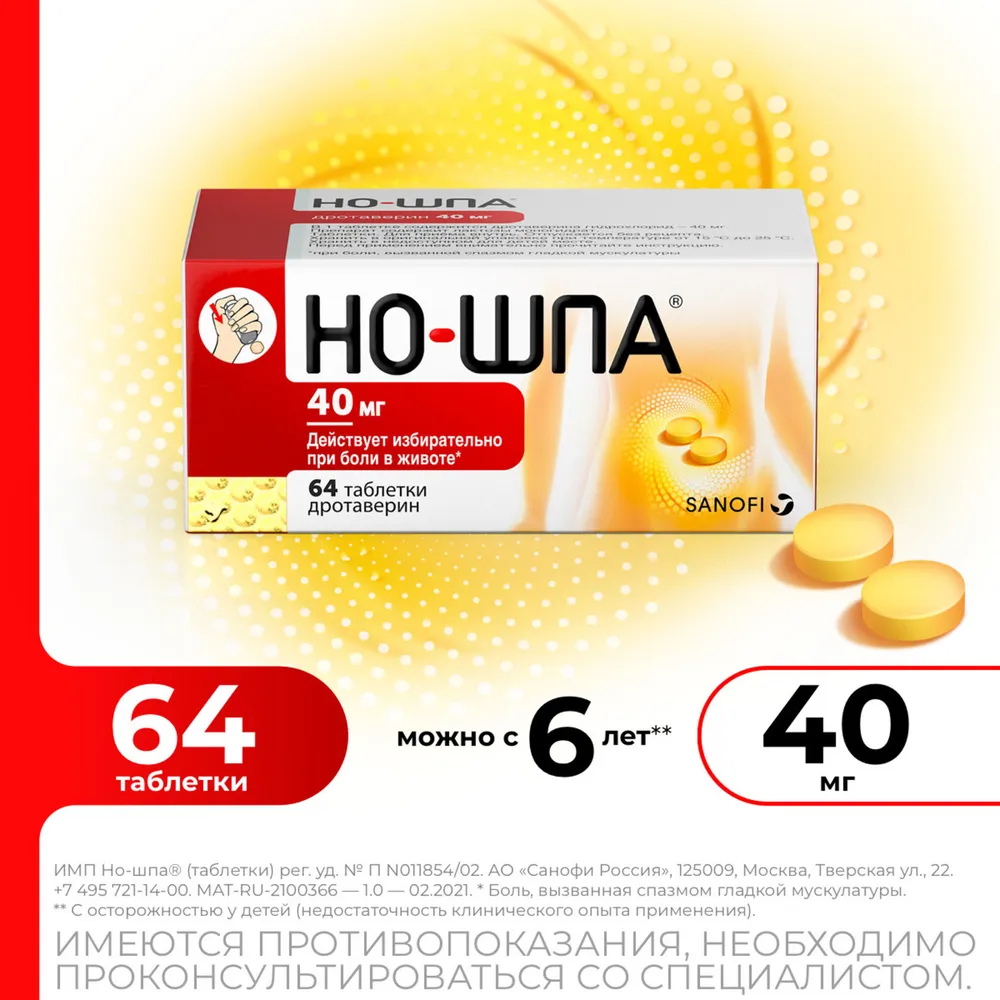
Table of Contents
INSTRUCTION FOR MEDICAL USE OF THE MEDICINAL PRODUCT NO-SPAÒ (NO-SPAÒ)
Composition:
Active substance: drotaverine;
1 tablet contains drotaverine hydrochloride 40 mg;
Excipients: magnesium stearate, talc, povidone, corn starch, lactose monohydrate.
Pharmaceutical form. Tablets.
Main physicochemical properties: yellow round convex tablets with a greenish or orange tint; with "spa" embossing on one side.
Pharmacotherapeutic group. Drugs used in functional gastrointestinal disorders. ATC code A03A D02.
Pharmacological properties.
Pharmacodynamics.
Drotaverine is an isoquinoline derivative that exerts a spasmolytic effect directly on smooth muscle by inhibiting the enzyme phosphodiesterase IV (PDE IV), leading to increased intracellular cAMP concentration. This results in inactivation of myosin light chain kinase (MLCK), thereby causing relaxation of smooth muscle.
In vitro, drotaverine inhibits the activity of PDE IV and does not affect the isoenzymes phosphodiesterase III (PDE III) and phosphodiesterase V (PDE V). PDE IV plays a significant functional role in reducing contractile activity of smooth muscles; therefore, selective inhibitors of this enzyme may be beneficial in treating diseases associated with hypermotility, as well as various conditions involving gastrointestinal tract spasms.
In smooth muscle cells of the myocardium and blood vessels, cAMP is predominantly hydrolyzed by the isoenzyme PDE III; hence, drotaverine acts as an effective spasmolytic agent without significant adverse effects on the cardiovascular system or strong therapeutic effects on this system.
Drotaverine is effective against smooth muscle spasms of both neural and myogenic origin. It acts on the smooth musculature of the gastrointestinal, biliary, genitourinary, and vascular systems independently of their type of autonomic innervation.
It enhances tissue blood flow due to its vasodilatory properties.
The effect of drotaverine is stronger than that of papaverine, with faster and more complete absorption, and it exhibits lower plasma protein binding. An additional advantage of drotaverine is that, unlike papaverine, it does not cause respiratory stimulation as a side effect following parenteral administration.
Pharmacokinetics.
Absorption. Drotaverine is rapidly absorbed after both oral administration and parenteral injection.
Distribution. It has a high degree of binding to plasma albumins (95–98%) and to alpha- and beta-globulins. Maximum serum concentration is reached within 45–60 minutes after oral administration.
Biotransformation. After first-pass metabolism, 65% of the administered dose enters systemic circulation unchanged. It is metabolized in the liver.
Elimination. The elimination half-life is 8–10 hours. Within 72 hours, drotaverine is almost completely eliminated from the body: more than 50% is excreted in urine and approximately 30% in feces. Drotaverine is mainly excreted in the form of metabolites; the unchanged form is not detected in urine.
Clinical characteristics.
Indications. Smooth muscle spasms associated with biliary tract disorders: cholelithiasis, cholangiolithiasis, cholecystitis, pericholecystitis, cholangitis, papillitis.
Smooth muscle spasms in urinary tract disorders: nephrolithiasis, ureterolithiasis, pyelitis, cystitis, bladder tenesmus.
As adjunctive therapy:
- in smooth muscle spasms of the gastrointestinal tract: peptic ulcer of the stomach and duodenum, gastritis, cardio- and/or pylorospasm, enteritis, colitis, spastic colitis with constipation and irritable bowel syndrome accompanied by meteorism;
- tension headache;
- in gynecological disorders: dysmenorrhea.
Contraindications.
Hypersensitivity to drotaverine or to any component of the drug. Severe hepatic, renal or cardiac insufficiency (low cardiac output syndrome).
Special safety precautions.
Use with special caution in arterial hypotension.
Each No-shpa® tablet contains 52 mg of lactose. Do not use in patients suffering from rare hereditary disorders such as galactose intolerance, Lapp lactase deficiency, or glucose-galactose malabsorption syndrome.
Interaction with other medicinal products and other types of interactions.
Phosphodiesterase inhibitors, such as papaverine, reduce the antiparkinsonian effect of levodopa. No-shpa® should be used with caution concomitantly with levodopa, as the antiparkinsonian effect of the latter is diminished and rigidity and tremor are intensified.
Special precautions for use.
Use with special caution in patients with arterial hypotension.
Each No-shpa® tablet contains 52 mg of lactose. Do not use in patients with rare hereditary disorders such as galactose intolerance, Lapp lactase deficiency, or glucose-galactose malabsorption syndrome.
Use during pregnancy or breastfeeding.
Pregnancy. Retrospective clinical studies and animal studies have shown that oral administration of the drug did not cause any signs of direct or indirect effects on pregnancy, embryonic development, labor, or postnatal development. Nevertheless, the drug should be prescribed with caution to pregnant women.
Breastfeeding. Due to lack of data during breastfeeding, use of the drug is not recommended.
Fertility.
There are no data available regarding the effect on human fertility.
Ability to influence reaction speed when driving or operating machinery.
If patients experience dizziness after taking the drug, they should avoid potentially hazardous activities such as driving a car or performing tasks requiring high concentration.
Dosage and Administration
Adults: The recommended dose is 120–240 mg per day in 2–3 divided doses.
Children: The use of drotaverine in children has not been studied in clinical trials; however, if the use of drotaverine is necessary, then:
for children aged 6–12 years the maximum daily dose is 80 mg (divided into 2 doses);
for children aged 12 years and older the maximum daily dose is 160 mg (divided into 2–4 doses).
There are no data on the use of the drug in children under 6 years of age.
Before using No-shpa® tablets from the dosing container, it is necessary to remove the protective strip under the cap and the protective label at the bottom of the container.
Children. The use of the drug is contraindicated in children under 6 years of age.
Clinical studies on the use of the drug in children have not been conducted.
Overdose.
Symptoms: in cases of significant drotaverine overdose, disturbances in cardiac rhythm and conduction have been observed, including complete bundle branch block and cardiac arrest, which may be fatal.
In case of overdose, the patient must be under close medical supervision and receive symptomatic treatment, including induction of vomiting and/or gastric lavage.
Adverse reactions.
Adverse reactions observed during clinical trials and possibly caused by drotaverine, classified by organ system and frequency of occurrence: very common (> 1/10), common (> 1/100, < 1/10), uncommon (> 1/1000, < 1/100), rare (> 1/10,000, < 1/1000), very rare (< 1/10,000), frequency not known: cannot be estimated based on available data.
Immune system disorders. Rare: allergic reactions, including angioneurotic edema, urticaria, rash, pruritus, skin hyperemia, chills, fever, weakness.
Cardiovascular system disorders. Rare: tachycardia, arterial hypotension.
Nervous system disorders. Rare: headache, dizziness, insomnia.
Gastrointestinal disorders. Rare: nausea, constipation, vomiting.
Shelf life. 3 years.
Storage conditions. Keep out of reach of children.
Store in the original packaging at a temperature not exceeding +25 °C.
Packaging.
No. 12: 12 tablets in a blister, 1 blister per cardboard box.
No. 24: 24 tablets in a blister, 1 blister per cardboard box.
No. 60: 60 tablets in a dosing container closed with a cap and a tamper-evident seal, 1 dosing container per cardboard box.
No. 100: 100 tablets in a bottle, 1 bottle per cardboard box with a tamper-evident label on the box.
Marketing authorization holder category. Over-the-counter.
Manufacturer. HINOIN Pharmaceutical and Chemical Products Private Ltd. Enterprise 2 (Vereshegyháza Enterprise).
Sanofi-Aventis Sp. z o.o.
Manufacturer's address and place of business.
Levai u. 5, Vereshegyháza, 2112, Hungary.
52 Lubelska Street, 35-233 Rzeszów, Poland.
Marketing authorization holder.
Opella Healthcare Ukraine LLC, Ukraine.
Address of the marketing authorization holder and/or its representative.
48-50A Zhylianska Street, Kyiv, 01033, Ukraine.