Nivalin
Ukraine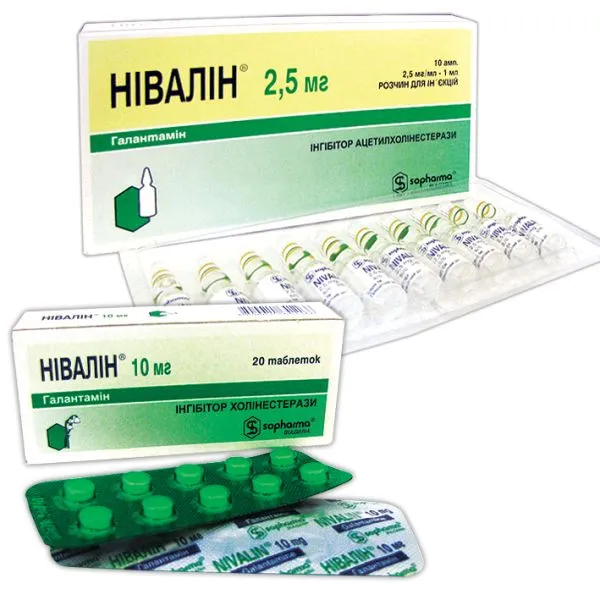
Table of Contents
INSTRUCTIONS FOR MEDICAL USE OF THE MEDICINAL PRODUCT NIVALIN (NIVALIN®)
Composition:
Active substance: galantamine;
1 tablet contains 5 mg or 10 mg of galantamine hydrobromide;
Excipients:
for 5 mg tablets: lactose monohydrate, wheat starch, talc, magnesium stearate, microcrystalline cellulose, calcium hydrogen phosphate;
for 10 mg tablets: lactose monohydrate, wheat starch, talc, magnesium stearate, microcrystalline cellulose.
Pharmaceutical form. Tablets.
Main physicochemical properties: flat, round tablets, bevelled on both sides, with a dividing line, 6 mm in diameter, white to almost white in colour.
The tablet can be divided into two equal halves.
Pharmacotherapeutic group.
Drugs used in dementia. Cholinesterase inhibitors. Galantamine.
ATC code N06DA04.
Pharmacological Properties
Pharmacodynamics
Galantamine belongs to the group of tertiary alkaloids and indirect-acting parasympathomimetics. It is a selective, competitive, and reversible inhibitor of the enzyme acetylcholinesterase. It increases the level of acetylcholine in the central nervous system (CNS). In addition to its action as a reversible inhibitor of acetylcholinester
Clinical characteristics.
Indications.
The drug is indicated for the treatment of:
- Mild or moderate Alzheimer's type dementia;
- Diseases of the peripheral nervous system (polyradiculoneuritis, radiculoneuritis, neuritis, polyneuritis, polyneuropathies);
- Conditions associated with damage to the anterior horns of the spinal cord (post-polio, myelitis, spinal muscular atrophy);
- Cerebral palsy (post-stroke condition, cerebral palsy in children);
- Neuromuscular junction disorders (myasthenia gravis, muscular dystrophy).
Contraindications.
- Hypersensitivity to the active substance galantamine hydrobromide or to any of the excipients of the medicinal product;
- Severe renal impairment (creatinine clearance below 9 mL/min);
- Severe hepatic impairment (> 9 points according to Child-Pugh classification (Child-Pugh));
- Bronchial asthma;
- Chronic obstructive pulmonary disease;
- Bradycardia;
- AV block;
- Arterial hypertension;
- Heart failure / severe heart failure (NYHA class III-IV);
- Ischemic heart disease / angina pectoris;
- Epilepsy;
- Hyperkinesis;
- Mechanical intestinal obstruction / obstructive diseases or recent surgical interventions on gastrointestinal tract organs;
- Mechanical urinary tract obstruction / obstructive diseases or recent surgical interventions on urinary tract organs.
Interaction with other medicinal products and other types of interactions.
Pharmacodynamic interactions.
Nivalin antagonizes the respiratory center depressant effect of morphine and its analogs.
When galantamine is used concomitantly with other cholinomimetics (such as ambenonium, donepezil, neostigmine, pyridostigmine, or systemic pilocarpine), an enhanced cholinomimetic effect may be observed; therefore, they should not be used simultaneously.
Galantamine antagonizes the anticholinergic effects of M-cholinolytics (atropine and other similar medicinal products), hexamethonium and other ganglion blockers, non-depolarizing muscle relaxants.
Pharmacodynamic interactions are possible when galantamine is used concomitantly with medicinal products that slow heart rate, such as, for example, digoxin, beta-blockers, calcium channel blockers, and amiodarone.
Procainamide, whose therapeutic effect is partly due to its anticholinergic activity, should not be used concomitantly with galantamine, as it may reduce its therapeutic effect.
Aminoglycosides (gentamicin, amikacin) may reduce the therapeutic effect of galantamine on neuromuscular conduction.
Enhanced effect of depolarizing neuromuscular blockers (succinylcholine) may occur when used concomitantly with galantamine, especially in cases of pseudocholinesterase deficiency.
Pharmacokinetic interactions.
Multiple metabolic pathways and renal excretion are involved in the elimination of galantamine. The likelihood of clinically significant interactions is low. Nevertheless, the occurrence of significant interactions may be clinically relevant in individual cases.
Concomitant intake with food slows the absorption rate of galantamine, but does not affect the extent of its absorption. It is recommended to take the medicinal product with food to reduce possible undesirable cholinergic effects.
Galantamine is metabolized by hepatic isoenzymes CYP3A4 and CYP2D6. Medicinal products metabolized by identical isoenzymes may interact with galantamine at the pharmacokinetic level. Clinical drug interaction studies have shown that paroxetine (a potent CYP2D6 inhibitor), ketoconazole, and erythromycin (CYP3A4 inhibitors) increase galantamine bioavailability when used concomitantly.
Concomitant use of galantamine with CYP2D6 inhibitors (quinidine, paroxetine, fluoxetine) or CYP3A4 inhibitors (ketoconazole, zidovudin, ritonavir, erythromycin) may affect galantamine metabolism and lead to increased plasma concentration and, consequently, bioavailability. In such cases, there is an increased risk of adverse reactions; therefore, a reduction in the maintenance dose of galantamine is recommended.
Cimetidine may increase galantamine bioavailability.
Galantamine does not affect the pharmacokinetics of warfarin.
Special precautions for use.
Cardiac disorders.
Due to its pharmacological action, galantamine, as a parasympathomimetic agent, may cause vagotonic effects on heart rhythm (bradycardia, AV block). Therefore, galantamine should be prescribed with caution in patients with sick sinus syndrome or other supraventricular cardiovascular conduction disorders; in patients concurrently receiving drugs that significantly slow heart rate, such as digoxin or beta-blockers; and in patients with uncorrected electrolyte imbalances (hyperkalemia or hypokalemia). Hence, special caution is required when administering galantamine to patients with cardiovascular diseases, such as: recent myocardial infarction, newly diagnosed atrial fibrillation, second- or higher-degree heart block, unstable angina, or congestive heart failure, particularly NYHA class III-IV. In such patients, pulse rate should be monitored more frequently.
Cases of QTc interval prolongation have been reported in patients receiving therapeutic doses of galantamine, as well as cases of torsade de pointes associated with overdose (see section "Overdose"). Therefore, galantamine should be used with caution in patients with QTc interval prolongation, in patients receiving medications known to affect the QTc interval, and in patients with underlying cardiac conditions or electrolyte disturbances.
According to a pooled analysis of placebo-controlled trials, patients with Alzheimer's dementia treated with galantamine showed an increased incidence of certain cardiovascular adverse events (see section "Adverse reactions").
Treatment with Nivalin carries a risk of syncope; therefore, blood pressure should be monitored more frequently, especially when higher doses are used (40 mg daily dose). To prevent such adverse reactions, careful dose titration at the beginning of treatment is essential.
Gastrointestinal disorders.
Due to its cholinomimetic action, galantamine may enhance gastric secretion and cause gastrointestinal side effects. The drug should be prescribed with caution in patients with peptic ulcer disease of the stomach or duodenum, or in those at increased risk of developing erosive or ulcerative gastrointestinal lesions. Higher risk exists in patients with a history of peptic ulcer disease, during the postoperative recovery period following gastric surgery, and in patients concurrently receiving nonsteroidal anti-inflammatory drugs (NSAIDs). During galantamine treatment, these patients should be monitored for signs of active or occult gastrointestinal bleeding.
Galantamine is not recommended for patients with gastrointestinal obstruction or those recovering from gastrointestinal surgery.
Nervous system disorders.
Parasympathomimetic agents are known to potentially induce seizures. Increased seizure activity has been observed in patients with Alzheimer's disease. In some cases, parasympathomimetics may increase cholinergic tone and exacerbate symptoms of parkinsonism.
Serious skin reactions.
Serious skin reactions (Stevens-Johnson syndrome and acute generalized exanthematous pustulosis) have been reported in patients receiving galantamine. Patients should be informed about the signs of serious skin reactions, and galantamine should be discontinued at the first appearance of a skin rash.
Respiratory, thoracic and mediastinal disorders.
Galantamine should be used with caution in patients with chronic obstructive pulmonary disease (COPD) or active lung infections (e.g., pneumonia).
Renal and urinary disorders.
Galantamine is not recommended for patients with urinary retention or those who have recently undergone surgery involving resection of the prostate or bladder.
Surgical and medical procedures.
Cholinomimetics may potentiate the effects of succinylcholine-type neuromuscular blockers during anesthesia.
During treatment with cholinesterase inhibitors, including galantamine, weight loss may occur in some patients. In such cases, patient weight should be monitored.
Galantamine should be used with caution and at lower doses in patients with mild renal impairment, depending on creatinine clearance values.
The medicinal product contains wheat starch as an excipient. It may contain only trace amounts of gluten and is therefore considered safe for individuals with gluten enteropathy (celiac disease).
The product should not be administered to patients with wheat allergy (distinct from celiac disease).
The product contains lactose as an excipient and may be hazardous for patients with rare hereditary forms of galactose intolerance, Lapp lactase deficiency, or glucose-galactose malabsorption—patients should not use this medicinal product.
Use during pregnancy or breastfeeding.
There are no clinical data on the safety of galantamine in pregnant women; therefore, the use of this medicinal product during pregnancy is not recommended.
There are no data on the passage of galantamine into breast milk. Clinical studies have not been conducted in breastfeeding women; therefore, the use of this product during breastfeeding is not recommended.
Animal studies have not shown any direct or indirect harmful effects on pregnancy, embryonic/fetal development, parturition, or postnatal development.
Ability to affect reaction speed when driving or operating machinery.
Nivalin has a mild to moderate effect on the ability to drive and operate machinery requiring rapid mental and physical responses. It may cause visual disturbances, dizziness, and somnolence, particularly at the beginning of treatment. Therefore, Nivalin should be prescribed with caution after careful assessment of the potential risk. In such cases, patients are advised to refrain from driving and operating machinery until these symptoms subside.
Dosage and Administration.
Nivalin, tablets, should be taken orally during meals. Adequate fluid intake must be ensured during treatment.
The dosage and duration of galantamine therapy depend on the nature and course of the disease and the individual patient's sensitivity to treatment.
Disorders of the peripheral and central nervous systems; neuromuscular junction disorders.
Adults.
The usual dose is 10–40 mg, divided into 2–4 doses per day.
Children.
The recommended daily dose for children is:
- 6 to 8 years of age – 5–10 mg per day;
- 9 to 11 years of age – 5–15 mg per day;
- 12 to 15 years of age – 5–25 mg per day.
Alzheimer's disease.
Nivalin, tablets, should be taken twice daily, preferably with morning and evening meals.
Initial dose. The recommended initial dose is 5 mg twice daily for 4 weeks.
Maintenance dose. After completing the 4-week treatment period, the dose may be increased to achieve a maintenance dose of 20 mg per day, divided into two doses (10 mg twice daily). The dose should be increased according to the clinical picture and individual patient response.
Duration of treatment.
The duration of treatment varies widely—from several weeks to several years—and depends on the nature and progression of the disease and the individual patient's tolerance. If adverse reactions occur, the dose should be reduced or treatment discontinued for 2–3 days, after which treatment may be resumed at a lower dose. If treatment is discontinued for a prolonged period, re-initiation of Nivalin therapy should begin at the lowest dose, gradually increasing to the optimal maintenance dose.
Patients with hepatic impairment.
In patients with moderate hepatic impairment (7–9 points on the Child-Pugh classification), plasma concentrations of galantamine may increase; therefore, a reduction of the daily dose to 15 mg is recommended.
Galantamine is contraindicated in patients with severe hepatic impairment (>9 points on the Child-Pugh classification). Dose adjustment is not required in patients with mild hepatic impairment.
Patients with renal impairment.
Galantamine and its metabolites are excreted via the kidneys.
Dosage adjustment of Nivalin is not required in patients with creatinine clearance greater than 9 mL/min. In patients with moderate renal impairment, the dose should not exceed 15 mg per day.
Nivalin is contraindicated in patients with severe renal impairment (creatinine clearance below 10 mL/min).
Concomitant therapy.
If a patient is receiving strong inhibitors of CYP2D6 or CYP3A4 enzymes, a reduction in the dose of Nivalin may be necessary (see section "Interaction with other medicinal products and other forms of interaction").
Children.
The drug should not be used for the treatment of children under 6 years of age.
Overdose.
Symptoms: Galantamine overdose symptoms are similar to those of other parasympathomimetics. These effects typically involve the CNS, parasympathetic nervous system, and neuromuscular junctions. In addition to muscle weakness or fasciculations, a cholinergic crisis may develop, manifesting some or all of the following signs: severe nausea, vomiting, abdominal cramping, diarrhea, salivation, lacrimation, increased sweating, bradycardia, hypotension, collapse, bronchospasm, and in more severe cases, seizures and coma. Severe muscle weakness combined with tracheal hypersecretion and bronchospasm may lead to acute respiratory distress syndrome.
Post-marketing reports have documented cases of torsade de pointes, QT interval prolongation, bradycardia, ventricular tachycardia, and brief episodes of loss of consciousness following unintentional galantamine overdose.
Treatment: is symptomatic. In case of oral overdose, if the patient is conscious, gastric lavage should be performed. Monitor the patient's cardiac rhythm and blood pressure.
Atropine may be used as an antidote at a dose of 0.5–1 mg intravenously; the dose may be repeated depending on the clinical condition.
Adverse Reactions
The most common adverse reactions of galantamine are related to its pharmacodynamics and may primarily manifest as nicotinic or, less frequently, muscarinic effects typical of the pharmacological class.
The frequency of adverse reactions is categorized as follows: very common (≥1/10), common (≥1/100 to <1/10), uncommon (≥1/1,000 to <1/100), rare (≥1/10,000 to <1/1,000), very rare (<1/10,000), and frequency not known (based on available data, it is not possible to estimate the frequency).
Cardiac disorders:
Common: Bradycardia.
Uncommon: Ventricular and supraventricular extrasystoles, first-degree AV block, sinus bradycardia, palpitations, angina pectoris, orthostatic collapse, heart failure, edema, atrial flutter or fibrillation, QT interval prolongation, myocardial ischemia or infarction.
Vascular disorders:
Common: Arterial hypertension.
Uncommon: Arterial hypotension, flushing, dynamic disturbances of cerebral circulation, stroke.
Nervous system disorders:
Common: Dizziness, somnolence, syncope, tremor, headache, lethargy.
Uncommon: Paraesthesia, dysgeusia, hypersomnia, seizures, insomnia, agitation, apraxia, aphasia, apathy, increased libido, delirium.
Psychiatric disorders:
Common: Hallucinations, depression.
Uncommon: Visual and auditory hallucinations, paranoid reactions, aggression.
Eye disorders:
Uncommon: Blurred vision, accommodative spasm.
Ear and labyrinth disorders:
Uncommon: Tinnitus.
Gastrointestinal disorders:
Very common: Nausea, vomiting.
Common: Abdominal pain, upper abdominal pain, diarrhea, dyspepsia, stomach discomfort, intestinal discomfort.
Uncommon: Nausea, abdominal distension, gastritis, dysphagia, dry mouth, increased salivation, diverticulitis, enteritis, duodenitis, esophageal mucosal perforation, gastrointestinal bleeding (upper and lower).
Respiratory, thoracic and mediastinal disorders:
Frequency not known: Tachypnea, bronchospasm, increased nasal and bronchial secretions, epistaxis.
Hepatobiliary disorders:
Rare: Hepatitis.
Renal and urinary disorders:
Frequency not known: Urinary incontinence, hematuria, frequent urination, urinary tract infections, urinary retention, urolithiasis, renal colic.
Metabolism and nutrition disorders:
Common: Decreased appetite, anorexia.
Uncommon: Dehydration, increased alkaline phosphatase levels.
Skin and subcutaneous tissue disorders:
Common: Hyperhidrosis.
Rare: Stevens-Johnson syndrome, acute generalized exanthematous pustulosis, erythema multiforme.
Musculoskeletal and connective tissue disorders:
Common: Muscle spasms.
Uncommon: Muscle weakness.
Immune system disorders:
Uncommon: Hypersensitivity, pruritus, rash, urticaria, rhinitis; acute reactions, including anaphylaxis with loss of consciousness, may occur in isolated cases.
Blood and lymphatic system disorders:
Frequency not known: Thrombocytopenia, purpura, anemia.
General disorders and administration site conditions:
Common: Asthenia, fatigue, weakness.
Investigations:
Common: Weight decrease.
Uncommon: Increased liver enzymes, hypokalemia, hypoglycemia.
Injury, poisoning and procedural complications:
Common: Falls.
Shelf life. 5 years.
Storage conditions.
Store in the original packaging at a temperature not exceeding 25 °C.
Keep out of the reach of children.
Packaging.
5 mg tablets: 10 or 20 tablets in a blister made of PVC film/aluminum foil. One blister per cardboard box.
10 mg tablets: 10 tablets in a blister made of PVC film/aluminum foil. One or two blisters per cardboard box.
Prescription category. Prescription only.
Manufacturer.
JSC "Sofarma".
Manufacturer's address.
16 Iliensko Shose Str., Sofia, 1220, Bulgaria.