Nystatin
Ukraine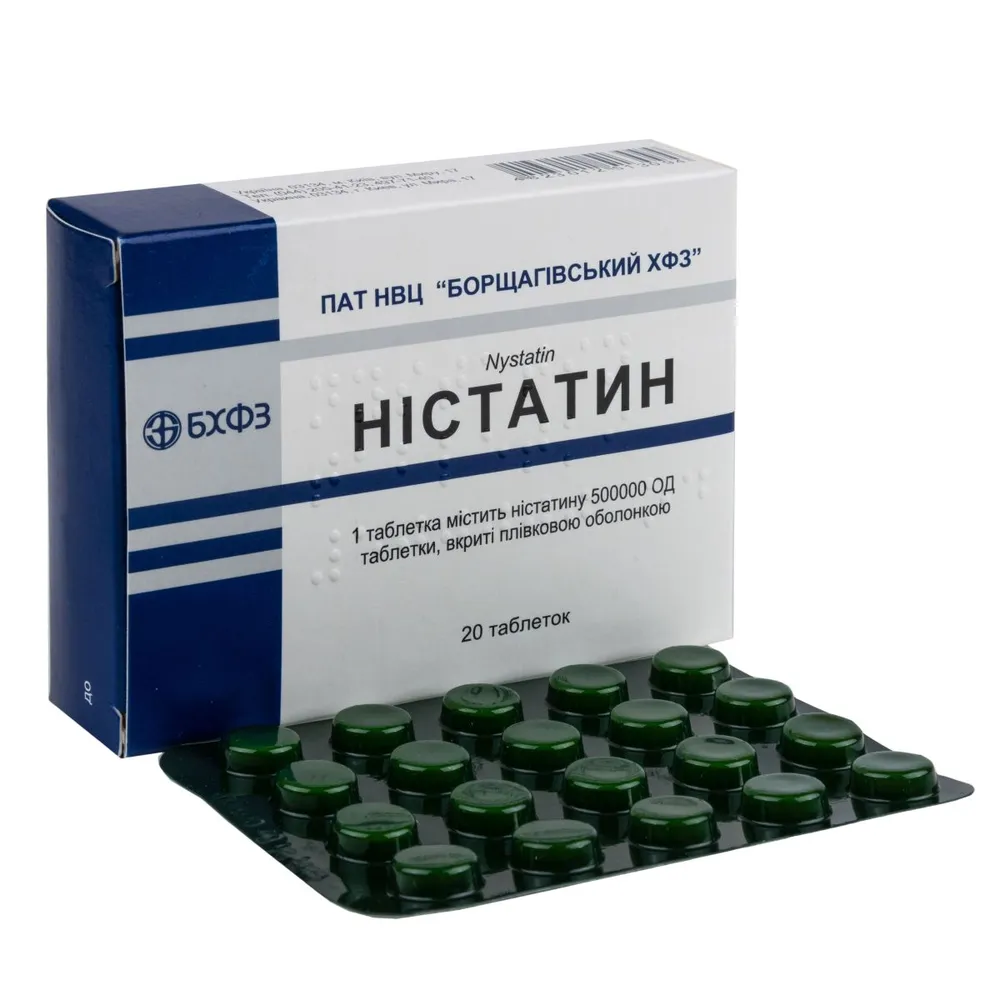
Table of Contents
INSTRUCTIONS FOR MEDICAL USE OF THE MEDICINAL PRODUCT NYSISTATIN (NYSTATIN)
Composition:
Active substance: nystatin;
1 tablet contains 500,000 IU of nystatin;
Excipients: microcrystalline cellulose, povidone, sodium croscarmellose, magnesium stearate; film-coating: hypromellose, copovidone, polyethylene glycol, medium-chain triglycerides, polydextrose, titanium dioxide (E 171), iron oxide red (E 172), iron oxide yellow (E 172).
Dosage form. Film-coated tablets.
Main physicochemical characteristics: round, biconvex tablets with a film coating, yellow to brownish-yellow in color.
Pharmacotherapeutic group. Antimicrobial agents used in intestinal infections. ATC Code A07AA02.
Pharmacological properties.
Pharmacodynamics.
Nystatin is a polyene antibiotic produced by the actinomycete Streptomyces noursei. It exhibits antifungal activity. Nystatin binds to sterols in the fungal cell membrane, disrupting membrane integrity and impairing its function as a selective barrier, which leads to leakage of essential intracellular components.
Nystatin selectively acts against pathogenic yeast-like fungi of the genus Candida and Aspergillus. Resistance to nystatin in Candida species and other sensitive fungi develops slowly. The drug exerts fungistatic effects and, at high doses, fungicidal effects.
The drug is inactive against bacteria, actinomycetes, and viruses. It is ineffective against Trichomonas vaginalis and Gardnerella vaginalis (Haemophilus vaginalis).
Pharmacokinetics.
When administered orally, nystatin is poorly absorbed from the gastrointestinal tract (its bioavailability does not exceed 3–5%). Fungistatic concentrations of the antibiotic in the blood and tissue levels close to therapeutic in internal organs are achieved only when high doses are administered. The drug does not cross the blood-brain barrier and does not enter cerebrospinal fluid.
The majority of orally administered nystatin is excreted unchanged in feces, resulting in high concentrations in the intestinal contents sufficient to exert a therapeutic effect against mucosal candidiasis of the gastrointestinal tract.
The small fraction of absorbed drug is eliminated from the body via urine.
Clinical characteristics.
Indications.
Treatment of gastrointestinal tract diseases caused by Candida fungi (Candida albicans).
Contraindications.
- Hypersensitivity to any component of the drug;
- hepatic function impairment;
- pancreatitis;
- peptic ulcer of the stomach and duodenum.
Interaction with other medicinal products and other forms of interaction.
When used concomitantly with clotrimazole, the antifungal activity of clotrimazole is reduced; when used with chloramphenicol, mutual weakening of antimicrobial action occurs; therefore, simultaneous use of these drugs should be avoided.
Cross-resistance may occur with certain polyene antibiotics, for example, amphotericin B.
Special precautions.
Do not use the drug for the treatment of systemic mycoses.
A complete course of therapy must be completed. The treatment regimen and schedule must be strictly followed throughout the entire course; the drug should be taken at regular intervals and doses must not be missed. If a dose is missed, it should be taken as soon as possible; however, if it is almost time for the next dose, the missed dose should be skipped; do not double the dose.
Nystatin may increase skin sensitivity to sunlight; therefore, during treatment, exposure to direct sunlight and artificial ultraviolet radiation should be avoided.
The drug should be discontinued if adverse reactions occur.
Use during pregnancy or breastfeeding.
The safety of using the drug in pregnant women has not been established; therefore, the drug is contraindicated during pregnancy.
Breastfeeding should be discontinued for the duration of treatment.
Ability to influence reaction rate when driving or operating machinery.
Does not affect.
Dosage and Administration
Nystatin tablets should be taken orally without chewing, 40–60 minutes before meals.
Adults: The recommended dose is 500,000 IU (1 tablet) 3–4 times daily. The daily dose ranges from 1,500,000 to 3,000,000 IU (3–6 tablets); in severe cases, it may be increased up to 4,000,000–6,000,000 IU (8–12 tablets).
Children aged 6 years and older: The recommended dose is 500,000 IU (1 tablet) 3–4 times daily.
Children aged 13 years and older: Dosage is the same as for adults.
Maximum daily dose for children aged 6 years and older: 2,000,000 IU (4 tablets); for children aged 13 years and older: 4,000,000 IU (8 tablets); in severe cases: up to 6,000,000 IU (12 tablets).
The average duration of treatment is 10–14 days (depending on the severity of the disease and sensitivity to the drug).
In chronic recurrent candidiasis, repeated courses of therapy should be administered with intervals of 2–3 weeks between them.
Dose adjustment is not required in patients with renal or hepatic impairment.
Children
This medicinal product in the given pharmaceutical form must not be used in children under 6 years of age.
Overdose
Symptoms: Exaggeration of adverse effects is possible. Oral doses of nystatin exceeding 5,000,000 IU per day have caused nausea and gastrointestinal disturbances.
Since gastrointestinal absorption of nystatin is negligible, overdose does not result in systemic toxicity.
Treatment: Discontinuation of the drug and symptomatic therapy.
Side effects.
Gastrointestinal system: bitter taste in the mouth, dyspeptic symptoms, nausea, vomiting, diarrhea, abdominal pain, loss of appetite.
Immune system: increased body temperature, chills, hypersensitivity reactions, including itching, skin rash, urticaria, anaphylactic reactions, e.g., angioedema, including facial swelling, bronchospasm, rarely – Stevens-Johnson syndrome.
Other: photosensitization, tachycardia, non-specific myalgia; possible overgrowth of resistant fungal forms, requiring discontinuation of the drug.
Shelf life. 2 years.
Do not use after the expiry date stated on the packaging.
Storage conditions.
In the original packaging at a temperature not exceeding 25 °C.
Keep out of reach of children.
Packaging.
20 tablets in a blister pack, 1 blister pack in a carton.
Prescription category. Prescription only.
Manufacturer.
Public Joint-Stock Company "Scientific-Production Center "Borshchagov Chemical-Pharmaceutical Plant".
Manufacturer's address and location of business activity.
17, Miru Street, Kyiv, 03134, Ukraine.