Neogemodex
Ukraine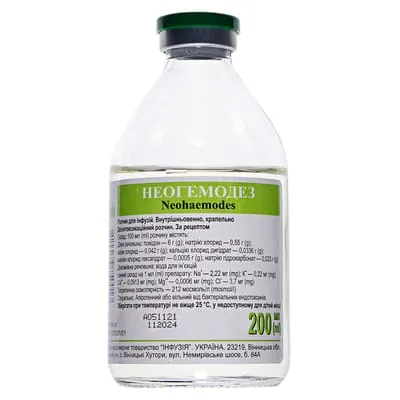
Table of Contents
INSTRUCTIONS FOR MEDICAL USE OF THE MEDICINAL PRODUCT NEOPHODES (NEOHAEMODES)
Composition:
Active substance: 1000 ml of solution contains: povidone 60 g; sodium chloride 5.5 g; potassium chloride 0.42 g; calcium chloride hexahydrate 0.5 g; magnesium chloride hexahydrate 0.005 g; sodium bicarbonate 0.23 g;
Ion composition per 1 ml of the preparation: Na+ − 2.22 mg, K+ − 0.22 mg, Ca2+ − 0.0915 mg, Mg2+ − 0.0006 mg, Clˉ − 3.7 mg;
Excipient: water for injections.
Pharmaceutical form. Infusion solution.
Main physicochemical properties: clear yellow liquid; theoretical osmolarity approximately 300 mOsmol/l.
Pharmacotherapeutic group. Electrolytes in combination with other agents.
ATC code B05BB04.
Pharmacological Properties.
Pharmacodynamics.
Neogemodez belongs to plasma-substituting solutions, improves blood suspension properties, and reduces its viscosity. As a detoxifying agent, it binds toxic products present in the bloodstream and promotes their excretion from the body through the kidneys.
Pharmacokinetics.
After intravenous administration, the effect of the drug manifests as it enters the bloodstream. The effect persists for 3–12 hours, depending on renal function and rate of blood circulation. The drug is excreted from the body through the kidneys.
Clinical characteristics.
Indications.
Detoxification of the body in infectious diseases accompanied by toxicosis; burn disease in the intoxication phase (days 2–5); acute radiation sickness in the intoxication phase; peritonitis and intestinal obstruction (in pre- and postoperative periods); edema caused by chronic kidney disease; thyrotoxicosis; sepsis; liver diseases in the phase of hepatic insufficiency.
Contraindications.
Hypersensitivity to the medicinal product (especially history of reactions to povidone), severe cardiovascular and pulmonary insufficiency, hemorrhagic stroke, bronchial asthma, acute nephritis, acute kidney injury, severe allergic and immunosuppressive conditions.
Interaction with other medicinal products and other types of interactions.
Not established. No medicinal products should be added to the Neogemodes solution.
Special precautions.
The drug should be administered with caution in patients with impaired renal excretory function. Treatment of severe intoxications must be carried out under medical supervision.
Arterial hypotension, tachycardia, and respiratory distress may occur during rapid infusion, requiring immediate discontinuation of the drug and administration of calcium chloride (intravenously), ephedrine, agents acting on the cardiovascular system, and polyglucin.
Use during pregnancy or breastfeeding.
This drug should not be used during pregnancy.
It is unknown whether the drug penetrates into breast milk; therefore, it should not be used during breastfeeding.
Ability to influence reaction rate while driving or operating machinery.
During treatment, patients should refrain from driving or operating machinery, as the drug may cause adverse effects such as dizziness and headache.
Administration and Dosage
The drug is administered intravenously by drip infusion at a rate of 20–40 drops per minute. The solution should be warmed to 35–37 °C prior to administration.
The single dose for adults is 400 mL; for children aged 6–9 years – up to 100 mL; for children aged 10–15 years – up to 150 mL. Repeat infusions may be administered as clinically indicated, but not earlier than 10–12 hours after the previous administration. The treatment course should not exceed 5 days.
Administration of the drug, especially in patients with severe conditions, must be performed under physician supervision.
Children
The drug may be used in children aged 6 years and older.
There is no experience with the use of the drug in children under 6 years of age.
Overdose
Symptoms: hyperhydration, arterial hypotension.
Treatment: discontinue administration of the drug; if necessary, administer cardiac agents, calcium chloride, and reopolyglucin.
Side effects.
Immune system: hypersensitivity reactions, anaphylactic shock, angioneurotic edema, hyperthermia.
Skin and subcutaneous tissue: pallor, skin rashes, urticaria, hyperemia, maculopapular and petechial rashes, itching.
Cardiovascular system: tachycardia, chest pain, arterial hypotension.
Respiratory system: dyspnea, bronchospasm.
Nervous system: headache, dizziness.
Gastrointestinal tract: nausea, vomiting.
General disorders: general weakness, sweating, increased body temperature with chills, local reactions at the injection site.
Shelf life. 3 years.
Storage conditions. Store in the original packaging at a temperature not exceeding 25 °C. Keep out of reach of children. Freezing during transportation is permitted provided the integrity of the bottle is maintained.
Incompatibility. Do not mix with other medicinal products.
Packaging. 200 ml, 250 ml, 400 ml, or 500 ml in glass bottles.
Prescription status. Prescription only.
Manufacturer. Limited liability company "Novopharm-Biosynthesis".
Manufacturer's address and location of business activity.
Ukraine, 11700, Zhytomyr region, Novohrad-Volynskyi, Zhytomyrska St., bld. 38.