Nefaljik
Ukraine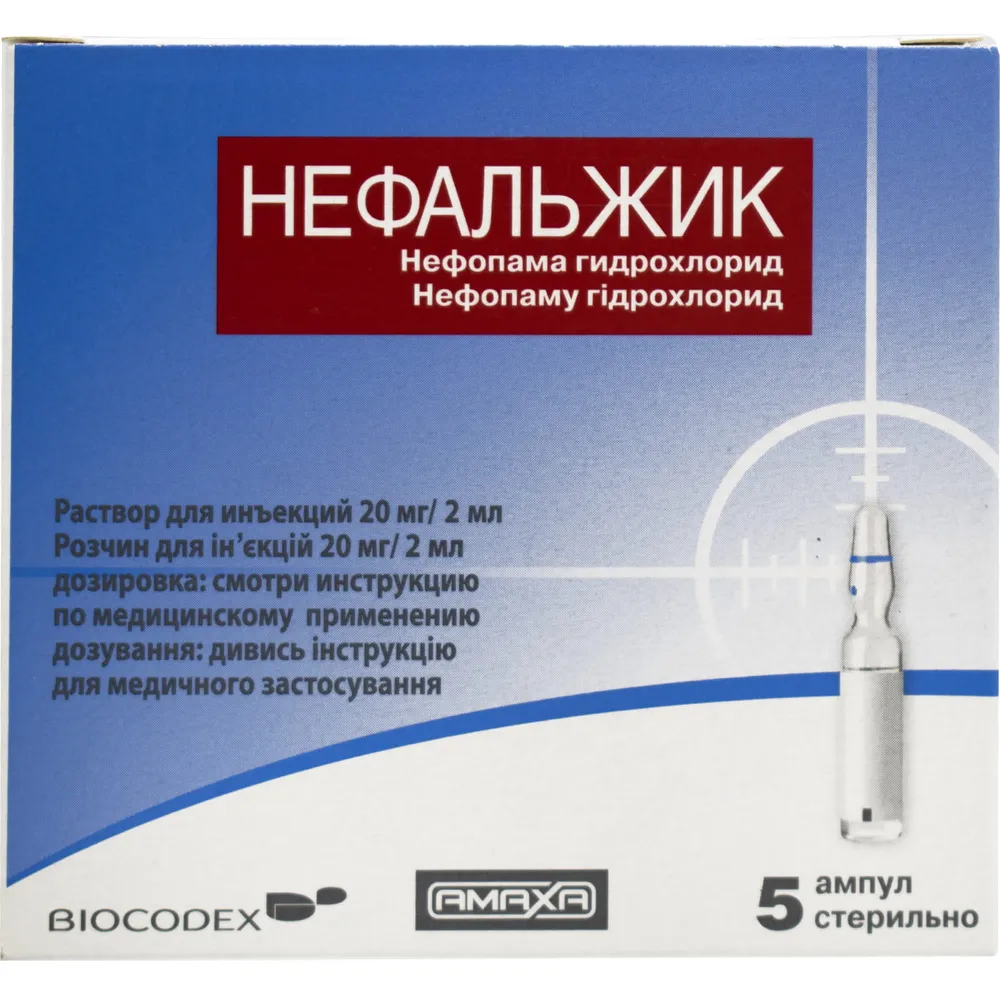
Table of Contents
INSTRUCTIONS FOR MEDICAL USE OF THE MEDICINAL PRODUCT NEFALGIC (NEFALGIC)
Composition:
Active substance: nefopam hydrochloride;
1 ampoule contains 20 mg of nefopam hydrochloride;
Excipients: sodium dihydrogen phosphate dihydrate; disodium hydrogen phosphate dodecahydrate; water for injections.
Pharmaceutical form. Solution for injection.
Main physicochemical properties: clear, colorless, odorless solution.
Pharmacotherapeutic group. Analgesics and antipyretics.
ATC Code N02BG06.
Pharmacological properties.
Pharmacodynamics.
Neofalzhik is a central non-narcotic analgesic, structurally unrelated to other analgesics.
In vitro experimental studies indicate a central action involving inhibition of the reuptake of catecholamines and serotonin at the synaptic level.
In vivo animal studies have demonstrated the antinociceptive properties of nefopam.
In clinical trials, Neofalzhik has shown a positive effect on postoperative shivering.
Neofalzhik has no anti-inflammatory or antipyretic activity, does not depress respiration, and does not affect intestinal peristalsis.
Neofalzhik has anticholinergic effects.
Pharmacokinetics.
After administration of a single 20 mg intramuscular dose, the time to reach maximum plasma concentration (Tmax) is 30 to 60 minutes, and the maximum concentration (Cmax) averages 25 ng/mL. The elimination half-life averages 5 hours. After intravenous administration of a 20 mg dose, the half-life is 4 hours. Plasma protein binding ranges from 71% to 76%. Extensive biotransformation occurs, with three metabolites identified: desmethylnefopam, nefopam N-oxide, and N-glucuronide of nefopam.
Desmethylnefopam and nefopam N-oxide are non-conjugated and have shown no analgesic activity in animal studies. Approximately 87% of the administered dose is excreted by the kidneys, with less than 5% excreted unchanged.
The metabolites found in urine account for 6%, 3%, and 36% of the intravenously administered dose, respectively.
Clinical characteristics.
Indications.
Postoperative analgesia as part of multimodal analgesia (nefopam also demonstrates a beneficial property in preventing postoperative shivering).
Symptomatic treatment of acute pain conditions (injuries, postoperative pain, relief of renal and hepatic colic).
Contraindications.
- Hypersensitivity to nefopam or to other components of the drug.
- Pediatric use under 15 years of age due to lack of clinical studies.
- Seizures or history of seizures.
- Risk of urinary retention associated with urethroprostatic disorders.
- Risk of acute glaucoma attack.
- Concomitant use of MAO inhibitors.
Interaction with other medicinal products and other forms of interaction.
It should be noted that a significant number of medicinal products may enhance central nervous system depression due to additive effects and reduce alertness, namely: opioids (analgesics, antitussives, opioid substitution therapy agents), neuroleptics, barbiturates, benzodiazepines, non-benzodiazepine tranquillizers (meprobamate), hypnotics, antidepressants with sedative effect (amitriptyline, doxepin, mianserin, mirtazapine, trimipramine), sedative H1-histamine receptor blockers, centrally-acting antihypertensive agents, baclofen, thalidomide.
Special precautions for use.
There is a risk of developing dependence on the drug. Nefaljik does not belong to opioid-like drugs or opioid antagonists. Therefore, discontinuation of opioid-like drugs in patients dependent on them, who are already receiving Nefaljik, increases the risk of developing withdrawal syndrome. The risk/benefit ratio of treatment with Nefaljik must be continuously evaluated.
Nefaljik should not be prescribed for the treatment of chronic pain syndromes.
Caution is advised when prescribing the drug to patients with hepatic or renal insufficiency due to the risk of drug accumulation, which increases the likelihood of adverse reactions.
Caution is also advised when prescribing the drug to patients with cardiovascular disorders, as there is a possibility of developing tachycardia.
Due to its anticholinergic effect, treatment with Nefaljik is not recommended in elderly patients.
Alcohol consumption and medicinal products containing alcohol should be avoided, as alcohol may enhance the sedative effect.
Use during pregnancy or breastfeeding.
There are no data on the use of the drug in pregnant women. Animal studies do not indicate a direct or indirect harmful effect on reproductive toxicity. For safety reasons, Nefaljik should not be used during pregnancy.
Lactation. Neofopam is excreted in breast milk to such an extent that effects on newborns/infants who are breastfed are probable. Nefaljik should not be used during breastfeeding.
Ability to influence reaction rate while driving or operating machinery. The possible risk of drowsiness during treatment with the drug should be taken into account, as it may affect the ability to drive a vehicle or operate machinery.
Method of Administration and Dosage
Therapy should be adjusted according to the intensity of pain and the patient's response.
Intramuscular administration.
Nefaljik should be administered by deep intramuscular injection. The recommended dose per administration is 20 mg. If necessary, the dose may be repeated every 6 hours. Maximum daily dose – 120 mg.
Intravenous administration.
Nefaljik should be administered as a prolonged intravenous infusion lasting at least 15 minutes. The patient should be in a lying position during administration to avoid certain adverse reactions such as nausea, dizziness, and sweating. The single dose per infusion is 20 mg. If necessary, administration may be repeated every 4 hours.
Maximum daily dose – 120 mg.
Administration technique:
Nefaljik can be administered diluted in a standard infusion solution (0.9% sodium chloride solution or 5% glucose solution). The optimal dilution ratio is 1 ampoule of the drug in 50 ml of infusion solution.
Duration of treatment – no more than 8–10 days.
Children.
Not recommended for use in children under 15 years of age.
Overdose.
Anticholinergic-type symptoms: tachycardia, coma, seizures, hallucinations.
Treatment: symptomatic treatment with cardiac and respiratory monitoring in a hospital setting.
Adverse reactions.
The reported adverse reactions are classified by system-organ classes and frequency: very common (≥ 1/10), common (≥ 1/100, < 1/10), uncommon (≥ 1/1,000, < 1/100), rare (≥ 1/10,000, < 1/1,000), very rare (< 1/10,000), not known (frequency cannot be estimated from available data).
Central nervous system: very common: somnolence; common: dizziness*; rare: seizures*; not known: coma.
Cardiac disorders: common: tachycardia*, palpitations*.
Gastrointestinal disorders: very common: nausea, vomiting; common: dry mouth*.
Renal and urinary disorders: common: urinary retention.
Immune system disorders: rare: hypersensitivity reactions, including urticaria, angioedema (Quincke's edema), anaphylactic shock.
General disorders: very common: hyperhidrosis*; rare: malaise.
Psychiatric disorders: rare: excitement*, irritability*, hallucinations, drug dependence, drug abuse; not known: confusion.
*Other anticholinergic-like effects may occur, even if they have never been reported.
Shelf life. 3 years.
Storage conditions. Store at temperatures not exceeding 25 °C in a place protected from light.
Incompatibilities.
The medicinal product should not be mixed with other medicinal products in the same container.
Packaging. 2 ml solution in an ampoule. 5 ampoules per tray in a cardboard package.
Prescription status. Prescription only.
Manufacturer.
1. Responsible for batch release: BIODEX, France.
2. Manufacturing: DELPHARM TOURS, France.
Manufacturer's name and address of the place of business.
- 1 Avenue Blaise Pascal, 60000 Beauvais, France.
- Rue Paul Langevin, 37170 Chambray-lès-Tours, France.