Miaser
Ukraine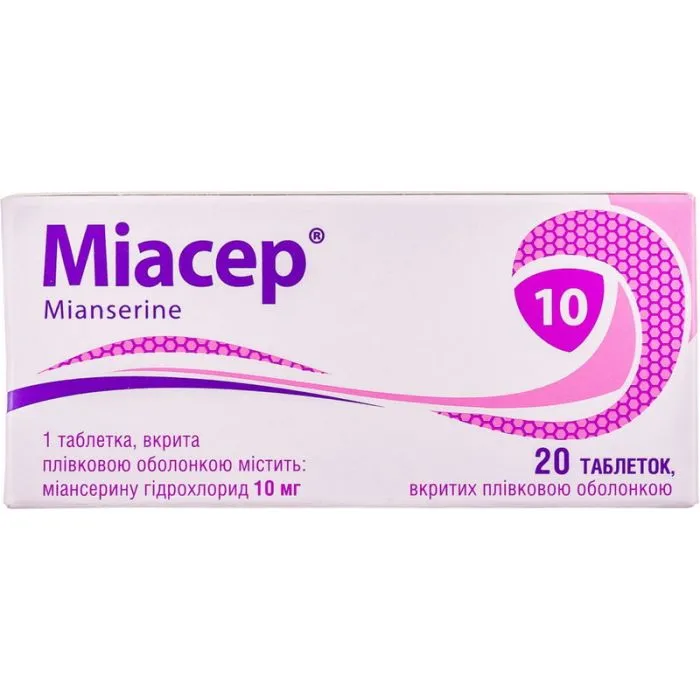
Table of Contents
INSTRUCTIONS for medical use of the medicinal product Miaser® (Miaser®)
Composition:
Active substance: mianserin;
1 tablet contains: mianserin hydrochloride – 10 mg, or 30 mg, or 60 mg;
Excipients: calcium hydrogen phosphate dihydrate, methylcellulose, silicon dioxide colloidal anhydrous, magnesium stearate, maize starch, purified water;
Film coating: Sepifilm 752 white (hypromellose, microcrystalline cellulose, polyoxyl 40 stearate, titanium dioxide), macrogol 8000, purified water.
Pharmaceutical form. Film-coated tablets.
Main physicochemical properties:
tablets of 10 mg: film-coated, biconvex, round, white tablets;
tablets of 30 mg and 60 mg: film-coated, biconvex, elongated tablets with a break line, white in colour.
Pharmacotherapeutic group. Antidepressants. ATC code N06AX03.
Pharmacological properties.
Pharmacodynamics.
Miaser® is an antidepressant drug belonging to the piperazino-azepine group of compounds. The chemical structure of mianserin (the active ingredient of the drug) lacks the side chain characteristic of tricyclic antidepressants, which is responsible for their anticholinergic activity. Mianserin enhances central noradrenergic neurotransmission through alpha2-autoreceptor blockade and inhibition of neuronal reuptake of norepinephrine. The drug binds to serotonin receptors of the central nervous system. The antidepressant effect of Miaser® is similar to that of other modern antidepressants. In addition, the drug also exerts a pronounced anxiolytic effect, which is important in the treatment of patients with depression associated with anxiety. The sedative effect of Miaser®, related to its action on alpha1-adrenergic and histamine H1 receptors, provides a strong rationale for using the drug in sleep disturbances associated with depression.
Miaser® is well tolerated by patients, including elderly individuals and those with cardiovascular diseases. When used at therapeutic doses, the drug exhibits virtually no anticholinergic activity and therefore does not impair cardiovascular function.
In overdose, Miaser® causes significantly fewer cardiotoxic effects compared to tricyclic antidepressants. The drug does not interact with sympathomimetics and antihypertensive agents whose action is mediated via beta-adrenergic receptors (bethanidine) or alpha-adrenergic receptors (clonidine, methyldopa).
Pharmacokinetics.
After oral administration, mianserin is rapidly absorbed. Maximum plasma concentration of the active substance is reached within 3 hours after drug administration. Bioavailability is approximately 20%. Mianserin is about 95% bound to plasma proteins. The elimination half-life of mianserin ranges from 20 to 60 hours; therefore, once-daily administration is sufficient. A steady-state plasma concentration of mianserin is achieved within 6 days of treatment. Mianserin is metabolized and excreted in urine and feces over a period of 7–9 days. The main pathways of mianserin biotransformation are demethylation and oxidation, followed by conjugation of metabolites.
Clinical characteristics.
Indications.
Depressive states of various origins.
Contraindications.
Manic states, severe impairment of liver function; hypersensitivity to the active substance or to any of the excipients.
Special precautions.
Do not use the medicinal product after the expiry date stated on the packaging.
Interaction with other medicinal products and other forms of interactions.
Miaser® may potentiate the central nervous system depressant effect of alcohol; therefore, patients are advised not to consume alcohol during treatment with this medicinal product.
Mianserin must not be administered concurrently with monoamine oxidase inhibitors (such as moclobemide, tranylcypromine, linezolid, etc.) or within two weeks after discontinuation of MAO inhibitor therapy. Conversely, approximately two weeks should elapse before patients who have received mianserin treatment can start therapy with MAO inhibitors.
Mianserin does not affect the action of medicinal products such as betanidine, clonidine, methyldopa, guanethidine, or propranolol (alone or in combination with hydralazine). Despite this fact, blood pressure should be monitored in patients receiving concomitant antihypertensive therapy with Miaser®. Concomitant treatment with antiepileptic drugs that are CYP3A4 inducers (such as phenytoin and carbamazepine) may lead to reduced plasma levels of mianserin.
Dosage adjustment should be considered at the initiation or discontinuation of concomitant therapy with these drugs. Like other antidepressants, Miaser® may affect the metabolism of coumarin derivatives, such as warfarin. Therefore, patients taking such medicinal products require close monitoring.
When antidepressants are prescribed together with atomoxetine, there may be an increased risk of seizures.
The hypotensive effect may be enhanced if mianserin is taken with diazoxide, hydralazine, or nitroprusside.
Antihistaminic and antimuscarinic agents may have an enhanced antimuscarinic effect when taken together with mianserin, and antihistaminic drugs may cause sedation.
Mianserin may reduce the effect of sublingual nitrates due to dry mouth. Concomitant use of mianserin with apraclonidine, brimonidine, sibutramine, or artemether with lumefantrine should be avoided.
The risk of QT interval prolongation and/or ventricular arrhythmias (including torsades de pointes ventricular tachycardia) increases when mianserin is co-administered with other drugs that cause QT prolongation (e.g., certain antipsychotics and antibiotics). Always refer to the package leaflet of other concomitantly used medicinal products to determine whether they affect QT interval duration.
Special precautions for use.
Warnings
Bone marrow suppression, manifested as granulocytopenia or agranulocytosis, has been reported during treatment with Miaser®. These reactions most commonly occurred after 4–6 weeks of therapy and were usually reversible upon discontinuation of treatment. If a patient develops fever, sore throat, stomatitis, or other signs of infection, treatment must be discontinued and a complete blood count should be obtained.
As with other antidepressants, Miaser® may precipitate hypomanic episodes in predisposed individuals with bipolar affective disorder. In such cases, treatment with Miaser® should be discontinued.
Standard precautionary measures should be observed when treating patients with diabetes mellitus, cardiovascular disease, or renal or hepatic impairment. Doses of concomitant medications should be continuously adjusted by the physician.
Mianserin has been associated with hematological and hepatic reactions, and patients require careful monitoring. A complete blood count is recommended every 4 weeks during the first 3 months of treatment; further clinical monitoring should continue, and treatment should be discontinued and a complete blood count obtained if fever, angina, stomatitis, or other signs of infection develop.
During the post-marketing period, cases of QT interval prolongation and ventricular arrhythmia (including cases of torsades de pointes) have been reported with the use of Miaser®. Miaser® should be administered with caution to patients with risk factors for QT prolongation/torsades de pointes, including those with congenital long QT syndrome, patients over 65 years of age, women, patients with structural cardiovascular disease/left ventricular (LV) dysfunction, renal or hepatic impairment, patients taking drugs that inhibit Miaser® metabolism, and those receiving concomitant medications known to prolong the QT interval. Hypokalemia and hypomagnesemia should be corrected prior to initiating treatment. If QT interval reaches >500 ms or increases by >60 ms, discontinuation of Miaser® or dose reduction should be considered.
Extreme caution is required in patients with recent myocardial infarction, heart block, or arrhythmia. Serious cardiotoxic effects are rare at therapeutic doses, even in patients with pre-existing heart disease, recent myocardial infarction, or heart failure.
Patients with closed-angle glaucoma or suspected prostatic hypertrophy should also be under medical supervision, although anticholinergic side effects are not typically associated with Miaser® use.
Treatment with Miaser® should be discontinued if jaundice occurs.
Treatment with Miaser® should also be discontinued if seizures develop.
If surgery is required during mianserin therapy, the anesthesiologist should be informed about the ongoing treatment.
Extreme caution is required in patients with pheochromocytoma.
Elderly patients are less prone to side effects such as agitation, confusion, and postural hypotension with mianserin than with tricyclic or bridged tricyclic antidepressants; however, all antidepressant therapy should be used with particular caution in this patient group.
Epilepsy
As with tricyclic antidepressants, mianserin is known to lower the seizure threshold and should therefore be used with particular caution or avoided, if possible, in patients with epilepsy and other predisposing factors such as brain lesions of various etiologies, concomitant use of neuroleptics, withdrawal from alcohol or anticonvulsant drugs (e.g., benzodiazepines).
Suicide/suicidal thoughts or clinical worsening
Depression is associated with an increased risk of suicidal thoughts and behaviors. This risk persists until significant remission occurs. Since improvement may not occur during the first few weeks of treatment, patients should remain under close supervision until improvement is evident. Based on general clinical experience, the risk of suicidal behavior may increase in the early stages of remission.
Patients with a history of suicidal behavior or those at high risk of suicide constitute a high-risk group for suicide attempts and should therefore be under close surveillance during treatment. A meta-analysis of placebo-controlled clinical trials of antidepressants in adult patients with psychiatric disorders demonstrated an increased risk of suicidal behavior with antidepressants compared to placebo in patients under 25 years of age. Close monitoring of patients, particularly those at high risk, should accompany antidepressant therapy, especially at the beginning of treatment and after dose adjustments. Patients (and caregivers) should be warned to monitor for any worsening of clinical condition, emergence of suicidal thoughts or behaviors, or unusual changes in behavior, and to seek immediate medical attention if these symptoms occur.
In cases where suicide is a possibility, especially at the beginning of treatment, patients should be given only a limited quantity of Miaser® tablets.
Use during pregnancy or breastfeeding
Limited clinical data do not indicate any adverse effects of mianserin on fetal development, and data show that mianserin passes into breast milk only in small amounts. However, when using Miaser® during pregnancy or breastfeeding, the benefit to the mother must be weighed against the potential risk to the fetus/newborn.
The use of this medicinal product during pregnancy is not recommended unless there are strong medical reasons. There is a lack of evidence for safety during pregnancy. Animal studies have not revealed any risk associated with use during pregnancy.
Breastfeeding
Mianserin is contraindicated during breastfeeding. Breastfeeding should be discontinued if mianserin treatment is considered necessary.
Ability to affect reaction speed when driving or operating machinery
Miaser® may affect psychomotor performance during the first few days of treatment. Therefore, patients with depression should refrain from driving or operating potentially hazardous machinery during treatment with this medicinal product.
Method of Administration and Dosage.
Mianserin tablets should be taken orally, swallowed whole with water, without chewing.
The dosage of the medication must be determined individually by a physician for each patient.
The recommended initial dose of Miaser® for adults is 30 mg per day. The dose may be gradually increased every 3–4 days to achieve the optimal clinical effect. Typically, the effective daily dose of Miaser® ranges from 60 to 90 mg, with a maximum of 90 mg.
The use of mianserin is limited to patients aged 65 years and older who:
- do not respond to other antidepressants,
- have glaucoma,
- have prostate hyperplasia.
Treatment of elderly patients should be initiated at a dose of 30 mg per day. A lower than normal maintenance dose may be sufficient to achieve a satisfactory clinical response.
Pharmacokinetic studies of mianserin in elderly patients indicate a longer elimination half-life and reduced metabolic clearance. This information suggests that a single nightly dose of mianserin is preferable to divided doses in elderly patients; furthermore, a lower than usual maintenance dose may be adequate to achieve a satisfactory clinical response.
The dose of Miaser® may be gradually increased thereafter. The effective maintenance daily dose may be somewhat lower than the standard adult dose.
The daily dose of Miaser® may be divided into several administrations; however, it is preferable to administer the medication as a single dose in the evening, considering its beneficial effect on night sleep.
Treatment with adequate doses of Miaser® should lead to noticeable positive results within 2–4 weeks of therapy. If the response is inadequate, the daily dose may be increased. If no positive effect is observed within the following 2–4 weeks, treatment with Miaser® should be discontinued.
After achieving clinical improvement, treatment with Miaser® should be continued for an additional 4–6 months to maintain the therapeutic effect.
Discontinuation of the medication may, in individual cases, lead to withdrawal syndrome.
Children.
There is no clinical experience with the use of mianserin in children; therefore, Miaser® is not recommended for administration to this age group.
Overdose.
Symptoms of significant overdose of Miaser® are generally limited to prolonged sedative effects. Cardiac arrhythmias, seizures, marked arterial hypotension, and respiratory depression occur rarely.
Treatment. There is no specific antidote. Gastric lavage is recommended, followed by symptomatic therapy and supportive care to maintain vital functions.
Side effects.
In patients suffering from depression, symptoms directly associated with the disease itself may occur (dry mouth, persistent constipation, accommodation disorders). Therefore, it is sometimes difficult to determine whether these symptoms are manifestations of the disease or adverse reactions to treatment with Miaser®.
| System Organ Classes |
Adverse reactions (frequency unknown) |
| Blood and lymphatic system disorders |
Blood disorders, which may manifest as granulocytopenia or agranulocytosis1 (see section "Special precautions") |
| Metabolism and nutrition disorders |
Weight gain, Hyponatremia2 |
| Psychiatric disorders |
Hypomania, suicidal thoughts, suicidal behaviour3. Psychotic symptoms including mania and paranoid delusions, which may be exacerbated during antidepressant therapy. Disturbances in sexual function in adults, withdrawal symptoms in adults, withdrawal symptoms (e.g., neuromuscular irritability) in newborns of mothers who received tricyclic or bridged tricyclic antidepressants during pregnancy4. |
| Nervous system disorders |
Sedative effect, occurring at the beginning of treatment and decreasing with continued treatment (Caution! Reducing the dose usually does not reduce the sedative effect, but may reduce the efficacy of the antidepressant) Seizures Hyperkinesia Neuroleptic malignant syndrome |
| Cardiac disorders |
Bradycardia after initial dose administration QT interval prolongation on ECG Torsade de pointes ventricular tachycardia Arterial hypotension |
| Hepatobiliary disorders |
Elevated liver enzymes Jaundice Hepatitis Liver function test abnormalities |
| Skin and subcutaneous tissue disorders |
Exanthema, sweating |
| Musculoskeletal and connective tissue disorders |
Arthralgia, polyarthropathy, arthritis |
| Reproductive system and breast disorders |
Breast disorders (gynecomastia, nipple tenderness, and postpartum lactation) |
| General disorders |
Edema |
Cases of suicidal thoughts and suicidal behavior have been reported during mianserin therapy or immediately after discontinuation of treatment.
1 These reactions most commonly occurred within 4-6 weeks and were generally reversible upon discontinuation of treatment. A complete blood count is recommended every four weeks during the first three months of treatment. In addition, clinical monitoring of the patient should continue, and if the patient develops fever, sore throat, stomatitis, or other signs of infection, treatment should be discontinued and a complete blood count obtained. These adverse reactions have been observed in all age groups, but appear to be more common in elderly patients.
2 Hyponatremia, usually in elderly patients and possibly due to inappropriate antidiuretic hormone secretion, has been associated with all classes of antidepressants and should be considered in any patient who develops drowsiness, confusion, or seizures during antidepressant therapy.
3 Cases of suicide and suicidal behavior have been reported during mianserin therapy or in the early period following discontinuation of treatment.
4 Although not specifically reported for mianserin, these adverse effects may occur with tricyclics and bridged tricyclics. Reporting of suspected adverse reactions
Shelf life. 3 years.
Storage conditions.
Store in the original packaging at a temperature not exceeding 25 °C.
Keep out of reach of children.
Packaging.
10 tablets in blisters; 2 blisters in a cardboard box.
Prescription category. Prescription only.
Manufacturer.
Rivopharm SA.
Manufacturer's location and address of operations.
Centro Insema, 6928 Manno, Switzerland.