Levana® ic
Ukraine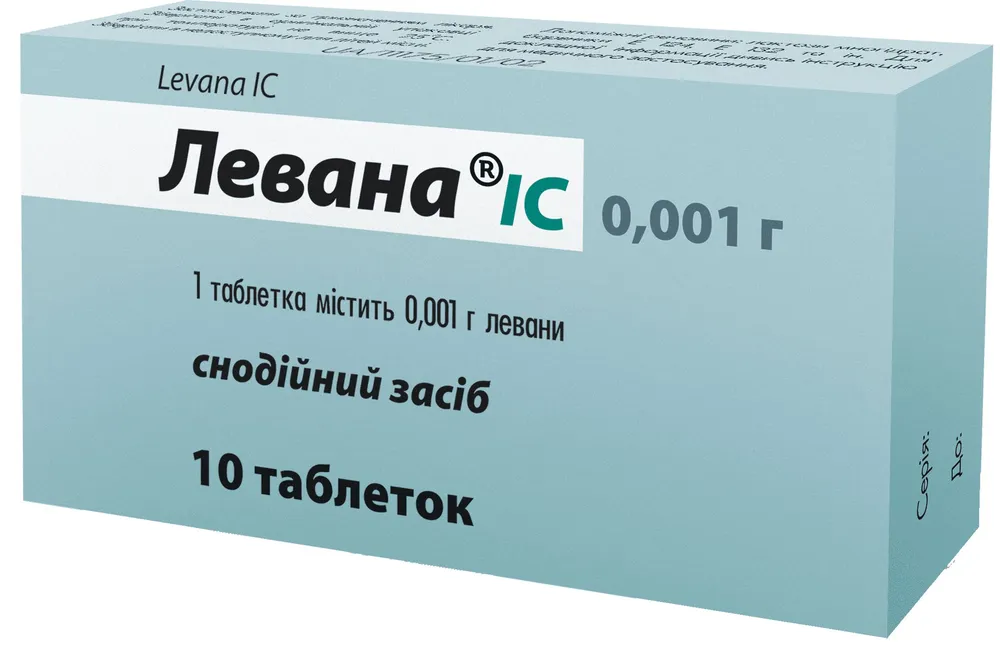
Table of Contents
INSTRUCTIONS FOR MEDICAL USE OF THE MEDICINAL PRODUCT LEVANA® IS (LEVANA IS)
Composition:
Active substance: levana;
1 tablet contains levana (mono-[7-bromo-2-oxo-5-(2-chlorophenyl)-2,3-dihydro-1H-benzo[1,4]diazepin-3-yl] succinate monohydrate) 0.5 mg, 1 mg or 2 mg;
Excipients: lactose monohydrate, potato starch, calcium stearate, gelatin, colorants (Yellow Sunset FCF (E 110) – for the 0.5 mg dosage; purple [Ponceau 4R (E 124), indigo carmine (E 132)] – for the 1 mg dosage).
Pharmaceutical form. Tablets.
Main physicochemical properties: tablets of pale orange color (0.5 mg dosage), pale purple color (1 mg dosage), and white color (2 mg dosage), flat cylindrical shape with bevelled edges; the company trademark is printed on one side of the tablet, a line on the other side.
Pharmacotherapeutic group.
Hypnotics and sedatives. ATC code N05CD.
Pharmacological properties.
Pharmacodynamics. The medicinal product is a partial (incomplete) selective agonist of the GABAA receptor complex. It belongs to the group of benzodiazepine derivatives. It exerts pronounced sedative, anxiolytic, moderate muscle relaxant, and anticonvulsant effects; enhances the effects of sedatives, narcotic drugs, neuroleptics, and ethanol. A distinctive feature of the drug's sedative action is its ability to increase the duration of not only slow-wave sleep but also paradoxical sleep, with an unchanged number of episodes, making the sedative effect of the drug more physiological.
Pharmacokinetics. The drug is rapidly absorbed in the gastrointestinal tract, bioavailability is about 80%, half-life is 10–14 hours (the drug can be classified as an agent with intermediate duration of action). It is excreted via renal and biliary pathways in the form of an active metabolite – 3-hydroxy derivative.
Clinical characteristics.
Indications.
Sleep disorders of various etiologies in adults.
Contraindications.
Increased individual sensitivity to any component of the medicinal product. Severe chronic respiratory insufficiency; sleep apnea syndrome (apnea); severe hepatic insufficiency; spinal and cerebellar ataxia; acute alcohol intoxication; intoxication with hypnotics, analgesics, or psychotropic agents (antidepressants, neuroleptics, lithium); severe form of myasthenia gravis; acute attacks of glaucoma (narrow-angle glaucoma).
Interaction with other medicinal products and other forms of interaction.
Alcohol should not be consumed during treatment with this medicinal product due to the possibility of psychomotor inhibition and respiratory depression. Concomitant use of this medicinal product with phenothiazine neuroleptics should be avoided because of the potentiation of respiratory depressant effects. It should be noted that cimetidine may increase blood concentrations of benzodiazepines (except oxazepam and lorazepam) by up to 50% by slowing their metabolism and clearance. High doses of caffeine, including in beverages, may reduce the therapeutic effect of the medicinal product.
Special precautions for use.
During treatment, alcohol consumption should be avoided, as well as the use of first-generation antihistamines and tranquilizers. Exercise caution when administering the medicinal product to patients with a history of alcohol, drug, or medication dependence, and to elderly patients.
The medicinal product contains dyes, which may cause allergic reactions.
Due to the presence of lactose, the medicinal product should not be taken by patients with rare hereditary galactose intolerance, lactase deficiency, or glucose-galactose malabsorption syndrome.
Treatment with this medicinal product should be initiated at the lowest effective dose. The medicinal product should be taken once daily in the evening before bedtime (see section "Dosage and administration"). Deviation from the recommended dosing regimen increases the risk of adverse reactions.
Use during pregnancy or breastfeeding.
Not recommended.
Ability to influence reaction speed when driving or operating machinery.
The medicinal product should not be taken by individuals whose activities require rapid mental and motor responses.
Dosage and Administration
Administer orally. Swallow without chewing. The medication should be taken once daily, 30–60 minutes before bedtime.
The single dose is 0.5–2 mg (individually adjusted, starting with the lowest dose of 0.5 mg, to achieve the therapeutic effect). The maximum single and daily dose is 2 mg.
For elderly patients, debilitated patients, and patients with organic brain disorders, hepatic or renal impairment, pulmonary insufficiency, or chronic obstructive pulmonary disease, the single dose is 0.5–1 mg.
The duration of treatment is determined individually by a physician depending on the patient's condition and disease course. The treatment course for abnormal insomnia is 3–5 days; for transient insomnia, 14–30 days. The maximum duration of treatment course is 30 days.
Children
Not recommended.
Overdose
Symptoms of overdose may include daytime drowsiness, hypersedation, lethargy, general weakness, cognitive impairment, decreased attention span, dizziness, nausea, ataxia, limb weakness, and allergic reactions.
Treatment: discontinue the medication, perform gastric lavage. If necessary, administer cardiovascular agents and central nervous system stimulants, and flumazenil (in a hospital setting). Hemodialysis is poorly effective. Symptomatic therapy.
Adverse reactions.
The medicinal product is usually well tolerated when used at recommended therapeutic doses. Individual cases of adverse reactions have been reported.
Nervous system disorders: headache, ataxia, limb weakness, hypersedation, daytime somnolence.
In the first days of taking the medicinal product, morning drowsiness may occur, which usually resolves within 2–3 days of treatment.
Psychiatric disorders: cognitive impairment, decreased concentration.
Respiratory system disorders: dyspnea.
Skin and mucous membranes: angioneurotic edema, pruritus, rash.
General disorders: lethargy, general weakness.
When using the medicinal product, adverse reactions that may occur with other hypnotic and sedative agents should be considered: muscle relaxation, psychomotor impairment, increased intraocular pressure, allergic reactions.
The frequency and severity of adverse reactions are dose-dependent. In case of pronounced adverse reactions, the dose should be reduced or the medicinal product discontinued.
Shelf life.
3 years.
Storage conditions.
Store in the original packaging at a temperature not exceeding 25 °C.
Keep out of reach of children.
Packaging.
10 tablets per blister; 2 blisters (for 0.5 mg dosage) and 1 blister (for 1 mg and 2 mg dosages) per carton.
Prescription status.
Prescription only.
Manufacturer.
Limited liability company "INTERKHIM".
Manufacturer's address and location of business activity.
40-A, 21st km, Starokyivska Road, Odesa, 65025, Ukraine.