Xylospray
Ukraine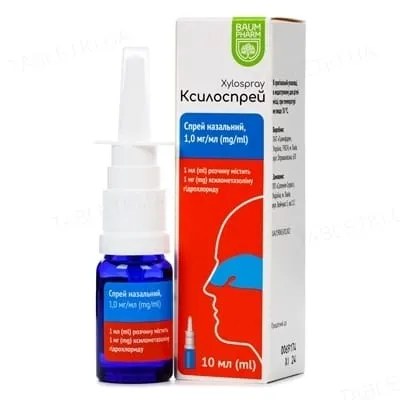
Table of Contents
INSTRUCTION FOR MEDICAL USE OF THE MEDICINAL PRODUCT XYLESPRAY (XYLOSPRAY)
Composition:
Active substance: xylometazoline hydrochloride;
1 ml of solution contains xylometazoline hydrochloride 0.5 mg or 1.0 mg;
Excipients: disodium hydrogen phosphate dihydrate; disodium phosphate dodecahydrate; edetate disodium; benzalkonium chloride; sorbitol liquid (non-crystallizing) (E 420); hypromellose; sodium chloride; purified water.
Pharmaceutical form. Nasal spray.
Main physicochemical properties: clear colorless or slightly yellowish liquid with a faint specific odor.
Pharmacotherapeutic group. Medicinal products used in nasal disorders. Anti-edematous and other locally acting drugs for nasal disorders. Simple sympathomimetics. ATC code R01A A07.
Pharmacological properties.
Pharmacodynamics.
Xylometazoline is a sympathomimetic agent acting on α-adrenergic receptors.
When administered intranasally, xylometazoline causes vasoconstriction of the blood vessels in the nasal mucosa and paranasal sinuses, thereby reducing swelling and hyperemia of the nasal and nasopharyngeal mucosa. It also reduces associated excessive mucus secretion and facilitates the removal of blocked secretions from the nose, promoting clearance of nasal passages and improving nasal breathing.
The effect of the drug begins within 2 minutes after administration and lasts up to 12 hours.
The product is well tolerated, including by patients with sensitive mucosa, and does not impair mucociliary function. Laboratory test results have shown that xylometazoline reduces the infectious activity of human rhinovirus associated with the common cold.
Due to its moisturizing components (sorbitol, hypromellose), the medicinal product Xylospray helps relieve dryness and irritation of the nasal mucosa. The product has a balanced pH value within the range typical for the nasal cavity.
Pharmacokinetics.
When applied locally, the drug is practically not absorbed, and the concentration of xylometazoline in plasma is so low that it is practically undetectable (plasma concentration is close to the limit of detection).
Xylometazoline has no mutagenic properties. In addition, animal studies have not revealed any teratogenic effects of xylometazoline.
Clinical characteristics.
Indications.
Symptomatic treatment of nasal congestion due to colds, hay fever, other allergic rhinitis, and sinusitis.
For facilitating drainage of secretions in diseases of the nasal sinuses.
Adjunctive therapy in cases of otitis media (to reduce mucosal swelling).
For facilitating rhinoscopy.
Contraindications.
Hypersensitivity to xylometazoline, to any of the excipients, or to other sympathomimetic amines; angle-closure glaucoma, transsphenoidal hypophysectomy, and history of surgical procedures involving exposure of the meninges; dry rhinitis (rhinitis sicca) or atrophic rhinitis. Patients receiving concomitant treatment with monoamine oxidase inhibitors (see section "Interactions").
Interaction with other medicinal products and other forms of interaction.
Monoamine oxidase inhibitors (MAO inhibitors): xylometazoline may potentiate the effect of MAO inhibitors and induce a hypertensive crisis. Xylometazoline must not be used in patients taking or who have taken MAO inhibitors within the previous two weeks.
Tricyclic and tetracyclic antidepressants: concurrent use of tricyclic or tetracyclic antidepressants and sympathomimetic agents may enhance the sympathomimetic effect of xylometazoline; therefore, concomitant use of these medicinal products is not recommended.
Concomitant use with β-blockers may cause bronchospasm or reduction in blood pressure.
Special precautions for use.
Xylo Spray, nasal spray, 0.5 mg/mL should not be used in children under 2 years of age.
Use in children aged 2 to 12 years should be under adult supervision.
The product should not be used in children for longer than 5 consecutive days.
Xylo Spray, nasal spray, 1.0 mg/mL should not be used in children under 12 years of age.
The duration of treatment should not exceed 5 days without interruption. Prolonged or excessive use of xylometazoline may cause secondary swelling of the nasal mucosa, with a risk of chronic rhinitis and/or atrophy of the nasal mucosa.
The product, like other sympathomimetics, should be used with caution in patients who exhibit strong reactions to adrenergic agents, such as insomnia, dizziness, tremor, cardiac arrhythmia, or increased blood pressure.
The recommended dose of the product should not be exceeded, especially when treating children and elderly patients.
The product should be prescribed with caution to patients with cardiovascular disorders, arterial hypertension, diabetes mellitus, hyperthyroidism, pheochromocytoma, or benign prostatic hyperplasia. It should not be used in patients receiving or who have received treatment with monoamine oxidase inhibitors (MAOIs) within the previous 2 weeks.
Patients with long QT syndrome who receive xylometazoline are at increased risk of serious ventricular arrhythmias. As first-line therapy, nasal irrigation with physiological saline is recommended. Xylo Spray, nasal spray, may be used as a second-line medicinal product.
The product contains benzalkonium chloride, which may cause nasal mucosal swelling, particularly with prolonged use.
Rare cases of posterior reversible encephalopathy syndrome (PRES)/reversible cerebral vasoconstriction syndrome (RCVS) have been reported with the use of sympathomimetic agents. Reported symptoms include sudden severe headache, nausea, vomiting, and visual disturbances. In most cases, symptoms resolve or improve within a few days after appropriate treatment. The product should be discontinued immediately and medical advice sought if signs/symptoms of PRES/RCVS develop.
Use during pregnancy or breastfeeding.
The product should not be used during pregnancy due to its potential vasoconstrictive effects.
There is no evidence of any adverse effect on the infant. It is unknown whether xylometazoline is excreted in breast milk; therefore, caution is required, and the product should be used during breastfeeding only on medical advice. Prolonged use should be avoided during breastfeeding due to the risk of adverse effects in the infant (tachycardia, excitability, increased blood pressure).
Fertility.
There are no adequate data on the effect of Xylo Spray on fertility. Since systemic exposure to xylometazoline hydrochloride is very low, the likelihood of an effect on fertility is extremely low.
Ability to affect reaction speed while driving or operating machinery.
The product usually has no effect or has a negligible effect on the ability to drive or operate machinery. However, with prolonged use of high doses of xylometazoline, systemic effects with cardiovascular effects cannot be ruled out.
Method of Administration and Dosage.
Xylospray, nasal spray, 0.5 mg/mL
For children aged 2 to 12 years, use under adult supervision.
For children aged 2 to 6 years, usually one spray into each nostril once or twice daily is sufficient. For children aged 6 to 12 years, the dose may be one to two sprays into each nostril one to two times daily. The interval between administrations should be at least 8–10 hours. Do not exceed three sprays into each nostril per day.
The duration of treatment depends on the course of the disease and should not exceed 5 consecutive days. One spray of Xylospray, nasal spray, 0.5 mg/mL contains 0.025 mg of xylometazoline hydrochloride.
Xylospray, nasal spray, 1.0 mg/mL is indicated for adults and children aged 12 years and older. Administer one spray into each nostril up to three times daily. Do not exceed three sprays into each nostril per day. The duration of treatment depends on the course of the disease and should not exceed 5 consecutive days.
The spray ensures accurate dosing and proper distribution of the solution over the nasal mucosal surface. Each spray delivers 0.14 mL of solution, corresponding to 0.14 mg of xylometazoline.
Before using the medicinal product, first remove the cap and the limiting ring under the nozzle, if present. Before the first use, prime the dosing device by performing several spray actuations until a fine, uniform mist is produced. After this, the spray will be ready for use throughout the entire treatment period. If the spray does not dispense when pressing the nozzle, or if the product has not been used for more than 7 days, re-prime the spray pump by actuating several times into the air.
The spray should be used as follows:
- thoroughly clean the nose before applying the medication;
− hold the bottle vertically, supporting the bottom with the thumb and placing the nozzle between two fingers;
− slightly tilt the bottle and insert the nozzle into the nostril;
− administer the spray while simultaneously taking a gentle nasal inhalation;
− after use, before covering the nozzle with the cap, clean and dry the nozzle thoroughly;
− to prevent infection, each bottle of the medication should be used by only one person.
The last administration is recommended immediately before bedtime.
Children.
Xylospray, nasal spray, 0.5 mg/mL is not recommended for children under 2 years of age. Use in children aged 2 to 12 years should be under adult supervision.
Xylospray, nasal spray, 1.0 mg/mL is not recommended for children under 12 years of age.
Overdose.
Excessive local use of xylometazoline hydrochloride or accidental ingestion may lead to sympatholytic effects, including central nervous system depression (e.g., drowsiness, coma), pronounced dizziness, excessive sweating, significant decrease in body temperature, pallor, headache, tachycardia, bradycardia, arterial hypertension, respiratory depression, miosis, seizures, ataxia, and agitation. Gastrointestinal symptoms such as nausea and vomiting may also occur. Elevated blood pressure may be followed by hypotension. Impaired consciousness may indicate severe overt intoxication.
Younger children are more sensitive to the toxic effects than adults. Severe symptoms after accidental ingestion have not been commonly reported; however, in newborns (aged 2 weeks), administration of one drop of a 0.1% solution into each nostril may lead to coma. At home, activated charcoal may be administered as an emergency measure prior to hospitalization.
In cases of severe intoxication, the patient should be hospitalized and immediate symptomatic treatment should be administered under medical supervision. Medical care should include observation of the patient for several hours. There is no specific antidote; atropine may be used in cases of bradycardia. In cases of severe overdose accompanied by cardiac arrest, resuscitation efforts should continue for at least 1 hour.
Side effects.
The side effects listed below are categorized by organ system and frequency of occurrence:
very common (≥ 1/10),
common (≥ 1/100 – < 1/10),
uncommon (≥ 1/1,000 – < 1/100),
rare (≥ 1/10,000 – < 1/1,000),
very rare (< 1/10,000).
Immune system disorders:
very rare: hypersensitivity reactions, including angioneurotic edema, rash, pruritus.
Nervous system disorders:
common: headache; uncommon: insomnia.
Eye disorders:
very rare: temporary visual disturbances.
Cardiovascular system disorders:
very rare: irregular or rapid heartbeat, hypertension, arrhythmia.
Respiratory, thoracic and mediastinal disorders:
common: dryness or discomfort of nasal mucosa, burning sensation, drug-induced rhinitis; uncommon: epistaxis.
Gastrointestinal disorders:
common: nausea; uncommon: vomiting.
General disorders and administration site conditions:
common: burning sensation at the application site.
Shelf life. 2 years.
Storage conditions. In the original packaging, in a place inaccessible to children, at a temperature not exceeding 30 °C.
Packaging. 10 ml in a bottle with a pump dispenser and spray nozzle. 1 bottle per carton.
Pharmaceutical category. Over-the-counter (without prescription).
Manufacturer. JSC "Halychpharm".
Manufacturer's address and place of business.
6/8 Opryshkovska Street, Lviv, 79024, Ukraine.