Corvalcaps
Ukraine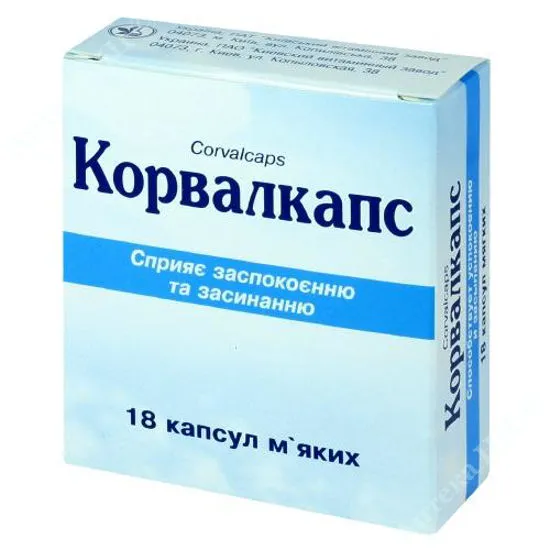
Table of Contents
INSTRUCTIONS FOR MEDICINAL USE OF THE MEDICINAL PRODUCT CORVALCAPS (CORVALCAPS)
Composition:
Active substances: ethyl ether of alpha-bromoisovaleric acid, phenobarbital;
1 capsule contains ethyl ether of alpha-bromoisovaleric acid 20 mg, phenobarbital 18.26 mg;
Excipients: peppermint oil; sodium acetate trihydrate; purified water; polyethylene glycol 200;
Capsule shell: gelatin, liquid sorbitol, partially dehydrated (E 420), methylparahydroxybenzoate (E 218), propylparahydroxybenzoate (E 216).
Medicinal form. Soft capsules.
Main physico-chemical properties: soft gelatin capsules, oval-shaped, with a seam, light yellow to light brownish-yellow in color, filled with a clear, colorless, viscous liquid with a characteristic odor.
Pharmacotherapeutic group. Sedatives and hypnotics. Combined barbiturate preparations. ATC code N05C B02.
Pharmacological properties.
Pharmacodynamics.
Corvalcaps is a sedative and spasmolytic agent, whose action is determined by the components included in its composition.
Ethyl ether of alpha-bromoisovaleric acid exerts reflex sedative and spasmolytic effects caused by stimulation primarily of receptors in the oral cavity and nasopharynx, reduction of reflex excitability in central parts of the nervous system, enhancement of inhibitory processes in neurons of the cerebral cortex and subcortical brain structures, as well as by decreasing the activity of central vasomotor centers and direct local spasmolytic action on smooth muscles of blood vessels.
Phenobarbital suppresses activating influences of the reticular formation centers in the midbrain and medulla oblongata on the cerebral cortex, thereby reducing excitatory impulses to the cerebral cortex and subcortaneous structures. Reduction of activating influences results in a sedative or hypnotic effect, depending on the dose.
Corvalcaps reduces excitatory influences on vasomotor centers, coronary and peripheral blood vessels, thereby lowering overall arterial pressure, relieving and preventing vascular spasms, especially in coronary vessels.
Pharmacokinetics.
The effect of the drug develops within 15–45 minutes and lasts for 3–6 hours. In patients previously taking barbituric acid derivatives, the duration of action is shortened due to accelerated hepatic metabolism of phenobarbital, as barbiturates induce liver enzymes. In elderly individuals and patients with liver cirrhosis, metabolism of Corvalcaps is reduced, resulting in prolonged elimination half-life, which necessitates dose reduction and longer intervals between doses.
Clinical characteristics.
Indications.
- Neuroses with increased irritability;
- insomnia;
- as part of combination therapy for hypertensive disease and vegetative-vascular dystonia;
- mild coronary vessel spasms, tachycardia;
- intestinal spasms due to neurovegetative disorders (as a spasmolytic agent).
Contraindications.
Hypersensitivity to the active substances or to any other component of the medicinal product; acute hepatic porphyria; severe impairment of liver or kidney function; diabetes mellitus; depression; myasthenia gravis. Medicinal products containing phenobarbital are contraindicated in alcoholism, drug or narcotic dependence (including in medical history); in respiratory diseases with dyspnea or obstructive syndrome; pronounced arterial hypotension; acute myocardial infarction; depressive disorders with patient's tendency to suicidal behavior.
Interaction with other medicinal products and other types of interactions.
When used concomitantly with other medicinal products that depress the central nervous system, mutual enhancement of effects (sedative and hypnotic effects) is possible, which may be accompanied by respiratory depression. Alcohol enhances the effect of the drug and may increase its toxicity.
Medicinal products containing valproic acid increase the effect of barbiturates.
Phenobarbital induces liver enzymes and thus may accelerate the metabolism of certain drugs metabolized by liver enzymes (e.g., coumarin derivatives, antibiotics, and sulfonamides). Phenobarbital enhances the effect of analgesics, anesthetics, anesthetic agents, neuroleptics, and tranquilizers; it reduces the effect of paracetamol, indirect anticoagulants, metronidazole, tricyclic antidepressants, salicylates, and digoxin.
Possible influence on blood concentrations of phenytoin, as well as carbamazepine and clonazepam. MAO inhibitors prolong the effect of phenobarbital. Rifampicin may reduce the effect of phenobarbital. When used concomitantly with gold-containing drugs, the risk of kidney damage increases. With prolonged concurrent use of non-steroidal anti-inflammatory drugs, there is a risk of gastric ulcer formation and bleeding. Simultaneous use of medicinal products containing phenobarbital and zidovudine enhances the toxicity of both agents. Unfavorable interaction of Corvalcaps (containing phenobarbital) with lamotrigine, thyroid hormones, doxycycline, chloramphenicol, antifungals (azoles), griseofulvin, glucocorticoids, and oral contraceptives due to possible reduction in the efficacy of the aforementioned drugs.
The medicinal product increases the toxicity of methotrexate.
Special precautions for use
Life-threatening skin reactions such as Stevens-Johnson syndrome and toxic epidermal necrolysis have been reported with the use of phenobarbital.
Patients should be informed about the signs and symptoms of these conditions, and skin reactions should be closely monitored. The highest risk of developing Stevens-Johnson syndrome or toxic epidermal necrolysis occurs during the first weeks of treatment.
If symptoms of Stevens-Johnson syndrome or toxic epidermal necrolysis occur (e.g. progressive skin rash, often with blisters, and mucosal lesions), treatment must be discontinued.
The best outcomes in treating Stevens-Johnson syndrome or toxic epidermal necrolysis are observed with early diagnosis and immediate discontinuation of any suspected causative drug. Prognosis is significantly improved by prompt withdrawal of the suspected agent.
If a patient has developed Stevens-Johnson syndrome or toxic epidermal necrolysis while taking Corvalcaps, the drug must never be used again in such patients.
If chest pain persists after administration, medical advice must be sought to exclude acute coronary syndrome. Use with caution in patients with hyperkinesia, hyperthyroidism, adrenal insufficiency, decompensated heart failure, severe arterial hypotension, persistent pain, or acute intoxication with medicinal products.
Prolonged use of Corvalcaps is not recommended due to the risk of drug dependence, potential bromide accumulation in the body, and bromism.
The medicinal product contains sorbitol; therefore, if you have been diagnosed with an intolerance to certain sugars, consult your doctor before taking this medicinal product.
Use during pregnancy or breastfeeding
The medicinal product must not be used during pregnancy or breastfeeding.
Ability to affect reaction speed when driving or operating machinery
The medicinal product contains phenobarbital, which may impair coordination and psychomotor reaction speed. Therefore, the product should not be taken by patients operating machinery or driving vehicles.
Dosage and Administration
The medicinal product is taken orally, independently of food intake, 1 capsule 2–3 times a day, swallowed with water. If necessary (pronounced tachycardia and coronary vessel spasm), the single dose may be increased to 2 capsules.
The duration of treatment with the medicinal product is determined by the physician depending on the clinical effect and tolerability of the drug.
Children. Experience with the use of the medicinal product in pediatric patients is lacking.
Overdose.
Symptoms.
Acute (mild to moderate) barbiturate poisoning: dizziness, fatigue, deep sleep from which the patient cannot be awakened.
Hypersensitivity reactions may occur: angioneurotic edema, urticaria, pruritus, rash.
Acute severe poisoning: central nervous system (CNS) depression up to coma; respiratory depression up to cessation of breathing; cardiovascular system depression up to collapse-like state, including decreased arterial pressure, tachycardia, arrhythmia; bradycardia, vascular collapse, diminished or absent reflexes, nystagmus, headache, nausea, weakness, hypothermia, pulse slowing, decreased diuresis.
If poisoning is not treated, a fatal outcome may occur due to circulatory failure, respiratory paralysis, or pulmonary edema.
Treatment.
Cases of acute poisoning with Corvalcaps should be treated as poisoning with other hypnotics and barbiturates, depending on the severity of symptoms. The patient should be transferred to an intensive care unit. It is necessary to stabilize respiration and circulation. Respiratory failure is managed by artificial ventilation; shock should be treated by infusions of
plasma and plasma substitutes. If a significant amount of time has passed since ingestion, gastric lavage is required (introduce 10 g of activated charcoal powder and sodium sulfate into the stomach). To accelerate the elimination of barbiturates from the body, forced alkaline diuresis, hemodialysis, and/or hemoperfusion may be performed.
Treatment of bromide poisoning: elimination of bromide ions from the body can be accelerated by administration of a large volume of sodium chloride solution along with saluretic agents.
In case of hypersensitivity reactions, administer desensitizing medicinal products.
Side effects.
Nervous system disorders: asthenia, weakness, impaired motor coordination, nystagmus, ataxia, hallucinations, paradoxical excitation, decreased attention span, fatigue, slowed reaction time, headache, cognitive disturbances. In individual cases, drowsiness and mild dizziness, confusion may occur.
Musculoskeletal system: with prolonged use of products containing phenobarbital, there is a risk of impaired osteogenesis and development of rickets (if administered to children). Cases of decreased bone mineral density, osteopenia, osteoporosis, and fractures have been reported in patients receiving long-term phenobarbital therapy. The mechanism by which phenobarbital affects bone metabolism has not been established.
Gastrointestinal disorders: nausea, vomiting, constipation, epigastric fullness; with prolonged use – liver function disturbances.
Blood and lymphatic system disorders: agranulocytosis, megaloblastic anemia, thrombocytopenia, anemia.
Cardiovascular system disorders: arterial hypotension, bradycardia.
Immune system disorders: allergic reactions, including angioneurotic edema.
Other: dyspnea, facial swelling, rash, pruritus.
Skin and mucous membranes: Stevens-Johnson syndrome, toxic epidermal necrolysis, urticaria, rhinitis, conjunctivitis, acne, purpura, lacrimation.
Prolonged use of products containing bromide may lead to bromism, characterized by the following symptoms: central nervous system (CNS) depression, depression, confusion, ataxia, apathy, depressive mood, conjunctivitis, rhinitis, acne, or purpura.
Shelf life. 2 years.
Storage conditions.
Store in original packaging at a temperature not exceeding 25°C.
Keep out of reach of children.
Packaging.
9 capsules in blisters.
9 capsules per blister; 2 blisters per pack.
9 capsules per blister; 3 blisters per pack.
Prescription status. Over-the-counter.
Manufacturer: JSC "KYIV VITAMIN PLANT".
Manufacturer's address and location of business activity.
38 Kopilivska Street, Kyiv, 04073, Ukraine.
Web-site: www.vitamin.com.ua