Cornergel®
Ukraine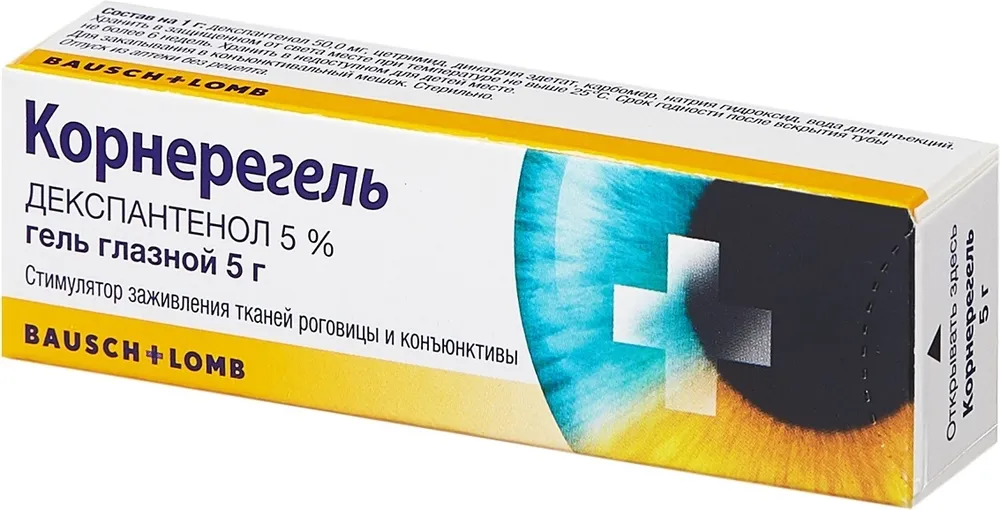
Table of Contents
INSTRUCTIONS FOR MEDICAL USE OF THE MEDICINAL PRODUCT KORNEREGEL® (CORNEREGEL®)
Composition:
Active substance: dexpanthenol;
1 g of ophthalmic gel contains 50 mg of dexpanthenol;
Excipients: cetrimide, disodium edetate, carbomer, sodium hydroxide, water for injections.
Pharmaceutical form.
Ophthalmic gel.
Main physicochemical properties: transparent, colorless gel.
Pharmacotherapeutic group.
Medicinal products used in ophthalmology. ATC code S01X A12.
Pharmacological properties.
Pharmacodynamics.
Dexpanthenol/Panthenol is an alcohol analogue of pantothenic acid which, through intermediate transformations, exhibits the same biological activity as pantothenic acid; however, it is better absorbed upon topical application. Pantothenic acid is a water-soluble vitamin that participates in various metabolic processes as part of coenzyme A. Pantothenic acid is essential for the formation and regeneration of skin and mucous membranes. When applied topically, dexpanthenol/panthenol can compensate for the increased demand of damaged skin or mucous membranes for pantothenic acid.
Pharmacokinetics.
In pharmacokinetic studies using tritium-labeled panthenol, it has been demonstrated that the substance is capable of being reabsorbed through the skin.
Clinical characteristics.
Indications.
Non-infectious keratopathies, including corneal dystrophies, corneal degenerations, recurrent corneal erosions, and prevention of corneal damage during contact lens use.
Complex treatment of corneal and conjunctival injuries, chemical and thermal burns.
In comprehensive therapy of infectious corneal lesions of bacterial, viral, and fungal origin.
Contraindications.
Hypersensitivity to any component of the drug.
Interaction with other medicinal products and other forms of interaction.
Not known to date.
If Cornegele® is used together with other eye drops/eye ointments, an interval of approximately 15 minutes should be maintained between administrations. In any case, Cornegele® should be administered last.
Special precautions for use.
Conrergel® should not be used as monotherapy for the treatment of infectious lesions of the cornea of bacterial, viral, or fungal origin; the drug should be used only as an adjunct in the complex therapy of these diseases.
Conrergel® contains the preservative cetrimide, which, especially with frequent or prolonged use, may cause eye irritation (redness, burning sensation, and foreign body sensation in the eye) and may damage the corneal epithelium. For long-term treatment of chronic dry keratoconjunctivitis, preservative-free medicinal products should be preferred.
Conrergel® should not be instilled while wearing contact lenses, as lens materials may be incompatible with the drug; lenses must be removed prior to instillation and not reinserted earlier than 10–15 minutes after administration of Conrergel®.
Use during pregnancy or breastfeeding.
Controlled studies on the use of the drug during pregnancy or breastfeeding have not been conducted. Animal studies have not revealed any direct or indirect harmful effects of the drug on pregnancy, embryonic/fetal development, parturition, or postnatal development. The drug passes into breast milk. Therefore, if use of the drug is necessary during pregnancy or breastfeeding, the physician must carefully weigh the benefit of treatment with Conrergel® to the mother against the potential risk to the fetus/infant.
Ability to affect reaction speed when driving vehicles or operating machinery.
For several minutes after instillation of Conrergel® into the conjunctival sac, temporary blurred vision may occur. Driving vehicles or operating complex machinery is not recommended until visual acuity is fully restored.
Method of Administration and Dosage.
The medication is intended for topical use.
Depending on the severity and intensity of symptoms, administer 1 drop into the conjunctival sac of the affected eye 4 times daily and before bedtime.
Use the medication until the desired therapeutic effect is achieved.
The duration of treatment depends on the clinical picture and is determined individually by the physician.
To prevent contamination of the medication and the dropper tip, avoid touching the eyelids, the area around the eyes, or other surfaces with the tip during administration.
Children.
The safety of using this medication for the treatment of children has not been studied.
Overdose.
Unknown.
Side effects.
Transient blurred vision may occur immediately after administration of the drug.
Eye disorders
Cornegele® contains the preservative cetrimide, which may cause eye irritation (redness, burning sensation, and foreign body sensation) and may damage the corneal epithelium. Other observed adverse reactions include pain, increased lacrimation, itching, and conjunctival edema.
Immune system disorders
Hypersensitivity reactions, including itching, rash, urticaria.
Shelf life.
The shelf life of the drug in the closed tube is 2 years.
After first opening, the contents of the tube should be used within a maximum of 6 weeks.
Storage conditions.
Store at a temperature not exceeding 25 °C, in a place inaccessible to children.
Packaging.
5 g in a tube; 1 tube in a cardboard box.
Availability.
Over-the-counter (without prescription).
Manufacturer.
Dr. Gerhard Mann Chem.-pharm. Fabrik GmbH.
Manufacturer's address.
Brunsbütteler Damm 165/173, 13581 Berlin, Germany.