Cordiamine®-darnitsa
Ukraine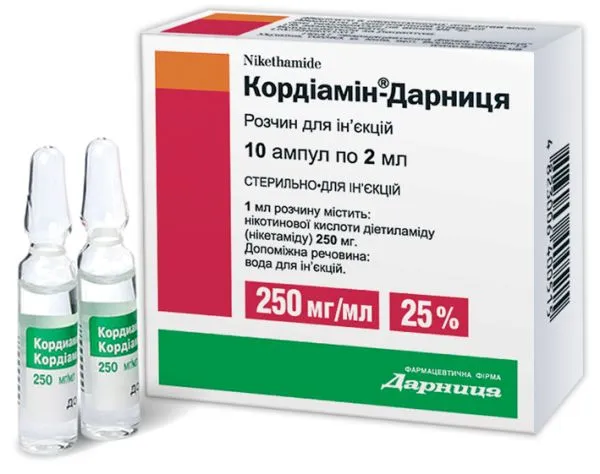
Table of Contents
INSTRUCTIONS for medical use of the medicinal product KORDIAMIN-DARNITSA (KORDIAMIN-DARNITSA)
Composition:
active substance: nikethamide;
1 ml of solution contains 250 mg of diethylamide of nicotinic acid (nikethamide);
excipient: water for injections.
Pharmaceutical form. Injection solution.
Main physicochemical properties: clear, colorless or slightly yellowish liquid with a specific odor.
Pharmacotherapeutic group. Respiratory analeptics. Nikethamide. ATC code R07AB02.
Pharmacological properties.
Pharmacodynamics.
A mixed-type analeptic. The mechanism of action consists of two components: central and peripheral. The first is associated with a direct effect on the vasomotor center of the medulla oblongata, leading to its excitation and indirect increase in systemic arterial pressure (especially in case of primary inhibition of this center). The peripheral component is related to stimulation of carotid sinus chemoreceptors, resulting in increased respiratory rate and depth. After intravenous administration of the drug, heart rate increases, respiratory rate and depth rise, and arterial pressure slightly and transiently increases. The drug does not exert a direct stimulatory effect on the heart and has no direct vasoconstrictive stimulatory effect.
Pharmacokinetics.
Nikethamide is well absorbed into the blood by all routes of administration, is relatively rapidly degraded, and has a short duration of action (15–60 minutes). In the body, it is metabolized in the liver to nicotinamide, monoethylamide of nicotinic acid, and nikethamide-N-oxide. It is rapidly excreted in the urine as inactive metabolites.
Clinical characteristics.
Indications.
- Collapse and asphyxia (including neonatal asphyxia);
- shock states during surgical procedures and in the postoperative period;
- acute and chronic circulatory disorders;
- decreased vascular tone and respiratory depression in patients with infectious diseases and during convalescence;
- poisoning with hypnotics and analgesics (as part of complex therapy).
Contraindications.
Hypersensitivity to nikethamide or to any component of the drug; predisposition to seizures, epilepsy, epileptic seizures (in medical history); porphyria; hyperthermia in children.
Interaction with other medicinal products and other forms of interaction.
The analeptic effect of nikethamide is reduced under the influence of para-aminosalicylic acid (PAS), saluzid, phenothiazine derivatives (aminazine, etc.). Aminazine and reserpine may enhance the convulsant effect of nikethamide. The pressor effect of the drug is increased under the influence of monoamine oxidase inhibitors (MAO inhibitors). Nikethamide promotes the development of intolerance to phthivazid. Enhances the effects of psychostimulants, antidepressants. Reduces the effects of narcotic analgesics, hypnotics, antipsychotic agents, anxiolytics, anticonvulsants. Nikethamide is ineffective during deep anesthesia.
Special precautions for use.
The medicinal product should be used only under medical supervision in a hospital setting. When administered intravenously, the effect is short-lived. Since subcutaneous and intramuscular injections of nikethamide are painful, procaine should be injected in advance into the injection site to reduce pain (for adults – 1 ml of 0.5% solution, for children – according to age-related dosages). Before administering procaine, a sensitivity test must be performed. When using procaine, the safety information regarding procaine must be taken into account.
Use during pregnancy or breastfeeding.
The medicinal product is contraindicated during pregnancy or breastfeeding.
Ability to affect reaction rate when driving or operating machinery.
During treatment, driving vehicles and engaging in potentially hazardous activities requiring high attention concentration and increased psychomotor reaction speed should be avoided.
Dosage and Administration.
The single and daily doses, as well as frequency of administration, are determined individually by a physician depending on the indication and patient's age.
The medicinal product is administered subcutaneously, intramuscularly, or intravenously. For adults and children aged 14 years and older, the dose is 1–2 mL administered 1–3 times daily.
For intravenous administration, the single dose of the medicinal product should be diluted in 10 mL of 0.9% sodium chloride solution and injected over 1–3 minutes.
Maximum single and daily doses for adults (subcutaneous administration): single dose – 2 mL, daily dose – 6 mL. The maximum single subcutaneous and intravenous dose in cases of poisoning for adults is 5 mL.
Recommended subcutaneous single doses for children, depending on age:
up to 1 year – 0.1 mL;
1–4 years – 0.15–0.25 mL;
5–6 years – 0.3 mL;
7–9 years – 0.5 mL;
10–14 years – 0.75 mL.
Administer 1–3 times daily.
Children.
The medicinal product is permitted for use in pediatric practice at the recommended age-related doses. Its use is contraindicated in cases of hyperthermia.
Overdose.
Symptoms: intensification of the drug's adverse effects; in large doses, the drug may cause generalized tonic-clonic seizures, disturbances of consciousness and respiration, apnea during seizures, and potentially fatal outcomes.
Treatment: administration of anticonvulsant agents, forced diuresis. If necessary, controlled ventilation.
Adverse Reactions.
Gastrointestinal disorders: nausea, vomiting.
Nervous system disorders: restlessness, increased irritability, anxiety.
Cardiovascular disorders: arrhythmias, arterial hypertension, tachycardia.
Immune system disorders: hypersensitivity reactions, including urticaria, angioneurotic edema, generalized papular rashes.
Skin and subcutaneous tissue disorders: facial swelling or redness, itching and/or skin peeling.
Musculoskeletal and connective tissue disorders: muscle twitching starting from the orbicularis oris muscles, tremor, muscle rigidity.
General disorders: hyperthermia, increased sweating.
Administration site reactions: infiltration, pain, hyperemia, itching, burning sensation at the injection site.
Reporting of suspected adverse reactions.
Reporting of suspected adverse reactions after marketing authorization is an important procedure. It allows continuous monitoring of the benefit-risk balance of the medicinal product. Healthcare professionals are required to report any suspected adverse reactions through the national reporting system.
Shelf life. 5 years.
Storage conditions.
Store in the original packaging at a temperature not exceeding 25 °C. Do not freeze.
Keep out of reach and sight of children.
Packaging.
2 ml in a vial; 5 vials in a blister pack; 2 blisters per carton.
Prescription status. Prescription only.
Manufacturer. JSC "Pharmaceutical company "Darnitsya".
Manufacturer's address and place of business.
13, Boryspilska Street, Kyiv, 02093, Ukraine.