Cognum
Ukraine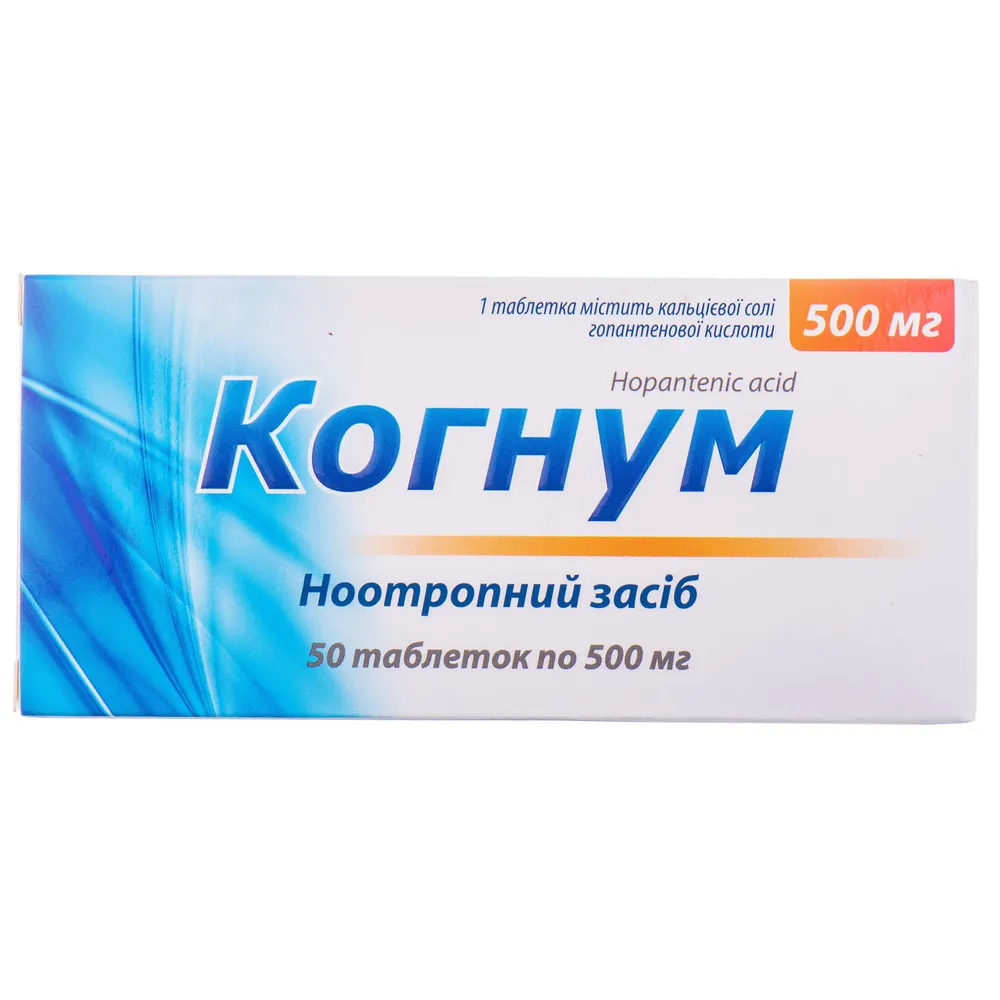
Table of Contents
INSTRUCTIONS FOR MEDICAL USE OF THE MEDICINAL PRODUCT COGNUM (cOGNUM)
Composition:
Active substance: calcium salt of hopantenic acid;
1 tablet contains 250 mg or 500 mg of calcium salt of hopantenic acid;
Excipients: magnesium carbonate heavy, potato starch, talc, calcium stearate.
Pharmaceutical form. Tablets.
Main physicochemical properties: white, flat cylindrical tablets with bevel and score line.
Pharmacotherapeutic group. Psychostimulants and nootropics. ATC code N06B X.
Pharmacological properties.
Pharmacodynamics.
The mechanism of action is due to the direct effect of hopantenic acid on the GABAB receptor-channel complex. The medicinal product exerts nootropic and anticonvulsant effects, increases brain resistance to hypoxia and toxic substances, stimulates anabolic processes in neurons, combines moderate sedative action with a mild stimulating effect, and reduces motor excitability. Enhances mental and physical performance. Promotes normalization of GABA levels in chronic alcohol intoxication and during subsequent ethanol withdrawal. Prolongs the action of procaine and sulfonamides by inhibiting their acetylation reactions. Causes inhibition of the pathologically increased micturition reflex and detrusor tone.
Pharmacokinetics.
Cognum is rapidly absorbed from the gastrointestinal tract and penetrates the blood-brain barrier; higher concentrations are found in the liver, kidneys, and skin.
Time to reach Cmax – 1 hour. The drug is not metabolized and is excreted unchanged within 48 hours: 67.5% of the administered dose is excreted in urine, 28.5% in feces.
Clinical characteristics.
Indications.
As part of combination therapy:
- cognitive disorders due to organic brain lesions (including sequelae of neuroinfections and traumatic brain injuries);
- cerebrovascular insufficiency caused by atherosclerotic changes in cerebral vessels;
- extrapyramidal disorders (myoclonic epilepsy, Huntington's chorea, hepatolenticular degeneration, Parkinson's disease);
- epilepsy with slowed mental processes (in combination therapy with anticonvulsant drugs);
- psychoemotional overload, decreased mental and physical performance (to enhance concentration and memory);
- neurogenic urinary disorders: enuresis, pollakiuria, imperative urges, imperative urinary incontinence;
- the drug is indicated for children aged 3 years and older with perinatal encephalopathy, mental retardation of varying severity, developmental delay (mental, speech, motor), various forms of cerebral palsy, hyperkinetic disorders (attention deficit hyperactivity syndrome, tics), stuttering (mainly clonic form), neurosis-like conditions.
Contraindications.
Hypersensitivity to the components of the drug; acute severe kidney diseases.
Interaction with other medicinal products and other types of interactions.
During long-term treatment, concomitant use of Cognium with other nootropic and stimulant agents is not recommended.
The drug prolongs the effect of barbiturates, enhances the action of anticonvulsant drugs and agents stimulating the central nervous system, prevents adverse effects of phenobarbital, carbamazepine, and antipsychotic agents (neuroleptics), and enhances the effect of local anesthetics (procaine).
The drug is capable of inhibiting acetylation reactions, which are part of the inactivation mechanisms of procaine and sulfonamides, thereby achieving a prolonged effect of the latter.
The action of Cognium is enhanced when combined with glycine, etidronic acid, and xidiphon.
Special precautions.
During prolonged treatment, concomitant administration of other nootropic and stimulant agents is not recommended. Due to the nootropic effect of the medicinal product, it should be taken primarily in the morning and during daytime hours.
Use during pregnancy or breastfeeding.
Cognum is contraindicated during pregnancy and breastfeeding.
Ability to influence reaction speed when driving or operating machinery.
Patients should exercise caution when driving or operating machinery during treatment with this medicinal product.
Administration and Dosage.
Cognum is used as part of complex therapy.
The tablets should be taken 15–30 minutes after a meal.
Single dose for children aged 12 years and adults – 250–1000 mg; for children aged 3 to 12 years – 250–500 mg.
Daily dose for children aged 12 years and adults – 1500–3000 mg; for children aged 3 to 12 years – 750–3000 mg.
The treatment course lasts from 1 to 4 months; in individual cases, up to 6 months. Repeat courses may be conducted after an interval of 3–6 months.
In sequelae of neuroinfections and traumatic brain injuries: children from 3 years of age and adults – 250 mg 3–4 times daily.
In cerebrovascular insufficiency: adults – 250 mg 3–4 times daily.
For treatment of extrapyramidal disorders caused by neuroleptics: children aged 12 years and adults – 500–1000 mg 3 times daily; children aged 3 to 12 years – 250–500 mg 3–4 times daily. Treatment course lasts 1–3 months.
In epilepsy, in combination with anticonvulsants: children aged 3 to 12 years – 250–500 mg 3–4 times daily; children aged 12 years and adults – 500–1000 mg 3–4 times daily, administered daily over a prolonged period (up to 6 months).
In psycho-emotional overload and decreased mental and physical performance: children from 3 years of age and adults – 250 mg 3 times daily.
In urinary dysfunction: children aged 12 years and adults – 500–1000 mg 2–3 times daily; children aged 3 to 12 years – 250–500 mg (daily dose – 25–50 mg/kg body weight) 2–3 times daily. Treatment course lasts from 1 to 3 months.
In children aged 3 to 12 years with perinatal encephalopathy, intellectual disability, developmental delay, cerebral palsy: Cognum is prescribed 500 mg 4–6 times daily, daily for 3 months; in delayed speech development – 500 mg 3–4 times daily for 2–3 months.
In hyperkinetic disorders, tics, stuttering, neurosis-like conditions: the drug is prescribed to children aged 3 to 12 years at 250–500 mg 3–6 times daily, daily for 1–4 months; to children aged 12 years and adults – 1500–3000 mg daily for 1–5 months.
Dosing strategy: gradual dose escalation over 7–12 days, administration at maximum dose for 15–40 days, followed by gradual dose reduction over 7–8 days until discontinuation of Cognum. The interval between treatment courses is 1 to 3 months.
Children. Can be used in children aged 3 years and older.
Overdose.
Exacerbation of adverse reaction symptoms.
Treatment: activated charcoal, gastric lavage, symptomatic therapy.
Adverse Reactions.
Allergic reactions are possible, including rhinitis, conjunctivitis, skin rash. If allergic reactions occur, the medicinal product should be discontinued.
During use of the medicinal product, the following may occur: urticaria, itching, skin hyperemia, facial hyperemia, skin desquamation. In such cases, the dose should be reduced or the medicinal product discontinued. Neurological disorders are possible, including sleep disturbances or drowsiness, tinnitus, which are usually transient and do not require discontinuation of the medicinal product.
Shelf life. 3 years.
Storage conditions.
Store in the original packaging at a temperature not exceeding 25 °C.
Keep out of reach of children.
Packaging. 10 tablets per blister; 5 blisters per carton.
Prescription status. Prescription only.
Manufacturer. JSC "KYIV VITAMIN PLANT".
Manufacturer's address and location of its business activities.
38 Kopilivska Street, Kyiv, 04073, Ukraine.
Web-site: www.vitamin.com.ua.
INSTRUCTION
for medical use of the medicinal product
COGNUM
(COGNUM)
Composition:
Active substance: calcium salt of hopantenic acid;
1 tablet contains calcium salt of hopantenic acid 250 mg or 500 mg;
Excipients: magnesium carbonate heavy, potato starch, talc, calcium stearate.
Pharmaceutical form. Tablets.
Main physicochemical properties: white-colored tablets, flat cylindrical in shape with beveled edges and a score line.
Pharmacotherapeutic group. Psychostimulants and nootropic agents.
ATC code N06BX.
Pharmacological properties.
Pharmacodynamics.
The mechanism of action is due to the direct effect of hopantenic acid on the GABAB receptor-channel complex. The medicinal product exerts a nootropic and anticonvulsant effect, increases brain resistance to hypoxia and toxic substances, stimulates anabolic processes in neurons, combines moderate sedative action with a mild stimulatory effect, reduces motor excitability. Enhances mental and physical performance. Promotes normalization of GABA levels in chronic alcohol intoxication and facilitates subsequent ethanol withdrawal. Prolongs the action of procaine and sulfonamides by inhibiting their acetylation reactions. Inhibits pathologically increased vesicular reflex and detrusor tone.
Pharmacokinetics.
Cognum is rapidly absorbed from the gastrointestinal tract and penetrates the blood-brain barrier; high concentrations accumulate in the liver, kidneys, and skin. Time to reach Cmax – 1 hour. The drug is not metabolized and is excreted unchanged within 48 hours: 67.5% of the administered dose is excreted in urine, 28.5% in feces.
Clinical characteristics.
Indications.
As part of complex therapy:
- Cognitive disorders due to organic brain lesions (including sequelae of neuroinfection and traumatic brain injury);
- Cerebrovascular insufficiency caused by atherosclerotic changes in cerebral vessels;
- Extrapyramidal disorders (myoclonus epilepsy, Huntington's chorea, hepatolenticular degeneration, Parkinson's disease);
- Epilepsy with slowed mental processes (in combination therapy with anticonvulsant drugs);
- Psycho-emotional overload, decreased mental and physical performance (to improve concentration and memory);
- Neurogenic urinary disorders: enuresis, pollakiuria, imperative urges, urge incontinence;
- The medicinal product is indicated for children from 3 years of age with perinatal encephalopathy, varying degrees of intellectual disability, developmental delay (psychological, speech, motor), various forms of cerebral palsy, hyperkinetic disorders (hyperactivity with attention deficit, tics), stuttering (mainly clonic form), neurosis-like conditions.
Contraindications.
Hypersensitivity to the components of the medicinal product; acute severe kidney diseases.
Interaction with other medicinal products and other types of interactions.
During long-term treatment, simultaneous use of Cognum with other nootropic and stimulant agents is not recommended.
The medicinal product prolongs the action of barbiturates, enhances the effect of anticonvulsant drugs and agents stimulating the central nervous system, prevents adverse effects of phenobarbital, carbamazepine, and antipsychotic drugs (neuroleptics), and enhances the action of local anesthetics (e.g., procaine).
The medicinal product can inhibit acetylation reactions, which are part of the inactivation mechanisms of procaine and sulfonamides, thereby prolonging their effects.
The effect of Cognum is enhanced when combined with glycine, etidronic acid, and xidiphon.
Special precautions.
During long-term treatment, simultaneous administration of other nootropic and stimulant agents is not recommended. Due to the nootropic effect of the medicinal product, it should be taken primarily in the morning and during daytime hours.
Use during pregnancy or breastfeeding.
Cognum is contraindicated during pregnancy and breastfeeding.
Ability to affect reaction rate when driving or operating machinery.
During treatment with this medicinal product, caution should be exercised when driving vehicles or operating machinery.
Method of administration and dosage.
Cognum is used as part of complex therapy.
Tablets should be taken 15–30 minutes after meals.
Single dose for children aged 12 years and adults – 250–1000 mg; for children aged 3 to 12 years – 250–500 mg.
Daily dose for children aged 12 years and adults – 1500–3000 mg; for children aged 3 to 12 years – 750–3000 mg.
Treatment duration ranges from 1 to 4 months; in individual cases, up to 6 months. Repeat courses may be conducted after 3–6 months.
Following neuroinfections and traumatic brain injuries: children from 3 years and adults – 250 mg 3–4 times daily.
Cerebrovascular insufficiency: adults – 250 mg 3–4 times daily.
Treatment of extrapyramidal disorders caused by neuroleptics:
children aged 12 years and adults – 500–1000 mg 3 times daily; children aged 3 to 12 years – 250–500 mg 3–4 times daily. Treatment duration: 1–3 months.
Epilepsy in combination with anticonvulsant drugs: children aged 3 to 12 years – 250–500 mg 3–4 times daily; children aged 12 years and adults – 500–1000 mg 3–4 times daily, daily, for a prolonged period (up to 6 months).
Psycho-emotional overload, decreased mental and physical performance: children from 3 years and adults – 250 mg 3 times daily.
Urinary disorders: children aged 12 years and adults – 500–1000 mg 2–3 times daily; children aged 3 to 12 years – 250–500 mg (daily dose – 25–50 mg/kg body weight) 2–3 times daily. Treatment duration: 1–3 months.
Children aged 3 to 12 years with perinatal encephalopathy, intellectual disability, developmental delay, cerebral palsy: Cognum is administered 500 mg 4–6 times daily, daily, for 3 months; in delayed speech development – 500 mg 3–4 times daily for 2–3 months.
Hyperkinetic disorders, tics, stuttering, neurosis-like conditions: the medicinal product is prescribed to children aged 3 to 12 years at 250–500 mg 3–6 times daily, daily, for 1–4 months; children aged 12 years and adults – 1500–3000 mg daily for 1–5 months.
Dosing strategy: dose escalation over 7–12 days, maintenance at maximum dose for 15–40 days, followed by gradual dose reduction over 7–8 days until discontinuation. The interval between treatment courses is 1–3 months.
Children. For use in children aged 3 years and older.
Overdose.
Exaggeration of adverse reaction symptoms.
Treatment: activated charcoal, gastric lavage, symptomatic therapy.
Adverse reactions.
Allergic reactions are possible, including rhinitis, conjunctivitis, skin rash. If allergic reactions occur, the medicinal product should be discontinued.
During use of the medicinal product, the following may occur: urticaria, itching, skin hyperemia, facial hyperemia, skin desquamation. In such cases, the dose should be reduced or the medicinal product discontinued. Neurological disorders are possible, including sleep disturbances or drowsiness, tinnitus, which are usually transient and do not require discontinuation of the medicinal product.
Shelf life. 3 years.
Storage conditions.
Store in the original packaging at a temperature not exceeding 25 °C.
Keep out of reach of children.
Packaging. 10 tablets per blister; 5 blisters per carton.
Prescription status. Prescription only.
Manufacturer. JSC "KYIV VITAMIN PLANT".
Manufacturer's address and location of its business activities.
38 Kopilivska Street, Kyiv, 04073, Ukraine.
Web-site: www.vitamin.com.ua.