Hofitol
Ukraine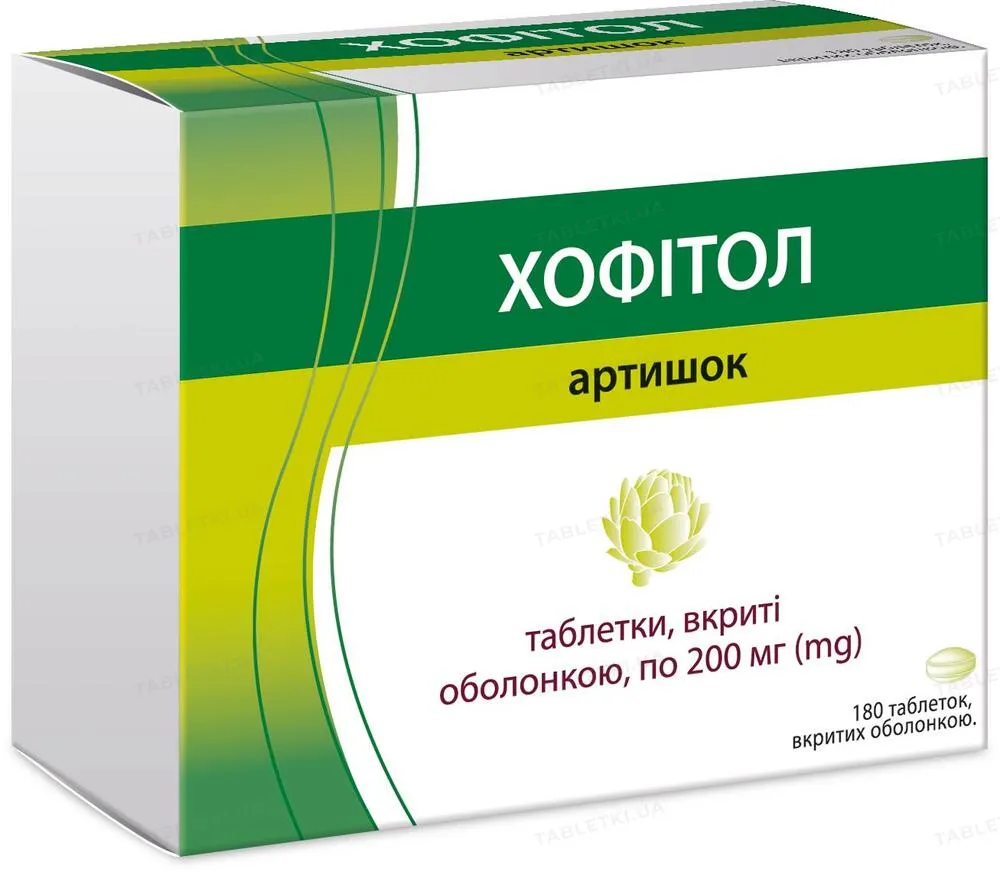
Table of Contents
INSTRUCTION FOR MEDICAL USE OF THE MEDICINAL PRODUCT KOFITOL
Composition:
Active substance: dry aqueous extract of field artichoke leaves (Cynara scolymus);
One coated tablet contains 200 mg of dry aqueous extract of field artichoke leaves (Cynara scolymus);
Excipients: magnesium trisilicate, pregelatinized corn starch, talc, magnesium stearate; coating: shellac, rosin, talc, gelatin, sucrose, calcium carbonate, carnauba wax, polysorbate 80, dispersion dye (sucrose, iron oxide yellow (E 172), iron oxide black (E 172), iron oxide brown (E 172), methylparaben (E 218), ethylparaben (E 214)).
Pharmaceutical form. Coated tablets.
Main physicochemical properties: round, biconvex, brown-coated tablets. Lighter-colored specks on the tablet surface are permissible.
Pharmacotherapeutic group. Agents used in liver and biliary tract disorders. Other agents used in biliary pathology.
ATC code A05A X.
Pharmacological properties.
Pharmacodynamics.
Pharmacological properties are determined by the action of a complex of biologically active substances contained in the leaves of field artichoke. It exerts choleretic, hepatoprotective, and diuretic effects, and also reduces blood urea levels. Inulin and other constituents present in artichoke improve metabolic processes in the body.
Pharmacokinetics.
The effect of Hofitol is a combined action of its components, therefore kinetic studies are not feasible; all components together cannot be traced using markers or bioassays. For the same reason, it is impossible to identify the metabolites of the drug.
Clinical characteristics.
Indications.
For improving choleretic and diuretic functions in liver, biliary tract, and kidney disorders, such as: chronic hepatitis, liver cirrhosis, chronic non-calculous cholecystitis, hypokinetic biliary dyskinesia, chronic nephritis, chronic renal failure.
Contraindications.
Hypersensitivity to the components of the drug, particularly to methylparahydroxybenzoate or ethylparahydroxybenzoate, or to plants of the family Asteraceae (Compositae); biliary tract obstruction, cholangitis, suppurative conditions (empyema) of the gallbladder, cholelithiasis or other biliary tract diseases, acute liver diseases, severe hepatic insufficiency; urinary tract obstruction, acute kidney diseases.
Interaction with other medicinal products and other forms of interactions.
Unknown.
Special precautions for use
Use with caution in patients with diseases that may lead to biliary tract obstruction or in severe liver disorders. If diarrhea or abdominal pain occurs, treatment should be discontinued and medical advice should be sought.
The product contains sucrose. Therefore, patients with fructose intolerance, glucose-galactose malabsorption, or sucrase-isomaltase deficiency should not take this medicine.
The product contains parahydroxybenzoates, which may cause allergic reactions (possibly delayed).
Contains methylparahydroxybenzoate (E 218) and ethylparahydroxybenzoate (E 214) as components of the colouring agent. One tablet contains 0.08 g of sucrose.
Use during pregnancy or breastfeeding
During pregnancy or breastfeeding, the medicine should be used only on a doctor's prescription, when the expected benefit to the mother outweighs the potential risk to the fetus or infant.
Ability to influence reaction speed while driving or operating machinery
The medicine does not affect the ability to drive or operate machinery.
Dosage and Administration.
For oral use in adults and children aged 6 years and older. Should be taken before meals.
Adults and children aged 12 years and older: 1–2 tablets three times daily.
Children aged 6–12 years: 1 tablet three times daily.
The duration of treatment is determined individually by a physician, depending on the nature and course of the disease. The usual treatment course lasts 2–3 weeks. Repeat courses of treatment are possible only after consultation with a physician.
Children.
To be used in children aged 6 years and older under medical supervision.
Overdose.
May result in an increase in adverse effects.
Side effects.
If the drug is used for a prolonged period at high doses, diarrhea, abdominal cramps, gastric disturbances, nausea, and heartburn may occur.
Allergic reactions are possible, including urticaria, skin rashes, hyperemia, and itching.
Shelf life. 3 years.
Storage conditions. Store at a temperature not exceeding 25°C in a place inaccessible to children.
Packaging.
30 coated tablets in a blister, 2 or 6 blisters per cardboard box.
Availability. Over-the-counter (without prescription).
Manufacturer.
Laboratoires Galenique Vernin.
Manufacturer's address and place of business.
20 rue Louis Charles Vernin, 77190 Dammarie-les-Lys, France.