Calendula tincture
Ukraine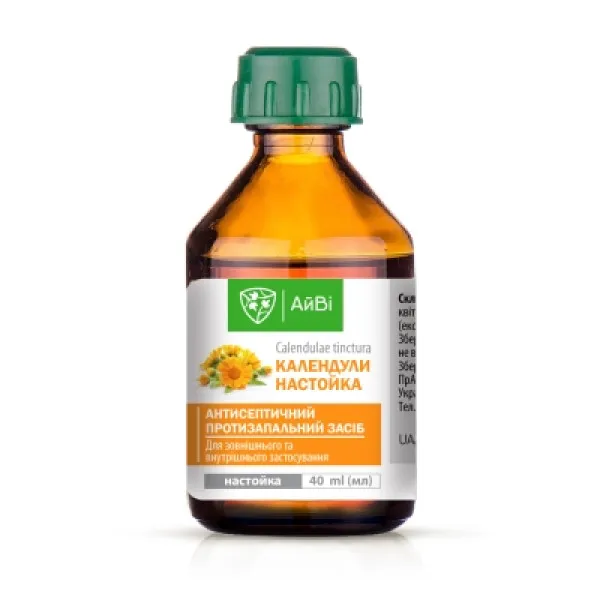
Table of Contents
INSTRUCTION FOR MEDICAL USE OF THE MEDICINAL PRODUCT CALENDULA TINCTURE
Composition:
Active substance: Calendula flower tincture (Calendula flos) (1 : 10) (extraction solvent – 70 % ethanol) 40 ml or 50 ml;
Excipients: none.
Pharmaceutical form. Tincture.
Main physicochemical properties: yellow-brown liquid with a specific odor. Sediment may form during storage.
Pharmacotherapeutic group. Medicinal products promoting wound healing.
ATC code D03AX.
Pharmacological properties.
Pharmacodynamics. Biologically active substances contained in marigold flowers and flower heads (flavonoid and carotenoid glycosides, saponins, tannins, essential oil, organic acids) exert antimicrobial, anti-inflammatory, and mild choleretic effects.
Pharmacokinetics. Not studied.
Clinical characteristics.
Indications.
Locally – as an antiseptic agent for infected (purulent) wounds, cuts, skin burns, and inflammation of mucous membranes of the oral cavity, gums (stomatitis, gingivitis), pharynx, and tonsils (pharyngitis, tonsillitis); internally – as a choleretic agent in biliary tract dyskinesias, cholangitis, and cholecystitis (as part of complex therapy).
Contraindications.
Calendula tincture is contraindicated in individuals with hypersensitivity to any component of the preparation.
Interaction with other medicinal products and other forms of interaction.
Calendula tincture enhances the effect of other anti-inflammatory and choleretic agents (particularly preparations based on chamomile and yarrow).
When using simultaneously with any other medicinal products, inform your doctor.
Special precautions for use.
Before starting treatment with this medicinal product, it is necessary to consult a physician. The preparation contains ethanol; therefore, prolonged use is not recommended.
Use during pregnancy or breastfeeding.
Since the medicinal product contains ethanol, the tincture is not recommended for oral use in women during pregnancy or breastfeeding.
Ability to influence reaction rate when driving vehicles or operating machinery.
When taking the tincture orally, patients should refrain from driving vehicles or operating potentially hazardous machinery.
The sedative effect develops gradually over a period of three weeks.
Dosage and Administration.
Calendula tincture is taken orally, 15–30 minutes before meals, diluted in a small amount of warm boiled water. Adults are recommended to take 10–20 drops of the tincture 3–4 times daily for up to 1 month. For children aged 12 years and older, the dose is calculated as 1 drop of tincture per year of life, 3–4 times daily.
For mouth rinsing, 1 teaspoon of Calendula tincture should be diluted in a glass of warm boiled water.
The method of using the drug for local applications depends on the nature of the skin lesion and is determined by a physician.
Treatment duration is determined individually.
Children.
Since ethanol is an ingredient of the preparation, the tincture is not recommended for children under 12 years of age.
Overdose.
No reports available.
Adverse reactions.
The drug is usually well tolerated; however, allergic reactions (including skin redness, rash, itching, angioedema) may occur in some patients with individual hypersensitivity. When taken orally, a bitter taste in the mouth, burning sensation in the epigastric area, or abdominal pain are possible.
Shelf life. 4 years.
Do not use the drug after the expiry date stated on the package.
Storage conditions.
Store in the original packaging at a temperature not exceeding 25 ºC.
Keep out of reach of children. Sediment formation may occur during storage.
Packaging.
40 ml or 50 ml in glass or polymer bottles.
Supply category. Over-the-counter.
Manufacturer/Marketing authorization holder.
LLC "Ternopharm".
Manufacturer's address and place of business.
46010, Ternopil, Fabrychna St., 4, Ukraine.