Calendula flowers
Ukraine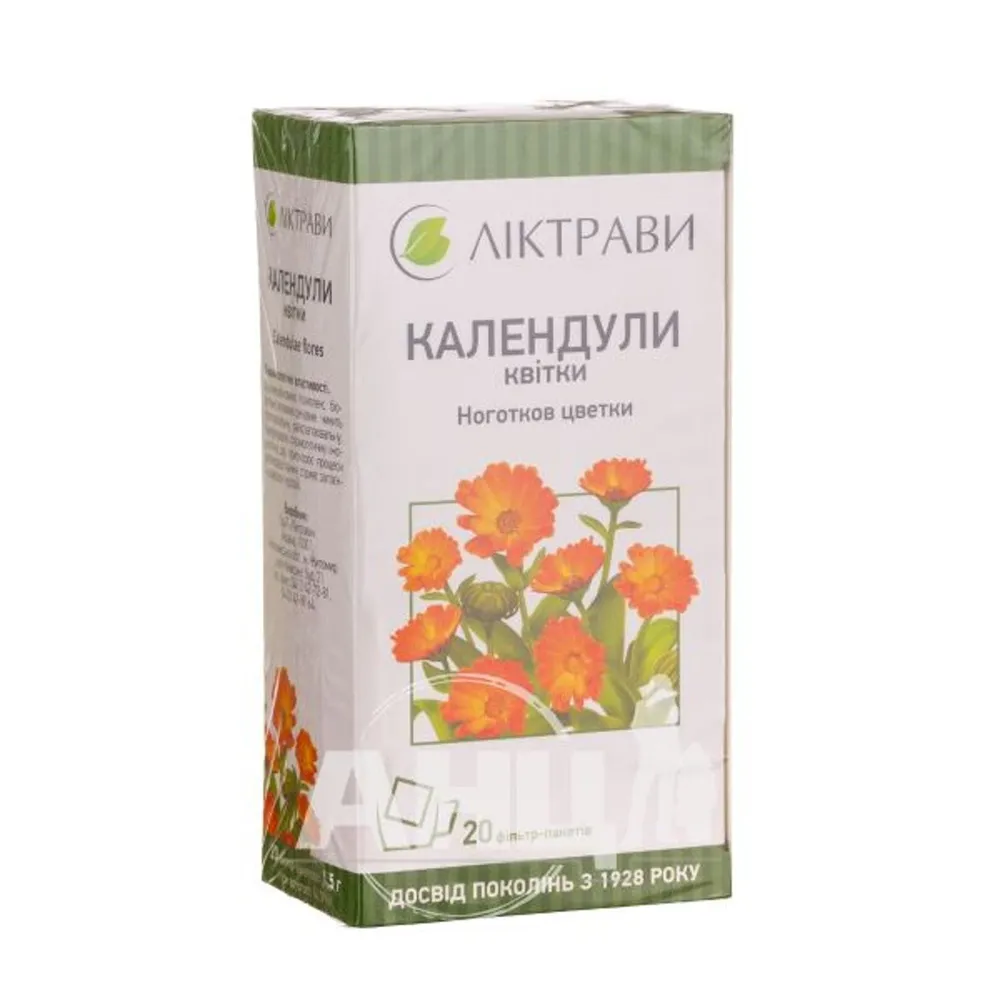
Table of Contents
INSTRUCTION FOR MEDICAL USE OF THE MEDICINAL PRODUCT CALENDULA FLOWERS
Composition:
Active substance: calendula flowers (calendulae flores);
1 pack contains calendula flowers (calendulae flores) 25 g, 40 g, 50 g, 55 g;
1 filter bag contains calendula flowers (calendulae flores) 1.5 g.
Pharmaceutical form. Flowers.
Main physico-chemical properties: powder-like mass, a mixture of yellow-orange, bright yellow, pale yellow or reddish-orange particles (filter bags).
A mixture of crushed receptacles, pedicels, tubular and false ligulate flowers, and involucral bracts. The color of the receptacle, pedicel, and involucral bract fragments is grayish-green or green. The color of flowers ranges from pale yellow to bright yellow, yellow-orange, yellow-brown, or reddish-orange (packs with crushed raw material).
Whole or partially disintegrated capitula up to 5 cm in diameter without pedicels or with pedicel remnants no longer than 3 cm (packs with whole raw material).
Pharmacotherapeutic group.
Antiseptics. ATC code R02A A20.
Pharmacological properties.
Marigold flowers contain carotenoids (carotene, lycopene, violaxanthin, citraxanthin, rubixanthin, flavochrome), flavonoids (narcicisin, ramnetin, isorhamnetin-3-triglucoside, isoquercitrin), essential oil, saponins, bitter substance calendin, resinous and tannins, mucilage, inulin, organic acids (malic, salicylic, pentadecylic), phytosterols, enzymes, vitamin C, alkaloids. This complex of biologically active substances exerts anti-inflammatory, wound-healing, bactericidal, spasmolytic and choleretic effects, and accelerates tissue regeneration processes. Preparations from marigold flowers, when administered internally, promote regeneration of gastric and intestinal mucosa, accelerate healing of ulcers and erosions, exert a mild sedative and hypotensive effect, and support normalization of cardiac function.
Clinical characteristics.
Indications.
Oral administration for gastritis, peptic ulcer of the stomach and duodenum, colitis, enterocolitis, inflammatory diseases of the liver, biliary tract and spleen; externally – for oral cavity diseases (oral candidiasis in children, gingivitis, pyorrhea, inflammatory-dystrophic form of periodontosis), tonsillitis, angina – as part of complex therapy.
Contraindications.
Individual hypersensitivity to the biologically active substances contained in the drug.
Interaction with other medicinal products and other forms of interaction.
Not known.
Special precautions for use.
Use during pregnancy or breastfeeding.
Calendula flowers should be administered during pregnancy or breastfeeding only when the expected benefit to the woman outweighs the potential risk to the fetus or infant.
Ability to affect reaction speed when driving or operating machinery.
Does not affect.
Method of Administration and Dosage
Whole raw material: Place 1 tablespoon of uncrushed flowers into an enameled container, pour 200 mL of hot boiled water, cover with a lid, and steep on a boiling water bath for 15 minutes. Cool at room temperature for 45 minutes, strain, and squeeze the residue into the strained infusion. Adjust the volume of the infusion to 200 mL with boiled water.
Administer warm, 3 times daily, 15–20 minutes before meals: for adults and children aged 14 years and older – 1/3 cup, for children aged 12–14 years – 1/4 cup, aged 7–12 years – 2 tablespoons, aged 3–7 years – 1 dessert spoon. Shake the infusion before use.
For external use, apply 3–4 times daily to rinse the mouth and throat.
Crushed raw material: Place 1 dessert spoon of crushed flowers into an enameled container, pour 200 mL of hot boiled water, cover with a lid, and steep on a boiling water bath for 15 minutes. Cool at room temperature for 45 minutes, strain, and squeeze the residue into the strained infusion. Adjust the volume of the infusion to 200 mL with boiled water.
Administer warm, 3 times daily, 15–20 minutes before meals: for adults and children aged 14 years and older – 1/3 cup, for children aged 12–14 years – 1/4 cup, aged 7–12 years – 2 tablespoons, aged 3–7 years – 1 dessert spoon. Shake the infusion before use.
For external use, apply 3–4 times daily to rinse the mouth and throat.
Powder: Place 2 filter packets into a glass or enameled container, pour 200 mL of boiling water, cover, and steep for 15 minutes. Administer warm, 3 times daily, 15–20 minutes before meals: for adults and children aged 14 years and older – 1/3 cup, for children aged 12–14 years – 1/4 cup, aged 7–12 years – 2 tablespoons, aged 3–7 years – 1 dessert spoon. Shake the infusion before use. For external use, apply 3–4 times daily to rinse the mouth and throat.
The duration of treatment is determined individually by a physician.
Children.
The product is administered orally to children aged 3 years and older as prescribed by a physician.
Overdose.
No cases of overdose have been reported.
Side effects.
In case of individual hypersensitivity to the drug, allergic reactions may develop, including hyperemia, rash, itching, and skin edema.
If adverse reactions occur, discontinue use of the drug and consult a physician.
Shelf life. 2 years.
Storage conditions.
Store in the original packaging at a temperature not exceeding 25 °C.
Keep out of reach of children.
The prepared infusion should be stored at a temperature of 8 °C to 15 °C for no more than 2 days.
Packaging.
25 g, 40 g, 50 g, 55 g in boxes with an inner packet containing raw material in whole form;
25 g, 40 g, 50 g, 55 g in boxes with an inner packet containing powdered raw material;
1.5 g in filter bags, 20 filter bags per cardboard box.
Dispensing category.
Over-the-counter.
Manufacturer.
JSC "Lubnifarm".
Manufacturer's address and place of business.
16 Barvinkova St., Lubny, Poltava region, 37500, Ukraine.