Ingesta
Ukraine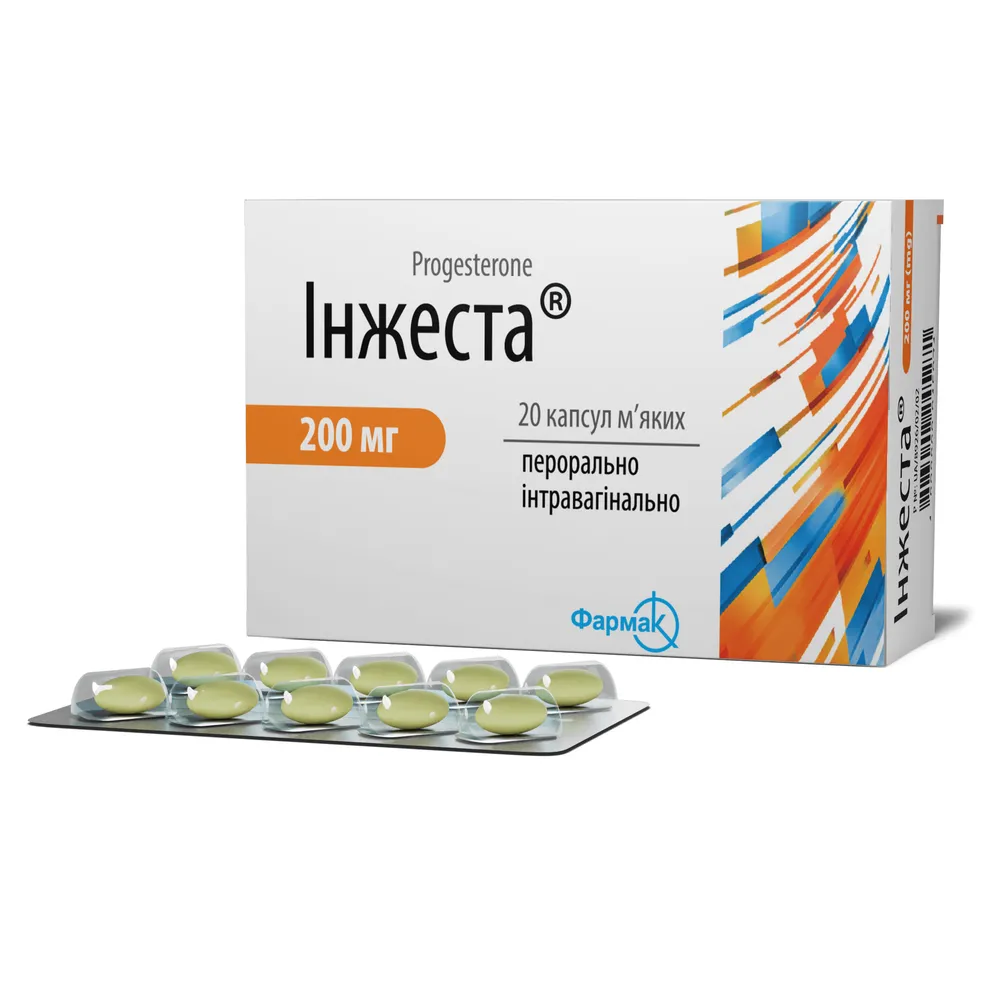
Table of Contents
INSTRUCTIONS FOR MEDICAL USE OF THE MEDICINAL PRODUCT INJESTA® (INJESTA®)
Composition:
Active substance: micronized progesterone;
1 capsule contains 100 mg or 200 mg of micronized progesterone;
Excipients: lecithin, sunflower oil;
capsule shell composition: gelatin, glycerin, titanium dioxide (E 171).
Dosage form. Soft capsules.
Main physicochemical properties:
100 mg capsules: soft gelatin capsules, round-shaped, yellowish in color. The capsule contents are an oily, pasty mixture, almost white in color;
200 mg capsules: soft gelatin capsules, oval-shaped, yellowish in color. The capsule contents are an oily, pasty mixture, almost white in color.
Pharmacotherapeutic group. Sex hormones and drugs used in disorders of the reproductive system. Progestogens. Pregnanediones (4). Progesterone.
ATC code G03D A04.
Pharmacological Properties
Pharmacodynamics
The pharmacological properties of the medicinal product are due to progesterone—one of the hormones of the corpus luteum—which promotes the formation of normal secretory endometrium in women. It induces the transition of the uterine mucosa from the proliferative phase to the secretory phase, and after fertilization, facilitates its transformation into a state necessary for the development of the fertilized ovum. It reduces excitability and contractility of the uterine and fallopian tube musculature. It has no androgenic activity. It blocks the secretion of hypothalamic releasing factors of luteinizing hormone (LH) and follicle-stimulating hormone (FSH), suppresses the pituitary formation of gonadotropic hormones and ovulation.
Pharmacokinetics
Oral administration
An increase in plasma progesterone levels is observed from the first hour after absorption of the medicinal product in the gastrointestinal tract. The highest plasma progesterone levels are observed 1–3 hours after administration (1 hour: 4.25 ng/mL, 2 hours: 11.75 ng/mL, 4 hours: 8.37 ng/mL, 6 hours: 2 ng/mL, and 8 hours: 1.64 ng/mL). The main metabolites of progesterone in plasma are 20α-hydroxy,δ4α-pregnanolone and 5α-dihydroprogesterone. The drug is excreted in urine as glucuronide metabolites, the main one being 3α,5β-pregnandiol (pregnanediol). These metabolites are identical to those formed during physiological secretion of the corpus luteum.
Intravaginal administration
After administration into the vagina, progesterone is rapidly absorbed by the mucous membrane.
An increase in plasma progesterone levels begins within the first hour, with peak plasma levels achieved 1–3 hours after administration.
With the average prescribed dose (100 mg of progesterone per night), Injestа® enables achieving and maintaining a physiological and stable level of plasma progesterone (averaging 9.7 ng/mL), similar to that in the luteal phase of the menstrual cycle with normal ovulation. Thus, the medicinal product Injesta® promotes adequate endometrial maturation and facilitates embryo implantation.
With higher doses (above 200 mg per day), progressively increased, the vaginal route of administration allows achieving plasma progesterone levels similar to those during the first trimester of pregnancy.
Metabolism: metabolites in plasma and urine are identical to those detected during physiological secretion of the ovarian corpus luteum: in plasma, mainly 20α-hydroxy,δ4α-pregnanolone and 5α-dihydroprogesterone. Excretion in urine occurs in 95% as glucuronide metabolites, the main component being 3α,5β-pregnandiol (pregnanediol).
Clinical Characteristics
Indications
Disorders associated with progesterone deficiency.
Oral administration
Gynecological:
- Disorders associated with progesterone deficiency, namely:
- premenstrual syndrome,
- menstrual cycle disorders (anovulation, oligoovulation),
- fibrocystic mastopathy,
- premenopausal period;
- hormone replacement therapy in menopause (in combination with estrogen therapy);
- infertility due to luteal phase deficiency.
Obstetrical:
- Prevention of habitual or threatened miscarriage due to luteal phase deficiency;
- risk of preterm labor.
Intravaginal administration
- Reduced fertility in primary or secondary infertility due to partial or complete luteal phase deficiency (anovulation, luteal phase support during preparation for in vitro fertilization, oocyte donation programs). Prevention of habitual or threatened spontaneous abortion due to luteal phase deficiency.
- Prevention of preterm birth in women with a short cervix or in women with a history of spontaneous preterm birth.
- Inability or limitation of oral administration of the drug.
Contraindications
- Hypersensitivity to any component of the medicinal product.
- Severe impairment of liver function.
- Suspected or confirmed neoplasia of the breast or genital organs.
- Undiagnosed vaginal bleeding.
- Incomplete or failed abortion.
- Thrombophlebitis. Thromboembolic disorders.
- Cerebral hemorrhage.
- Porphyria.
Interaction with other medicinal products and other types of interactions
During hormone replacement therapy for menopause with estrogens, it is strongly recommended to administer progesterone no later than day 12 of the cycle.
If the medicinal product Inzhesta® is combined with beta-adrenomimetics in the treatment of preterm labor, the doses of the latter may be reduced.
Concomitant use of other medicinal products may alter the metabolism of progesterone, causing increased or decreased plasma progesterone concentrations, and thus lead to altered drug effects.
Strong inducers of hepatic enzymes (barbiturates, antiepileptic agents (phenytoin), rifampicin, phenylbutazone, spironolactone, griseofulvin) cause increased hepatic metabolism.
Some antibiotics (ampicillins, tetracyclines) may alter intestinal microflora, resulting in changes to the enterohepatic steroid cycle.
Such drug interactions are known to be individual and may significantly differ among various patient groups; therefore, clinical manifestations of such interactions cannot be definitively predicted. All progestins may reduce glucose tolerance, which may necessitate an increase in the daily dose of insulin and other antidiabetic agents in patients with diabetes mellitus.
Progesterone bioavailability may be decreased by smoking and increased by alcohol consumption.
Special precautions for use
Administration of the medicinal product at the recommended doses does not have a contraceptive effect.
If treatment is initiated very early — at the beginning of the menstrual cycle, particularly before day 15 of the cycle — cycle shortening or breakthrough bleeding may occur.
The drug should not be administered in cases of uterine bleeding without first determining the cause, including examination of the endometrium.
The drug should be used with caution in patients with fluid retention (e.g., in conditions such as hypertension, cardiovascular disorders, renal or hepatic impairment, epilepsy, migraine, or bronchial asthma), history of depression, diabetes mellitus, hepatic dysfunction, or photosensitivity.
Prior to prescribing, patients with a family history of tumors, or those with recurrent cholestasis, persistent pruritus during pregnancy, hepatic dysfunction, cardiac or renal insufficiency, fibrocystic mastopathy, epilepsy, asthma, otosclerosis, diabetes mellitus, multiple sclerosis, or systemic lupus erythematosus should be thoroughly evaluated.
Due to the thromboembolic and metabolic risks that cannot be completely excluded, drug administration should be discontinued if any of the following occur:
- Visual disturbances such as vision loss, diplopia, retinal vascular lesions, proptosis, or optic disc edema;
- Venous thromboembolic or thrombotic complications, regardless of the site;
- Severe headache or migraine.
In case of amenorrhea during treatment, pregnancy should be confirmed or excluded, as it may be the cause of amenorrhea.
With vaginal administration of the drug, oily discharge may occur, which is related to the pharmaceutical form of the preparation.
More than half of early spontaneous abortions are caused by genetic abnormalities. Infections and mechanical disturbances may also lead to early miscarriages; the only justification for progesterone administration would then be delayed expulsion of a nonviable embryo. Therefore, progesterone should be prescribed only when progesterone secretion is insufficient, as recommended by a physician.
Before initiating treatment, the patient should undergo a thorough medical and gynecological examination, including transvaginal and mammological examination and a Pap smear, taking into account the patient's history, contraindications, and precautions for use. Regular physician check-ups are recommended during treatment.
All risks and benefits associated with therapy should be carefully evaluated for women receiving hormone replacement therapy (HRT).
In postmenopausal women receiving or who have previously received HRT, a slight to moderate increase in the likelihood of breast cancer diagnosis has been observed. This may be due to earlier diagnosis, a direct effect of HRT, or a combination of these factors. The risk of developing breast cancer increases with the duration of treatment and returns to baseline levels within five years after discontinuation of HRT. Breast cancer diagnosed in women receiving or who have recently received HRT tends to be less invasive than in women who have not undergone HRT. The physician should discuss the increased risk of breast cancer with patients considering long-term hormone therapy, weighing the benefits of HRT.
The drug should not be taken with food but should be administered before bedtime. Concomitant food intake increases the drug's bioavailability.
The medicinal product contains lecithin (soy) and may cause hypersensitivity reactions (urticaria and anaphylactic shock).
Use during pregnancy or breastfeeding
Use of the medicinal product Inzhesta® is not contraindicated during pregnancy, including the first weeks [see section "Indications" (obstetrical indications)].
During the period of drug administration, no adverse effects on the fetus have been observed.
When the drug is used during the second and third trimesters of pregnancy, liver function should be monitored.
Excretion of progesterone into breast milk has not been thoroughly studied. Therefore, its use should be avoided during breastfeeding.
There are data suggesting a possible risk of hypospadias with the use of progestogens during pregnancy for prevention of habitual or threatened miscarriage due to luteal phase deficiency, about which the patient should be informed.
Ability to influence reaction rate while driving or operating machinery
For drivers and machine operators: drowsiness and dizziness may occur related to the oral administration of the drug.
Administration of capsules before bedtime can help avoid these adverse effects.
Cases of drowsiness and dizziness have been observed only with oral administration of the drug.
Dosage and Administration
The duration of treatment depends on the nature of the disease.
Oral administration
In most cases, the average daily dose is 200–300 mg administered in 1 or 2 doses (200 mg in the evening before bedtime, and 100 mg in the morning, if necessary).
- In luteal phase deficiency (premenstrual syndrome, menstrual cycle disorders, premenopause, fibrocystic mastopathy): the drug is taken for 10 days (usually from day 17 to day 26 of the cycle, inclusive).
- In menopausal hormone replacement therapy: since estrogen therapy alone is not recommended, progesterone must be used as an addition during the last 2 weeks of each therapeutic course, following a one-week supportive phase of any replacement therapy, during which withdrawal bleeding may occur.
- In threatened preterm labor: 400 mg of the drug is administered every 6–8 hours until symptoms resolve. The effective dose and frequency are individually adjusted according to clinical manifestations of preterm labor threat. After symptom resolution, the dose should be gradually reduced to a maintenance level (e.g., 200 mg three times daily). This maintenance dose can be used until week 36 of pregnancy.
Progesterone use after 36 weeks of gestation is not recommended.
Intravaginal administration
Capsules should be inserted deeply into the vagina while lying on the back.
Hands must be thoroughly washed before each administration to avoid leaving any detergent residue on the hands.
The average dose is 200 mg of progesterone per day (1 capsule of 200 mg or 2 capsules of 100 mg, divided into two doses administered in the morning and evening, inserted deeply into the vagina, if necessary with an applicator). The dose may be increased depending on the patient's response.
- In partial luteal phase deficiency (dysovulation, menstrual cycle disorders): the daily dose is 200 mg for 10 days (usually from day 17 to day 26 of the cycle).
- In complete luteal phase deficiency [complete absence of progesterone in women with non-functioning (absent) ovaries (oocyte donation)]: the progesterone dose is 100 mg on days 13 and 14 of the transfer cycle. From day 15 to day 25 of the cycle, the dose is 200 mg, divided into two administrations (morning and evening). Starting from day 26, in case of early pregnancy diagnosis, the dose is gradually increased (each week) by 100 mg per day, up to a maximum of 600 mg per day, divided into three doses. This dosage should be maintained until day 60.
- Luteal phase support during in vitro fertilization (IVF) cycles: treatment begins on the evening of embryo transfer, at a dose of 600 mg per day divided into three doses (200 mg every 8 hours).
- In threatened miscarriage or for prevention of recurrent miscarriages due to luteal insufficiency: 200–400 mg per day (100–200 mg per dose every 12 hours) up to 12 weeks of gestation.
- Prevention of preterm birth in women with a short cervix or with a history of spontaneous preterm birth: the dose is 200 mg per day administered in the evening before bedtime from week 22 to week 36 of pregnancy.
Children. Clinical data on the use of the drug in children are lacking.
Overdose
Overdose may manifest as symptoms of adverse reactions, including somnolence, dizziness, euphoria, dysmenorrhea, shortened cycle duration, and metrorrhagia.
In some patients, the standard dose may be excessive due to existing or secondary unstable endogenous progesterone secretion, increased sensitivity to the drug, or very low concomitant serum estradiol levels.
In such cases, it is sufficient to:
- reduce the progesterone dose or administer the dose in the evening before bedtime for 10 days per cycle in case of somnolence or transient dizziness;
- delay the start of treatment to a later point in the cycle (e.g., day 19 instead of day 17) in case of cycle shortening or bleeding;
- verify whether the patient undergoing hormone replacement therapy in the premenopausal period has adequate estradiol levels.
Adverse reactions
When administered orally, the following events have been observed with the use of the medicinal product.
| Organ systems |
Common |
Uncommon (>1/1000; <1/100) |
Rare |
Very rare (<1/10000) |
| Reproductive system and breast |
menstrual changes, amenorrhoea, intermenstrual bleeding |
mastodynia |
||
| Central nervous system |
headache |
drowsiness, transient dizziness |
depression |
|
| Gastrointestinal disorders |
vomiting, diarrhoea, constipation |
nausea |
||
| Hepatobiliary disorders |
cholestatic jaundice |
|||
| Immune system |
urticaria |
|||
| Skin and subcutaneous tissue |
itching, acne |
chloasma |
Other adverse reactions may also be observed, such as changes in libido, breast discomfort, premenstrual symptoms, hyperthermia, insomnia, alopecia, hirsutism, venous thromboembolism, pulmonary artery embolism, fluid retention, changes in body weight, gastrointestinal disorders, and anaphylactic reactions.
Somnolence and/or transient dizziness are most commonly observed in cases of concomitant hypoestrogenism. Reducing the dose of the drug or increasing the estrogen dose promptly eliminates these symptoms without reducing the therapeutic effect.
If treatment is initiated very early in the menstrual cycle, particularly before day 15, shortening of the cycle or breakthrough bleeding may occur.
Vaginal administration of the drug may cause hypersensitivity reactions, including burning, itching, hyperemia, as well as oily vaginal discharge.
Reporting suspected adverse reactions
Reporting of suspected adverse reactions after drug registration is important. It enables ongoing monitoring of the benefit-risk balance of the medicinal product. Healthcare and pharmaceutical professionals, as well as patients or their legal representatives, should report all suspected adverse reactions and lack of drug efficacy via the Automated Information System for Pharmacovigilance at the following link: https://aisf.dec.gov.ua
Shelf life. 2 years.
Do not use the medicinal product after the expiry date stated on the packaging.
Storage conditions. Store at a temperature not exceeding 25 °C.
Keep out of reach and sight of children.
Packaging
100 mg capsules: 10 capsules per blister, 3 blisters per carton.
200 mg capsules: 10 capsules per blister, 2 blisters per carton.
Prescription status. Prescription only.
Manufacturer. JSC "Farmak".
Manufacturer's name and address of the place of business
74, Kyrylivska Street, Kyiv, 04080, Ukraine