Hydrasec
Ukraine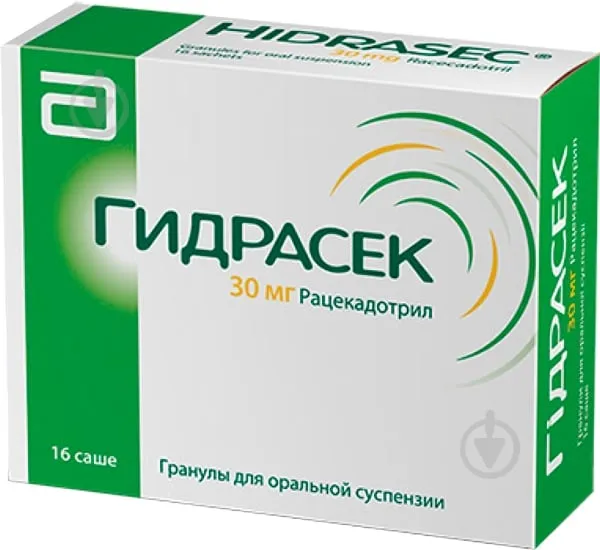
Table of Contents
INSTRUCTIONS FOR MEDICAL USE OF THE MEDICINAL PRODUCT HİDRASEC (HIDRASEC®)
Composition:
Active substance: racecadotril;
1 sachet contains 10 mg or 30 mg of racecadotril;
Excipients: sucrose, colloidal anhydrous silicon dioxide, polyacrylate dispersion, apricot flavoring.
Pharmaceutical form. Granules for oral suspension.
Main physicochemical properties: white powder with a characteristic apricot odor.
Pharmacotherapeutic group. Agents affecting the digestive system and metabolism. Other antidiarrheal agents. Racecadotril. ATC code A07XA04.
Pharmacological Properties.
Pharmacodynamics.
Racecadotril is a prodrug that requires hydrolysis to form the active metabolite thiorphan, which is an enkephalinase inhibitor—an enzyme located in cell membranes of various tissues, particularly in the epithelium of the small intestine. This enzyme promotes the hydrolysis of both exogenous and endogenous peptides, such as enkephalins. Thus, racecadotril protects endogenous enkephalins—physiologically active substances in the gastrointestinal tract—by prolonging their antisecretory effect.
Racecadotril is an antisecretory agent acting exclusively on the intestinal mucosa. It reduces intestinal hypersecretion of water and electrolytes induced by cholera toxins or inflammation, without affecting basal secretory activity. Racecadotril exerts a rapid antidiarrheal effect without altering intestinal transit time.
Racecadotril does not cause abdominal distension. In clinical studies, the incidence of secondary constipation during racecadotril treatment was similar to that observed in the placebo group.
After oral administration, the drug exhibits exclusively peripheral activity, with no effect on the central nervous system.
In two clinical trials in children, racecadotril reduced stool weight by 40% and 46%, respectively, within the first 48 hours. A significant reduction in the duration of diarrhea and the need for fluid rehydration was also observed.
In a meta-analysis of individual patient data (9 randomized clinical trials of racecadotril versus placebo, in addition to oral rehydration solution), individual data from 1,384 boys and girls suffering from acute diarrhea of varying severity and treated either in hospital or on an outpatient basis were collected. The mean age was 12 months (interquartile range: 6 to 39 months). Of the total, 714 patients were under 1 year of age, and 670 were aged 1 year or older. Mean body weight ranged from 7.4 kg to 12.2 kg across studies. The mean duration of diarrhea after enrollment was 2.81 days in the placebo group and 1.75 days in the racecadotril group. The proportion of patients who recovered was higher in the racecadotril groups compared to placebo [Hazard Ratio (HR): 2.04; 95% CI: 1.85 to 2.32; p<0.001; Cox Proportional Hazards Regression]. Results were very similar for infants (<1 year) (HR: 2.01; 95% CI: 1.71 to 2.36; p<0.001) and preschool-aged children (>1 year) (HR: 2.16; 95% CI: 1.83 to 2.57; p<0.001). For inpatients (n=637), the ratio of mean stool weight in the racecadotril group to mean stool weight in the placebo group was 0.59 (95% CI: 0.51 to 0.74; p<0.001). For outpatients (n=695), the ratio of mean frequency of diarrheal stools in the racecadotril group to that in the placebo group was 0.63 (95% CI: 0.47 to 0.85; p<0.001).
Pharmacokinetics.
Absorption.
Racecadotril is rapidly absorbed after oral administration. The time to onset of plasma enkephalinase inhibition is 30 minutes.
The bioavailability of racecadotril is not altered by food intake, although the time to maximum effect is delayed by approximately 1.5 hours.
Distribution.
After an oral dose of radiolabeled 14C racecadotril, the concentration of radioactive carbon isotope measured in plasma was many orders of magnitude higher than in blood cells and three times higher than in total blood volume. Thus, the drug is largely not bound to blood cells. Distribution of the radioactive carbon isotope to other body tissues is moderate, as indicated by the mean apparent volume of distribution in plasma of 66.4 L. Ninety percent of the active metabolite of racecadotril, thiorphan ((RS)-N-(1-oxo-2-(mercaptomethyl)-3-phenylpropyl)glycine), is bound to plasma proteins, primarily albumin.
The pharmacokinetic properties of racecadotril are not altered upon repeated administration or in elderly patients.
The duration and extent of racecadotril's effect are dose-dependent.
In children, the time to peak plasma enkephalinase inhibition is approximately 2 hours, corresponding to 90% inhibition at a dose of 1.5 mg/kg. In adults, the time to peak plasma enkephalinase inhibition is approximately 2 hours, corresponding to 75% inhibition at a dose of 100 mg.
The duration of plasma enkephalinase inhibition is approximately 8 hours.
Metabolism.
The biological half-life of racecadotril, based on the degree of plasma enkephalinase inhibition, is approximately 3 hours.
Racecadotril is rapidly hydrolyzed to thiorphan, the active metabolite, which in turn is converted into inactive metabolites.
Repeated administration of racecadotril does not lead to compound accumulation in the body.
In vitro data indicate that racecadotril/thiorphan and four major inactive metabolites do not inhibit the major CYP enzyme isoforms 3A4, 2D6, 2C9, 1A2, and 2C19 to a clinically significant extent.
In vitro data indicate that racecadotril/thiorphan and four major inactive metabolites do not induce CYP enzyme isoforms (class 3A, 2A6, 2B6, 2C9/2C19, class 1A, 2E1) or UDP-GT (uridine-5-diphosphate glucuronosyltransferase) conjugating enzymes to a clinically significant extent.
Racecadotril does not affect the protein binding of active substances with significant protein binding, such as tolbutamide, warfarin, niflumic acid, digoxin, or phenytoin.
In patients with hepatic insufficiency [cirrhosis, Child-Pugh class B], the kinetic profile of the active metabolite of racecadotril showed Tmax and T½ values similar to those in healthy volunteers, but lower Cmax (-65%) and AUC (-29%).
In patients with severe renal insufficiency (creatinine clearance 11–39 mL/min), the kinetic profile of the active metabolite of racecadotril showed lower Cmax (-49%), higher AUC (+16%), and prolonged T½ compared to healthy volunteers (creatinine clearance >70 mL/min).
In children, pharmacokinetic parameters are similar to those in adults, with Cmax reached 2 hours 30 minutes after administration. No accumulation occurs after multiple doses every 8 hours over 7 days.
Elimination.
Racecadotril is eliminated in the form of both active and inactive metabolites. The drug is primarily excreted by the kidneys, to a much lesser extent in feces. Pulmonary excretion is negligible.
Clinical characteristics.
Indications.
Adjunctive symptomatic treatment of acute diarrhea in infants (from 3 months of age) and children, in combination with oral rehydration and standard supportive measures, when these measures alone are insufficient to control the clinical condition, and when etiological treatment is not possible.
When etiological treatment can be performed, racecadotril may be used as an adjunctive therapy.
Contraindications.
Hypersensitivity to the active substance or to any of the excipients.
Patients who have experienced angioneurotic edema during treatment with angiotensin-converting enzyme inhibitors (such as captopril, enalapril, lisinopril, perindopril, ramipril) should not receive racecadotril.
Due to the presence of sucrose, Hydrasec is contraindicated in patients with rare hereditary fructose intolerance, glucose-galactose malabsorption syndrome, or sucrase-isomaltase deficiency.
Interaction with other medicinal products and other forms of interaction.
Angiotensin-converting enzyme inhibitors (such as captopril, enalapril, lisinopril, fosinopril, perindopril, ramipril) may cause angioneurotic edema. This risk may be increased in the presence of racecadotril.
Concomitant administration of racecadotril with loperamide or nifuroxazide in humans does not alter the pharmacokinetics of racecadotril.
Special precautions for use
Administration of Hydrasec does not alter the usual rehydration regimen.
Restoration of fluid balance is extremely important in the treatment of acute diarrhoea in children. When restoring fluid balance and choosing the appropriate approach, the patient's age and body weight, as well as the stage and severity of the condition, must be taken into account, especially in cases of severe or prolonged diarrhoea associated with significant vomiting or loss of appetite. It is also important to continue regular feeding (including breastfeeding) and to ensure adequate fluid intake.
Bloody or purulent stools and fever may indicate the presence of invasive bacteria as the cause of diarrhoea or another serious condition requiring specific treatment (e.g. with antibiotics) or further investigation. Therefore, racecadotril should not be used in such cases. Racecadotril may be used concomitantly with antibiotics in cases of acute bacterial diarrhoea as an adjunctive therapy.
Use of racecadotril in diarrhoea induced by antibiotic treatment or in chronic diarrhoea is not recommended due to insufficient data.
Diabetic patients should be aware that each sachet contains:
Hydrasec, 10 mg granules – 0.966 g of sucrose;
Hydrasec, 30 mg granules – 2.899 g of sucrose.
If the amount of sucrose (a source of glucose and fructose) in the daily dose of Hydrasec exceeds 5 g per day, this should be taken into account in the daily sugar intake.
The product should not be used in infants under 3 months of age, as clinical studies have not been conducted in this population.
The product should not be used in children with renal or hepatic impairment of any degree of severity due to limited information in this patient population.
Due to the possibility of reduced bioavailability, the product should not be used in cases of prolonged or uncontrolled vomiting.
Skin reactions have been reported during treatment with this medicinal product. In most cases, these reactions are of moderate severity and do not require treatment. However, in some cases, they may be severe and even life-threatening. A causal relationship with racecadotril cannot be completely ruled out. If severe skin reactions occur, treatment should be discontinued immediately.
Hypersensitivity reactions/angioedema have been reported in patients treated with racecadotril. These conditions may occur at any time during treatment. Patients with a history of angioedema unrelated to racecadotril may have an increased risk of developing angioedema.
Severe cutaneous adverse reactions (SCARs)
Severe cutaneous adverse reactions (SCARs), including drug reaction with eosinophilia and systemic symptoms (DRESS syndrome), have been reported in association with racecadotril treatment. These reactions may be life-threatening or fatal. Patients should be informed about the signs and symptoms and closely monitored for skin reactions. If signs or symptoms suggestive of DRESS syndrome occur, racecadotril should be discontinued immediately and alternative treatment considered. If a patient develops DRESS syndrome while taking racecadotril, re-administration of racecadotril is absolutely contraindicated.
Use during pregnancy or breastfeeding
Pregnancy
There are no adequate data on the use of racecadotril in pregnant women. Animal studies do not indicate direct or indirect harmful effects on pregnancy, embryofetal development, parturition or postnatal development. However, since specific clinical studies have not been conducted, racecadotril should not be used during pregnancy.
Breastfeeding
Due to insufficient data on the excretion of Hydrasec into breast milk, the product should not be used during breastfeeding.
Ability to influence reaction speed when driving or operating machinery
Racecadotril has no effect or has a negligible effect on the ability to drive a vehicle or operate machinery.
Dosage and Administration
HYDRASEC is administered orally together with oral rehydration solutions (see section "Special Instructions").
HYDRASEC 10 mg granules are intended for children with body weight up to 13 kg.
HYDRASEC 30 mg granules are intended for children with body weight of 13 kg and above.
The recommended dose is calculated according to body weight: 1.5 mg/kg per dose. This corresponds to 1–2 sachets of the appropriate strength, taken 3 times daily at regular intervals.
For children with body weight up to 9 kg: 1 sachet (10 mg) 3 times daily.
For children with body weight from 9 kg to 13 kg: 2 sachets (10 mg each) 3 times daily.
For children with body weight from 13 kg to 27 kg: 1 sachet (30 mg) 3 times daily.
For children with body weight from 27 kg: 2 sachets (30 mg each) 3 times daily.
In clinical trials involving children, the duration of treatment was 5 days.
Treatment should be continued until two normal bowel movements are observed.
The total duration of treatment should not exceed 7 days.
Prolonged treatment with racecadotril is not recommended.
Clinical studies in children under 3 months of age have not been conducted.
Special patient groups
Studies in infants or children with renal or hepatic impairment have not been performed (see section "Special Instructions").
The medicinal product should not be administered to children with renal or hepatic impairment.
HYDRASEC granules may be added to food, or dissolved in a glass of water or in a feeding bottle, and thoroughly mixed. The preparation should then be administered immediately.
Children
HYDRASEC 10 mg granules are intended for infants and children aged from 3 months to 2 years.
HYDRASEC 30 mg granules are intended for children aged 2 years and older.
Overdose
Isolated cases of overdose without occurrence of adverse reactions have been reported in infants and children. The administered doses were up to 7 times higher than the recommended dose.
In adults, single doses exceeding 2 g (i.e. 20 times higher than the therapeutic dose) did not produce harmful effects.
Adverse Reactions
Below are the adverse reactions observed with racécadotril that occurred more frequently in the racécadotril group than in the placebo group, or were reported during the post-marketing period. Adverse reactions are categorized by frequency as follows: very common (≥ 1/10), common (≥ 1/100 to < 1/10), uncommon (≥ 1/1000 to < 1/100), rare (≥ 1/10,000 to < 1/1000), very rare (< 1/10,000), and frequency not known (cannot be estimated from available data).
Serious skin adverse reactions (SSARs), including drug-induced eosinophilia with systemic symptoms (DRESS syndrome), have been reported in association with racécadotril treatment (see section "Special Warnings and Precautions for Use").
Infections and infestations
Uncommon: tonsillitis.
Skin and subcutaneous tissue disorders
Uncommon: rash, erythema.
Frequency not known: polymorphic erythema, tongue swelling, facial swelling, lip swelling, eyelid swelling, angioneurotic edema, urticaria, nodular erythema, papular rash, prurigo, itching, drug-induced eosinophilia with systemic symptoms (DRESS syndrome).
Immune system disorders
Frequency not known: anaphylactic shock.
Severe skin reactions (including angioneurotic edema) have been reported in patients treated with racécadotril. The frequency of these reactions is unknown. If such reactions occur, treatment with racécadotril must be discontinued and appropriate alternative therapy initiated. In such cases, patients should be informed of the necessity to avoid re-administration of racécadotril.
Shelf life. 3 years.
Storage conditions. Store at a temperature not exceeding 25 °C. Keep out of reach of children.
Packaging. 16 sachets per cardboard box.
Prescription status. Over-the-counter (without prescription).
Manufacturer. Sophartex, France.
Manufacturer's address and place of business. 21 rue du Pressoir, 28500 Vernouillet, France.