Hek-infusion 6 %
Ukraine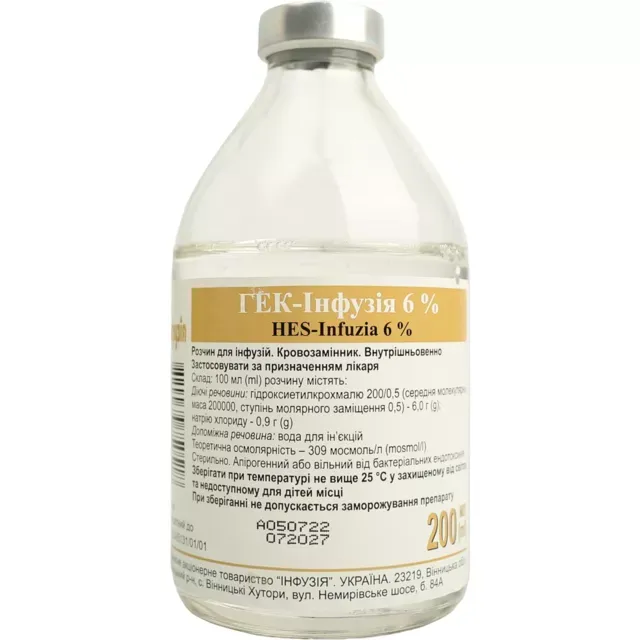
Table of Contents
INSTRUCTION FOR MEDICAL USE OF THE MEDICINAL PRODUCT HES-Infuzia 6 % HES-Infuzia 10 %
Composition:
Active substance: hydroxyethyl starch;
100 ml of solution contain: hydroxyethyl starch 200/0.5 (average molecular weight 200000, molar substitution degree 0.5) – 6.0 g or 10.0 g, sodium chloride – 0.9 g;
Excipient: water for injections.
Pharmaceutical form. Infusion solution.
Main physicochemical properties: clear, colorless or slightly yellowish liquid, theoretical osmolarity 309 mosmol/l, pH 4.0–7.0.
Pharmacotherapeutic group. Plasma substitutes and perfusion solutions. Hydroxyethylated starch preparations. ATC code B05AA07.
Pharmacological properties.
Pharmacodynamics.
6% or 10% isotonic solution of hydroxyethyl starch (a hydroxyethyl derivative of the product of acid hydrolysis of starch) with an average molecular weight of 200,000 daltons and a molar substitution degree of 0.45–0.55. The 6% solution provides a volemic effect of 85–100% of the infused volume, maintained for 3–4 hours; the 10% solution provides a volemic effect of up to 130% of the infused volume. The drug's action is due to its ability to bind and retain water within the intravascular space, thereby reducing tissue edema.
The drug improves blood rheological properties and microcirculation, as well as cerebral blood flow (including due to reduction in hematocrit levels), resulting in improved tissue perfusion, reduced plasma viscosity, platelet aggregation, and prevention of erythrocyte aggregation. It is effective in conditions associated with increased capillary wall permeability. The administered drug remains in the vascular bed for 24 hours.
Pharmacokinetics.
The drug has no local irritant or immunotoxic effects. Accumulation in reticuloendothelial system (RES) cells does not lead to toxic effects on the liver, lungs, spleen, lymph nodes, or cause RES cell blockade.
Hydroxyethyl starch is rapidly metabolized in the liver, with 40% excreted by the kidneys within 24 hours after infusion.
Clinical characteristics.
Indications.
Hypovolemia caused by acute blood loss in cases where the use of crystalloids alone is considered insufficient.
Contraindications.
Hypersensitivity to the components of the drug; hypervolemia; hyperhydration; hyperchloremia; marked hypernatremia; dehydration state requiring correction of water-electrolyte balance; chronic heart failure; renal failure; patients undergoing renal replacement therapy; severe hepatic insufficiency; pulmonary edema; intracranial hemorrhage; severe coagulation disorders; sepsis; burns; critically ill patients due to the risk of kidney injury and death. Contraindicated in patients with transplanted organs.
Interaction with other medicinal products and other forms of interaction.
When used concomitantly with aminoglycoside antibiotics, the drug may enhance their nephrotoxic effect. To prevent incompatibility, mixing the drug with other medicinal products is not recommended. Administration of hydroxyethyl starch may cause an increase in serum amylase levels. This effect should be considered not as a sign of pancreatic dysfunction, but as a result of the formation of a hydroxyethyl starch–amylase complex, followed by delayed excretion of this complex via renal and non-renal pathways.
Special precautions for use.
Use the drug with special caution in patients with renal pathology, coagulation disorders, especially in hemophilia and diagnosed or suspected von Willebrand's disease.
Avoid volume overload, which may occur in case of drug overdose, particularly dangerous in patients with concomitant cardiac and/or renal pathology, as well as in elderly patients.
Frequent monitoring of fluid and electrolyte balance and renal function parameters is mandatory, along with ensuring adequate fluid intake.
The drug may affect the results of the following clinical and biochemical tests, including: blood glucose level; blood protein level; ESR; biuret test; levels of fatty acids, cholesterol, and sorbitol dehydrogenase in blood; urine specific gravity.
Due to the risk of allergic (anaphylactoid) reactions, strict monitoring of the patient's condition is required, and infusion should be administered at a low rate.
Doses should be carefully adjusted, especially in patients with pulmonary diseases. The use of HES preparations is not recommended in patients undergoing open-heart surgery combined with extracorporeal circulation due to the risk of excessive bleeding.
In cases of pronounced dehydration, fluid and electrolyte balance should be corrected first.
Reliable data on the safety of long-term use of HES in postoperative patients and in patients with trauma are currently lacking. In such patients, the expected benefit should be carefully weighed against the uncertainty regarding long-term safety before prescribing HES, and alternative treatments should be considered. HES administration must be immediately discontinued at the first signs of kidney damage. Cases requiring renal replacement therapy have been reported up to 90 days after HES infusion. Therefore, renal function must be monitored in patients after HES administration.
HES use should be immediately discontinued at the first signs of coagulopathy. In case of repeated administration, coagulation parameters should be carefully monitored.
The presence of HES in blood may lead to errors in determining the patient's blood group. To correctly determine blood type, blood testing must be performed before infusion.
To detect potential anaphylactic reactions as early as possible, the first 10–20 mL of the preparation should be administered slowly under continuous supervision of medical personnel.
Do not use the drug if the solution is opaque or contains visible particles, or if the vial is damaged or has been previously opened.
Prolonged daily use of medium (500 mL/day) or high (1,000 mL/day) doses may cause skin pruritus that is difficult to treat. Pruritus may begin several weeks after discontinuation of treatment and may persist for months.
Use during pregnancy or breastfeeding.
There are no data on the safety of hydroxyethyl starch use during pregnancy. The drug is contraindicated in the first trimester of pregnancy and should be used in the second and third trimesters only when the expected benefit to the mother outweighs the potential risk to the fetus.
There are no clinical data or experience regarding the use of the drug during breastfeeding; therefore, it should be used with caution.
Ability to affect reaction speed when driving or operating machinery.
Data on the effect of the drug on reaction speed during driving or operating machinery are unavailable, as the drug should only be administered under hospital conditions.
Method of Administration and Dosage.
The drug is intended for intravenous infusion in adults and children aged 12 years and older. HES should be administered at the lowest effective doses for the shortest possible duration. The dose and rate of infusion must be determined individually based on the patient's condition, blood loss volume, and hemodynamic parameters.
The first 10–20 mL of the drug should be administered slowly, with careful monitoring of the patient's condition, due to the potential risk of anaphylactic reactions.
For treatment of volume deficiency in adults and children aged 12 years and older, the maximum daily dose is 33 mL/kg body weight for the 6% solution and 20 mL/kg body weight for the 10% solution. The maximum infusion rate is up to 20 mL/kg/hour, equivalent to 0.33 mL/kg body weight per minute.
Treatment must be accompanied by continuous hemodynamic monitoring and should be discontinued immediately once the desired hemodynamic parameters are achieved.
Children.
The drug may be used in children aged 12 years and older.
Overdose.
Overdose or excessively rapid administration may lead to volume overload or hypernatremia, resulting in peripheral, interstitial, or pulmonary edema and acute heart failure. Excessive chloride administration may cause hyperchloremic metabolic acidosis.
Treatment: immediate discontinuation of infusion, administration of diuretics.
Adverse Reactions
Immune system disorders: Hypersensitivity reactions of varying severity may occur, including anaphylactic reactions (bradycardia, tachycardia, bronchospasm, non-cardiogenic pulmonary edema, urticaria, hypotension, nausea, vomiting). Increased body temperature, chills, swelling of lower limbs, anaphylactic shock, enlargement of submandibular and periauricular salivary glands, mild influenza-like symptoms (headache, muscle pain, back pain).
Blood and lymphatic system disorders: Reduction in coagulation factors due to hemodilution may occur as a result of administration of HES solutions without concomitant administration of blood components. Hemodilution frequently leads to decreased hematocrit and plasma protein concentration. Depending on the administered dose, HES solutions may affect blood coagulation due to reduced concentration of coagulation factors. Bleeding time and activated partial thromboplastin time (aPTT) may be prolonged, and FVIII/vWF (Factor VIII/ von Willebrand Factor) activity may be reduced.
Skin and subcutaneous tissue disorders: Skin pruritus, which is difficult to treat and may persist for months.
Effects on biochemical parameters: Serum amylase levels may significantly increase after infusion of the drug and return to normal within 3–5 days.
All patients receiving HES solutions must remain under continuous medical supervision. In case of anaphylactic reaction, infusion must be stopped immediately and emergency treatment initiated. The efficacy of prophylactic corticosteroid administration has not been proven.
Shelf life: 5 years.
Storage conditions: Store at temperatures not exceeding 25 °C, in a place protected from light and inaccessible to children. Freezing of the product must be avoided during storage.
Incompatibility: The drug must not be mixed with other infusion solutions due to possible pharmaceutical incompatibility.
Packaging: 200 ml or 400 ml in bottles.
Prescription status: Prescription only.
Manufacturer: Private Joint-Stock Company "Infuziya".
Manufacturer's address and location of operations:
Ukraine, 21034, Vinnytsia, Voloshkova St., b. 55
or
Ukraine, 23219, Vinnytsia region, Vinnytsia district, village Vinnytski Khutory, Nemirovskе Highway, b. 84A.
Marketing Authorization Holder: Private Joint-Stock Company "Infuziya".
Address of Marketing Authorization Holder:
Ukraine, 04073, Kyiv, Moskovske Avenue, b. 21-A.