Fleboton
Ukraine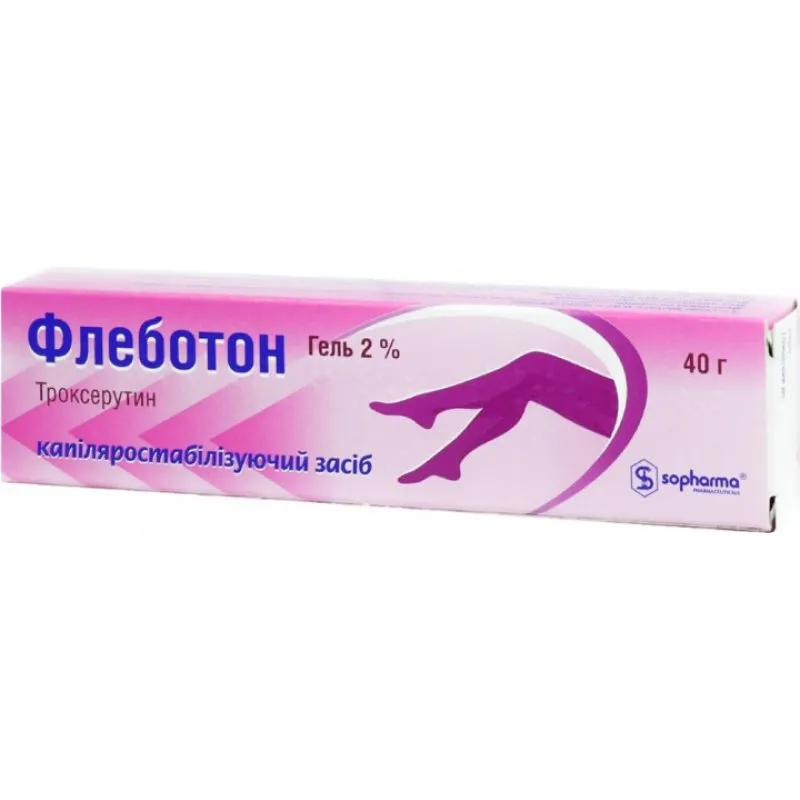
Table of Contents
INSTRUCTIONS FOR MEDICAL USE OF THE MEDICINAL PRODUCT FLEBOTON (PHLEBOTON)
Composition:
Active substance: troxerutin;
1 g of gel contains troxerutin 0.02 g (20 mg);
Excipients: carbomers, disodium edetate, benzalkonium chloride, sodium hydroxide, purified water.
Pharmaceutical form. Gel.
Main physicochemical properties: yellow, odorless gel.
Pharmacotherapeutic group.
Angioprotectors. Capillary stabilizing agents. Bioflavonoids.
ATC code C05C A04.
Pharmacological Properties.
Pharmacodynamics.
Phleboton is a capillary-strengthening and venotonic agent. It exhibits anti-inflammatory and antioxidant effects and inhibits hyaluronidase. It prevents oxidation of hyaluronic acid, ascorbic acid, and adrenaline, and suppresses lipid peroxidation. Troxerutin reduces capillary permeability and fragility and prevents damage to the basement membrane of endothelial cells; in addition, it possesses membrane-stabilizing, antihemorrhagic, detoxifying, antiallergic, and venotonic properties. It reduces edema, improves trophicity, and alleviates other symptoms associated with venous insufficiency or impaired lymphatic drainage.
Pharmacokinetics.
The Phleboton dosage form (gel) ensures complete absorption of the active substance through the stratum corneum of the epidermis and its penetration into blood vessels in the subcutaneous tissue. Its pH corresponds to the pH of the skin, thus it does not produce local irritant or sensitizing effects. Due to its water-based formulation, the gel does not disrupt the physiological properties of the skin.
Clinical characteristics.
Indications.
Symptomatic treatment of:
- prevaricose and varicose syndrome;
- superficial thrombophlebitis, phlebitis, and postphlebitic conditions;
- chronic venous insufficiency;
- edema and pain associated with injuries and varicose veins.
Contraindications.
Hypersensitivity to troxerutin or to any excipient.
The gel should not be applied to mucous membranes, open wounds, or areas of skin affected by eczema.
Interaction with other medicinal products and other forms of interaction.
Enhances the capillary-protective effect of ascorbic acid.
Special precautions for use.
Prolonged use may cause hypersensitivity!
Benzalkonium chloride may cause skin reactions.
During breastfeeding, this medicinal product should not be applied directly to the breasts, as the infant may ingest it with breast milk.
The drug is not recommended for long-term use in patients with severe renal function impairment.
If the severity of disease symptoms does not decrease during treatment with the drug, consult a physician.
Use during pregnancy or breastfeeding.
There are no clinical data on the use of the drug in pregnant or breastfeeding women. Therefore, use is permitted only under a physician's prescription, who should assess the benefit-to-risk ratio for the woman and the fetus (child).
Ability to affect reaction rate when driving or operating machinery.
Does not affect.
Method of Administration and Dosage
Apply topically to the skin.
Apply the gel in the morning and evening, gently rubbing it into the affected areas of the skin with light massaging motions. If necessary, the gel may also be used under a bandage or compression stockings.
Dosage and duration of treatment are determined individually by a physician, depending on the severity and course of the disease.
In complicated cases, combination therapy using troxerutin in capsules is recommended.
Children
There are no contraindications for the use of the drug in children.
Overdose
There are no data on overdose with topical application of the drug. In case of accidental ingestion of a large amount of the medicinal product, general measures for drug elimination should be applied, and symptomatic treatment should be administered if necessary.
Side effects.
In rare cases, hypersensitivity reactions may occur, including skin irritation, redness, itching, skin rashes, dermatitis, angioneurotic edema. Symptoms usually disappear after discontinuation of the drug.
Shelf life. 5 years.
Shelf life after tube opening – 12 months.
Storage conditions.
Keep out of reach of children. This medicinal product does not require special storage conditions.
Packaging.
40 g of gel in an aluminum tube with a membrane and a plastic cap; 1 tube in a cardboard box.
Availability.
Over-the-counter (without prescription).
Manufacturer.
Sofarma AD.
Manufacturer's address and place of business.
16 Iliensko Shose Str., Sofia, 1220, Bulgaria.