Ethoxysclerol 3 %
Ukraine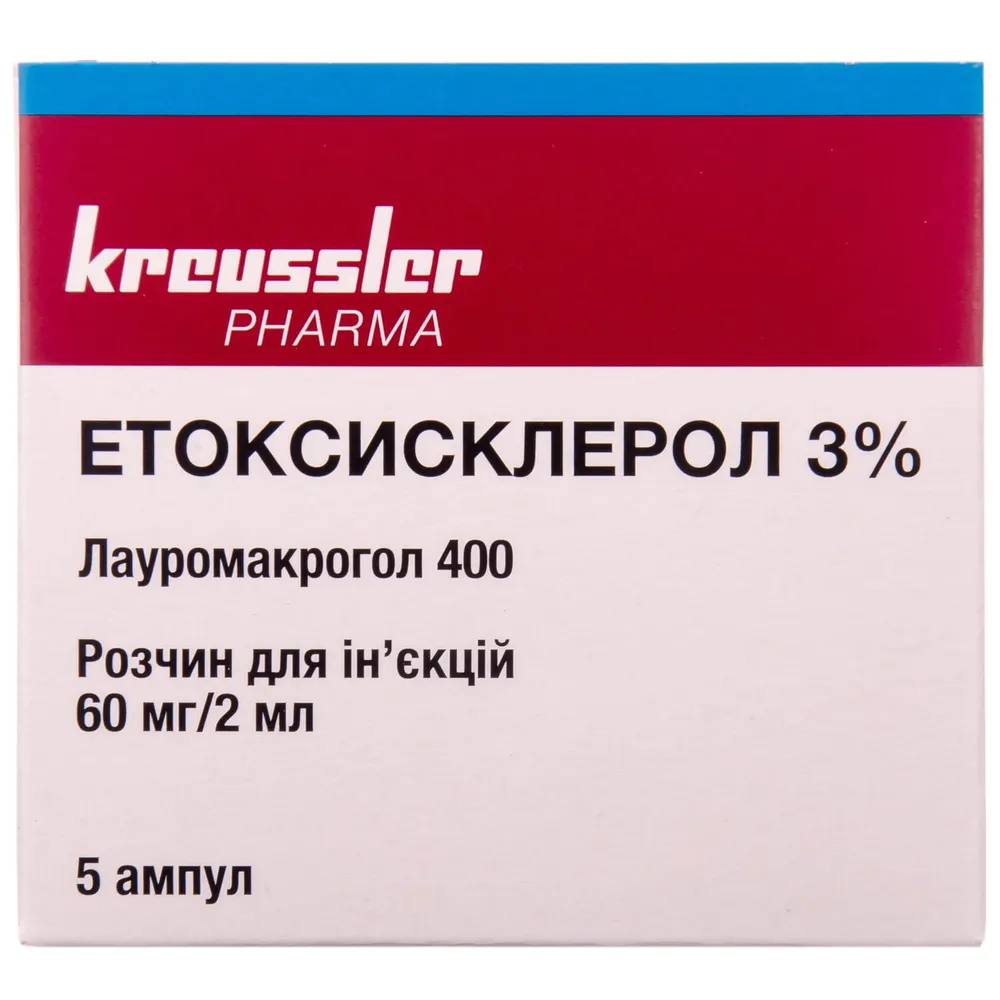
Table of Contents
- INSTRUCTIONS FOR MEDICAL USE OF THE MEDICINAL PRODUCT ETOXISCLEROL 0.5%, ETOXISCLEROL 1%, ETOXISCLEROL 3% (AETHOXYSKLEROL® 0.5%, AETHOXYSKLEROL® 1%, AETHOXYSKLEROL® 3%)
- Composition:
- Pharmacological properties.
- Clinical characteristics.
- Special precautions for use
- Method of administration and doses.
- Adverse Reactions.
INSTRUCTIONS FOR MEDICAL USE OF THE MEDICINAL PRODUCT ETOXISCLEROL 0.5%, ETOXISCLEROL 1%, ETOXISCLEROL 3% (AETHOXYSKLEROL® 0.5%, AETHOXYSKLEROL® 1%, AETHOXYSKLEROL® 3%)
Composition:
Active substance: lauromacrogol 400 (polidocanol);
2 ml of injection solution contains lauromacrogol 400 – 10 mg or 20 mg or 60 mg;
Excipients: ethanol 96%; sodium hydrogen phosphate, dihydrate; potassium dihydrogen phosphate; water for injections.
Pharmaceutical form. Injection solution.
Main physico-chemical characteristics: clear solution, colorless to slightly greenish-yellow.
Pharmacotherapeutic group.
Sclerosing agents for local administration. ATC code C05B B02.
Pharmacological properties.
Pharmacodynamics.
Laurocapram 400 exerts a sclerosing and simultaneously local analgesic effect. This ensures almost painless obliteration of varicose veins. The action is primarily directed at the endothelium. Laurocapram 400 has high affinity for damaged endothelium, while not affecting undamaged areas; therefore, the sclerosing effect occurs only in truly varicose-affected veins, not in merely cylindrically moderately dilated veins. The sclerosing effect is based on irritation of the damaged venous endothelium, leading to local thrombosis. Thanks to the tight compression bandage applied after injection, the venous walls are compressed, preventing recanalization of the forming thrombus, thus ensuring the desired transformation of the thrombus into a fibrous scar strand. With proper selection of concentration and dosage, correct treatment technique, and appropriate post-procedural care (compression therapy), laurocapram 400 reliably ensures durable and long-lasting obliteration.
Pharmacokinetics.
Within 12 hours after intravenous injection of laurocapram 400, 89% of the administered dose is eliminated from the blood. In a study conducted in patients with varicose veins (diameter greater than 3 mm) following administration of 3% Ethoxysclerol, the following parameters were determined: terminal half-life elimination time – 0.94–1.27 hours, volume of distribution – 17.9 L, total clearance – 12.4 L/hour.
Clinical characteristics.
Indications.
Sclerotherapy of vascular networks, varicose branches of the central vein, reticular varicose veins, small, medium, and large varicose nodes; hemorrhoids of grade 1 and 2.
Depending on the size of the varicose nodes, different concentrations of the drug are used; for the treatment of hemorrhoids, Ethoxysclerol 3% is used.
| Indications |
Concentration of Aethoxysklerol |
|||
| 0.5% |
1% |
3% |
Method of administration |
|
| Vascular networks |
х |
As a solution |
||
| Varicose branches of the central vein |
х |
х |
As a solution |
|
| Reticular varicose veins |
х |
As a solution |
||
| Small varicose nodes |
х |
As a solution and foam |
||
| Medium and large varicose nodes |
х |
As a solution and foam |
||
| Hemorrhoids of 1st and 2nd degree |
х |
As a solution |
||
Contraindications
For varicose vein treatment, the drug is contraindicated in the following cases:
Absolute contraindications for the use of the drug:
- known hypersensitivity to lauromacrogol 400 or to other components of the drug;
- acute severe systemic diseases (especially incurable ones);
- bedridden state;
- obliterative endarteritis grade III and IV;
- thromboembolic disease;
- high risk of thrombosis (e.g., in hereditary thrombophilia or in the presence of multiple risk factors such as hormone replacement therapy, use of hormonal contraceptives, obesity, smoking, and all diseases and conditions associated with restricted mobility);
Absolute contraindications for the use of the drug in foam form (additional):
- history of symptomatic "patent foramen ovale";
Relative contraindications for the use of the drug:
- febrile conditions;
- bronchial asthma or known predisposition to allergies;
- general physical debility;
- obliterative endarteritis grade II;
- leg edema (not correctable by compression therapy);
- inflammatory skin diseases at the injection site;
- symptoms of microangiopathy or neuropathy;
- limited patient mobility;
Relative contraindications for the use of the drug in foam form (additional):
- history of asymptomatic "patent foramen ovale";
- psychiatric, neurological symptoms, or visual disturbances.
For hemorrhoid treatment, the drug is contraindicated in the following cases:
Absolute contraindications for the use of the drug in case of hemorrhoids:
- known hypersensitivity to lauromacrogol 400 or to other components of the drug;
- acute severe systemic diseases (especially incurable ones);
- acute inflammation in the anal area;
Relative contraindications for the use of the drug in case of hemorrhoids:
- febrile conditions;
- bronchial asthma or known predisposition to allergies;
- general physical debility;
- chronic inflammatory bowel diseases (e.g., Crohn's disease);
- known hypercoagulability.
Interaction with other medicinal products and other forms of interaction.
Lauromacrogol 400 is a local anesthetic. When used concomitantly with other anesthetics, there is a risk of enhanced effects on the cardiovascular system.
Special precautions for use
The product contains 5% (v/v) alcohol, which should be taken into account in patients with a history of alcoholism.
The product contains potassium (less than 39 mg per ampoule) and sodium (less than 23 mg per ampoule).
Sclerotherapy of varicose veins
Like all sclerosing agents, lauromacrogol 400 must never be administered intra-arterially, as this may cause severe necrosis, which in turn may lead to amputation. In such cases, immediate consultation with a vascular surgeon is required.
For all sclerosing agents, strict indications for use on the face are necessary, since intra-venous injection may alter arterial pressure and cause irreversible ocular damage, potentially leading to blindness.
The risk of accidental intra-arterial injection at the foot or ankle level should also be considered. When obliterating the ankle area, only a small dose with low concentration should be administered under careful supervision to avoid excessive obliterative reaction.
The recommended total foam volume per session is 2–8 mL; the maximum foam volume (for one or multiple injections) is 10 mL.
When treating truncal veins, foam injection should be performed at least 8–10 mm away from the sapheno-femoral junction. If ultrasound examination reveals foam embolization into the deep venous system, the patient should perform muscle activation, for example, by dorsiflexion of the ankle joint.
Sclerotherapy of haemorrhoids
Sclerotherapy of haemorrhoids should be performed with particular caution due to the risk of injury to the internal anal sphincter and subsequent faecal incontinence.
When treating 11 o'clock haemorrhoidal nodes in males, a maximum of 0.5 mL of Ethoxysclerol 3% should be injected due to proximity to the urethra and the prostate gland.
Use during pregnancy or breast-feeding
There is insufficient data on the use of the drug in pregnant women. Reproductive toxicity, but no teratogenic effects, were observed in animal studies.
The drug should be used during pregnancy only if the potential benefit outweighs the risk to the fetus.
It is unknown whether lauromacrogol 400 passes into breast milk.
If sclerotherapy is necessary, breastfeeding should be discontinued for 2–3 days.
Ability to influence reaction speed when driving or operating machinery
There have been no reports of negative effects on the ability to drive or operate machinery.
Method of administration and doses.
The concentration of the drug should be selected depending on the diameter of the vein and the individual condition of the patient.
The lowest possible concentration of the drug should be used.
Dosing (single and daily doses).
The dose of lauromacrogol 400 must not exceed 2 mg/kg body weight per day.
For example, the maximum dose for a patient weighing 70 kg is 140 mg (except for dosing in case of haemorrhoids).
140 mg of lauromacrogol 400 contains:
Ethoxysclerol 0.5 %: 28 ml of injection solution;
Ethoxysclerol 1 %: 14 ml of injection solution;
Ethoxysclerol 3 %: 4.6 ml of injection solution.
If desired, the drug may be administered in foam form.
For preparation of standardized, homogeneous, viscous foam, see instructions for individual systems.
When administering the drug as foam, the dose must not exceed 10 ml of foam per session and per day, regardless of the patient's body weight.
Extensive varicose veins should be treated over several sessions.
For patients with varicose veins prone to hypersensitivity reactions, only one injection should be administered during the first treatment session. Depending on treatment outcomes and the size of the obliteration area, multiple injections may be given during subsequent sessions, without exceeding the maximum dose.
Sclerotherapy of vascular networks: depending on the size of varicose nodules, administer 0.1–0.2 ml of Ethoxysclerol 0.5 % intravascularly.
Sclerotherapy of branches of the central vein: depending on the size of varicose nodules, administer 0.1–0.2 ml of Ethoxysclerol 1 % intravascularly.
Sclerotherapy of reticular varicose veins: depending on the size of varicose nodules, administer 0.1–0.3 ml of Ethoxysclerol 1 % intravascularly.
Sclerotherapy of small varicose nodules: depending on the size of varicose nodules, administer 0.1–0.3 ml of Ethoxysclerol 1 % as a solution intravascularly.
When using Ethoxysclerol 1 % as foam, e.g. for treatment of collateral varicose veins, up to 4 ml (maximum 6 ml) of the drug per injection may be administered. For treatment of perforating veins, up to 2 ml (maximum 4 ml) per injection may be administered. The maximum daily dose must not be exceeded.
Sclerotherapy of medium-sized varicose nodules: depending on the size of varicose nodules, administer 0.5–1 ml of Ethoxysclerol 3 % as a solution intravascularly at the first administration. Depending on the course and size of varicose nodules, up to 2 ml of solution may be administered in subsequent sessions, without exceeding the maximum daily dose.
Ethoxysclerol 3 % as foam (e.g. for treatment of large and small subcutaneous veins) may be administered in doses up to 4 ml per injection (maximum 6 ml for treatment of large subcutaneous veins). The maximum daily dose must not be exceeded.
Sclerotherapy of large varicose nodules: at the first administration, 1 ml of Ethoxysclerol 3 % as a solution is administered. Depending on the course and size of varicose nodules, several injections (2–3) of up to 2 ml may be administered in subsequent sessions. The maximum daily dose must not be exceeded.
Ethoxysclerol 3 % as foam (e.g. for treatment of large and small subcutaneous veins) may be administered in doses up to 4 ml per injection (maximum 6 ml for treatment of large subcutaneous veins). The maximum daily dose must not be exceeded.
Drug concentration in foam form, depending on the indication.
| 1 %* |
3%* |
| Varicose veins of collateral veins |
Varicose veins of large subcutaneous veins |
| Varicose veins of perforating veins |
Varicose veins of small subcutaneous veins |
*The indicated concentrations refer to the preparation in the form of a solution for foam preparation.
Hemorrhoids: During a single treatment session, the dose of Ethoxysclerol 3% should not exceed 3 ml. Depending on the course of the disease, up to 1 ml of solution is injected into each node by injection directly under the mucosa. An exception is the 11 o'clock nodes in men, where a maximum of 0.5 ml is administered.
Method of administration.
Sclerotherapy of vascular networks
Sclerotherapy of branches of the central vein
Sclerotherapy of reticular varicose veins
Small varicose nodes
Sclerotherapy is performed with the leg in a horizontal position or slightly elevated at an angle of 30–45°. All injections are administered intravenously only, including when treating vascular networks.
Very fine needles (e.g., insulin needles) and syringes with smooth plungers are used. The puncture is performed tangentially, and the preparation is injected slowly. When using the preparation in the form of foam, the needle size should be no smaller than 25 G.
Medium and large varicose nodes
Regardless of the venipuncture technique (patient standing – only with a cannula; patient sitting – with a ready-to-use injection syringe), sclerotherapy is performed with the leg in a horizontal position or slightly elevated at an angle of 30–45°.
All injections are performed intravenously only.
Foam administration by direct injection into non-visible truncal veins, perforating veins, and varicose nodes in the inguinal region or popliteal fossa must be performed under ultrasound guidance (preferably in duplex mode). For sclerotherapy of other non-visible varicose nodes, ultrasound guidance is also recommended for puncture and injection.
Depending on the level and severity of varicose veins, several treatment courses may be required.
Thrombi that may occasionally form are removed by puncture incision and extrusion.
Compression therapy after injection of the solution.
After injection of the solution, the injection site should be firmly pressed with a gauze swab and a tight elastic compression bandage applied. The patient should walk for at least 30 minutes immediately after injection, preferably within the hospital setting.
Compression therapy after injection of the foam.
After injection of the foam, the patient's leg should be immobilized for 2–5 minutes. The Valsalva maneuver and muscle activation in the patient should be avoided.
Immediate bandaging should also be avoided. The compression bandage is applied approximately 10 minutes after treatment of large and small subcutaneous veins and approximately 5 minutes after treatment of collateral varicose nodes, recurrent varicose nodes, or perforating veins.
Duration of compression therapy.
The bandage should be worn for 2–3 days after sclerotherapy of vascular networks and for 5–7 days in other cases.
The bandage should be worn for 3–5 weeks after sclerotherapy of medium and large varicose veins.
Patients with extensive varicose vein dilation are recommended to undergo compression therapy with short-stretch bandages for several months.
To prevent slippage of the bandage, especially on the thigh, it is recommended to place a non-slip bandage made of porous synthetic material under the compression bandage.
The success of sclerotherapy depends on proper subsequent compression treatment.
Sclerotherapy of hemorrhoids.
The preparation is injected under the mucosa directly into the hemorrhoidal node or the upper part of the hemorrhoidal node into the inflow area.
Sclerotherapy in the area of the internal anal sphincter should be performed with particular caution due to the risk of injury and subsequent incontinence.
Obliteration of medium and large nodes is performed intravenously only, avoiding air embolism.
When treating 11 o'clock nodes in men, a maximum of 0.5 ml of Ethoxysclerol 3% is administered due to proximity to the urethra and the prostate gland.
The number of repeated treatment courses is determined depending on the severity of hemorrhoids.
Children.
The preparation is not used in children.
Overdose.
Emergency measures and antidotes
Anaphylactic reactions
Anaphylactic reactions are rare but may be potentially life-threatening. Medications for countermeasures must always be available during sclerosing therapy.
Treatment of local intoxication after improper use of the preparation for leg varicose treatment:
- intra-arterial injection
- Leave the cannula in place; if the cannula has already been removed, redirect the puncture.
- Inject 5–10 ml of local anesthetic without adrenaline.
- Administer heparin 10,000 IU.
- Wrap the ischemic leg in cotton and lower it downward.
- Hospitalize the patient in a vascular surgery department.
- paravenous injection
Depending on the dose and concentration of the preparation injected paravenously, inject 5–10 ml of 0.9% sodium chloride solution, preferably together with hyaluronidase if possible. In case of acute pain, administer a local anesthetic (without adrenaline).
Adverse Reactions.
Varicose Vein Sclerotherapy
The adverse reactions described below are based on global spontaneous reports of lauromacrogol 400 use. In some cases, adverse reactions were severe, but in most cases, they were transient. These reports were often spontaneous, without belonging to a specific patient group or control group, making it impossible to precisely estimate the frequency or definitively establish a causal relationship between the reaction and the drug.
Local adverse reactions (e.g., necrosis), particularly of the skin and adjacent tissues (rarely nerve endings), have been observed following accidental injection into surrounding tissues (paravenous injection). The risk of such reactions increases with higher concentrations and larger volumes of Ethoxysclerol.
Adverse reactions are listed according to the following frequency categories (according to MedDRA): very common: ≥ 10 %, common: ≥ 1 % to < 10 %, uncommon: ≥ 0.1 % to < 1 %, rare: ≥ 0.01 % to < 0.1 %, very rare: < 0.01 %.
Immune system disorders: very rare – anaphylactic shock, angioneurotic edema, generalized urticaria, asthma (asthmatic attacks).
Nervous system disorders: very rare – cerebrovascular disorders, headache, migraine (rarely when the drug is used in foam form), local sensory disturbances, loss of consciousness, confusion, dizziness, aphasia, ataxia, hemiparesis, oral hypoesthesia.
Eye disorders: very rare (rarely when the drug is used in foam form) – visual disturbances.
Cardiac disorders: very rare – cardiac arrest, stress cardiomyopathy, palpitations.
Vascular disorders: common – appearance of telangiectasias at the sclerotherapy site, hematoma; uncommon – superficial thrombophlebitis, phlebitis; rare – deep vein thrombosis, possibly related to the underlying condition; very rare – pulmonary embolism, vasovagal syncope, collapse, vasculitis.
Respiratory system disorders: very rare – dyspnea, chest tightness, cough.
Gastrointestinal disorders: very rare – dysgeusia, nausea, vomiting.
Skin and subcutaneous tissue disorders: common – skin discoloration (hyperpigmentation, ecchymosis); uncommon – allergic dermatitis, contact urticaria, skin reaction, erythema; very rare – hypertrichosis at the sclerotherapy site.
Musculoskeletal and connective tissue disorders: rare – limb pain.
General disorders: common – pain at injection site (transient), local (at injection site) blood clot in the varicose vein; uncommon – necrosis, induration, tissue swelling; very rare – fever, flushing, asthenia, malaise.
Investigations: deviations from normal blood pressure values, abnormal heart rhythm.
Injury, poisoning, and procedural complications: uncommon – nerve injury.
Hemorrhoid Sclerotherapy
During and after injection for hemorrhoid treatment, local adverse reactions such as sensation of warmth, pain, discomfort, and pressure sensation have been observed, particularly in men with 11 o'clock hemorrhoidal nodes (in the area of the prostate). These reactions are transient and rarely last for 2–3 days. Sclerosing of hemorrhoidal nodes is painless if the correct technique is used and there are no sensitive nerve fibers at the injection site.
Adverse reactions are listed according to the following frequency categories (according to MedDRA): very common: ≥ 10 %, common: ≥ 1 % to < 10 %, uncommon: ≥ 0.1 % to < 1 %, rare: ≥ 0.01 % to < 0.1 %, very rare: < 0.01 %.
Immune system disorders: very rare – anaphylactic shock, angioneurotic edema, generalized urticaria, asthma (asthmatic attacks).
Nervous system disorders: very rare – loss of consciousness, confusion, dizziness.
Cardiac disorders: palpitations.
Vascular disorders: very rare – vasovagal syncope, collapse.
Gastrointestinal disorders: uncommon – proctitis, anal pruritus; very rare – nausea.
Skin and subcutaneous tissue disorders: uncommon – allergic dermatitis, contact urticaria, skin reaction.
Reproductive system disorders: very rare – erectile dysfunction.
General disorders: common – burning sensation of mucous membrane, pain at injection site, discomfort, pressure sensation; uncommon – induration; rare – necrosis (local, rarely spreading to adjacent tissues), bleeding at injection site, thrombosis at injection site (intragrade hemorrhoidal); very rare – pyrexia.
Investigations: very rare – deviations from normal blood pressure values.
Shelf life.
3 years.
Storage conditions.
Store at a temperature not exceeding 25 °C in the original packaging.
Keep out of the reach of children.
Incompatibilities.
Compatibility studies have not been conducted. This medicinal product must not be mixed with other medicinal products in the same container.
Packaging.
2 ml of solution in an ampoule, 5 ampoules in a plastic blister pack in a cardboard box.
Prescription status.
Prescription only.
Manufacturer.
Chemische Fabrik Kreussler & Co. GmbH.
Manufacturer's address and place of business:
Reinhardswaldstraße 87–93, 65203 Wiesbaden, Germany.