Erebra
Ukraine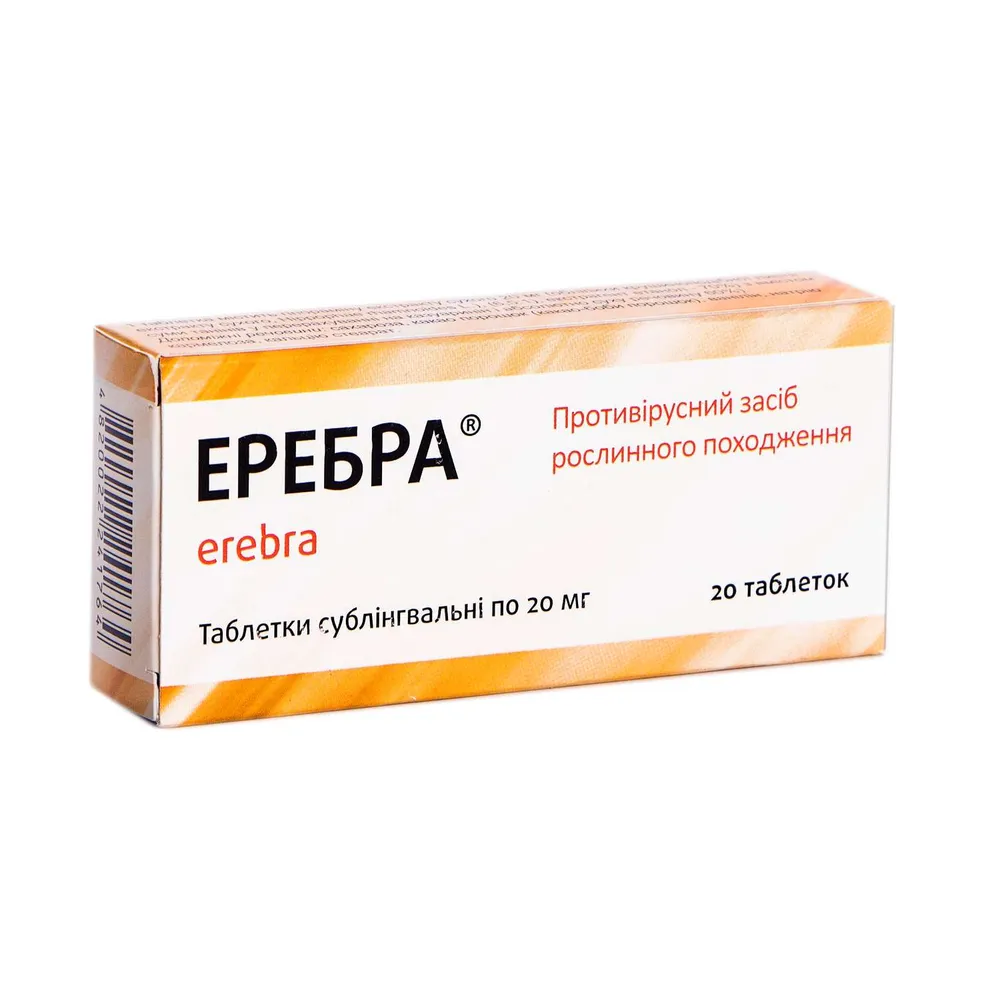
Table of Contents
INSTRUCTION FOR MEDICAL USE OF THE MEDICINAL PRODUCT EREBRA® (ERE BRA)
Composition:
Active substance: hyporamin dry extract (dry extract of sea buckthorn leaves, Hippophae rhamnoides L.), (6.5:1), extracted with ethanol – 70 %, containing a total tannin content of 60 % calculated as catechin and on absolutely dry substance);
One tablet contains 20 mg of hyporamin dry extract;
Excipients: sucrose, cocoa powder (cocoa beans powder), vanillin, sodium carmellose, calcium stearate.
Pharmaceutical form. Sublingual tablets.
Main physicochemical properties: round, biconvex tablets with a score line, from light grey or light grey with a pinkish tint to light brown in color, with darker and lighter specks.
Pharmacotherapeutic group.
Other antiviral agents. ATC code J05AX.
Pharmacological properties.
Hiporamin – a dry purified extract from the leaves of sea buckthorn (Hippophae rhamnoides L.) – is a polyphenolic complex of gallotannins and ellagitannins, whose biologically active components are hydrolyzed tannins possessing common structural elements in the form of glucogallic and hexahydroxydiphenoyl residues.
Hiporamin exhibits high antiviral activity against various strains of influenza A and B viruses, adenoviruses, paramyxoviruses, herpes simplex viruses, varicella-zoster virus, cytomegalovirus (CMV), and respiratory syncytial virus (RS virus). The inhibitory effect of the drug on viral replication manifests at early stages of viral development. One of the mechanisms of action of the drug is the inhibitory effect on viral neuraminidase.
Hiporamin induces interferon production in blood cells in vitro and increases interferon levels in the blood of patients.
The drug also exerts moderate antimicrobial activity in vitro against Gram-positive bacteria (Staphylococcus aureus), Gram-negative bacteria (Escherichia coli, Proteus vulgaris, Pseudomonas aeruginosa), tuberculous mycobacteria (Mycobacterium tuberculosis), Candida (Candida albicans), and certain molds (Microsporum canis).
Clinical characteristics.
Indications.
As a therapeutic and prophylactic agent in influenza (A and B), parainfluenza, respiratory syncytial virus, viral, adenoviral, and other acute respiratory viral infections; in tonsillitis occurring against the background of acute respiratory viral diseases (complex therapy); in acute and recurrent forms of extragenital and genital herpes simplex, herpes zoster, varicella, and cytomegalovirus infection.
Contraindications.
Hypersensitivity to the components of the drug. Sucrase/isomaltase deficiency, fructose intolerance, glucose-galactose malabsorption.
Interaction with other medicinal products and other forms of interactions.
The drug may be used in combination with other medicinal products (antimicrobial agents, synthetic antiviral agents, symptomatic therapy agents).
Special precautions for use.
The medication should be prescribed at the earliest stages of the disease.
Use with caution in patients with diabetes.
One tablet contains 0.5539 g of carbohydrates, equivalent to 0.046 carbohydrate units (CH). Diabetic patients should take this medication only after consulting a physician.
Use during pregnancy or breastfeeding.
Safety and efficacy have not been established; therefore, the medication should not be used during pregnancy.
Ability to influence reaction speed when driving or operating machinery.
No effect.
Dosage and Administration
The drug should be taken orally.
Treatment
Hold 1 tablet in the mouth until completely dissolved. For adults and children aged 12 years and older: 1 tablet 4–6 times daily. For children aged 6–12 years: 1 tablet 3–4 times daily. For children aged 3–6 years: ½ tablet 2–4 times daily.
Duration of treatment ranges from 3 days to 3 weeks, depending on the nosological form of the disease.
In influenza: for at least 3 days; in parainfluenza, respiratory syncytial virus infections, adenovirus infections, tonsillitis occurring against the background of acute respiratory viral infections (as part of combination therapy), and other respiratory viral infections: for at least 5 days.
In varicella, herpes zoster, herpesvirus, and cytomegalovirus infections, the duration of treatment depends on the severity of the condition and is 3–10 days in mild cases. In severe and recurrent cases, the minimum treatment course is 2–3 weeks. Repeated courses of treatment are advisable.
For prophylaxis during influenza outbreaks, the drug should be taken according to age-related dosages for 3 days to 3 weeks.
Children
The drug is indicated for children aged 3 years and older.
Overdose
No cases of overdose have been reported to date.
Prolonged use at doses exceeding those specified in the instructions may lead to increased blood coagulation.
Treatment is symptomatic.
Side effects.
Allergic reactions are possible.
If any adverse reactions occur, discontinue use and consult a doctor.
Shelf life.
4 years.
This product must not be used after the expiry date indicated on the packaging.
Storage conditions.
Store in the original packaging, out of reach of children, at a temperature not exceeding 25 °C.
Packaging. 10 tablets per blister; 1 or 2 blisters per cardboard box; 20 tablets per blister; 1 blister per cardboard box.
Supply category.
Over-the-counter.
Manufacturer.
PJSC "Tekhnolog".
Manufacturer's address.
8 Stara Prorizna Street, Uman, Cherkasy region, 20300, Ukraine