Edarbi
Ukraine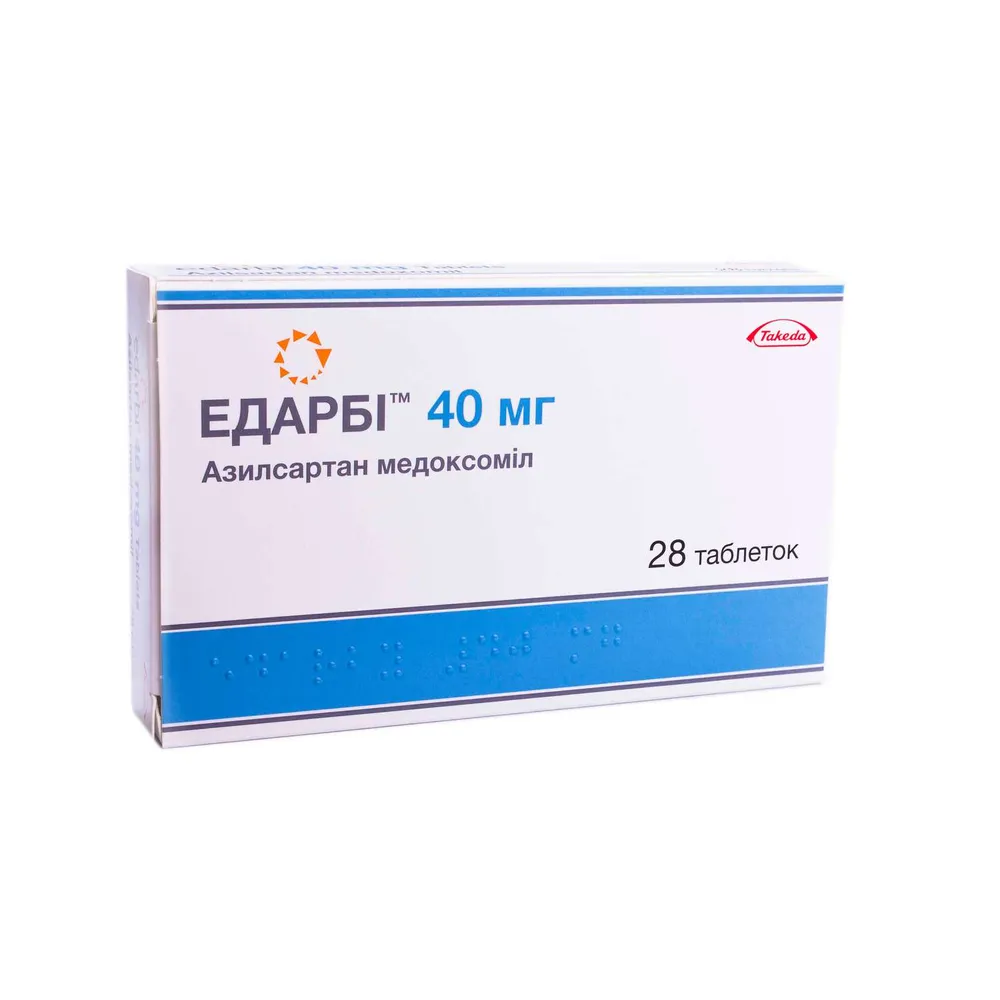
Table of Contents
INSTRUCTIONS FOR MEDICAL USE OF THE MEDICINAL PRODUCT EDARBI®
Composition:
Active substance: azilsartan medoxomil;
One tablet of Edarbi® 20 mg contains 21.34 mg of azilsartan medoxomil potassium, equivalent to 20 mg of azilsartan medoxomil;
One tablet of Edarbi® 40 mg contains 42.68 mg of azilsartan medoxomil potassium, equivalent to 40 mg of azilsartan medoxomil;
One tablet of Edarbi® 80 mg contains 85.36 mg of azilsartan medoxomil potassium, equivalent to 80 mg of azilsartan medoxomil;
Excipients: mannitol (E 421); fumaric acid; sodium hydroxide; hydroxypropylcellulose; sodium croscarmellose; microcrystalline cellulose; magnesium stearate; purified water.
Pharmaceutical form. Tablets.
Main physicochemical properties:
Tablets 20 mg: white or almost white tablets, engraved with "ASL" on one side and "20" on the other;
Tablets 40 mg: white or almost white tablets, engraved with "ASL" on one side and "40" on the other;
Tablets 80 mg: white or almost white tablets, engraved with "ASL" on one side and "80" on the other.
Pharmacotherapeutic group. Agents acting on the renin-angiotensin system, angiotensin II receptor antagonists, plain.
ATC code C09CA09.
Pharmacological Properties.
Pharmacodynamics. Azilsartan medoxomil is an active prodrug intended for oral administration. The prodrug is rapidly converted into the active molecule azilsartan, which acts as a selective antagonist of angiotensin II effects by blocking the binding of angiotensin II to AT1 receptors in various tissues (see section "Pharmacokinetics"). Angiotensin II is the primary effector of the renin-angiotensin system; effects of angiotensin II include vasoconstriction, stimulation of aldosterone synthesis and release, cardiac stimulation, and stimulation of sodium reabsorption in the kidneys.
Blocking AT1 receptors suppresses the negative feedback effect of angiotensin II on renin secretion, but increased plasma renin activity and elevated levels of angiotensin II in systemic circulation resulting from receptor blockade do not interfere with the antihypertensive effect of azilsartan.
Pharmacokinetics. After oral administration, azilsartan medoxomil is rapidly hydrolyzed in the gastrointestinal tract and/or during absorption into the active substance (azilsartan).
In vitro studies indicate that the enzyme carboxymethylenebutenolide hydrolase is involved in the hydrolysis of azilsartan medoxomil in the intestinal tract and liver. Plasma esterases also participate in the conversion of azilsartan medoxomil to azilsartan.
Absorption. Based on plasma concentrations of azilsartan, the estimated absolute oral bioavailability of azilsartan medoxomil is approximately 60%. After oral administration of azilsartan medoxomil, maximum plasma concentration (Cmax) of azilsartan is reached within 1.5–3 hours (see section "Administration and Dosage"). Food does not affect the bioavailability of azilsartan.
Distribution. The volume of distribution of azilsartan is approximately 16 liters. Azilsartan is highly bound (>99%) to plasma proteins, primarily to serum albumin. Protein binding does not change over a concentration range significantly higher than those achieved with recommended doses.
Metabolism. Metabolic degradation of azilsartan leads to the formation of two main metabolites. The major metabolite in plasma is formed via O-dealkylation and is designated as metabolite M-II. A minor metabolite formed by decarboxylation is designated as metabolite M-I. Systemic exposure levels of the major and minor metabolites in humans are approximately 50% and less than 1% of azilsartan exposure, respectively. M-I and M-II do not contribute additional pharmacological effects to azilsartan medoxomil. Metabolism of azilsartan occurs predominantly via the CYP2C9 enzyme.
Elimination. After oral administration of radiolabeled (14C) azilsartan medoxomil, approximately 55% of radioactivity was excreted in feces and about 42% in urine. Approximately 15% of the administered dose was excreted unchanged in urine. The elimination half-life of azilsartan from plasma is approximately 11 hours, and renal clearance is about 2.3 mL/min. Steady-state plasma concentrations of azilsartan are achieved within 5 days, and no accumulation occurs in plasma with repeated once-daily dosing.
Linearity/Non-linearity. A dose-dependent exposure to azilsartan was observed in the dose range of azilsartan medoxomil from 20 to 320 mg after single or multiple doses.
Characteristics in Special Patient Populations.
Children. The pharmacokinetics of azilsartan in pediatric patients (under 18 years of age) have not been studied.
Elderly Patients. No significant differences in the pharmacokinetics of azilsartan were observed between young adults (18–45 years of age) and elderly patients (65–85 years of age).
Renal Impairment. In patients with mild, moderate, and severe renal impairment, total exposure to azilsartan (AUC) increased by 30%, 25%, and 95%, respectively. In patients with end-stage renal disease on dialysis, no increase in exposure was observed (+5%). However, clinical experience with the use of the drug in patients with severe renal impairment or end-stage renal disease is lacking. Azilsartan is not removed from systemic circulation by hemodialysis.
Hepatic Impairment. Treatment with Edarbi® in patients with mild (Child-Pugh class A) or moderate (Child-Pugh class B) hepatic impairment for up to 5 days resulted in a slight increase in azilsartan exposure (AUC increased by 1.3–1.6 times). The use of Edarbi® in patients with severe hepatic impairment has not been studied.
Gender. No significant differences in the pharmacokinetics of azilsartan between males and females have been observed. Dose adjustment based on patient gender is not required.
Race. No significant differences in the pharmacokinetics of azilsartan were observed between Caucasian and Black patients. Dose adjustment based on race is not required.
Clinical characteristics.
Indications.
Treatment of essential hypertension in adults.
Contraindications.
Hypersensitivity to the active substance or to any of the excipients of the medicinal product.
Pregnant women or women who are planning to become pregnant (see section "Use in pregnancy or breastfeeding").
Do not use Edarbitm with aliskiren-containing medicinal products in patients with diabetes mellitus or renal impairment (eGFR < 60 mL/min/1.73 m²).
Interaction with other medicinal products and other forms of interaction.
Not recommended combinations.
Lithium. When lithium preparations are used concomitantly with angiotensin-converting enzyme inhibitors (ACE inhibitors), reversible increases in serum lithium concentration and reversible symptoms of lithium toxicity have been observed. A similar effect may occur with angiotensin II receptor blockers. Due to the lack of experience with concomitant use of azilsartan medoxomil and lithium preparations, such combination is not recommended. If concomitant use of these medicinal products is necessary, careful monitoring of serum lithium levels is recommended.
Combinations which should be used with caution.
Non-steroidal anti-inflammatory drugs (NSAIDs), including selective cyclooxygenase-2 (COX-2) inhibitors, acetylsalicylic acid at doses >3 g/day, and non-selective NSAIDs.
Concomitant use of NSAIDs (i.e., selective COX-2 inhibitors, acetylsalicylic acid at doses >3 g/day, and non-selective NSAIDs) and angiotensin II receptor blockers may result in reduced antihypertensive effect of the latter. In addition, concomitant use of angiotensin II receptor blockers and NSAIDs may increase the risk of worsening renal function and elevated serum potassium levels. Therefore, adequate hydration of the patient and monitoring of renal function are recommended at the start of treatment.
Potassium-sparing diuretics, potassium-containing supplements, potassium-containing salt substitutes, and other substances capable of increasing potassium levels in blood.
Potassium-sparing diuretics, potassium-containing supplements, potassium-containing salt substitutes, and other medicinal products (e.g., heparin), when used concomitantly, may increase potassium levels in blood. Serum potassium levels should be monitored if necessary.
Additional information.
Clinical trial data have shown that dual blockade of the renin-angiotensin-aldosterone system (RAAS) by combining ACE inhibitors, angiotensin II receptor blockers, or aliskiren increases the risk of hypotension, hyperkalemia, and worsening renal function (including acute renal failure), compared to monotherapy with a single RAAS-acting agent (see sections "Contraindications" and "Special warnings and precautions for use").
Clinical studies involving co-administration of azilsartan medoxomil or azilsartan with amlodipine, antacids, chlorthalidone, digoxin, fluconazole, glyburide, ketoconazole, metformin, and warfarin did not reveal any clinically significant drug interactions.
Azilsartan medoxomil is rapidly hydrolyzed by esterases in the gastrointestinal tract and/or during absorption to its active moiety, azilsartan. In vitro studies suggest a low likelihood of interactions based on inhibition of esterases.
Special precautions for use.
Activated RAAS. In patients whose vascular tone and renal function predominantly depend on the activity of the renin-angiotensin-aldosterone system (RAAS) (e.g., patients with congestive heart failure, severe renal insufficiency, or renal artery stenosis), treatment with drugs affecting the RAAS (e.g., ACE inhibitors and angiotensin II receptor blockers) has been associated with acute hypotension, azotemia, oliguria, or, rarely, acute renal failure. The occurrence of such events during the use of Edarbitm cannot be excluded.
Edarbitm should be used with caution in patients with hypertension and severe renal function impairment, congestive heart failure, or renal artery stenosis, as there is no experience with the use of the drug in such patients (see sections "Pharmacokinetics" and "Dosage and administration").
Excessive reduction in blood pressure in patients with ischemic cardiomyopathy or ischemic cerebrovascular disorders may lead to myocardial infarction or stroke.
Dual blockade of RAAS. Concomitant use of ACE inhibitors, angiotensin II receptor blockers, or aliskiren increases the risk of hypotension, hyperkalemia, and worsening renal function (including acute renal failure). Therefore, dual blockade of RAAS by combining ACE inhibitors, angiotensin II receptor blockers, or aliskiren is not recommended (see sections "Pharmacodynamics" and "Interaction with other medicinal products and other forms of interaction"). If dual blockade therapy is necessary, it should be conducted under strict medical supervision with regular monitoring of renal function, electrolyte levels, and blood pressure. Patients with diabetic nephropathy should not receive ACE inhibitors together with angiotensin II receptor blockers.
Kidney transplantation. There is currently no experience with the use of Edarbitm in patients who have recently undergone kidney transplantation.
Hepatic impairment. The use of Edarbitm in patients with severe hepatic impairment has not been studied; therefore, this drug is not recommended for use in such patients (see sections "Pharmacokinetics" and "Dosage and administration").
Hypotension in patients with volume and/or salt depletion. Symptomatic hypotension may occur after initiation of Edarbitm therapy in patients with significant volume and/or salt depletion (e.g., patients with diarrhea, vomiting, or those receiving high doses of diuretics). Prior to initiating therapy, measures should be taken to correct hypovolemia, or treatment should be started under close medical supervision. Consideration should also be given to initiating therapy with a 20 mg dose.
Primary hyperaldosteronism. Patients with primary hyperaldosteronism usually do not respond to antihypertensive drugs whose mechanism of action involves suppression of the RAAS. Therefore, the use of Edarbitm in such patients is not recommended.
Hyperkalemia. Based on experience with other drugs affecting the RAAS, concomitant use of Edarbitm with potassium-sparing diuretics, potassium supplements, potassium-containing salt substitutes, or other medicinal products that may increase serum potassium levels (e.g., heparin) may lead to elevated serum potassium levels in patients with hypertension (see section "Interaction with other medicinal products and other forms of interaction"). The risk of hyperkalemia (which may be fatal) is increased in elderly patients, patients with renal impairment, patients with diabetes, and/or patients with other comorbidities. Serum potassium levels should be monitored if necessary.
Aortic and mitral valve stenosis, obstructive hypertrophic cardiomyopathy. Treatment of patients with aortic or mitral valve stenosis or obstructive hypertrophic cardiomyopathy requires special caution.
Lithium. As with other angiotensin II receptor blockers, Edarbitm is not recommended for concomitant use with lithium-containing medications (see section "Interaction with other medicinal products and other forms of interaction").
Use during pregnancy or breastfeeding.
Pregnancy. The medicinal product should not be used in pregnant women or in women planning pregnancy. If pregnancy is confirmed during treatment with the drug, administration should be discontinued immediately and replaced with another medicinal product approved for use during pregnancy.
Data on the use of azilsartan medoxomil in pregnant women are lacking. Animal studies have shown reproductive toxicity.
Epidemiological data do not indicate a teratogenic risk associated with exposure to ACE inhibitors during the first trimester of pregnancy; however, a slight increase in risk cannot be excluded. Due to the lack of controlled epidemiological data on the risk associated with angiotensin II receptor blockers, this risk cannot be excluded for drugs of this class. If long-term therapy with angiotensin II receptor blockers is not essential, women planning pregnancy should switch to an alternative antihypertensive therapy with a more thoroughly investigated safety profile during pregnancy.
Therapy with angiotensin II receptor blockers in women during the second and third trimesters of pregnancy may result in fetal toxicity (reduced renal function, oligohydramnios, delayed skull ossification) and neonatal toxicity (renal failure, arterial hypotension, hyperkalemia).
If the use of angiotensin II receptor blockers is necessary during the second trimester of pregnancy, ultrasound monitoring to assess fetal renal function and skull ossification is recommended.
Infants born to mothers who received angiotensin II receptor blockers should be closely monitored for the development of hypotension (see sections "Contraindications" and "Special precautions for use").
Lactation period. Azilsartan medoxomil is not recommended during breastfeeding due to the lack of adequate data. During breastfeeding, it is preferable to initiate alternative treatment with a more thoroughly investigated safety profile, especially when nursing a newborn or premature infant.
Fertility. Data on the effect of azilsartan medoxomil on human reproductive function are lacking. Preclinical studies showed that azilsartan did not affect reproductive function in male and female rats.
Ability to affect reaction speed when driving or operating machinery.
Azilsartan medoxomil has no effect or may have a negligible effect on reaction speed when driving or operating machinery. However, one should be aware of the possible occurrence of dizziness or fatigue.
Dosage and Administration
Edarbitm is intended for oral administration; tablets may be taken independently of food intake (see section "Special Precautions").
The recommended initial dose is 40 mg once daily.
For patients in whom this dose does not adequately control blood pressure, the dose may be increased to the maximum recommended dose of 80 mg once daily.
A sustained antihypertensive effect is achieved within 2 weeks of treatment. Maximum effect is reached after 4 weeks of therapy with the drug.
If adequate control of arterial pressure cannot be achieved with Edarbitm monotherapy, additional reduction in blood pressure may be achieved by combination therapy with other antihypertensive agents, including diuretics (e.g., chlorthalidone and hydrochlorothiazide) and calcium channel blockers.
Elderly patients (aged 65 years and older) do not require adjustment of the initial dose of Edarbitm. However, for patients aged 75 years and older at risk of developing hypotension, consideration should be given to initiating treatment with a dose of 20 mg (see section "Pharmacokinetics").
Renal impairment. Edarbitm should be used with caution in patients with arterial hypertension and severe renal impairment or end-stage renal disease, as experience with the drug in such patients is lacking. Azilsartan is not removed from systemic circulation by hemodialysis. Patients with mild or moderate renal insufficiency do not require dose adjustment.
Hepatic impairment. Studies on the use of Edarbitm in patients with severe hepatic impairment have not been conducted; therefore, the drug is not recommended for use in this patient group.
Due to limited experience with Edarbitm in patients with mild to moderate hepatic impairment, careful monitoring of these patients is recommended, and consideration should be given to initiating treatment with a dose of 20 mg.
Intravascular volume depletion. Edarbitm should be administered under close medical supervision to patients with possible intravascular volume depletion or salt depletion (e.g., patients with vomiting, diarrhea, or those receiving high doses of diuretics). Consideration should also be given to initiating treatment with a dose of 20 mg.
Patients of non-Caucasian race. Dose adjustment is not required, although a less pronounced reduction in blood pressure is observed in these patients compared to patients of other races. This is generally true for other angiotensin II receptor blockers and ACE inhibitors. In this population, more frequent dose escalation of Edarbitm and concomitant therapy may be needed.
Children. Safety and efficacy of Edarbitm in children and adolescents (under 18 years of age) have not been established. There is no data available on the use of the drug in this population.
Overdose.
Symptoms. Based on pharmacological properties, the main manifestations of overdose are expected to be symptomatic hypotension and dizziness. In controlled clinical studies involving healthy volunteers, participants received Edarbitm at doses up to 320 mg once daily for 7 days. These doses were well tolerated by study participants.
Treatment. In cases of symptomatic hypotension, supportive treatment should be initiated and vital signs should be monitored. Azilsartan is not eliminated by hemodialysis.
Adverse Reactions
Adverse effects are classified by frequency of occurrence into the following categories: very common (≥ 1/10), common (> 1/100 and < 1/10), uncommon (> 1/1000 and < 1/100), rare (> 1/10000 and < 1/1000), very rare (< 1/10000), including isolated cases. Within each system-organ class, adverse reactions are listed in order of decreasing clinical significance.
From the nervous system.
Common: dizziness.
From the vascular system.
Uncommon: hypotension.
From the gastrointestinal tract.
Common: diarrhea.
Uncommon: nausea.
From the skin and subcutaneous tissues.
Uncommon: rash, pruritus.
Rare: angioneurotic edema.
From the musculoskeletal and connective tissue system.
Uncommon: muscle spasms.
General disorders.
Uncommon: fatigue, peripheral edema.
Laboratory investigations.
Common: increased blood creatine phosphokinase levels.
Uncommon: increased blood creatinine levels, increased blood uric acid levels / hyperuricemia.
Description of selected adverse reactions.
When Edarbitm was used concomitantly with chlorthalidone, the frequency of increased blood creatinine levels and hypotension increased from uncommon to common.
When Edarbitm was used concomitantly with amlodipine, the frequency of peripheral edema increased from uncommon to common, but remained lower than that observed with amlodipine monotherapy.
Laboratory investigations.
Serum creatinine levels. In randomized placebo-controlled monotherapy studies, the frequency of serum creatinine elevation after treatment with Edarbitm did not differ from that in the placebo group. Concomitant use of Edarbitm and diuretics, e.g., chlorthalidone, resulted in a higher frequency of increased serum creatinine levels. This observation is consistent with known facts for other angiotensin II receptor blockers and ACE inhibitors. The increase in serum creatinine during concomitant use of Edarbitm and diuretics was associated with a more pronounced reduction in arterial pressure compared to use of either drug alone. Most episodes of elevated creatinine levels were transient or did not progress with continued treatment. After discontinuation of treatment, creatinine levels returned to normal or near-normal values spontaneously in most cases.
Uric acid. A small mean increase in serum uric acid levels was observed with Edarbitm compared to placebo (10.8 µmol/L vs. 4.3 µmol/L).
Hemoglobin and hematocrit. In placebo-controlled monotherapy studies, a small decrease in hemoglobin and hematocrit levels (approximately 3 g/L and 1 volume percent, respectively) was observed. This effect has also been observed with other RAS inhibitors.
Shelf life. 3 years.
Storage conditions. No special storage conditions required. Store in the original packaging. Keep out of reach of children!
Incompatibilities. Not described.
Packaging. 14 tablets in a blister. 1, 2, or 4 blisters per cardboard box.
Prescription category. Prescription only.
Manufacturer. Takeda Ireland Ltd, Ireland.
Manufacturer's address and location of operations.
Bray Business Park, Kilruddery, Co. Wicklow, Ireland.