Ebrantil
Ukraine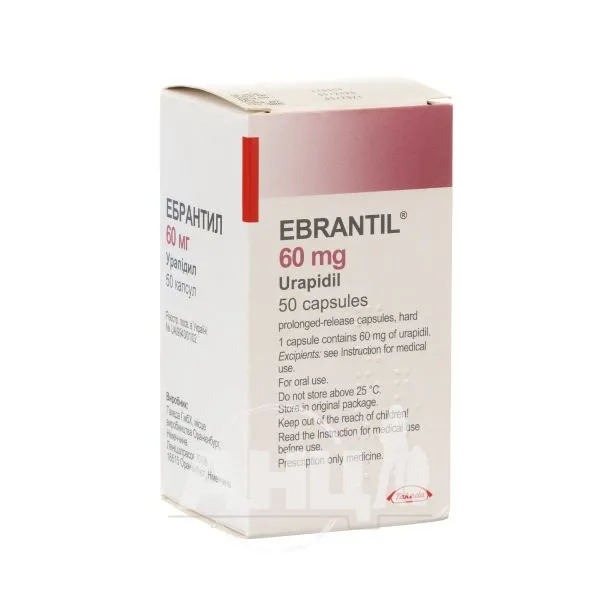
Table of Contents
INSTRUCTIONS FOR MEDICAL USE OF THE MEDICINAL PRODUCT EBRANTIL (EBRANTIL®)
Composition:
Active substance: urapidil;
1 Ebrantil 30 mg capsule contains 30 mg of urapidil;
1 Ebrantil 60 mg capsule contains 60 mg of urapidil;
Excipients: methacrylic acid copolymer (type B); diethyl phthalate; talc; hypromellose; fumaric acid; ethylcellulose; hypromellose phthalate; stearic acid; spherical sugar;
Capsule shell for 30 mg: gelatin; titanium dioxide (E 171); yellow iron oxide (E 172); purified water; black ink (for printing);
Capsule shell for 60 mg: gelatin; titanium dioxide (E 171); erythrosine (E 127); indigo carmine (E 132); red iron oxide (E 172); purified water; black ink (for printing).
Pharmaceutical form.
Prolonged-release hard capsules.
Main physicochemical properties:
30 mg capsules:
Hard gelatin capsules (size №4) with an opaque yellow body and a yellow cap, bearing a black printed inscription "Ebr 30" on the body. The capsule contents are yellow granules.
60 mg capsules:
Hard gelatin capsules (size №2) with an opaque pink body and a bright red cap, bearing a black printed inscription "Ebr 60" on the body. The capsule contents are yellow granules.
Pharmacotherapeutic group.
Antihypertensive agent. Alpha-adrenoreceptor blockers. ATC code: C02CA06.
Pharmacological properties.
Pharmacodynamics.
Urapidil reduces systolic and diastolic pressure by decreasing peripheral resistance.
Heart rate remains practically unchanged. Cardiac output remains unchanged; cardiac output, which may decrease due to increased afterload, may actually increase.
Mechanism of action.
Urapidil has both central and peripheral mechanisms of action.
At the peripheral level, urapidil primarily blocks postsynaptic α₁-adrenoceptors, thereby inhibiting the vasoconstrictive effect of catecholamines.
At the central level, urapidil modulates the activity of the cardiovascular regulatory center, thus preventing reflex increases in sympathetic nervous system tone or reducing sympathetic tone.
Pharmacokinetics.
Absorption.
After oral administration, more than 80–90% of urapidil is absorbed from the gastrointestinal tract. Peak plasma concentration of the prolonged-release dosage form is reached within 4–6 hours after administration; the elimination half-life from plasma is approximately 4.7 hours (3.3–7.6 hours).
Bioavailability.
The relative bioavailability of prolonged-release capsules compared to an orally administered solution is 92 (83–103)%. The absolute bioavailability of prolonged-release capsules compared to an intravenous reference is 72 (63–80)%.
Plasma protein binding of urapidil (in human serum) in vitro is 80%. This relatively low plasma protein binding of urapidil may explain why clinically significant interactions between urapidil and highly protein-bound drugs have not been reported to date.
Distribution.
Volume of distribution is 0.77 L/kg body weight. The substance crosses the blood-brain barrier and passes through the placenta.
Metabolism.
Urapidil is mainly metabolized in the liver. The primary metabolite is hydroxylated urapidil at the 4th position of the benzene ring, which has no significant antihypertensive activity. The O-dimethylated metabolite of urapidil has nearly the same biological activity as urapidil itself, but is formed in very small amounts.
Excretion and elimination.
Elimination of urapidil and its metabolites in humans occurs via the kidneys by 50–70%, of which approximately 15% of the administered dose is pharmacologically active urapidil; the remainder, primarily the antihypertensive para-hydroxylated urapidil, is excreted in feces.
Special populations.
In elderly patients, as well as in patients with progressive hepatic and/or renal insufficiency, the volume of distribution and clearance of urapidil are reduced, and the elimination half-life from plasma is prolonged.
Clinical characteristics.
Indications.
Arterial hypertension.
Contraindications.
Hypersensitivity to the active substance or to any of the excipients.
Interaction with other medicinal products and other forms of interaction.
The antihypertensive effect of Ebrotidine may be enhanced when used concomitantly with alpha-adrenoreceptor blockers, vasodilators, and other antihypertensive agents, as well as in the presence of hypovolemia (e.g., diarrhea, vomiting) and alcohol consumption.
Concomitant use of cimetidine may increase the maximum serum concentration of urapidil by 15%.
Currently, information regarding combination therapy with ACE inhibitors is insufficient; therefore, such treatment is not recommended.
Special precautions for use.
Urapidil should be administered with special caution in:
- patients with heart failure caused by mechanical or functional disorders (e.g. aortic or mitral valve stenosis), pulmonary embolism, or impaired cardiac function due to pericardial disorders ;
- children, as studies have not been conducted in this age group;
- patients with hepatic dysfunction;
- patients with moderate or severe renal dysfunction;
- elderly patients;
- patients concurrently using cimetidine (see section "Interaction with other medicinal products and other forms of interaction").
Patients with rare hereditary fructose intolerance, glucose-galactose malabsorption, or sucrase-isomaltase deficiency should not take Ebrantil.
The product contains sugar, which should be taken into account in patients with diabetes mellitus.
Use during pregnancy or breastfeeding.
Women of childbearing potential.
Ebrantil is not recommended for women of childbearing potential who are not using contraception.
Pregnancy.
Data on the use of urapidil in pregnant women are lacking or limited in quantity.
Animal studies have shown reproductive toxicity.
Urapidil crosses the placenta.
Ebrantil should not be used during pregnancy unless treatment with urapidil is considered necessary due to the woman's clinical condition.
Lactation.
It is unknown whether urapidil is excreted in breast milk.
A risk to the newborn/infant cannot be excluded.
Ebrantil should not be used during lactation.
Fertility.
Clinical trials on the effect on fertility in men and women have not been conducted. Animal studies have shown that urapidil affects fertility.
Ability to influence reaction speed when driving or operating machinery. In individual cases, certain adverse reactions affecting the central nervous system (e.g. dizziness) may impair the ability to drive or operate machinery. This is particularly important at the beginning of treatment, when switching medications, or when consuming alcohol.
Method of Administration and Dosage
To gradually reduce arterial pressure, initiate treatment with a dose of 30 mg twice daily (2 capsules of Ebrantil 30 mg capsules daily).
To rapidly reduce arterial pressure, initiate treatment with a dose of 60 mg twice daily (2 capsules of Ebrantil 60 mg capsules daily).
The dose may be gradually adjusted according to individual requirements. The maintenance dose range is 60–180 mg of urapidil per day; the total daily dose should be divided into two individual doses.
Ebrantil capsules should be taken in the morning and in the evening, during meals, swallowed whole with a small amount of liquid.
Ebrantil is suitable for long-term use. Treatment of arterial hypertension with this medicinal product requires regular medical monitoring.
Special patient groups
Hepatic impairment
Patients with hepatic impairment may require a reduced dose of Ebrantil.
Renal impairment
Patients with moderate to severe renal impairment may require a reduced dose of Ebrantil during long-term treatment.
Elderly patients
Elderly patients may require a reduced dose of Ebrantil during long-term treatment.
Children
Clinical data on the efficacy and safety of the use of this medicinal product in children are lacking.
Overdose
Symptoms:
- Cardiovascular: dizziness, orthostatic hypotension, collapse;
- Central nervous system: increased fatigue and impaired reaction time.
Treatment: In case of excessive reduction in arterial pressure, place the patient in a horizontal position with low head elevation and initiate infusion therapy to increase circulating blood volume.
If these measures are insufficient, vasopressors may be administered slowly intravenously under arterial pressure monitoring.
In very rare cases, intravenous injection of catecholamines (e.g., 0.5–1 mg adrenaline diluted in 10 ml of 0.9% sodium chloride solution) may be necessary.
Adverse reactions.
Undesirable effects are classified by frequency of occurrence as follows:
very common (≥ 1/10), common (≥ 1/100, < 1/10), uncommon (≥ 1/1000, < 1/100), rare (≥ 1/10000, < 1/1000), very rare (< 1/10000), not known (available data do not allow estimation of frequency).
Cardiovascular system.
Uncommon: palpitations, tachycardia, bradycardia, sensation of pressure or pain behind the breastbone (symptoms similar to angina pectoris), decrease in blood pressure upon change in body position, e.g. when standing up from a lying position (orthostatic dysregulation).
Gastrointestinal tract.
Common: nausea.
Uncommon: vomiting, diarrhea, dry mouth.
General disorders.
Uncommon: increased fatigue.
Very rare: edema due to increased fluid retention.
Investigations.
Very rare: transient increase in liver enzymes, thrombocytopenia*.
Nervous system.
Common: dizziness, headache.
Psychiatric disorders.
Uncommon: sleep disturbances.
Very rare: feeling of anxiety.
Renal and urinary disorders.
Very rare: increased frequency of urination or increased episodes of urinary incontinence.
Reproductive system and breast.
Very rare: priapism.
Respiratory system.
Uncommon: nasal congestion.
Skin and subcutaneous tissue.
Uncommon: hypersensitivity (including itching, skin redness, rash).
Not known: Quincke's edema (angioedema), urticaria.
* - In isolated cases, a decrease in platelet count has been observed temporally associated with the use of the medicinal product Ebrantil; however, a causal relationship with the administration of urapidil cannot be established, for example, by immunological investigations.
Shelf life.
18 months.
Storage conditions.
Store in the original packaging at a temperature not exceeding 25 °C. Keep out of the reach of children!
Packaging.
50 or 100 capsules in a bottle. 1 bottle in a cardboard box.
Prescription category.
Prescription only.
Manufacturer.
Takeda GmbH, Oranienburg, Germany / Takeda GmbH Betriebsstätte Oranienburg, Germany.
Manufacturer's address.
Lehnitzstrasse 70-98, 16515 Oranienburg, Germany.