Duofilm
Ukraine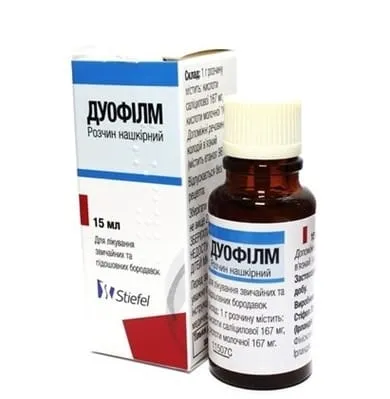
Table of Contents
INSTRUCTIONS for medical use of the medicinal product DUOFILM (DUOFILM)
Composition:
Active substances: salicylic acid, lactic acid;
1 g of solution contains: salicylic acid 167 mg, lactic acid 167 mg;
Excipient: flexible collodion (containing 96% ethanol).
Pharmaceutical form. Topical solution.
Main physicochemical properties: clear viscous liquid ranging in color from yellowish to amber.
Pharmacotherapeutic group.
Dermatological agents. Treatments for warts and calluses.
ATC code D11AF.
Pharmacological properties.
Pharmacodynamics.
When applied topically, salicylic acid acts as a keratolytic agent. Its keratolytic effect increases the solubility of the intercellular cement in the stratum corneum, leading to desquamation of the skin.
Lactic acid affects the keratinization process by reducing hyperkeratosis, which is characteristic of warts. At high doses, it may cause epidermolysis, resulting in destruction of the keratinized tissue of the wart and the virus causing it. It also possesses antiseptic properties.
The elastic collodion provides an adhesive base, enabling precise application of the active substances to the wart. It also forms a film that promotes hydration and destruction of the wart tissue.
Pharmacokinetics.
Salicylic acid is absorbed through the skin, with maximum plasma levels appearing 6–12 hours after application. Systemic absorption of salicylic acid has been reported to range from 9% to 25% following topical application of other products containing salicylic acid.
Salicylates are metabolized in the liver via microsomal enzymes into salicyluric acid and phenolic glucuronides of salicylic acid. The remainder is excreted in urine as unchanged salicylic acid.
Clinical characteristics.
Indications.
Treatment of common and plantar warts.
Contraindications.
Hypersensitivity to the components of the drug. Do not apply to damaged, inflamed, reddened skin or to open wounds.
Do not apply to moles, pigmented skin lesions, for treatment of warts located on the face or genitals, for hairy warts, warts with a red border, or warts of unusual color.
Interaction with other medicinal products and other forms of interaction.
The use of Duofilm may increase the absorption of other topical agents. Concomitant application of Duofilm and other topical agents on the same skin area should be avoided. Systemic effects following topical application of this drug are negligible; interactions with systemically administered medicinal products are not expected.
Special precautions for use.
The product is intended for topical use only. Duofilm should not be applied to the face, genital areas, or the anal region. Avoid contact with eyes and other mucous membranes due to the possibility of irritation. In case of accidental contact, rinse with water for 15 minutes. Avoid inhaling the vapors of the solution.
The skin surface treated with Duofilm should not exceed 5 cm². If warts cover a skin surface larger than 5 cm², alternative treatment options should be considered, as there is a potential risk of salicylate toxicity.
Patients with diabetes mellitus or those suffering from peripheral circulatory disorders or peripheral neuropathy should use the product only under medical supervision.
Care should be taken to apply the solution only to warts and to avoid contact with healthy skin. Skin irritation may occur. If significant irritation develops, treatment should be discontinued.
Due to the flammable nature of this solution, smoking and exposure to open flames should be avoided during and immediately after application of the product.
Use during pregnancy or breastfeeding.
Use of Duofilm during pregnancy or breastfeeding is not recommended. Salicylates may pass into breast milk.
The potential for embryotoxic effects in humans has not been studied, but animal studies have demonstrated embryotoxicity at high doses. Systemic absorption following application of this topical product is limited. However, caution should be exercised when used during pregnancy, and the product should be used only under medical supervision. Prolonged use should be avoided during pregnancy or breastfeeding. During breastfeeding, the solution should not be applied to the breast area to prevent accidental exposure to the infant’s mouth.
Ability to affect reaction speed when driving vehicles or operating machinery.
Does not affect reaction speed when driving vehicles or operating machinery.
Method of Administration and Dosage.
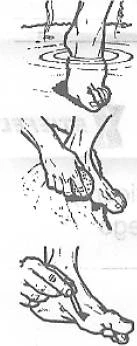
The medication should be applied once daily to the affected area as follows:
- Soak the wart in warm water (40–50 °C) for several minutes.
- Gently wipe the surface of the wart with a soft towel.
- Apply Duofilm solution with a brush exclusively to the wart, taking care to avoid contact with healthy skin.
- Allow the medication to dry and cover the wart with a plaster, if located on the sole.
- Continue treatment until complete disappearance of the wart.
- If warts persist after 12 weeks of treatment, consult a physician.
Children.
Salicylic acid preparations for oral use may cause Reye's syndrome. Since there is a theoretical risk of Reye's syndrome also with topical salicylates, the medication should not be used to treat children and adolescents during or immediately after varicella (chickenpox), influenza, or other viral infections.
Do not use in children under 2 years of age.
Children under 12 years of age should use the medication under adult supervision.
Overdose.
Excessive or prolonged use of the medication may cause skin irritation. If this occurs, reduce the amount of medication or frequency of application. In case of accidental ingestion, especially in children, monitor the patient's condition and provide necessary medical support. Symptoms of overdose may include headache, nausea, vomiting, diarrhea, and increased rate and depth of respiration.
Treatment should be based on clinical indications (symptomatic).
Adverse reactions
Adverse effects classified by system organ class and frequency of occurrence:
Very common (≥ 1/10), common (≥ 1/100 to < 1/10), uncommon (≥ 1/1,000 to < 1/100), rare (≥ 1/10,000 to < 1/1,000), very rare (< 1/10,000), including isolated cases.
Immune system disorders
Common: Skin rashes.
Skin and subcutaneous tissue disorders
Very common: Hypersensitivity reaction at the application site, itching, burning sensation, erythema, skin peeling, and dryness.
Common: Skin hypertrophy.
Post-marketing surveillance reported the following adverse reactions:
Immune system disorders
Rare: Hypersensitivity reactions, including inflammation.
Skin and subcutaneous tissue disorders
Rare: Burning sensation, pain, skin discoloration, skin peeling and bleeding, contact dermatitis, skin rashes, and swelling.
Localized irritation reactions may occur when the solution is applied to healthy skin surrounding the wart. Irritation usually resolves after temporary discontinuation of treatment and resuming application only to the wart itself.
Shelf life.
2.5 years.
Storage conditions.
Store below 25 °C. Keep out of reach of children.
Packaging.
A cardboard box containing 1 glass bottle with a plastic cap and an integrated brush applicator. The glass bottle contains 15 ml of solution.
Availability. Over-the-counter.
Manufacturer.
Stiefel Laboratories (Ireland) Ltd / Stiefel Laboratoríes (Ireland) Ltd.
Manufacturer's address and place of business.
Finisklin Business Park, Sligo, Ireland / Finisklin Business Park, Sligo, Ireland.