Drotaverine hydrochloride
Ukraine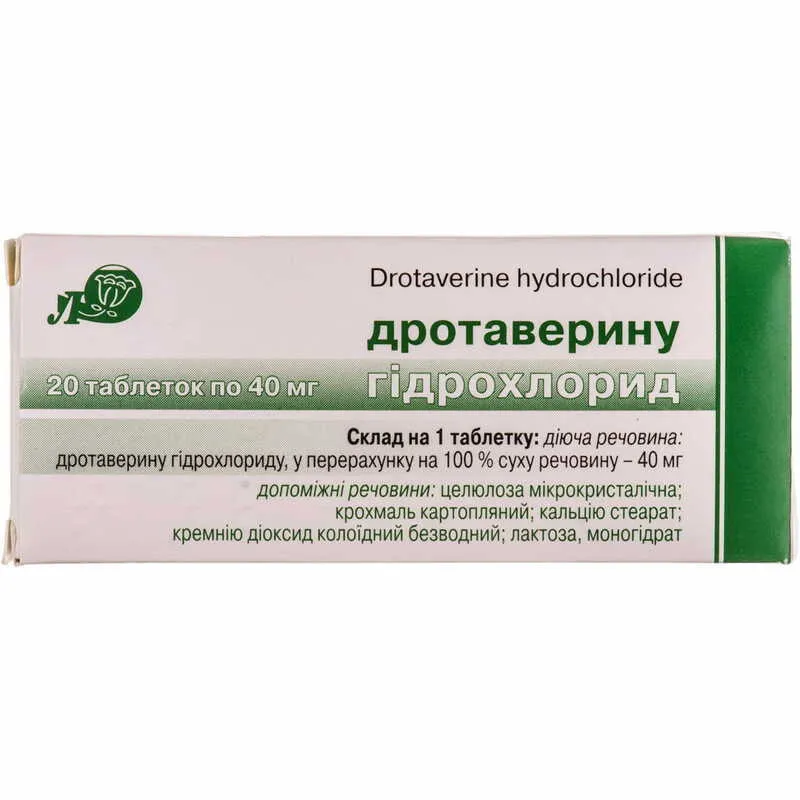
Table of Contents
INSTRUCTION FOR MEDICAL USE OF THE MEDICINAL PRODUCT DROTAVERINE HYDROCHLORIDE
Composition:
Active substance: drotaverine;
One tablet contains drotaverine hydrochloride equivalent to 100% dry substance 40 mg;
Excipients: microcrystalline cellulose; potato starch; calcium stearate; colloidal anhydrous silicon dioxide; lactose monohydrate.
Pharmaceutical form. Tablets.
Main physico-chemical characteristics: intact, regular, round cylindrical tablets with bevelled upper and lower surfaces, without a break line, pale yellow to yellowish-green in colour, with speckles.
Pharmacotherapeutic group.
Agents used in functional gastrointestinal disorders.
ATC code A03AD02.
Pharmacological properties.
Pharmacodynamics.
Drotaverine hydrochloride is a spasmolytic agent acting directly on smooth muscles. By binding to the surface of smooth muscles, the drug alters membrane potential and membrane permeability. Inhibition of the enzyme phosphodiesterase plays a role in its mechanism of action, leading to a sequential increase in intracellular cAMP levels and enhanced initial calcium uptake by cells. The spasmolytic effect of the drug acts uniformly on smooth muscles of the gastrointestinal, biliary, urogenital, and vascular systems. Due to its vasodilatory action, tissue blood supply is improved.
Pharmacokinetics.
At low concentrations, the drug binds to albumin, α- and β-globulins of blood plasma. Maximum plasma concentration after oral administration is reached within 45–60 minutes. The drug is metabolized in the liver. The biological half-life is 16–22 hours. It is almost completely eliminated from the body within 72 hours, with approximately 30% excreted in urine and 50% in feces. It is excreted mainly as metabolites; unchanged drug is not detected in urine. The drug crosses the placenta.
Clinical characteristics.
Indications.
For therapeutic use in:
− smooth muscle spasms associated with biliary tract disorders: cholelithiasis, choledocholithiasis, cholecystitis, pericholecystitis, cholangitis, papillitis;
− smooth muscle spasms in urinary tract disorders: nephrolithiasis, ureterolithiasis, pyelitis, cystitis, vesical tenesmus.
As adjunctive therapy in:
− smooth muscle spasms of the gastrointestinal tract: peptic ulcer of the stomach and duodenum, gastritis, cardio- and/or pylorospasm, enteritis, colitis, spastic colitis with constipation and irritable bowel syndrome accompanied by meteorism;
− tension headache;
− gynecological disorders (dysmenorrhea).
Contraindications.
Hypersensitivity to drotaverine or to any component of the drug. Severe hepatic, renal or cardiac insufficiency (low cardiac output syndrome).
Interaction with other medicinal products and other forms of interaction.
Phosphodiesterase inhibitors such as papaverine reduce the antiparkinsonian effect of levodopa. Concomitant use of Drotaverine hydrochloride with levodopa should be cautious, as the antiparkinsonian effect of the latter is diminished, while rigidity and tremor are intensified.
Usage Notes.
Use with caution in patients with arterial hypotension.
The product contains lactose and therefore should not be administered to patients with rare hereditary forms of galactose intolerance, lactase deficiency, or glucose-galactose malabsorption syndrome.
Use during pregnancy or breastfeeding.
During pregnancy, the drug should be used only when the expected benefit to the mother outweighs the potential risk to the fetus.
Due to lack of adequate studies, use of the drug during breastfeeding is not recommended.
Fertility
There is no information available regarding the effect on human fertility.
Ability to influence reaction speed while driving or operating machinery.
If patients experience dizziness after taking the drug, they should avoid potentially hazardous activities such as driving vehicles or performing tasks requiring high concentration.
Dosage and Administration.
Adults: the usual average dose is 120–240 mg per day in 2–3 divided doses.
Children: the use of drotaverine in children has not been studied in clinical trials; however, if administration of drotaverine is necessary, then:
for children aged 6–12 years, the maximum daily dose is 80 mg (divided into 2 doses);
for children aged 12 years and older, the maximum daily dose is 160 mg (divided into 2–4 doses).
The duration of treatment is determined individually by a physician depending on the nature of the disease.
Children.
The efficacy and safety of the drug in children under 6 years of age have not been studied; therefore, it is not recommended for patients in this age group.
Overdose.
Symptoms: in cases of significant overdose, disturbances in cardiac rhythm and conduction have been observed, including complete bundle branch block of His and cardiac arrest, which may be fatal.
Treatment: in case of overdose, the patient must be under close medical supervision and receive symptomatic therapy, including induction of vomiting and/or gastric lavage.
To alleviate atrioventricular block, administer atropine and isoprenaline intravenously; to restore heart rhythm – atropine or adrenaline intravenously, with temporary cardiac pacing; in case of respiratory center paralysis, perform artificial ventilation of the lungs.
Side effects.
Immune system: allergic reactions, including angioneurotic edema, urticaria, rash, itching, skin hyperemia, fever, chills, increased body temperature, weakness.
Gastrointestinal tract: nausea, constipation, vomiting.
Nervous system: headache, dizziness, insomnia.
Cardiovascular system: rapid heartbeat, arterial hypotension, sensation of warmth.
Shelf life. 2 years.
Storage conditions.
Store in the original packaging at a temperature not exceeding 25 °C.
Keep out of reach of children.
Packaging.
10 tablets in blisters;
10 tablets in a blister; 2 or 3 blisters per cardboard pack.
Availability category. Over-the-counter.
Manufacturer.
JSC "Lubnipharm".
Manufacturer's location and address of business activity.
16 Barvinkova Street, Lubny, Poltava region, 37500, Ukraine.