Doccef
Ukraine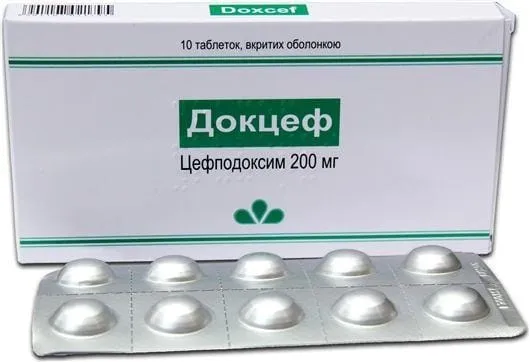
Table of Contents
INSTRUCTIONS FOR MEDICAL USE OF THE MEDICINAL PRODUCT DOXCEF (DOXCEF)
Composition:
Active substance: cefpodoxime;
One film-coated tablet contains cefpodoxime proxetil equivalent to cefpodoxime 100 mg or 200 mg;
Excipients: sodium lauryl sulfate, calcium carmellose, lactose monohydrate, hydroxypropyl cellulose, magnesium stearate; Opadry 03A28718 White: hypromellose, titanium dioxide (E 171), talc.
Pharmaceutical form. Film-coated tablets.
Main physicochemical properties:
100 mg tablets: round, biconvex, white to almost white film-coated tablets, with the imprint "100" on one side and smooth on the other;
200 mg tablets: round, biconvex, white to almost white film-coated tablets, with the imprint "200" on one side and smooth on the other.
Pharmacotherapeutic group.
Antibacterials for systemic use. Other beta-lactam antibiotics. Third-generation cephalosporins. ATC code J01D D13.
Pharmacological Properties
Pharmacodynamics
Doksef (cefepime proxetil) is a third-generation oral β-lactam antibiotic. Its bactericidal effect is due to inhibition of bacterial cell wall synthesis in microorganisms. In vitro, the drug has demonstrated bactericidal activity against many Gram-positive and Gram-negative microorganisms.
Susceptible Gram-positive bacteria: Streptococcus pneumoniae, group A streptococci (S. pyogenes), group B (S. agalactiae), groups C, F, G, as well as S. mitis, S. sanguis, S. salivarius, and Corynebacterium diphtheriae.
Susceptible Gram-negative bacteria: Haemophilus influenzae, Haemophilus parainfluenzae, Moraxella (Branhamella) catarrhalis (both β-lactamase-producing and non-producing strains), Neisseria meningitidis, Neisseria gonorrhoeae, Escherichia coli, Klebsiella spp. (K. pneumoniae; K. oxytoca), Proteus mirabilis.
Doksef shows moderate activity against methicillin-susceptible staphylococci and strains producing or not producing penicillinase (S. aureus and S. epidermidis).
Resistant to cefpodoxime, as with other cephalosporins, are: enterococci, methicillin-resistant staphylococci (S. aureus and S. epidermidis), Staphylococcus saprophyticus, Pseudomonas aeruginosa and Pseudomonas spp., Clostridium difficile, Bacteroides fragilis.
Pharmacokinetics
The active ingredient of Doksef is absorbed in the small intestine and hydrolyzed to the active metabolite, cefpodoxime. Peak plasma concentrations are observed 2–3 hours after a single dose, reaching 1.2 mg/L and 2.5 mg/L for 100 mg and 200 mg doses, respectively.
It binds to plasma proteins (primarily to albumins – 40%) via non-saturable binding. The minimum inhibitory concentration (MIC) of cefpodoxime against most pathogens can be achieved in lung parenchyma, bronchial mucosa, pleural fluid, tonsils, interstitial fluid, and prostate tissues.
Cefpodoxime concentrations are high. Within 12 hours after a single dose, the MIC90 concentration against common uropathogens is achieved. The drug is primarily excreted in urine, with a half-life of approximately 2.4 hours.
Clinical characteristics.
Indications.
Infections caused by pathogens sensitive to cefpodoxime:
- Ear, nose, and throat organs (including sinusitis, tonsillitis, pharyngitis); Dokscef is prescribed for the treatment of tonsillitis and pharyngitis in cases of chronic or recurrent infection, as well as when resistance of the pathogen to widely used antibiotics is known or suspected;
- respiratory tract (including acute bronchitis, recurrent episodes or exacerbations of chronic bronchitis, bacterial pneumonia);
- uncomplicated infections of the upper and lower urinary tract (including acute cystitis and pyelonephritis);
- skin and soft tissues (abscesses, cellulitis, infected wounds, furuncles, folliculitis, paronychia, carbuncles, and ulcers);
- uncomplicated gonococcal urethritis.
Contraindications.
Hypersensitivity to cephalosporin or penicillin drugs.
Hereditary intolerance of galactose, lactase deficiency, or glucose/galactose malabsorption syndrome.
Interaction with other medicinal products and other types of interactions.
Drugs that block histamine H2-receptors and antacid agents reduce the bioavailability of the drug. Concomitant use of the drug with loop diuretics may increase nephrotoxicity. Careful monitoring of renal function is recommended if Dokscef tablets are prescribed simultaneously with drugs exhibiting nephrotoxic effects. Probenecid delays excretion of cefpodoxime.
Special precautions for use.
Cross-reactivity between penicillins and cephalosporins has been observed in approximately 5–10% of patients with penicillin allergy. Therefore, before prescribing cephalosporins, it is essential to determine whether the patient has a history of penicillin allergy, and strict medical supervision must be ensured from the first day of Doksef administration.
Patients with known allergy to other cephalosporins should be aware of the possibility of cross-allergy to cefpodoxime. Doksef must not be administered to patients with a history of hypersensitivity reactions to cephalosporins. Hypersensitivity reactions (e.g., anaphylaxis) associated with β-lactam antibiotics may be severe and occasionally fatal. If early signs of hypersensitivity occur, the drug must be discontinued immediately.
Doksef should not be used for the treatment of atypical pneumonia caused by Legionella, Mycoplasma, or Chlamydia species.
For patients with renal impairment, dosage adjustment is required based on creatinine clearance (recommended doses are provided in Table 2). Concomitant use of Doksef with potentially nephrotoxic agents (e.g., aminoglycosides, furosemide) may impair renal function. Renal function parameters should be monitored during treatment.
Adverse reactions may occur, including gastrointestinal effects (e.g., vomiting, nausea, abdominal pain). Antibiotics should always be administered with caution to patients with gastrointestinal disorders, particularly those with colitis.
Treatment with Doksef and other broad-spectrum antibiotics may disrupt intestinal microflora balance, leading to diarrhea, colitis, including pseudomembranous colitis caused by Clostridium difficile toxin. These adverse reactions, which are more likely in patients receiving high doses of cefpodoxime for prolonged periods, should be considered potentially serious.
Testing for Clostridium difficile should be performed. If colitis is suspected, Doksef administration must be stopped immediately. Diagnosis should be confirmed via sigmoidoscopy and rectoscopy, and if clinically indicated, alternative antibiotic therapy (e.g., vancomycin) should be initiated.
Avoid using agents that cause fecal retention.
As with other β-lactam antibiotics, prolonged use of Doksef may lead to neutropenia and, very rarely, agranulocytosis. Blood parameters should be monitored, and therapy should be discontinued if neutropenia occurs.
A positive direct Coombs test may occur in some individuals during treatment. Hemoglobin levels may decrease, and very rarely, cases of hemolytic anemia have been reported.
Prolonged use of cefpodoxime may lead to overgrowth of resistant microorganisms.
Severe cutaneous adverse reactions (SCARs)
Severe cutaneous adverse reactions (SCARs), including Stevens-Johnson syndrome (SJS), toxic epidermal necrolysis (TEN), drug reaction with eosinophilia and systemic symptoms (DRESS), and acute generalized exanthematous pustulosis (AGEP), have been reported at an "unknown" frequency in association with cefpodoxime therapy. These reactions may be life-threatening or fatal.
Patients should be informed about the signs and symptoms of SCARs and closely monitored for skin reactions.
If signs or symptoms suggestive of these reactions occur, cefpodoxime must be discontinued immediately, and alternative treatment options should be considered.
If a patient develops a serious reaction such as SJS, TEN, DRESS, or AGEP during cefpodoxime therapy, re-administration of cefpodoxime is absolutely contraindicated.
Use during pregnancy or breastfeeding.
Well-controlled studies on the use of cefpodoxime in pregnant women have not been conducted. Therefore, Doksef should be used in this patient group only if clearly needed.
Cefpodoxime is excreted in breast milk; therefore, if its use is necessary, breastfeeding should be discontinued.
Ability to affect the speed of reactions when driving or operating machinery.
Dizziness may occur during cefpodoxime treatment, which may impair the ability to drive or operate complex machinery.
Method of administration and dosage.
Tablets are taken orally during meals to enhance absorption.
The duration of treatment depends on the severity of the disease and is determined individually.
Recommended doses for adults and children aged 12 years and older with normal renal function:
Table 1
| Infections |
Daily dose |
Dosing regimen |
| ENT infections: sinusitis other infections (including tonsillitis, pharyngitis) |
400 mg 200 mg |
200 mg twice daily 100 mg twice daily |
| Respiratory tract infections (including acute bronchitis, recurrent or acute exacerbations of chronic bronchitis, bacterial pneumonia) |
200–400 mg (depending on pathogen sensitivity) |
100–200 mg twice daily |
| Uncomplicated urinary tract infections: upper (acute pyelonephritis) lower (cystitis) |
400 mg 200 mg |
200 mg twice daily 100 mg twice daily |
| Infections of skin and soft tissues (abscesses, cellulitis, infected wounds, furuncles, folliculitis, paronychia, carbuncles, and ulcers) |
400 mg |
200 mg twice daily |
| Uncomplicated gonococcal urethritis |
200 mg |
single dose |
Elderly patients.
There is no need to adjust the dose in elderly patients with normal renal function.
Hepatic impairment.
There is no need to adjust the dose in patients with hepatic impairment.
Renal impairment.
There is no need to adjust the dose in patients with impaired renal function if creatinine clearance is greater than 40 ml/min.
Table 2
| Creatinine clearance (mL/min) |
Recommended dose |
| 39-10 |
100 mg or 200 mg (depending on the type of infection) every 24 hours |
| < 10 |
100 mg or 200 mg (depending on the type of infection) every 48 hours |
| Patients undergoing hemodialysis |
100 mg or 200 mg (depending on the type of infection) after each dialysis session |
Children.
Doksef tablets are prescribed for children aged 12 years and older.
For children under 12 years of age, Doksef oral suspension powder is recommended.
Overdose.
Symptoms: nausea, vomiting, abdominal pain, diarrhea. In case of overdose, especially in patients with renal insufficiency, encephalopathy may occur.
Cases of encephalopathy are generally reversible with low plasma levels of cefpodoxime.
Treatment: hemodialysis, peritoneal dialysis. Symptomatic therapy.
Side effects.
The following classification of the frequency of adverse reactions is used: very common (> 1/10), common (> 1/100, < 1/10), uncommon (> 1/1000, < 1/100), rare (> 1/10,000, < 1/1000), very rare (< 1/10,000).
Infections and infestations: rare – superinfection caused by Candida species resistant to cefpodoxime; very rare – antibiotic-associated colitis.
Blood and lymphatic system disorders: rare – eosinophilia; very rare – leukopenia, neutropenia, thrombocytopenia, thrombocytosis, agranulocytosis, decreased hemoglobin concentration, hemolytic anemia.
Immune system disorders: rare – hypersensitivity, anaphylactic reactions.
Metabolic and nutritional disorders: rare – dehydration, gout, peripheral edema, weight gain.
Musculoskeletal and connective tissue disorders: rare – myalgia.
Nervous system disorders: uncommon – headache; rare – vertigo; very rare – dizziness, insomnia, somnolence, neurosis, irritability, nervousness, unusual dreams, visual disturbances, confusion, night terrors, paresthesia.
Respiratory, thoracic and mediastinal disorders: rare – asthma, cough, epistaxis, rhinitis, wheezing, bronchitis, dyspnea, pleural effusion, pneumonia, sinusitis.
Gastrointestinal disorders: rare – diarrhea; uncommon – abdominal pain, nausea; rare – thirst, tenesmus, abdominal distension, vomiting, dyspepsia, dry mouth, decreased appetite, constipation, candidal stomatitis, anorexia, eructation, gastritis, oral ulcers, pseudomembranous colitis.
Hepatobiliary disorders: rare – cholestatic liver injury.
Skin and subcutaneous tissue disorders: rare – rash, pruritus, urticaria, increased sweating, maculopapular rash, fungal dermatitis, desquamation, dry skin, alopecia, vesicular rash, sunburn erythema, purpura, bullous reactions (including Stevens-Johnson syndrome), toxic epidermal necrolysis, erythema multiforme; not known – acute generalized exanthematous pustulosis (AGEP), drug reaction with eosinophilia and systemic symptoms (DRESS).
Renal and urinary disorders: rare – hematuria, urinary tract infections, metrorrhagia, dysuria, frequent urination, proteinuria, vaginal candidiasis.
Cardiac disorders: rare – congestive heart failure, migraine, tachycardia, vasodilation, hematoma, arterial hypertension or hypotension.
Sensory organ disorders: rare – taste disturbances, eye irritation, tinnitus.
General disorders and administration site conditions: rare – discomfort, fatigue, asthenia, drug fever, chest pain (pain may radiate to the back), fever, generalized pain, candidiasis, abscess, allergic reaction, facial swelling, bacterial infections, parasitic infections.
Laboratory findings: rare – increased levels in liver function tests (AST, ALT, alkaline phosphatase, bilirubin), increased urea and creatinine levels, pseudopositive Coombs test.
Shelf life.
Tablets 100 mg – 3 years.
Tablets 200 mg – 2 years.
Storage conditions.
Store at a temperature not exceeding 25 °C. Keep out of reach of children.
Packaging.
10 tablets in a blister pack, 1 blister pack in a cardboard box.
Prescription status.
Prescription only.
Manufacturer.
Lupin Limited.
Manufacturer's address and place of business.
198-202, New Industrial Area No. 2, Mandideep (Unit-1) – 462046, Dist. Raisen, M.P., India.
Marketing Authorization Holder.
Sky Pharma VZ LLC.
Address of the Marketing Authorization Holder.
Unit No. 708S, 7th Floor, Dubai Science Park (DSP), South Tower, Dubai Science Park, Dubai, United Arab Emirates.