Dopamine-darnitsa
Ukraine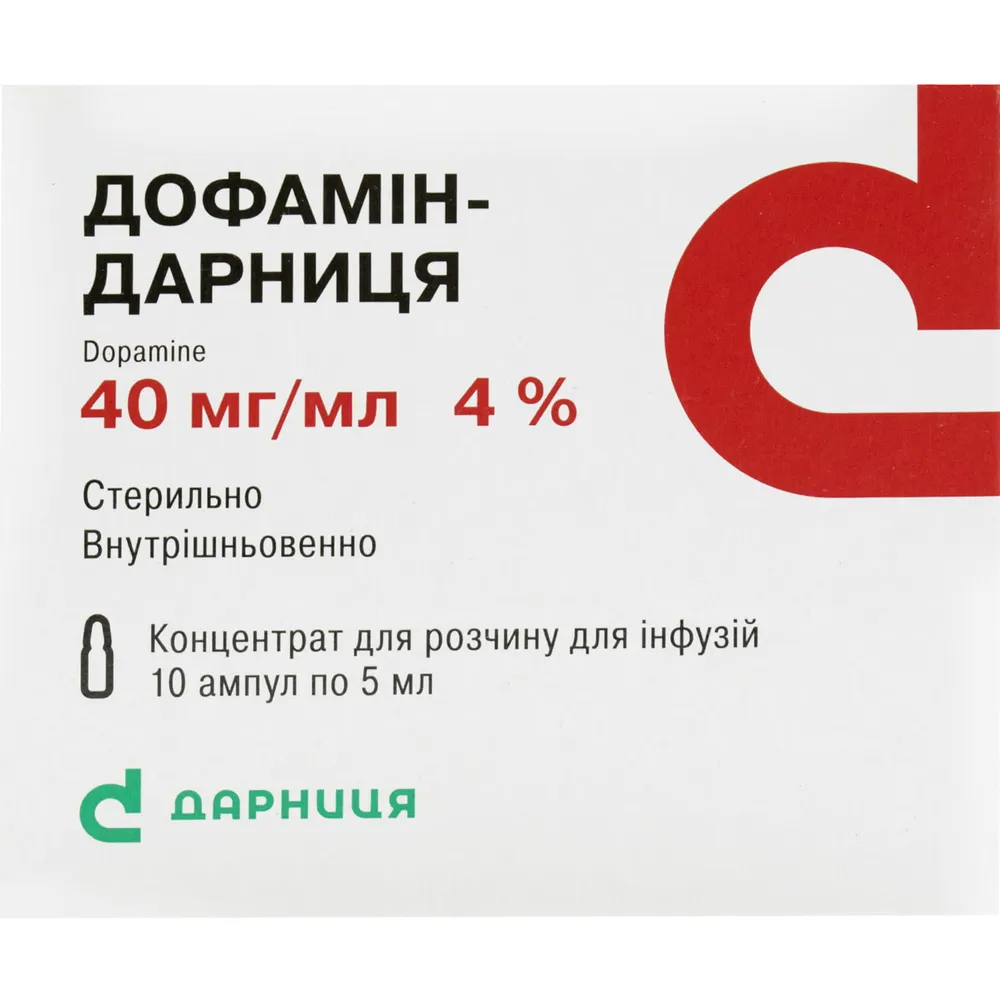
Table of Contents
INSTRUCTIONS FOR MEDICAL USE OF THE MEDICINAL PRODUCT DOFAMIN-DARNITSA (DOFAMIN-DARNITSA)
Composition:
active substance: dopamine hydrochloride;
1 ml of concentrate contains 5 mg or 40 mg of dopamine hydrochloride;
excipients: sodium metabisulfite (E 223), diluted hydrochloric acid, water for injections.
Pharmaceutical form. Concentrate for solution for infusion.
Main physicochemical properties: clear colorless or slightly yellowish liquid.
Pharmacotherapeutic group. Nonglycoside cardiotonic agents. Adrenergic and dopaminergic agents. ATC code C01CA04.
Pharmacological Properties
Pharmacodynamics
Dopamine is chemically a precursor in the biosynthesis of norepinephrine and has a specific stimulatory effect on dopamine receptors. At higher doses, it also stimulates α- and β-adrenergic receptors. Under the influence of Dopamine-Darnitsa, total peripheral vascular resistance (TPVR) and systolic arterial pressure increase, myocardial contractions are enhanced, and cardiac output rises. Heart rate changes relatively little. Myocardial oxygen demand increases, but due to increased coronary blood flow, oxygen delivery is enhanced. Dopamine-Darnitsa reduces renal vascular resistance, thereby increasing renal blood flow, glomerular filtration rate, and sodium excretion. The observed pharmacological effects depend on the concentration of the active substance in the blood.
At low doses (0.5–2 mcg/kg per minute), dopamine primarily affects dopamine receptors. It dilates mesenteric, cerebral, and coronary vessels, reduces renal vascular resistance, increases glomerular filtration, enhances diuresis, and promotes sodium excretion from the body.
At medium doses (2–10 mcg/kg per minute), it stimulates β₁-adrenergic receptors, resulting in a positive inotropic effect and increased cardiac minute volume.
At doses of 10 mcg/kg per minute and higher, stimulation of α₁-adrenergic receptors predominates, leading to increased TPVR, constriction of renal vessels, elevated arterial pressure, and reduced diuresis.
After discontinuation of infusion, the effect persists for no more than 5–10 minutes.
Pharmacokinetics
Since dopamine is a natural intermediate in norepinephrine synthesis, tracking its pharmacokinetics in the body is mostly impossible.
Following intravenous administration, the elimination half-life (T₁/₂) is up to 5 minutes (on average, 2 minutes). Dopamine is metabolized in virtually all tissues. Up to 75% of the administered dose is excreted by the kidneys within the first 24 hours as inactive metabolites. Approximately 25% of the administered dopamine is taken up via the reuptake mechanism into neuronal vesicles and used for norepinephrine synthesis. Onset of action occurs within 5 minutes after initiation of infusion; termination of effect occurs 5–10 minutes after stopping the infusion.
Clinical characteristics.
Indications.
Shock states or conditions threatening the development of shock:
- Heart failure caused by acute myocardial infarction (cardiogenic shock);
- Severe infections (septic shock);
- Shock following surgery;
- Marked decrease in arterial blood pressure (severe hypotension) of any etiology;
- Hypersensitivity reactions (anaphylactic shock).
Contraindications.
Hypersensitivity to dopamine or to any of the excipients.
Pheochromocytoma, thyrotoxicosis.
Tachyarrhythmia, ventricular fibrillation, as well as conditions associated with mechanical obstruction to ventricular filling.
Hypovolemia (circulating blood volume deficit must be corrected prior to initiation of therapy with this drug).
Closed-angle glaucoma.
Benign prostatic hyperplasia with urinary retention.
Anesthesia with cyclopropane and halogenated hydrocarbons should be avoided.
Interaction with other medicinal products and other forms of interaction.
Sympathomimetic agents, guanethidine. Enhance the sympathomimetic effect of Dopamine-Darnytsia.
Monoamine oxidase inhibitors (MAO inhibitors). Potentiate the effects of dopamine and prolong the drug's action. Dopamine should be used with extreme caution in patients who are currently taking or have taken MAO inhibitors within the previous 2 weeks. Such patients should receive a significantly lower dose of dopamine (initial dose – 1/10 of the usual therapeutic dose).
Tricyclic antidepressants and maprotiline. Dopamine increases the amount of norepinephrine released at nerve endings. Tricyclic antidepressants inhibit the reuptake of norepinephrine at nerve endings and thereby potentiate the effects of dopamine. The dose of dopamine should be reduced in patients receiving antidepressants due to potentiation of effects.
Dopamine may enhance the action of diuretics.
Anesthetic agents. Increase the risk of cardiac adverse effects.
Butyrophenones, propranolol. Reduce the risk of cardiac adverse effects.
Halothane and cyclopropane. When dopamine is used in combination with halothane, cyclopropane, and certain other anesthetics that increase myocardial sensitivity, ventricular arrhythmias and arterial hypertension may develop. Concomitant use of these drugs should be avoided.
Thyroid hormones. Reduce the positive chronotropic effect of Dopamine-Darnytsia.
Phenytoin or tricyclic antidepressants. Concomitant use with dopamine may lead to increased arterial blood pressure and bradyarrhythmias.
Selegiline (used in Parkinson’s disease). Concomitant use of selegiline with dopamine is undesirable.
β-adrenergic blockers (propranolol, metoprolol). Reduce the cardiac effects of dopamine.
Short-acting α-adrenergic blockers (phentolamine). Reduce dopamine-induced peripheral vasoconstriction.
Catechol-O-methyltransferase (COMT) inhibitors, e.g., entacapone. May potentiate chronotropic and arrhythmogenic effects of catecholamines, including Dopamine-Darnytsia. The clinical significance of this potentiating interaction is not established.
Patients who have received entacapone within 1–2 days prior to dopamine administration should receive lower doses of the drug.
Dobutamine. When dobutamine and Dopamine-Darnytsia are administered simultaneously, a more pronounced increase in arterial blood pressure may occur, while ventricular filling pressure decreases or remains unchanged.
Dopamine-Darnytsia reduces the antianginal effect of nitrates and the antihypertensive effect of α- and β-adrenergic blockers and other antihypertensive agents.
Dopamine-Darnytsia may be combined with cardiac glycosides and diuretics (furosemide). In hypovolemic shock, Dopamine-Darnytsia is combined with administration of plasma, plasma substitutes, or blood.
Dopamine should not be administered to patients taking ergot alkaloids.
Special precautions for use.
Hypoxia, hypercapnia, and acidosis reduce the efficacy of the drug and increase the risk of adverse effects. Treatment should be administered concurrently with correction of these conditions.
Dopamine administration requires monitoring of heart rate, arterial pressure, ECG parameters, and urine output. Hemodynamic parameters such as cardiac stroke volume, ventricular filling pressure, central venous pressure, and pulmonary artery pressure should also be monitored.
During prolonged parenteral therapy, regardless of the patient's clinical status, cardiac output, or laboratory findings, regular monitoring of electrolyte and acid-base balance, as well as liver and kidney function, is required.
Before administering the drug to patients in shock, hypovolemia should be corrected by administration of plasma or other plasma substitutes. Infusion should be performed under continuous cardiomonitory control. Decreased urine output without hypotension, excessive increase in diastolic blood pressure, or development of arrhythmias indicates the need to reduce the dose or discontinue the infusion.
All types of hypovolemia should be corrected prior to initiating dopamine therapy.
Particular attention should be paid to patients with organic heart or vascular disease, such as:
- patients with ischemic heart disease or angina;
- patients with occlusive vascular diseases (atherosclerosis, thromboembolism, Raynaud’s disease, frostbite, diabetic microangiopathy, or Buerger’s disease);
- patients with arrhythmias.
Since the drug improves atrioventricular conduction, patients with atrial fibrillation should be given digitalis preparations prior to starting dopamine therapy.
In shock due to acute myocardial infarction, low doses of dopamine should be used.
If a disproportionate increase in diastolic pressure (i.e., marked reduction in cardiac stroke volume) is observed, the infusion rate should be reduced and the patient should remain under physician supervision, as this may result from increased peripheral vascular resistance.
Dopamine infusion, even at low doses, should be initiated gradually to prevent undesirable arterial hypotension, which typically resolves with increased infusion rate.
The infusion rate should be continuously adjusted based on changes in the patient's condition, urine output, cardiac output, and arterial pressure. If a patient receiving dopamine develops increased diastolic arterial pressure (i.e., noticeable reduction in pulse pressure), the infusion rate should be reduced and the patient should be closely monitored for further signs of vasoconstriction, but only if the desired therapeutic effect has been achieved. In case of excessive increase in diastolic arterial pressure, decreased urine output, or development of arrhythmias, the dopamine dose should be reduced. Once cardiac function and arterial pressure stabilize, dose reduction may be necessary to maintain optimal urine output.
Ischemia prevention may be achieved by injecting phentolamine (5–10 mg phentolamine in 10–15 mL of 0.9% saline solution) with a fine needle directly into the affected area. When discontinuing the infusion, gradual tapering of dopamine dosage may be required to prevent arterial hypotension.
Dopamine must not be administered intraarterially or as a bolus injection.
Patients with a history of peripheral vascular disease should be carefully monitored for any changes in skin color or temperature of the extremities. Any change in skin color or temperature should be considered a sign of impaired peripheral circulation, and the benefit of continuing dopamine infusion should be weighed against the risk of potential necrosis. These changes may be reversed by reducing or stopping the infusion.
Due to dopamine administration, especially in patients with occlusive peripheral vascular disease and/or disseminated intravascular coagulation syndrome, severe vasoconstriction may occur, leading to skin necrosis and gangrene. Close monitoring of such patients is essential; if signs of peripheral ischemia appear, dopamine administration should be stopped immediately. Patients with impaired renal or hepatic function should also be closely monitored.
Patients in a comatose state must have their airways secured.
Dopamine should be used with particular caution in patients inhaling cyclopropane or halogenated hydrocarbon anesthetics due to the potential for arterial arrhythmogenicity.
Glucose solutions should be used with caution in patients with diabetes mellitus.
To prevent extravasation, dopamine should be administered into a large vein. Accidental infiltration into surrounding tissues may cause necrosis. In case of extravasation, tissue necrosis can be prevented by local infiltration with phentolamine.
After gastrointestinal surgery and in patients with hemorrhagic diathesis, there is a risk of bleeding due to redistribution of blood flow.
When discontinuing the infusion, gradual reduction of dopamine dosage may be necessary to prevent arterial hypotension.
Excessive administration of potassium-free solutions may lead to significant hypokalemia.
Important information on excipients.
This medicinal product contains sodium metabisulfite.
For the 5 mg/mL dosage form, the product contains less than 1 mmol (23 mg)/dose of sodium, i.e., practically sodium-free.
For the 40 mg/mL dosage form, the product contains 25 mg of sodium; therefore, caution is advised when administering to patients on a sodium-controlled diet.
Use during pregnancy or breastfeeding.
The drug is not recommended for use during pregnancy due to insufficient data on safety and efficacy.
It is unknown whether dopamine passes into breast milk and what effect it may have on the infant.
Effect on ability to drive or operate machinery.
Dopamin-Darnytsia is a medicinal product intended for hospital use with a very short half-life. After discharge from the hospital, there is no potential for the drug to affect reaction speed when driving or operating machinery.
Method of Administration and Dosage.
The dosage of the medicinal product is determined individually by the physician, taking into account the severity of shock, the patient's response to dopamine therapy, and adverse effects. To achieve the desired hemodynamic effect of dopamine, the dose for each patient should be carefully titrated.
Before initiating treatment, circulating blood volume must be restored. Electrolyte balance should be monitored during dopamine administration.
If otherwise not prescribed by the physician, the following dosages are recommended:
Adults: For patients who may respond to moderate cardiovascular support, dopamine infusion may be initiated at a dose of 2.5 mcg/kg body weight per minute.
For critically ill patients, the initial dose should be 5 mcg/kg, and if necessary, it may be gradually increased (e.g., every 15–30 minutes) up to 10 mcg/kg body weight per minute, with a maximum dose of 20–50 mcg/kg body weight per minute.
In most patients, satisfactory clinical response is achieved with dopamine doses below 20 mcg/kg body weight per minute. Administration of doses exceeding 20 mcg/kg body weight per minute may be associated with reduced renal blood flow.
In cases of worsening heart failure, dopamine should be administered as an infusion at a dose not exceeding 50 mcg/kg body weight per minute.
If doses higher than 50 mcg/kg body weight per minute are required, diuresis should be monitored.
It is preferable to increase the infusion rate using lower concentration solutions before resorting to more concentrated solutions.
If 1 ampoule of Dopamine-Darnytsia, concentrate for infusion solution, 40 mg/mL, is diluted in 50 mL of infusion solution, 1 mL of this solution contains 4000 mcg of dopamine hydrochloride.
If 1 ampoule of Dopamine-Darnytsia, concentrate for infusion solution, 40 mg/mL, is diluted in 500 mL of infusion solution, 1 mL of this solution contains 400 mcg of dopamine hydrochloride.
Duration of treatment depends on the patient's clinical condition and is determined by the physician.
Prior to initiating dopamine therapy in patients with hypovolemia, circulating blood volume should be restored. Since dopamine improves atrioventricular conduction, cardiac glycosides should be administered to patients with atrial fibrillation and rapid ventricular response before starting dopamine.
When treating unconscious patients, airway patency must be monitored due to the risk of aspiration. For patients with increased preload and afterload, nitroglycerin should be additionally administered to reduce cardiac workload.
The medicinal product must be diluted before administration. The dilution volume is 1 ampoule per 250 mL or 500 mL of recommended diluents (0.9% sodium chloride solution or 5% glucose solution).
The infusion solution should be prepared immediately before use, using only clear solutions that do not change color after addition of Dopamine-Darnytsia. Infusion should be administered, if possible, via a central venous catheter.
The prepared solution should be used within 12 hours.
Elderly Patients.
No dosage adjustments are recommended for elderly patients. However, careful monitoring of arterial pressure, urine output, and peripheral tissue perfusion is required.
Children.
There is no information available on the use of dopamine in children; therefore, the medicinal product should not be administered to this patient group.
Overdose.
Symptoms of overdose are typically due to sympathomimetic effects of dopamine.
At high doses, α-receptor stimulation increases, combined with antagonistic β-receptor effects, resulting in vasoconstrictive effects, particularly at higher doses.
Symptoms: Excessive increase in arterial blood pressure, tachycardia, arrhythmia, increased left ventricular end-diastolic pressure leading to pulmonary edema, angina attacks (especially in patients with heart failure), nonspecific chest pain, palpitations, nausea, vomiting, cold extremities, cyanosis.
Treatment: Reduce the dose or temporarily discontinue infusion, as the duration of dopamine action is very short. If these measures are insufficient, β-blockers or nitroglycerin should be administered. Phentolamine may be administered if necessary.
Adverse Reactions
The development of adverse reactions associated with dopamine administration is related to the pharmacological action of the drug.
The following classification is used to assess the frequency of adverse reactions: very common (≥ 1/10), common (≥ 1/100 to < 1/10), uncommon (≥ 1/1000 to < 1/100), rare (≥ 1/10,000 to < 1/1000), very rare (< 1/10,000), frequency not known (cannot be estimated based on available data).
Eye disorders:
Uncommon: mydriasis.
Respiratory, thoracic and mediastinal disorders:
Common: dyspnea;
Frequency not known: in patients with respiratory insufficiency, increased hypoxemia may occur, characteristic of increased blood flow through hypoventilated alveolar areas (pulmonary intrapulmonary shunt).
Gastrointestinal disorders:
Common: nausea, vomiting;
Frequency not known: gastrointestinal bleeding.
Renal and urinary disorders:
Frequency not known: polyuria.
Metabolism and nutrition disorders:
Uncommon: azotemia;
Frequency not known: increased blood urea levels.
Nervous system disorders:
Common: headache;
Uncommon: restlessness, anxiety, fear, tremor, piloerection.
Cardiac disorders:
Common: palpitations, cardiac arrhythmias, including tachycardia (ventricular, supraventricular, and sinus);
Uncommon: bradycardia, arrhythmias (extrasystoles, ventricular extrasystoles, ventricular arrhythmia), ectopic cardiac rhythm, aberrant ventricular conduction, conduction disturbances, AV block, QRS complex widening; substernal pain, anginal pain, myocardial ischemia, angina pectoris, increased ventricular pressure, increased blood pressure, hypotension, peripheral arterial spasm, vasoconstriction, hemorrhage.
Immune system disorders:
Frequency not known: hypersensitivity reactions, hyperemia, pruritus, burning sensation of the skin; in patients with bronchial asthma – bronchospasm, impaired consciousness, shock. The excipient sodium metabisulfite may very rarely cause severe hypersensitivity reactions and bronchospasm.
General disorders and administration site conditions: reactions at the site of administration; skin and subcutaneous tissue necrosis in case of subcutaneous leakage of the drug. Peripheral ischemic gangrene may also occur in patients with pre-existing vascular disorders.
Patients with a history of arterial occlusive disease (e.g., arteriosclerosis, arterial embolism, Raynaud's disease, cold injuries such as frostbite, diabetic microangiopathy, or Buerger's disease) should be carefully monitored for any changes in skin color or temperature of the extremities. Changes in skin color or temperature may indicate worsening of skin circulation.
Reporting of suspected adverse reactions.
Reporting of suspected adverse reactions after drug authorization is an important procedure. It allows continuous monitoring of the benefit-risk balance of the medicinal product. Healthcare professionals are required to report any suspected adverse reactions via the national reporting system.
Shelf life. 4 years.
Storage conditions.
Store in the original packaging at a temperature not exceeding 25 °C. Do not freeze.
Keep out of reach of children.
Incompatibilities.
Dopamine is sensitive to alkaline agents; therefore, it must not be mixed with alkaline solutions (pH above 7), such as sodium bicarbonate.
Alteplase and amphotericin B are unstable in the presence of dopamine.
In addition, physical-chemical incompatibility is known with the following substances: acyclovir; alteplase; amikacin; amphotericin B; ampicillin; cephalothin; dacarbazine; ethylenediamine theophylline (euphyllin); calcium theophyllinate solution (calcium euphyllin solution); furosemide; gentamicin; heparin; iron salts; sodium nitroprusside; benzylpenicillin; tobramycin; oxidizing agents; thiamine (promotes vitamin degradation).
Packaging.
5 ml in a vial; 5 vials in a blister pack; 2 blister packs in a carton.
Prescription status. Prescription only.
Manufacturer. JSC "Pharmaceutical Company "Darnytsia".
Manufacturer's address and location of its operations.
13, Boryspilska Street, Kyiv, 02093, Ukraine.