Dioxidine
Ukraine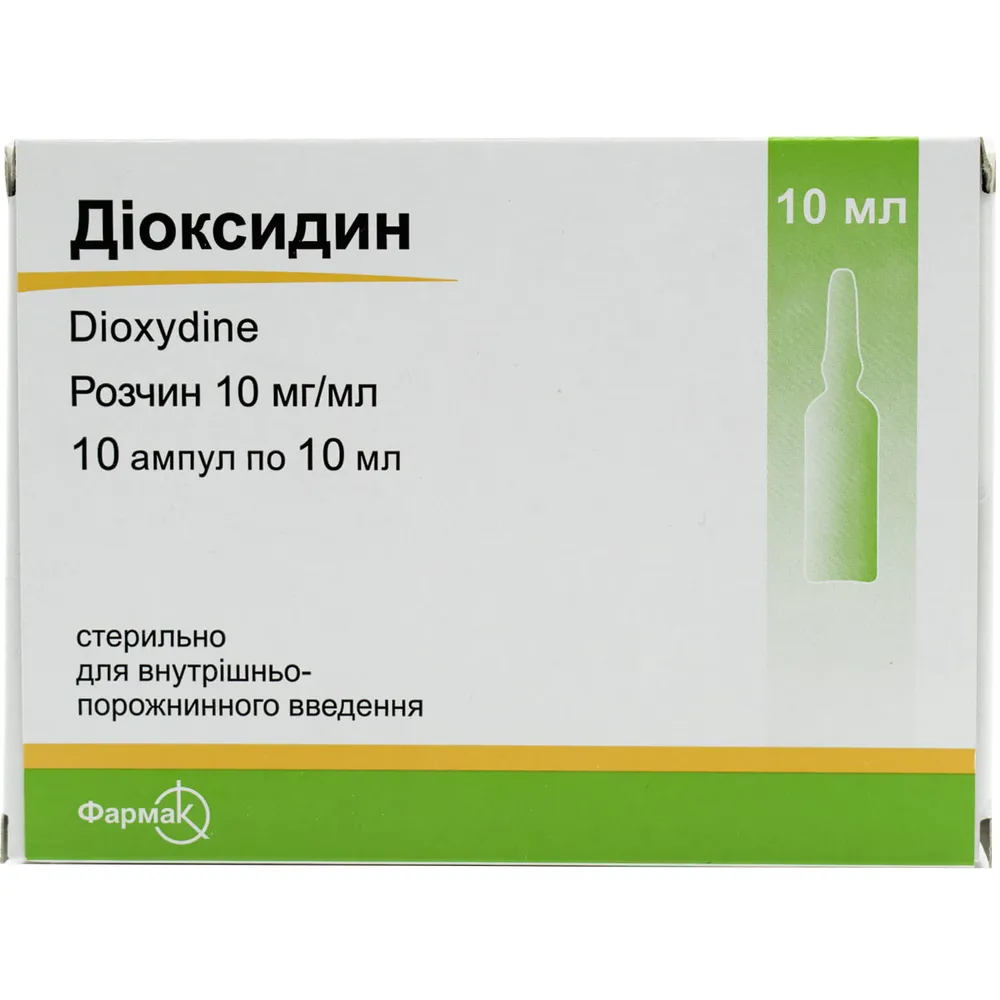
Table of Contents
INSTRUCTION FOR MEDICAL USE OF THE MEDICINAL PRODUCT DIOXYDINE (DIOXYDINE)
Composition:
Active substance: dioxydine;
1 ml of solution contains 10 mg of dioxydine, calculated as open 100% substance;
Excipients: water for injections.
Pharmaceutical form. Solution.
Main physicochemical properties: transparent greenish-yellow liquid.
Pharmacotherapeutic group. Antibacterial agents. ATC code J01XX.
Pharmacological Properties.
Pharmacodynamics. Dioxydin is a broad-spectrum antibacterial agent. It is effective against infections caused by Proteus vulgaris, Pseudomonas aeruginosa, Klebsiella pneumoniae, Escherichia coli, Shigella, Salmonella, Staphylococci, Streptococci, and pathogenic anaerobes, including causative agents of gas gangrene. It is active against bacterial strains resistant to antibiotics, sulfonamides, nitrofurans, and other drugs.
Pharmacokinetics. When applied locally, dioxydin is partially absorbed, does not produce local irritant effects, undergoes no metabolism, and does not accumulate. It is excreted by the kidneys.
Clinical characteristics.
Indications.
Purulent-inflammatory processes of various localization: purulent pleuritis, pleural empyema, lung abscess, peritonitis, cystitis, wounds with deep cavities, soft tissue abscesses, phlegmons, postoperative wounds of urinary and biliary tracts. Also used for prevention of infectious complications after urinary bladder catheterization.
Contraindications.
Individual hypersensitivity to the drug, adrenal cortex insufficiency (including in medical history).
Interaction with other medicinal products and other types of interactions.
Not described.
Special precautions.
Dioxidine is used under inpatient conditions. The drug has experimentally demonstrated teratogenic and embryotoxic effects (therefore, it is contraindicated during pregnancy); the drug also exerts mutagenic effects. Because of this, Dioxidine should be prescribed only for severe forms of infectious diseases or when other antibacterial agents, including second to fourth-generation cephalosporins, fluoroquinolones, and carbapenems, are ineffective. Uncontrolled use of Dioxidine and medicinal forms containing it is not permitted.
Use with caution in patients with renal impairment; in cases of chronic renal failure, the dose should be reduced.
If pigmented skin spots appear, the duration of dose administration should be increased to 1.5–2 hours, the dose should be lowered, and antihistamine agents should be prescribed. If necessary, discontinue the drug.
Use during pregnancy or breastfeeding.
The drug is contraindicated during pregnancy and breastfeeding.
Ability to affect reaction speed when driving or operating machinery.
During treatment, caution should be exercised when driving a vehicle or engaging in other potentially hazardous activities requiring increased attention and rapid psychomotor reactions.
Method of Administration and Dosage
Dioxidine is prescribed only for adults.
Before starting the treatment course, a tolerance test must be performed by introducing 10 mL of a 1% solution into the purulent cavity. If no adverse reactions (dizziness, chills, body temperature increase) occur within 3–6 hours, the course treatment may begin. The solution is administered into the cavity through a drainage tube, catheter, or syringe—usually 10–50 mL of a 1% solution. The maximum daily dose is 70 mL of a 1% solution. Administer once or twice daily (without exceeding the daily dose of 70 mL of a 1% solution). The duration of treatment depends on the severity of the disease and the patient's tolerance to the drug. The treatment course may last 3 weeks or longer. If necessary, the course may be repeated after 1–1.5 months.
The drug is also used locally by applying dressings moistened with a 1% solution to the wound surface.
Children. The drug is not used for the treatment of children.
Overdose.
Acute adrenal cortical insufficiency may develop.
Treatment: immediate discontinuation of the drug, appropriate replacement hormone therapy.
Side effects.
When administered intracavitarily, possible side effects include headache, chills, fever, dyspeptic disorders, muscle spasms, allergic reactions, and photosensitizing effect (appearance of pigmented spots on the skin upon exposure to sunlight).
When applied topically – periwound dermatitis, itching.
Shelf life.
4 years.
Do not use the drug after the expiry date stated on the packaging.
Storage conditions.
Store in a place protected from light, at a temperature between 18 °C and 25 °C. Keep out of reach of children.
If dioksidin crystals precipitate in ampoules during storage (at temperatures below 15 °C), dissolve them by heating the ampoules in boiling water bath with shaking until complete dissolution of crystals (solution becomes clear). If no crystals reappear after cooling to (37 ± 1) °C, the drug is suitable for use.
Packaging. 10 ml in an ampoule. 10 ampoules per pack.
Prescription status. Prescription only.
Manufacturer.
JSC "Farmak".
Manufacturer's name and address of manufacturing site.
74, Kyrylivska Street, Kyiv, 04080, Ukraine.