Diavitex pd 4 3.86 %
Ukraine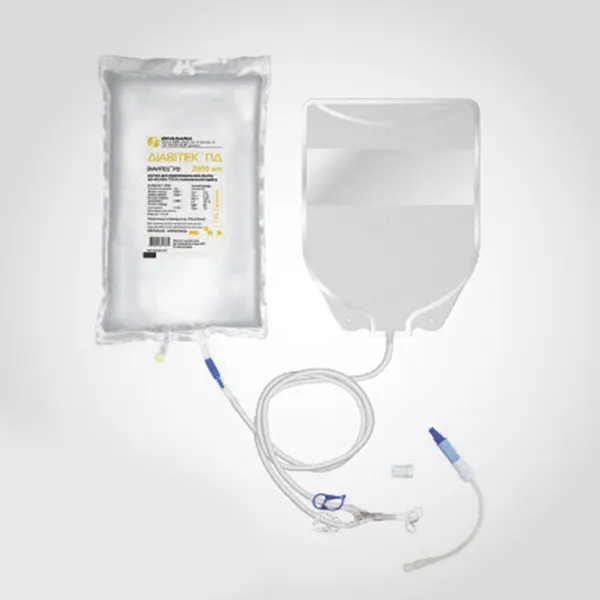
Table of Contents
INSTRUCTIONS FOR MEDICAL USE OF THE MEDICINAL PRODUCT
DIAVITEK PD4 1.36%
DIAVITEK PD4 2.27%
DIAVITEK PD4 3.86%
Composition:
Active substances: glucose monohydrate, sodium chloride, calcium chloride dihydrate, magnesium chloride hexahydrate, sodium lactate;
1000 ml of solution contains 15 g, 25 g, or 42.5 g of glucose monohydrate (equivalent to 13.6 g, 22.7 g, or 38.6 g of anhydrous glucose), sodium chloride 5.38 g, calcium chloride dihydrate 0.184 g, magnesium chloride hexahydrate 0.051 g, sodium lactate 4.48 g;
Excipients: water for injections, concentrated hydrochloric acid, sodium hydroxide.
Pharmaceutical form. Solution for peritoneal dialysis.
Main physicochemical properties: clear, colorless or slightly yellowish solution.
Ion composition: Na+ — 132 mmol/l, Ca2+ — 1.25 mmol/l, Mg2+ — 0.25 mmol/l, Cl– — 95 mmol/l, C3H5O3– — 40 mmol/l.
Theoretical osmolarity: 344 mOsm/l (395 mOsm/l, 483 mOsm/l).
Pharmacotherapeutic group. Agents for peritoneal dialysis.
ATC code B05DB.
Pharmacological Properties.
Pharmacodynamics.
Peritoneal dialysis for patients with renal insufficiency is a procedure designed to remove toxic substances produced during nitrogen metabolism that are normally excreted by the kidneys, as well as to maintain regulation of fluid, electrolyte, and acid-base balance.
This procedure is performed by introducing a peritoneal dialysis solution through a catheter into the abdominal cavity. The movement of substances between the dialysis fluid and the patient's peritoneal capillaries occurs across the peritoneal membrane according to the principles of osmosis and diffusion. After remaining in the abdominal cavity for several hours, the solution becomes saturated with toxic substances and must be replaced.
Except for lactate, which is provided as a bicarbonate precursor, the electrolyte concentrations in the solution are adjusted to match standardized plasma electrolyte concentrations. Nitrogenous waste products, present in high concentrations in the blood, pass through the peritoneal membrane into the dialysis solution. Glucose creates a solution that is hyperosmolar relative to plasma, generating an osmotic gradient that promotes fluid removal from plasma into the dialysate, thereby compensating for the fluid overload commonly observed in patients with chronic renal insufficiency.
Pharmacokinetics.
When administered intraperitoneally, glucose is absorbed into the bloodstream and metabolized via normal metabolic pathways.
Clinical characteristics.
Indications.
- Acute renal failure;
- chronic renal failure;
- pronounced fluid retention in the body;
- electrolyte imbalance;
- drug intoxication — when other therapies are ineffective.
Dyavitex PD4 is particularly useful for controlling serum calcium and phosphate levels in patients with renal failure who are taking phosphate-binding agents containing calcium or magnesium.
Contraindications.
- Hypersensitivity to the active substances or to any of the excipients of the medicinal product;
- presence of severe lactic acidosis;
- irreversible mechanical defects that prevent effective peritoneal dialysis or increase the risk of infection;
- documented loss of peritoneal function or significant adhesions that negatively affect peritoneal function.
Interaction with other medicinal products and other types of interactions.
No studies on interactions with other medicinal products have been conducted. During peritoneal dialysis, plasma concentrations of other dialyzable drugs may decrease.
Serum potassium, calcium, and magnesium levels should be carefully monitored in patients receiving treatment with cardiac glycosides due to the risk of digitalis intoxication. Potassium supplements may be required.
Special precautions for use.
Peritoneal dialysis should be performed with caution in patients with:
- abdominal disorders, including disruption of the peritoneal membrane and diaphragm due to surgical procedures, developmental abnormalities, or trauma (until recovery); with tumors in the abdominal cavity, infections of the abdominal wall, hernias, fecal fistulas, history of colostomy or ileostomy, recurrent diverticulitis, inflammatory or ischemic bowel disease, large polycystic kidneys, or other conditions that compromise the integrity of the abdominal wall, abdominal surface, or intraperitoneal cavity;
- other conditions, including recently implanted aortic grafts and severe pulmonary disease.
Encapsulating peritoneal sclerosis (EPS) is a known rare complication of peritoneal dialysis. Cases of EPS have been observed in patients treated with peritoneal dialysis solutions as part of peritoneal dialysis therapy. Fatal outcomes of EPS during treatment with the medicinal product have been reported infrequently.
In the event of peritonitis, the choice and dosage of antibiotics should be based on microbiological identification and sensitivity testing, whenever possible. Broad-spectrum antibiotics may be indicated prior to identification of causative microorganisms.
Solutions containing glucose should be used with caution in patients diagnosed with allergy to corn or corn-derived products. Hypersensitivity reactions due to allergy to corn starch, including anaphylactic/anaphylactoid reactions, may occur. If any signs or symptoms of hypersensitivity reactions develop, the infusion should be stopped immediately, and the solution should be drained from the abdominal cavity. Appropriate therapeutic measures should be initiated according to clinical indications.
Peritoneal dialysis solutions based on lactate should not be administered to patients with severe lactic acidosis (see section "Contraindications"). Patients at risk of lactic acidosis (e.g., severe arterial hypotension or sepsis, which may be associated with acute kidney injury, inherited metabolic disorders, treatment with drugs such as metformin and nucleoside/nucleotide reverse transcriptase inhibitors) should be monitored before and during treatment with lactate-based peritoneal dialysis solutions.
Before initiating therapy, potential interactions between the solution and medications used by the patient for treatment of other concomitant diseases should be carefully evaluated for each individual patient. Serum levels of potassium, calcium, and magnesium should be closely monitored in patients receiving cardiac glycosides.
Accurate records of fluid balance must be maintained, and the patient's body weight should be carefully monitored to avoid hyper- or hypohydration with serious consequences, including congestive heart failure, reduced extracellular fluid volume, and shock.
Significant losses of protein, amino acids, and water-soluble vitamins may occur during peritoneal dialysis. Replacement therapy should be administered if necessary.
In patients receiving solutions with low calcium content, serum calcium concentration should be monitored to prevent the development of hypocalcemia or worsening of hypercalcemia. In such cases, the physician should adjust the doses of phosphate binders and/or vitamin D analogs and/or calcimimetics.
Use of 5 or 6 liters of solution per single exchange cycle is not recommended in continuous ambulatory peritoneal dialysis (CAPD) or automated peritoneal dialysis (APD) due to the risk of overfilling.
Excessive infusion of the medicinal product into the peritoneal cavity may manifest as abdominal distension/pain and/or dyspnea.
To treat excessive infusion of the medicinal product into the peritoneal cavity, the solution should be drained from the abdominal cavity.
Incorrect sequence of clamp application or solution administration may lead to air entering the peritoneal cavity, potentially causing abdominal pain and/or peritonitis.
Excessive use of the medicinal product Diavitex PD4 with high glucose content during peritoneal dialysis may cause significant dehydration.
Potassium is excluded from the formulation due to the risk of hyperkalemia. Addition of potassium chloride (up to a concentration of 4 mmol/L) may be indicated in cases of normal serum potassium levels or hypokalemia to prevent severe hypokalemia. This should be performed only under medical supervision after careful assessment of serum potassium levels and total body potassium status.
Serum electrolyte concentrations (particularly bicarbonate, potassium, magnesium, calcium, and phosphate), blood chemistry (including parathyroid hormone and lipid levels), and hematological parameters should be monitored periodically.
In diabetic patients, blood glucose levels should be monitored regularly during and after dialysis with glucose-containing solutions, and insulin dosage or other hyperglycemia treatment should be adjusted accordingly.
The solution should be used immediately after removal from the outer packaging.
Use during pregnancy or breastfeeding.
Pregnancy
The medicinal product is not recommended for use in pregnant women or women of reproductive potential who are not using contraception.
Breastfeeding period
It is unknown whether metabolites of the medicinal product are excreted in breast milk. Risk to newborns/infants cannot be excluded.
The necessity of discontinuing breastfeeding or discontinuing/abstaining from treatment with the medicinal product should be considered, taking into account the benefits of breastfeeding for the child and the benefits of therapy for the woman.
Fertility
Clinical data on fertility are lacking.
Ability to affect reaction speed when driving or operating machinery.
Patients with end-stage renal disease (ESRD) undergoing peritoneal dialysis may experience adverse effects that could impair their ability to drive or operate machinery (e.g., malaise, hypovolemia).
Method of Administration and Dosage
Dosage
The treatment regimen, frequency, exchange volume, dwell time in the peritoneal cavity, and duration of dialysis are determined by the physician.
Adults
For CAPD, patients usually undergo 4 cycles per day (24 hours). For APD, typically 4–5 cycles are performed overnight and up to 2 cycles during the day. The volume of medicinal product to be instilled depends on body size and usually ranges from 2 to 2.5 liters.
Children (from birth to 18 years)
The recommended dose is 800–1400 mL/m² per cycle. The maximum dose should not exceed 2000 mL. For children under 2 years of age, the recommended instillation volume is 500–1000 mL/m².
As the patient's body weight approaches the ideal dry body weight, it is recommended to reduce the glucose concentration in the solution.
Dialyte PD4 with 3.86% glucose content is a highly osmotic fluid; its independent use may lead to dehydration (see section "Special Precautions").
To prevent the risk of severe dehydration and hypovolemia, and to minimize protein loss, it is recommended to select the peritoneal dialysis solution with the lowest osmolarity sufficient to remove the required amount of fluid during each session.
Method of Administration
Precautions to be taken before administration of the medicinal product
Dialyte PD4 is intended only for intraperitoneal administration. Not for intravenous use.
Warming the solution to 37°C reduces patient discomfort. However, this procedure should only be performed using dry heat (e.g., heating pad or warming plate). Solutions should not be heated in water due to increased risk of contamination. To avoid potential damage to the bag and patient injury or discomfort, solutions must not be heated in a microwave oven.
The entire procedure must be performed under strict aseptic conditions.
Administration must not be performed if the solution is cloudy, contains particles, the packaging shows signs of leakage, or if the protective seals preventing contact of the solution with the external environment are damaged.
The drained fluid should be examined for the presence of fibrin or cloudiness, which may indicate peritonitis.
For single use only.
Addition of Potassium
Potassium is excluded from the composition of the medicinal product, as dialysis may also be performed to correct hyperkalemia. In cases of normal serum potassium levels or hypokalemia, addition of potassium chloride (at concentrations up to 4 mEq/L) may be indicated to prevent severe hypokalemia. This should only be done under physician supervision following careful assessment of serum potassium levels.
Children
Administer to children according to the recommendations specified in the section "Method of Administration and Dosage".
Overdose
There is a possibility of overdose, which may manifest as hypervolemia, hypovolemia, electrolyte imbalance, or (in diabetic patients) hyperglycemia.
Excessive use of Dialyte PD4 with 3.86% glucose during peritoneal dialysis may cause significant dehydration of the patient.
Treatment of Overdose
Hypervolemia can be treated using hypertonic peritoneal dialysis solutions and fluid restriction.
Hypovolemia can be managed by restoring fluid losses orally or intravenously, depending on the degree of dehydration.
Electrolyte imbalances should be treated according to the specific type identified by blood analysis. The most likely imbalance—hypokalemia—can be treated by oral potassium supplementation or by adding potassium chloride to the peritoneal dialysis solution as prescribed by the physician.
Hyperglycemia (in diabetic patients) should be managed by adjusting insulin dosage or oral antidiabetic medications according to the treatment regimen prescribed by the physician.
Adverse reactions.
The table below lists adverse reactions by organ systems.
Frequency is defined as: very common (≥ 1/10); common (≥ 1/100 to < 1/10); uncommon (≥ 1/1000 to < 1/100); rare (≥ 1/10000 to < 1/1000); very rare (< 1/10000), not known (cannot be estimated from available data).
| System organ |
Adverse reaction |
Frequency |
| Metabolism and nutrition disorders |
hypokalemia, fluid retention, hypervolemia, hypovolemia, hyponatremia, dehydration, hypochloremia |
unknown |
| Vascular disorders |
arterial hypertension, arterial hypotension |
unknown |
| Respiratory, thoracic and mediastinal disorders |
dyspnea |
unknown |
| Gastrointestinal disorders |
encapsulating sclerosing peritonitis, peritonitis, turbid peritoneal exudate, vomiting, diarrhea, nausea, constipation, abdominal pain, abdominal distension, abdominal discomfort |
unknown |
| Skin and subcutaneous tissue disorders |
Stevens-Johnson syndrome, urticaria, rash (including pruritic, erythematous and generalized), pruritus |
unknown |
| Musculoskeletal and connective tissue disorders |
muscle pain, muscle spasm, musculoskeletal pain |
unknown |
| General disorders and administration site reactions |
generalized edema, hyperthermia, malaise, pain at administration site |
unknown |
Other adverse effects associated with the peritoneal dialysis procedure: fungal peritonitis, bacterial peritonitis, catheter-related infection, catheter-related complications.
Reporting of suspected adverse reactions
Reporting of adverse reactions after marketing authorization of the medicinal product is of great importance. It enables continuous monitoring of the benefit-risk balance of the medicinal product. Medical and pharmaceutical professionals, as well as patients or their legal representatives, should report all suspected adverse reactions and lack of effectiveness of the medicinal product via the Automated Pharmacovigilance Information System at the following link: https://aisf.dec.gov.ua.
Shelf life. 2 years.
Do not use the solution remaining in the bag after completion of the procedure.
Storage conditions.
Store at a temperature not exceeding 25 °C, in a place inaccessible to children. Do not freeze.
Incompatibilities.
Formal drug interaction studies have not been conducted.
Compatibility should be verified when using additives. The resulting mixture should be used immediately.
Packaging.
2000 ml of solution in a polymer container equipped with an injection port, integrated via two tubing lines and a Y-connector to an empty plastic drainage bag, all enclosed in a transparent plastic pouch.
2000 ml of solution in a polymer container equipped with an injection port, integrated via two tubing lines and a Y-connector to an empty plastic drainage bag, enclosed in a transparent plastic pouch, with 4 or 5 plastic pouches per cardboard box.
2500 ml of solution in a polymer container equipped with an injection port, integrated via two tubing lines and a Y-connector to an empty plastic drainage bag, enclosed in a transparent plastic pouch.
2500 ml of solution in a polymer container equipped with an injection port, integrated via two tubing lines and a Y-connector to an empty plastic drainage bag, enclosed in a transparent plastic pouch, with 4 plastic pouches per cardboard box.
5000 ml of solution in a polymer container equipped with an injection port, integrated via two tubing lines and a Y-connector to an empty plastic drainage bag, enclosed in a transparent plastic pouch.
5000 ml of solution in a polymer container equipped with an injection port, integrated via two tubing lines and a Y-connector to an empty plastic drainage bag, enclosed in a transparent plastic pouch, with 2 plastic pouches per cardboard box.
Prescription status. Prescription only.
Manufacturer.
LLC "Yuria-Pharm".
Manufacturer's address and site of operations.
108, Kobzarska Street, Cherkasy, Cherkasy Oblast, 18030, Ukraine. Tel.: (044) 281-01-01.